Feeds:
Posts
Comments

Archive for the ‘Birds’ Category

 “I made a circle with a smile for a mouth on yellow paper, because it was sunny and bright.” Harvey Ball

Bullock’s Oriole and American Goldfinch
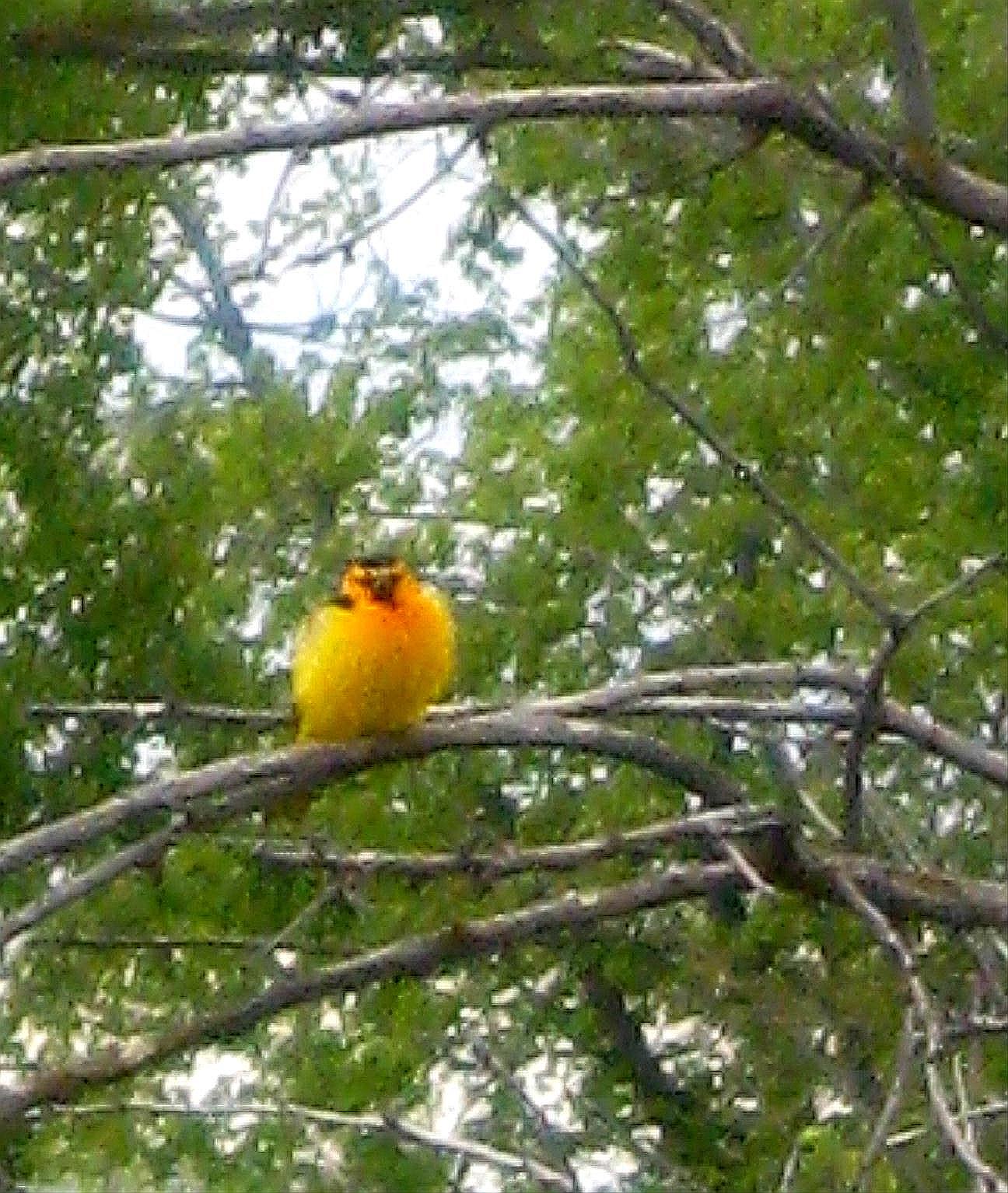
Bullock’s oriole. This one was all puffed up on a cold morning. — Photo by Pat Bean

There are two birds I have seen almost every day since I arrived in Southern Idaho, a Bullock’s oriole and an American goldfinch.

The oriole hangs out in an untrimmed area of the manicured park located to the rear of my RV site. Its landscape is dotted with Russian olive trees, sagebrush, a few small cottonwood trees and tall grasses.

In the cool of the evening, when I sit outside with my binoculars in hand, I almost always see an oriole, or two or three, flit about in the foliage, lighting up whichever branch or twig they land on like a Christmas ornament. I often point it out to campers who stop by. Oohs and ahs are the usual reactions.
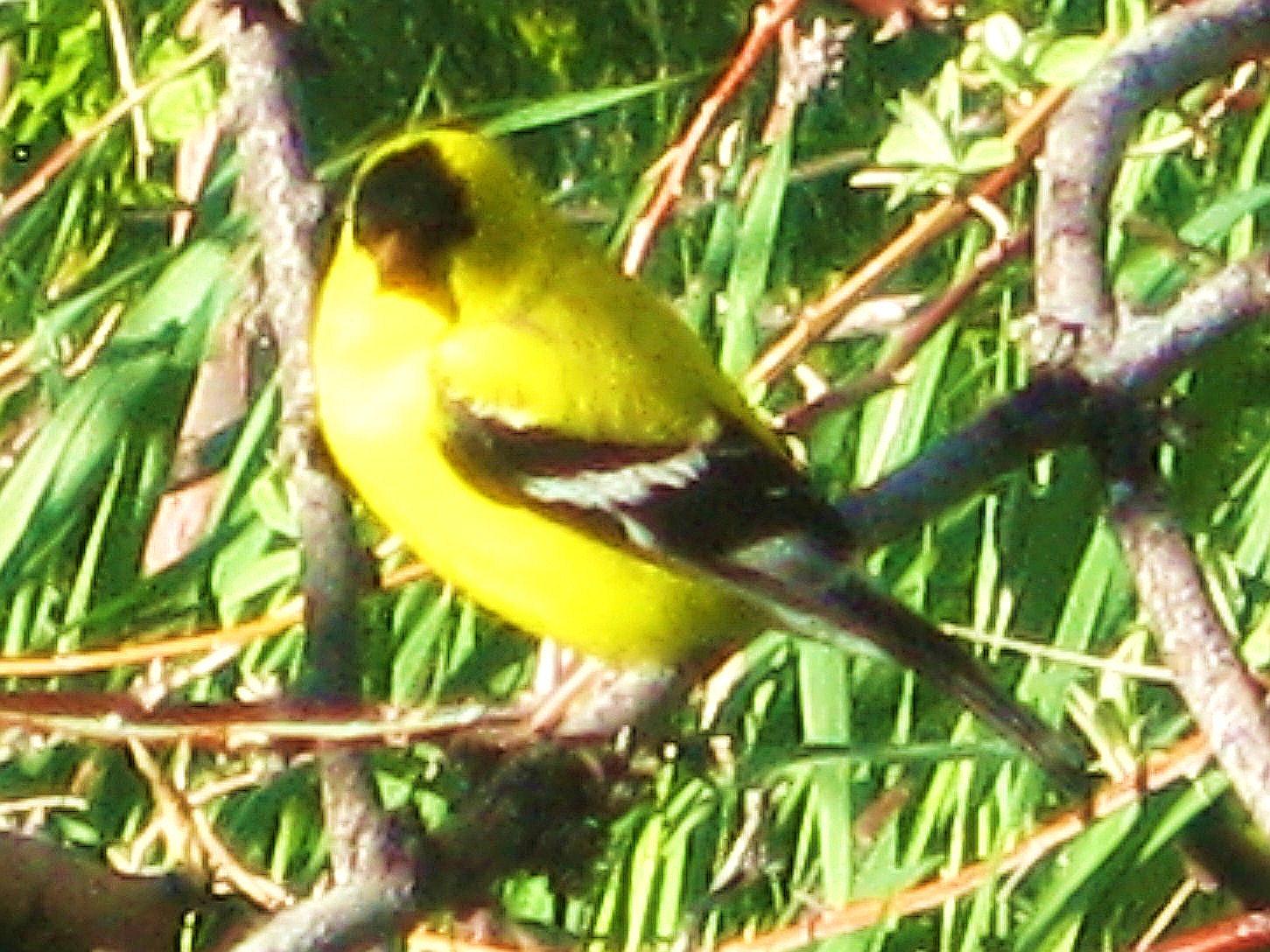
American goldfinch: Hanging out on a willow tree next to the lake. — Photo by Pat Ban

Competing with the oriole for the golden-yellow award is the American goldfinch. Last year they hung out at the finch feeder bag I put out near my RV, but since I haven’t put that out this year, I usually see them flitting among the shoreline trees near the park’s Upper Lakeview campground.

It’s common, however, for me to spot these two birds just about anywhere in the park. I never tire of seeing them.

Bean’s Pat:: Daily Diversion http://onetrackmuse.com/ One big, odd pig. What’s up in your neighborhood. Blog pick of the day from this wondering wanderer.

Read Full Post »

 “For me, as for flower and beast and bird, the supreme triumph is to be most vividly, most perfectly alive.” – David Herbert Lawrence

This stalking black-crowned night heron is patiently waiting for its mouse dinner to pop up out of its hole. — Photo by Pat Bean

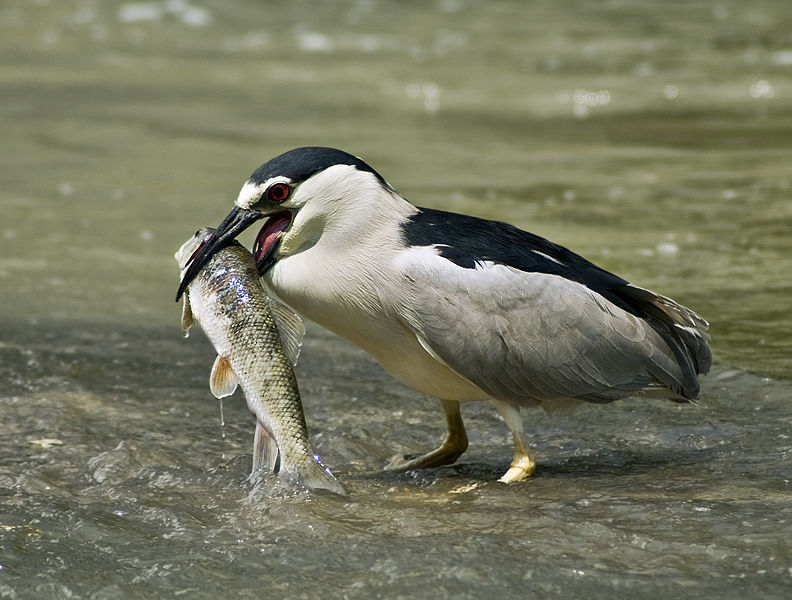
Black-Crowned Night Heron

A pair of black-crowned night heron have taken up residence in a landscape of reeds, Russian olives and cattails that line the bank of Lake Walcott between the park’s campground and boat dock.

The path between the two is one of those I take on my daily walks with my canine traveling companion, Pepper. Most days, mid-to-late-afternoons, I come up on one of the herons patiently waiting in the lawn area near a rock wall for dinner to appear.

This black-crowned night heron’s dinner is more common. — Wikipedia photo

The gourmet item on this heron’s menu is one of the small mice that make their home among holes in the rocks. The stalking heron is usually so still that Pepper seldom notices it, and so intent on dinner that I get a chance to marvel at its glowing red eye, which stands out vividly from its white and black feathers. .

Most days, unless Pepper sees it and barks and strains on the leash to go chase it, we don’t even disturb it as we pass by,

Although I’ve never seen but one on the manicured lawn, I know there are two because one day I spooked the second one as I passed by the cattails, and watched  as it flew deeper into the reed cover.

A fish dinner, or even a snake one, is a more normal diet for these herons. But their flexibility in food choices is probably one of the reasons these tree-nesting birds can be found on five continents, and why there is no current concern about their numbers.

Bean’s Pat: Dodging Commas http://tinyurl.com/7hfuamp Words for writers. This wondering wanderer’s blog pick of the day.

Read Full Post »

 “How hard to realize that every camp of men or beast has this glorious starry firmament for a roof … it is easy to realize that whatever special nests we make – leaves and moss like the marmots and birds, or tents or piled stone – we all dwell in a house of one room – the world with firmament for its roof.” –John Muir

Lake Powell — It was here that I spent my first night in my brand new RV, which I call Gypsy Lee — Photo by Pat Bean

I Chose Lake Powell’s Wahweap Campground

Make reservations or go with the flow?

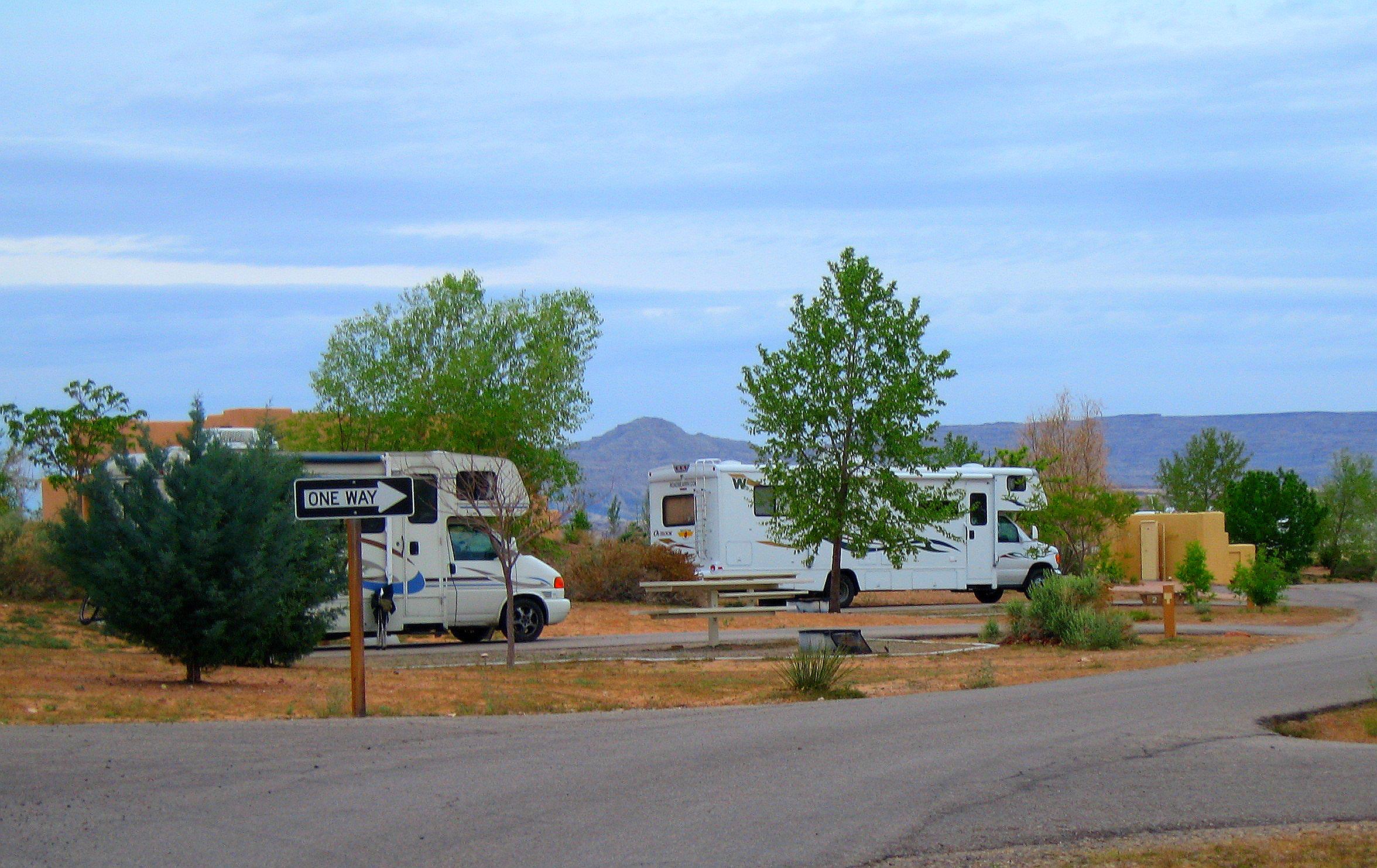
The campground meets my desire for a scenic place for me and my canine traveling companion to take a pleasant walk. — Photo by Pat Bean

That’s a question often on my mind as my canine traveling companion, Pepper, and I roam the country in Gypsy Lee, our 22-foot home on wheels.

I actually do both.

Knowing I have a place to stay for the night lets me enjoy my dawdling sight-seeing ways without worry. Not having a reservation means I can go as few or as many miles as I want before stopping for the day.

There have been times when I’ve traveled as few as 15 miles before seeing an inviting place to stay and stopped. There have also been times when I’ve driven 400 miles because nothing captured my fancy – or there was nothing. I really hate the latter situation, but it’s happened to me both in Texas and New Mexico, where there are a lot of wide-open spaces with nothing appealing in between.

And Gypsy Lee, left, has a place to park with a view of the lake. — Photo by Pat Bean

What I want in a nightly roosting place is a scenic landscape, a hiking trail and internet access. I know I’ll find the first two at a state or national park, which are my favorite roosts, but the latter is iffy, especially if the campground is much distance from a populated area.

But that’s changed a lot during the eight years since I traded my Ogden, Utah, home for Gypsy Lee. I started my travels using my phone as the modem for internet connection, and often had to drive into town to make a connection. Today, I have my own Verizon hot spot and the times when I have to say “I can’t hear you” are getting fewer and fewer.

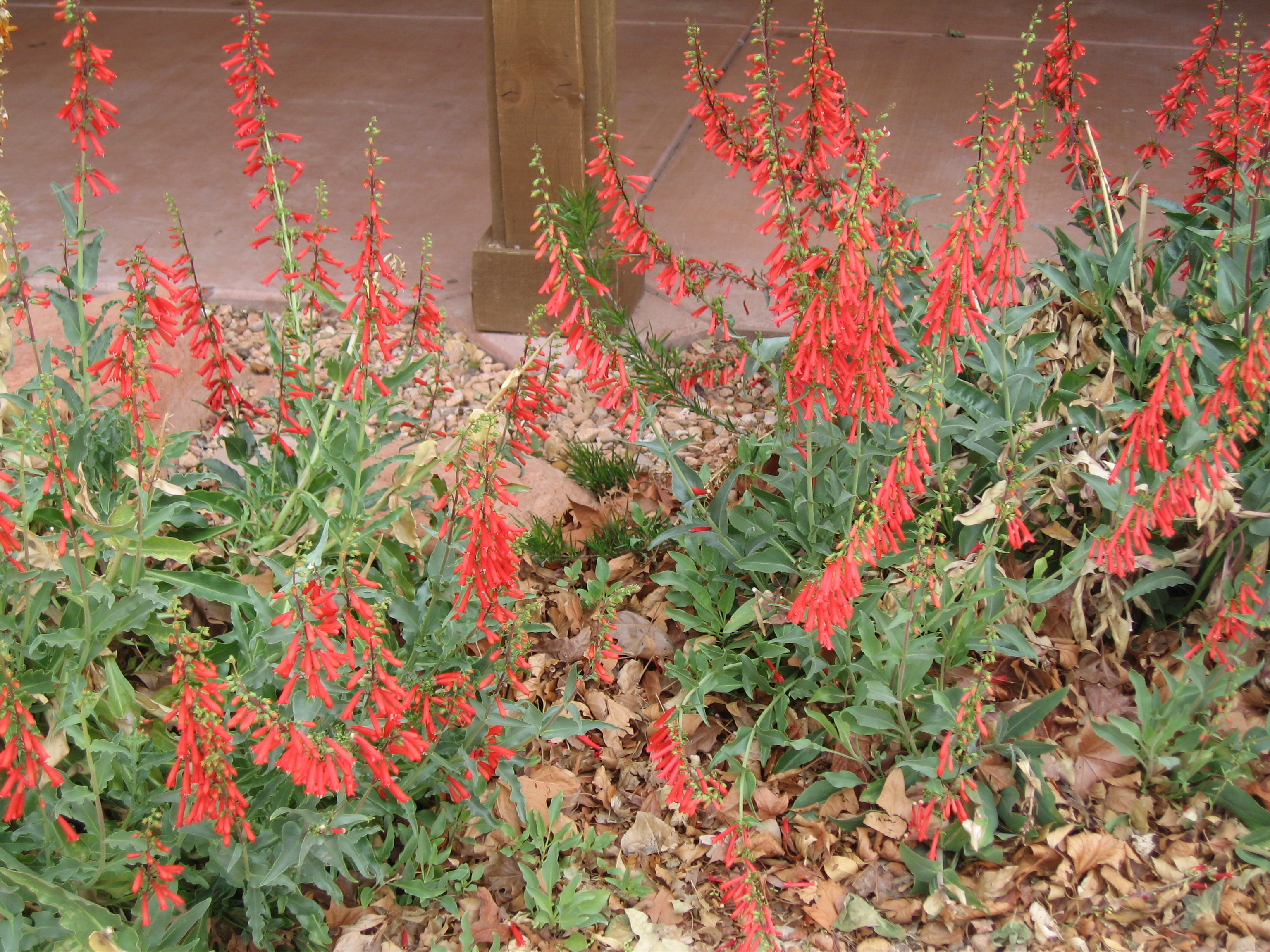
And the flowers were a bonus — Photo by Pat Bean

Since it was a weekday, I hadn’t called ahead for campground reservations the day I visited the Grand Canyon on my way to Zion National Park. Nor did I check my Trailer Life Directory for potential places to stay. I knew Lake Powell’s Wahweap Campground lay directly in path. It was the place I stayed my very first night on the road in Gypsy Lee. It had it all.

Bean’s Pat: 10,000 Birds http://tinyurl.com/6ogapq3Go birding in Namibia.  

*This pat-on-the-back recognition is merely this wandering/wondering old broad’s way of bringing attention to a blog I enjoyed – and thought perhaps my readers might, too. June 12, patbean.wordpress.com

Read Full Post »

 “What makes a river so restful to people is that it doesn’t have any doubt – it is sure where it is going, and it doesn’t want to go anywhere else.” – Hal Boyle

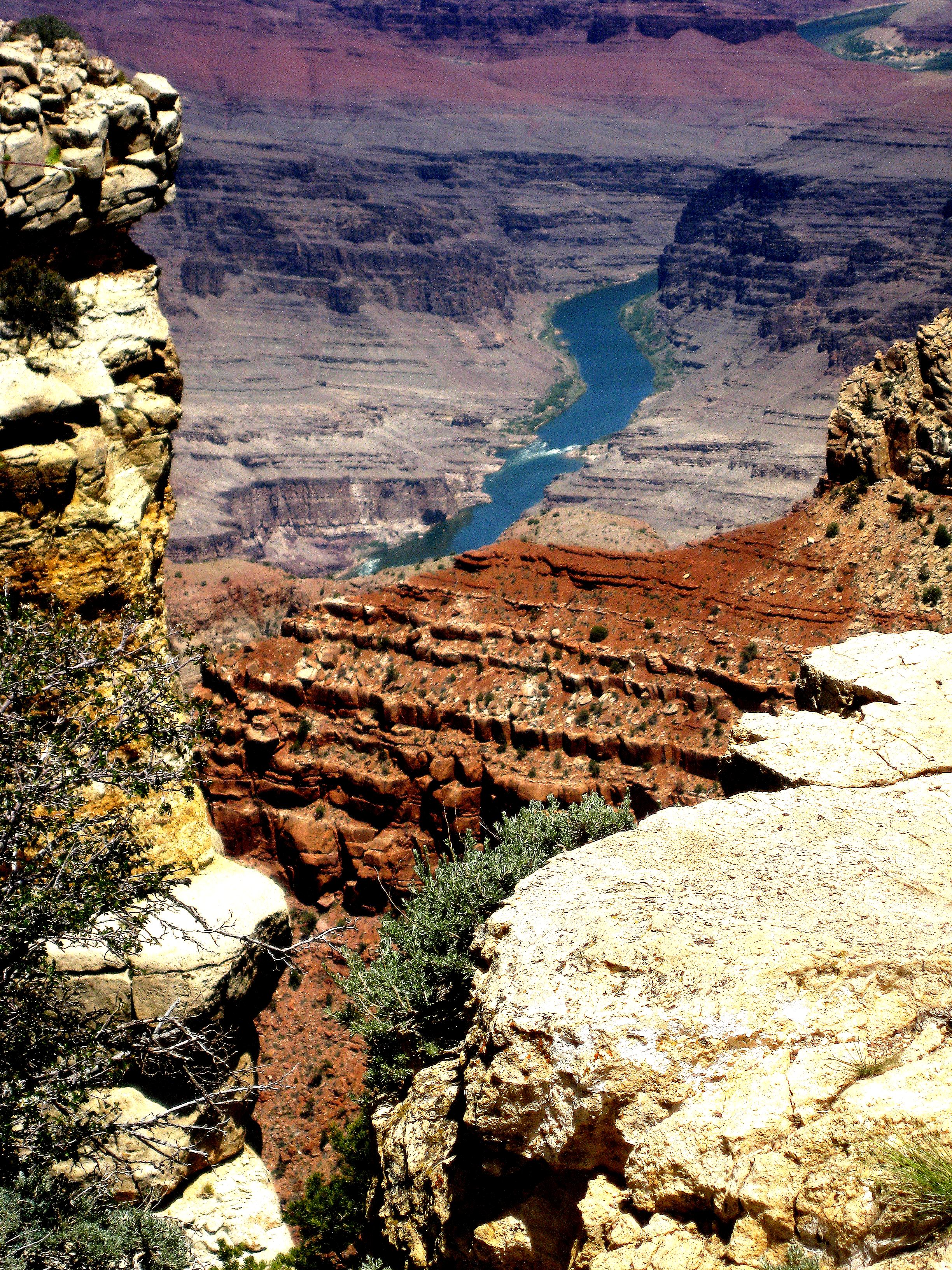
A mile below me flowed the Colorado River — and in it flowed a treasure chest of my memories. — Photo by Pat Bean

Memories of the Canyon Floor

If I could see the rapid from a mile away, it had to be one of the big ones. I wondered which? — Photo by Pat Bean

While there’s no bad view of the Grand Canyon, I must admit that my heart beat a little faster whenever the viewpoint allowed me a peak at the Colorado River a mile below.

I rafted that same river twice, once in 1991 when I paddled my way through it in a small six-man raft, and once in 1999, when I was oared through it in a larger raft by someone else’s hand.

In all, I’ve spent a total of 32 days at the canyon’s bottom. The first trip ranks No. 1 of all my adventures, including an African Safari (No. 2) and jumping out of an airplane (No. 3). Yes, I know, I’m an adrenalin junkie, or at least I was.

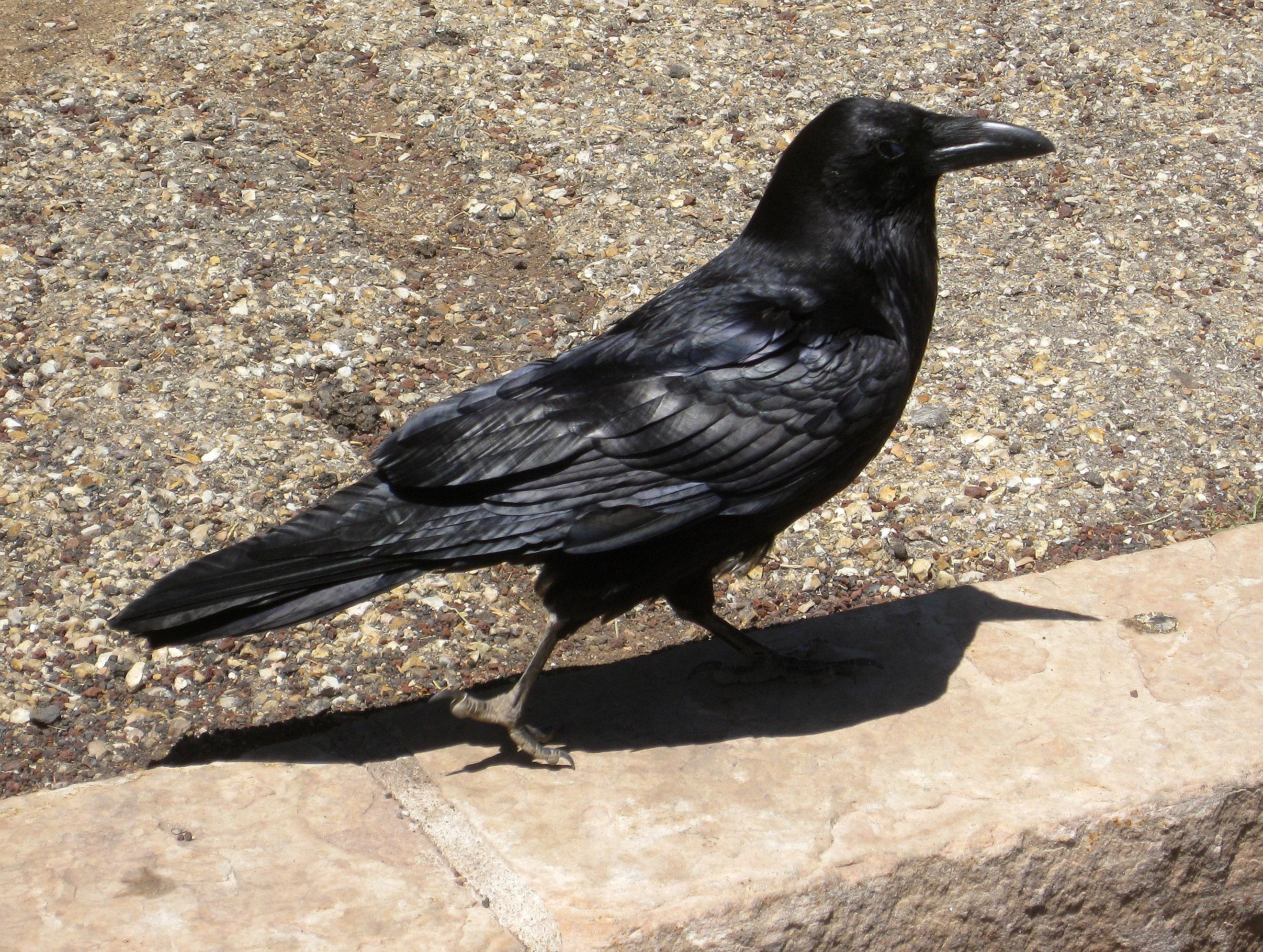
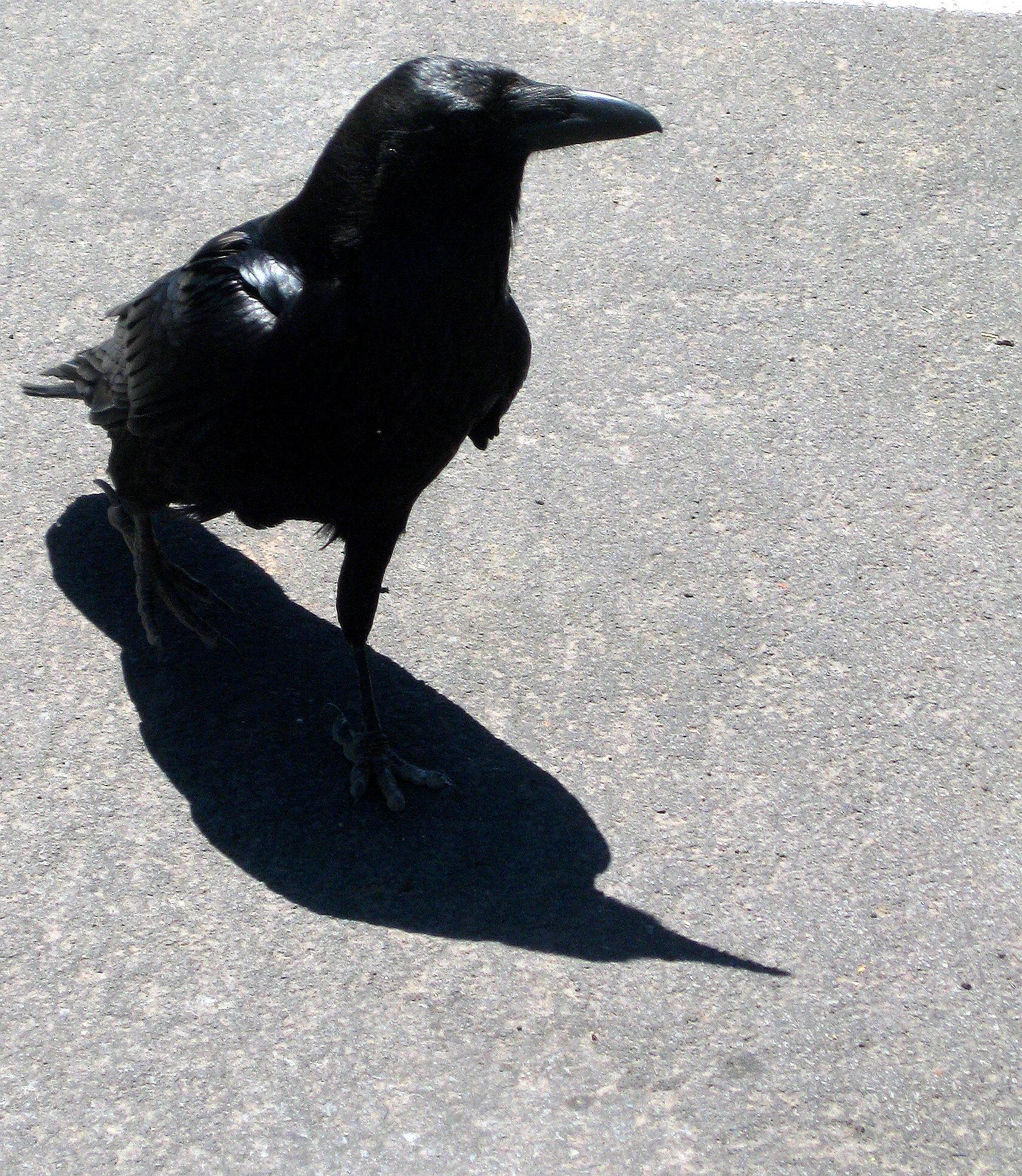
Ravens haunted every overlook where I stopped to view the canyon this day, just as they had haunted every camp site on the river below. This bold one that didn’t move off at my approach reminded me of the one that had stolen my tube of toothpaste on one of my Colorado River rafting trips through the Grand Canyon. — Photo by Pat Bean

I’m just as happy these days going for a quiet canoe ride on a gentle river – or doing as I was this day, stopping at every overlook along the Grand Canyon’s Desert View Drive.

Each time my stop included a view of the river, memories of the time I spent on it flooded out of my memory bank to be relived.

Once again I was holding onto the paddle boat from the water side in terror after Granite Rapid claimed me for its own. Or I was lying on my back on a beach, staring up at a slim sliver of sky watching the stars drift past.

I remembered awakening to the song of a canyon wren, and drinking in the peace of the silence that always marked the first half hour of our daily time on the river.  I emerged at the end of both 16-day trips a different person than the one who began it. More peaceful, more knowing who I was, more understanding what is important in life.

Today, that was simply spending time with the south rim of the Grand Canyon.

Bean’s Pat: http://thismansjourney.net/ Rhythm of the Waves. I love Galveston, and wave watching.

 *This pat-on-the-back recognition is merely this wandering/wondering old broad’s way of bringing attention to a blog I enjoyed – and thought perhaps my readers might, too. June 7, patbean.wordpress.com

Read Full Post »

 “Don’t cry because it’s over. Smile because it happened.” – Dr. Seuss

Flagstaff, Not as I remembered

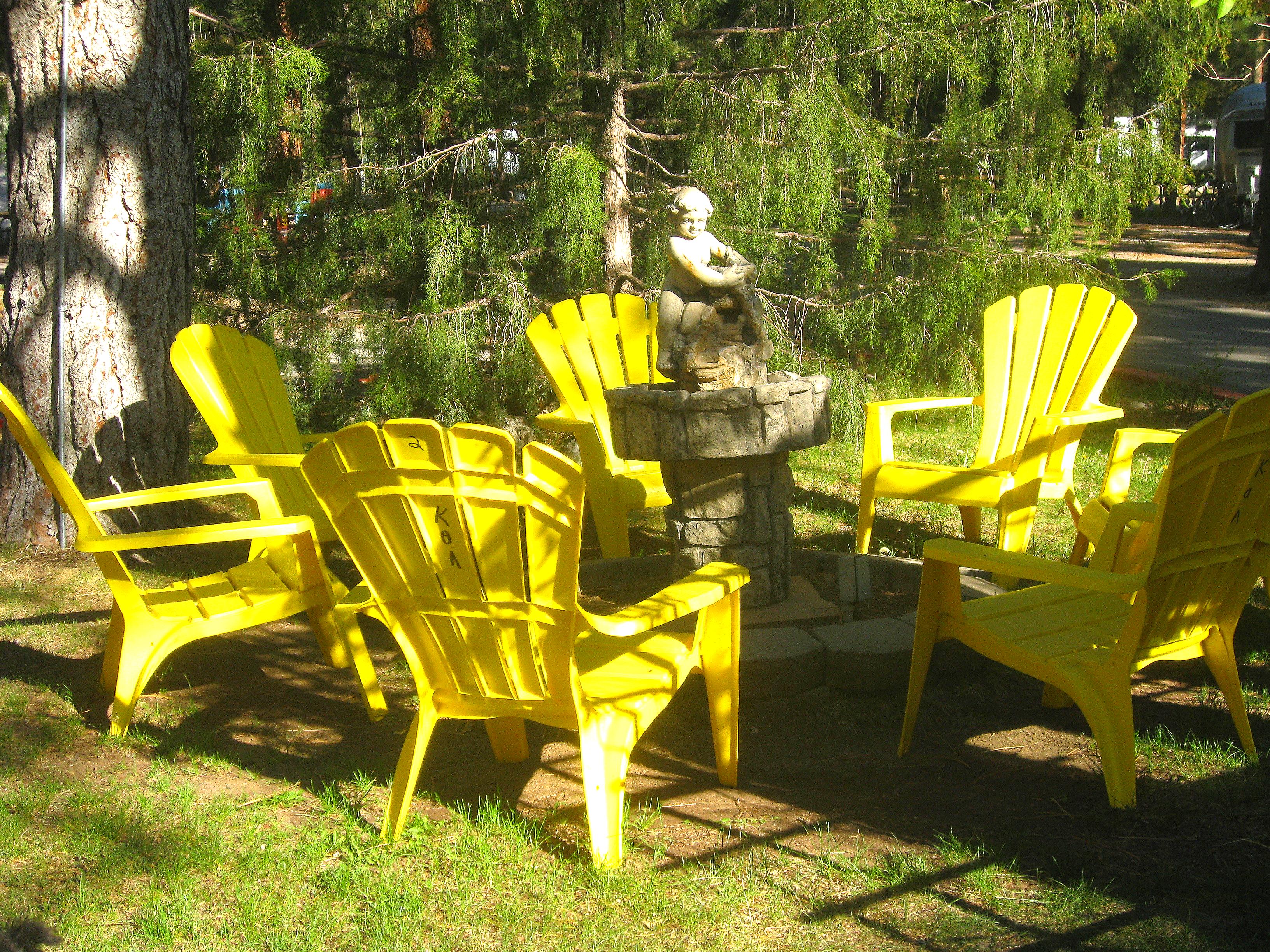
This cheerful seating area at the Flagstaff KOA reinforced my inclination to simply sit quiet for a while. — Photo by Pat Bean

Flagstaff still remembers Route 66 in all its glory. No crumbling, run-down remains in this elevated city, whose 6,920-foot elevation lets it nestle comfortably among 12,000-foot peaks. Flagstaff – which incidentally got its name from a flagpole made by a scouting party from Boston on July 4, 1876, to celebrate this country’s centennial – even holds an annual festival in September to celebrate the Mother Road.

I observed many signs and buildings as I made my way down the old highway through the town that loudly announced to travelers that Route 66 had passed this way.

Of course I never stop birdwatching. And this raven obligingly posed for a photograph. — Photo by Pat Bean

I had meant to explore some of them, to walk among Route 66 landmarks, hearing Nat King Cole in my head singing Bobby Troup’s “Get Your Kicks on Route 66.”

But I didn’t.

 Flagstaff wasn’t the quiet town I remembered from past visits. Today it seemed like people and traffic were everywhere. After my drive through the town, my canine traveling companion, Pepper, and I took Highway 89 heading north out of town and checked into the Flagstaff KOA.

And there Pepper and I stayed for the rest of the day and the next day, our sightseeing limited to what we could see in the large rustic park and on a short nature trail that we hiked several times a day.

It simply felt like the right thing to do at the time.

Bean’s Pat: http://inaroomofmyown.wordpress.com/  Girls Just Wanna Have Fun – writing! This one’s for the writers among us. 

*This recognition is merely this wandering/wondering old broad’s way of bringing attention to a blog I enjoyed – and thought perhaps my readers might, too. The Pat on the back is presented with no strings attached. June 2, patbean.wordpress.com

Read Full Post »

“When once the itch of literature comes over a man, nothing can cure it but the scratching of a pen. But if you have not a pen, I suppose you must scratch any way you can.” Samuel Lover, “Handy Andy,” 1842

Marker depicting some of the petroglyphs that can be seen below the cliff from the viewing platform. — Photo by Pat Bean

Newspaper Rock

The newspaper I found as I continued my travels on old Route 66 through the Petrified Forest National Park was 650 to 2000 years old. And it wasn’t written on paper pages.

Newspaper Rock, a National Historic Landmark. — Photo by Pat Bean

It was scratched in desert varnish on large boulders. And I couldn’t understand it. Neither can the experts.

Actually, in today’s age we would probably call it graffiti.

Were the petroglyphs carved into the rock by wise men among the Puerco River Valley Indian farmers who lived in the area?

 Or were they done by bored Indian teenagers wanting to leave their mark on something?

Up close details — Photo by Pat Bean

As usual, the landscape I’m wandering through has me wondering again.

I love it.

“To raise new questions, new possibilities, to regard old problems from a new angle, requires creative imagination and marks real advance in science.: – Albert Einstein

Bean’s Pat: Everyday Sunshine: Get Close http://tinyurl.com/73enmyg I dare you to look into these birds’ eyes – even if you’re not an avid birdwatcher like me, I think you will be amazed. 

*This recognition is merely this  wandering/wondering old broad’s way of bringing attention to a blog I enjoyed – and thought perhaps my readers might, too. The Pat on the back is presented with no strings attached.  May 25, patbean.wordpress.com


Read Full Post »

 “Precisely the least, the softest, lightest, a lizard’s rustling, a breath, a flash, a moment – a little makes the way of the best happiness.” – Fredrich Nietzsche


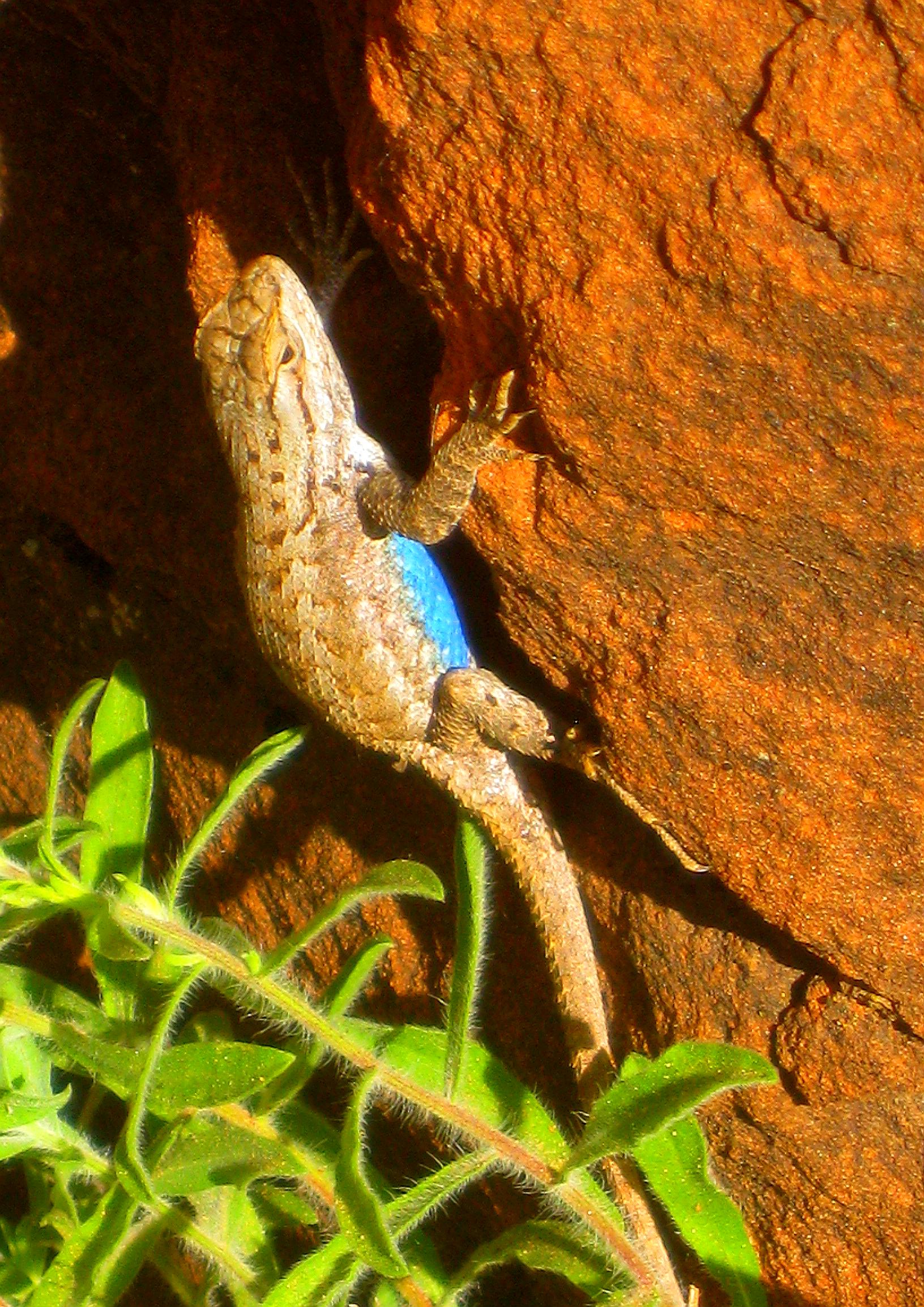
Blue-bellied lizard — Photo by Pat Bean


Blue-Bellied Lizard

When I hiked the Kayenta Trail Saturday, instead of Angel’s Landing, I came across a blue-bellied lizard, a sight I had never seen before.

I’d say this is a lizard with attitude. Don’t you agree? — Photo by Pat Bean

Well that’s probably not accurate. I had just never seen this lizard’s belly before. This lizard, however, was propped up in such a way that the cobalt blue underside was clearly visible. It even posed long enough for me to take a picture before it scrambled away to safety.

The next day, when my son and his family and I were hiking, we came across a northern pygmy owl sitting in a tree not far off the trail to Weeping Rock.

My son, Lewis and his wife, Karen, were thrilled. They’re avid birders, like me – and the owl was a lifer for both of them. While I had seen this cute little owl before, I had never seen one eating a blue-bellied lizard. And this is exactly what it was doing.

While I didn’t bemoan the loss of a lizard to the owl, I kinda hoped it wasn’t the same lizard I had seen the day before. I had grown sort of fond of that one.

The one being eaten by the pygmy owl brought some Shakespeare words to mind. I know, my brain’s a bit warped. Anyway:

“Eye of newt and toe of frog, Wool of bat and tongue of dog, Adder’s fork and blind-worm’s sting, lizard’s leg and owlet’s wing, For a charm of powerful trouble,Like a hell-broth boil and bubble.”

Bean’s Pat: Shakespeare Geek http://blog.shakespearegeek.com/ I wondered after I wrote the above quote if there were any blogs devoted to Shakespeare. Quite a few. This is just one. I thought you might find it fun.


Read Full Post »

 “Some people are always grumbling because roses have thorns; I am thankful that thorns have roses.” – Alphonse Karr

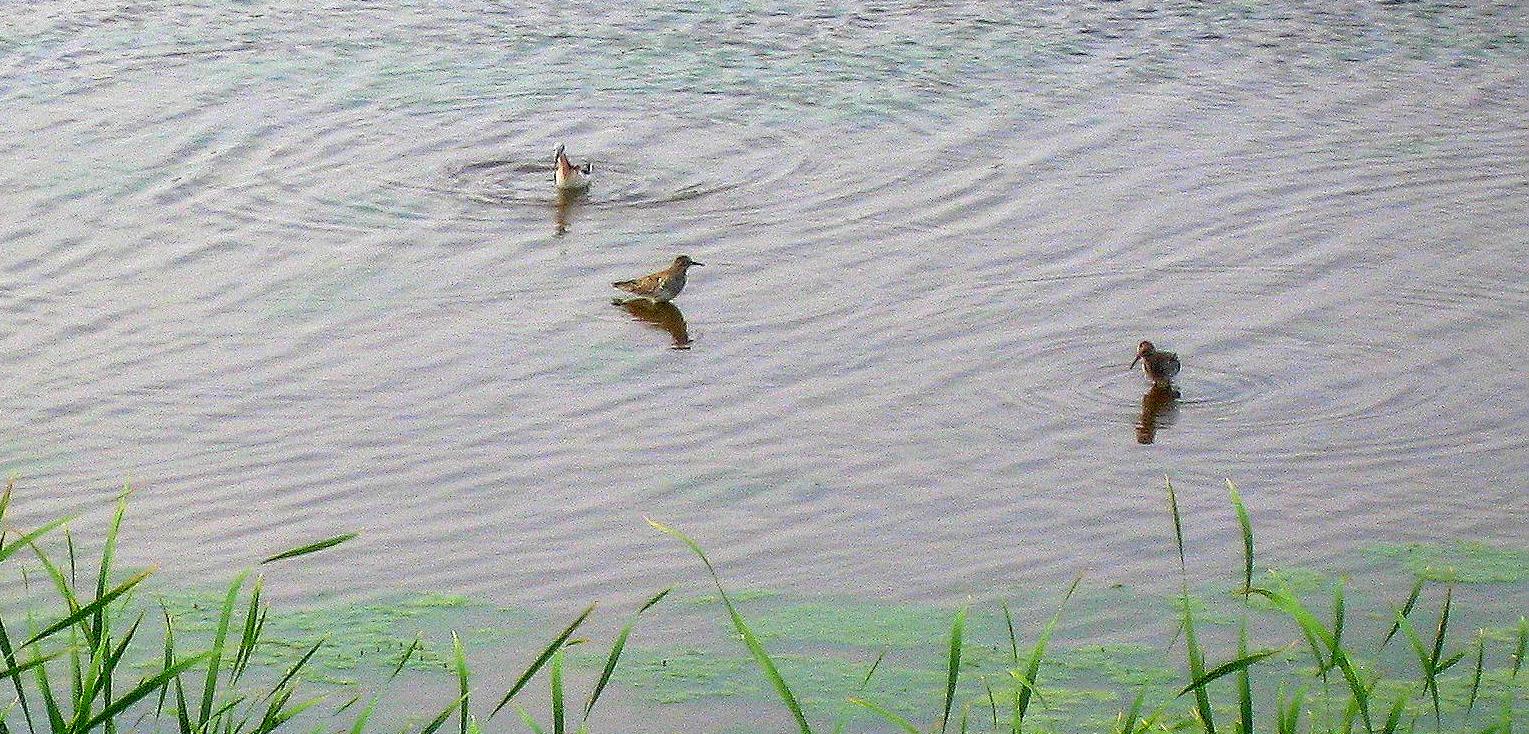
While I watched the red-necked phalaropes in the pond ..... -- Photo by Pat Bean

Adventures with Pepper

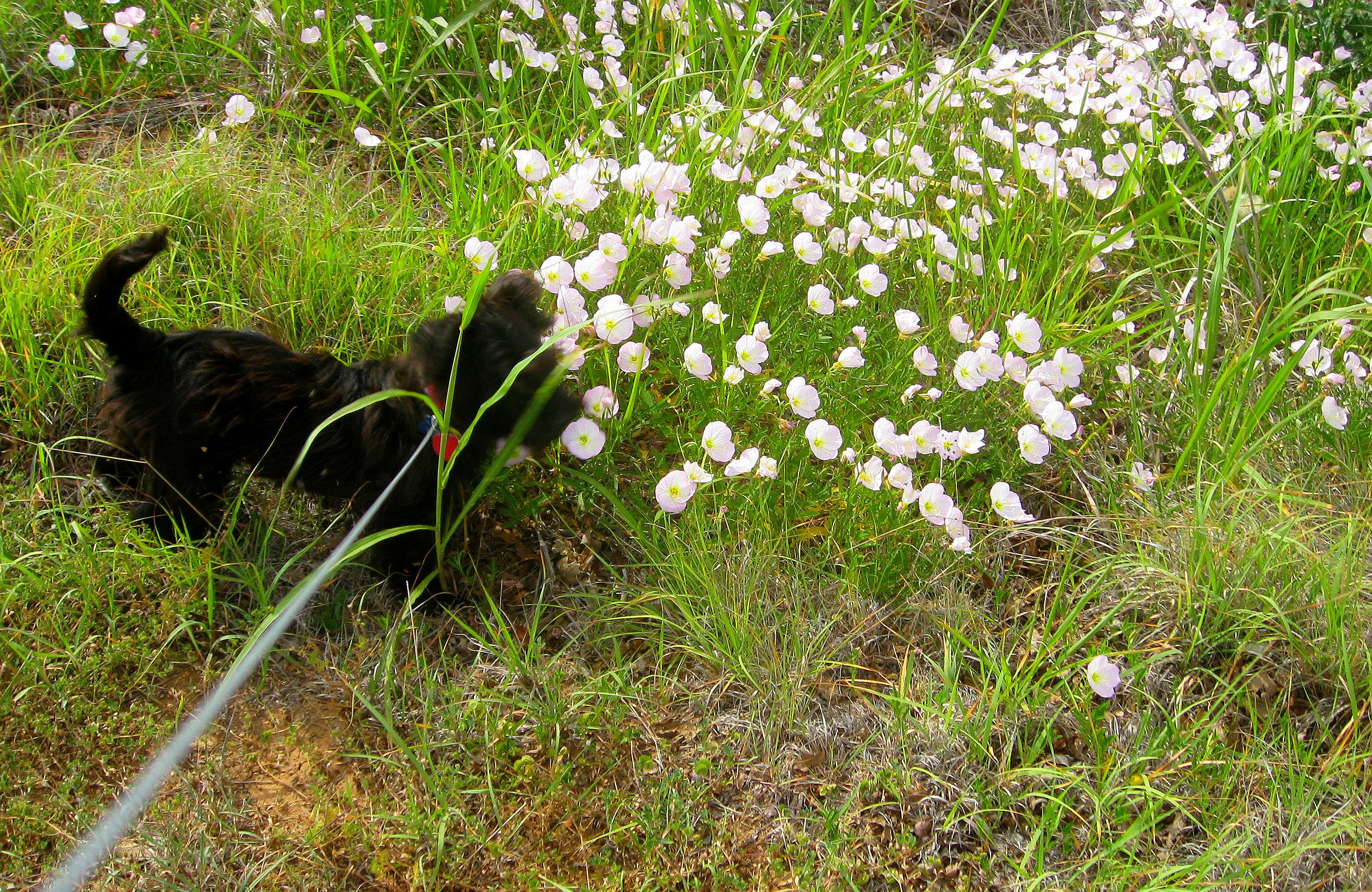
Pepper played around in the buttercups -- Photo by Pat Bean

The roadsides between Wichita Falls and Amarillo were strewn with wildflowers in abundance this past week. While Texas’ glorious spring bluebonnets have already disappeared, purple penstemons, golden coreopsis, scarlet Indian paintbrush, and white prickly poppy blossoms stood in nicely.

And then when Pepper and I pulled into a fancy rest stop, complete with a sign near the entrance to the information center that warned visitors to be aware of rattlesnakes, there was a large field of buttercups. I feel sorry for anyone who doesn’t thrill at such a sight.

Beyond the flowers, there was a small pond with a dozen or so phalaropes doing their thing.

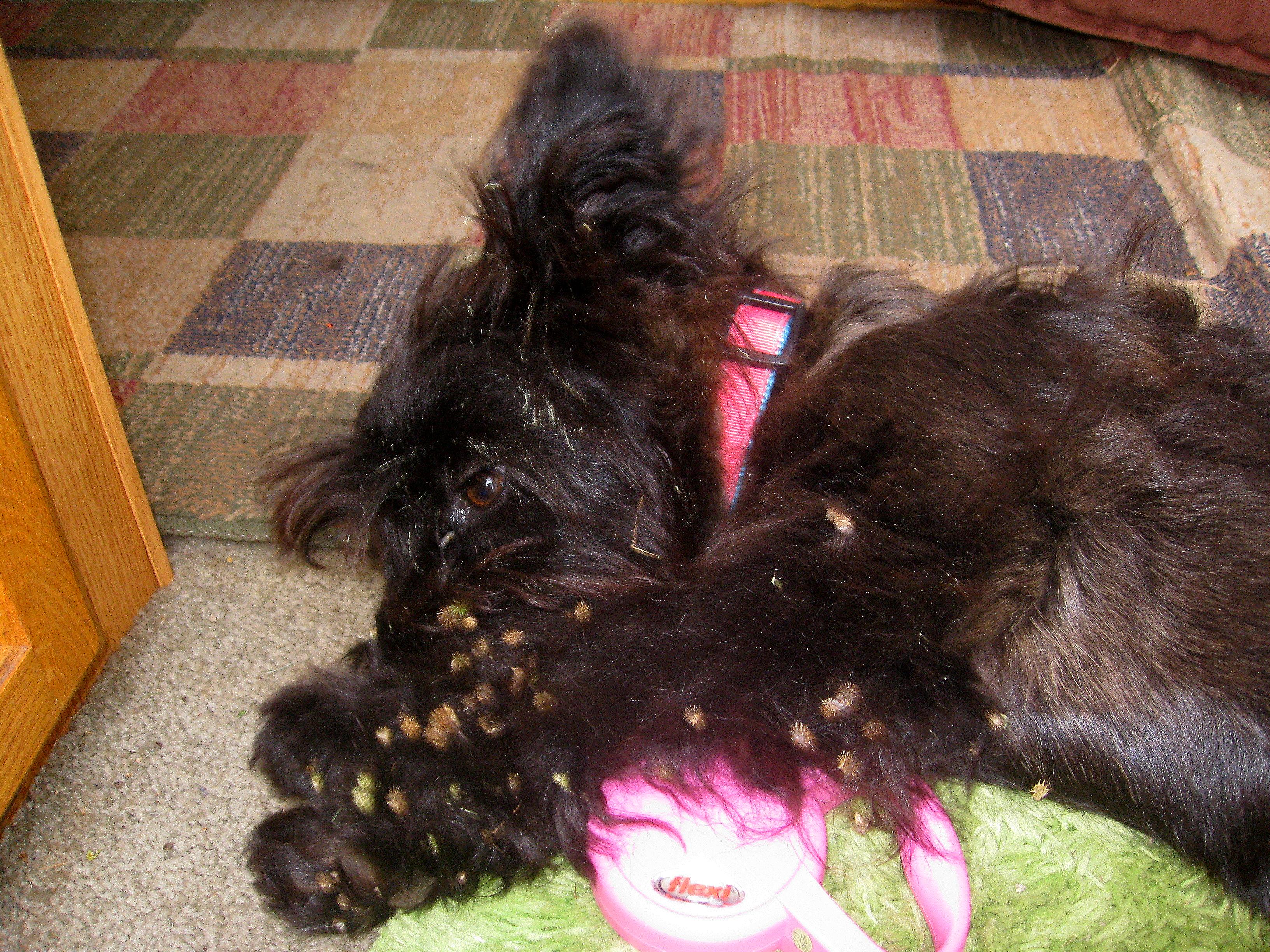
And the Texas nasties got her. -- Photo by Pat Bean

Phalaropes swim in circles to stir up the water and bring up their dinner. I’ve seen thousands of them do this on the Great Salt Lake in Utah, where they fill up on brine shrimp eggs before continuing their migration.

There were only about a dozen, however, on this small pond.

While I watched these small birds, Pepper decided to explore the buttercups. When I looked around, she was having a blast bounding among them. Watching her made me laugh out loud – well until she tired and came back to stand beside me.

It took me half an hour of picking and brushing and cutting of hair before Pepper wasn’t as prickly as a cactus. That sign that warned about snakes should have also mentioned Texas’ nasty burs.

Bean’s Pat: Peter Pan http://tinyurl.com/84j3cf9 How many of you have actually read J.M. Barrie’s book? I love the quotes.

Read Full Post »

 Oh What a Beautiful Morning …

“Every morning in Africa, a gazelle wakes up. It knows it must run faster than the faster lion or it will be killed. Every morning a lions wakes up. It knows it must outrun the slowest gazelle or it will starve to death. It doesn’t matter whether you are a lion or a gazelle … when the sun comes up, you’d better be running.”

First view of Lake Arrowhead's sunrise -- Photo by Pat Bean

A Howl of a Sunrise

Five minutes later ... Photo by Pat Bean

When Pepper and I stepped out of the RV on our last morning at Lake Arrowhead State Park. It was to a chorus of howling coyotes.

My new canine companion perked her ears up, listened for a couple of seconds and then joined their chorus. What a great traveler she’s going to make, I thought.

Then I stepped around the side of my RV, Pepper’s leash in one hand and a cup of cream-laced African coffee in the other hand, and watched the sun rise.

Every morning should have such a great start.

Bean’s Pat: The Greening of the Great Egret  http://tinyurl.com/br8fhd A great bird decked out in its courting colors.

Read Full Post »

Thomas Young together with Snow, his gyrfalcon/peregrine hybrid bird. Both were 37 years old in 2006 when I took this photo.

 “The greatness of a nation and its moral progress can be judged by the way its animals are treated.” – Mahatma Gandhi

One Man’s Love of Animals

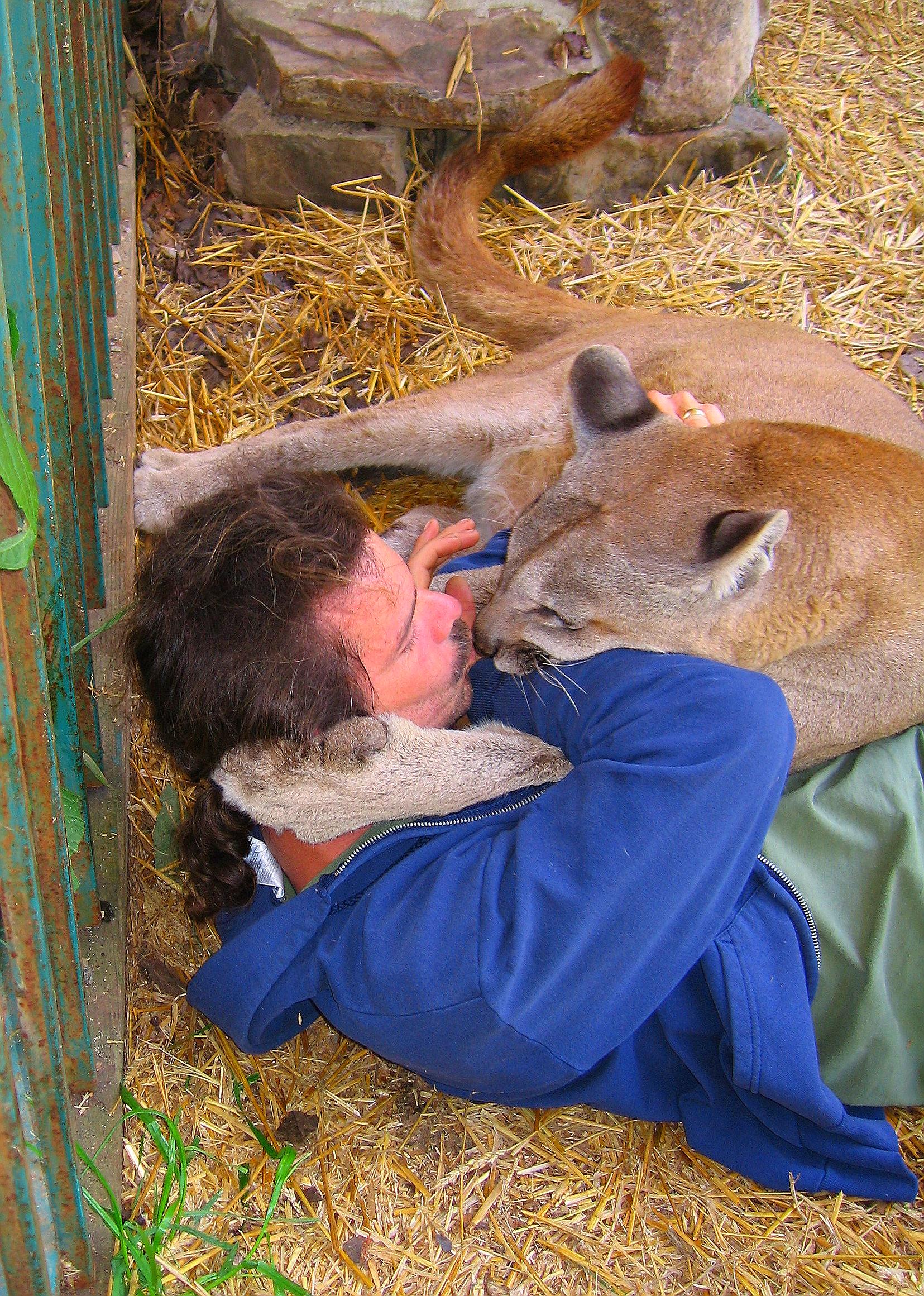
Togetherness: Sheena may be a cougar but she acts as if she's right where she belongs. -- Photo by Pat Bean

During my 2006 wanderings, I came across Queen Wilhelmina State Park near Mena. Arkansas. One of its attractions at that time was a small zoo and wildlife sanctuary operated by Thomas Young, a wildlife rehabilitator.

The zoo animals included a bear, a timber wolf cub, orphaned fawns, bobcats, wild turkeys, hawks, owls, raccoons – and a cougar named Sheena. Almost all of them had been injured at some point in time.

The side of a small unpainted wooden building on the property told the real story of this place. Large white lettering boldly announced that 12 bears, 5,000 hawks, 2,000 owls, 22 bald eagles, 18 golden eagles and thousands of small mammals had been released back into the wild by Young. The $4 entry fee to the zoo helped cover his expenses.

It was while I was questioning Paul, a volunteer and apprentice falconer working with Young, that I saw Tom for the first time.

Paul pointed him out to me as the long-haired man who had just appeared with a turkey neck in his hand to feed a wild turkey vulture that had just landed in the park.

As I watched the scene from about 30 feet away, the volunteer told me the vulture was a bird Tom had rehabilitated. Later Tom told me it was actually the parent of the rescued bird. He said it was the first time this particularly vulture had fed from his hand.

I was more amazed that he could tell the difference between two vultures than that a large, society-designated-ugly, wild bird had fed from his hand. .

“For some reason it’s come to trust me,” Tom said of his vulture friend. “A while back it brought its young here for me to babysit while it flew off on some business for about three hours.”

The volunteer had already told me this story in more detail but I was still fascinated with Tom’s less wordy rerun along with a sparse sketch of his life.

This man was a doer not a talker.

Tom said the park’s lofty location in the Ouachita Mountains made it ideal for releasing rehabilitated birds back to the wild. I was privileged to see one such release the next day, an awesome red-shouldered hawk that Tom released from the overlook just beyond the park’s lodge.

The bird simply fall off the edge of the mountain and glided away, one of the most beautiful sights any birder could ever hope to see.

Bean’s Pat: A Traveler’s Tale http://tinyurl.com/brbfpsh Take an armchair tour of a Papua, New Guinea, village.

Read Full Post »

« Newer Posts - Older Posts »