Feeds:
Posts
Comments

The Curious Coyote

The stillness of night here at Cedar Hill State Park, where the sounds of modern day life are muted, is often broken by the yapping bark of coyotes. It’s a sound that reminds me nature is my backyard. The snippy howls are music to rival that of Willie Nelson singing “Blue Eyes Crying in the Rain,” one of my favorite songs.

The coyotes also fascinate Maggie, the 25-pound, black cocker spaniel who is my traveling companion. Her wild cousins have been leaving scat on the road on which she and I take our daily walk down to the lake and back. Maggie always gets agitated with me because I keep her leash too short for her to stick her nose in the territorial offering.

 A couple of days ago Maggie was on the couch sleeping, her favorite past time, when for no reason that I could tell she awoke. In a flash she was up and barking out the open RV window. Usually that signals a camper with a dog is walking past. Not this time, however.

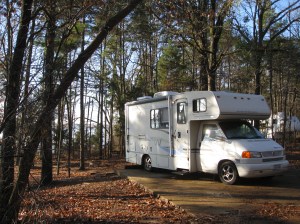
Maggie’s eyes were glued toward the forest behind our motor home. I looked and saw nothing, and was in the process of sternly telling Maggie to be quiet when something moved. It was a coyote, hidden from a casual view because of how well it melded against a tree trunk. It was close enough for me to see the yellow of its eyes and to be able to distinguish the individual patches of brown and gray fur in its winter coat.

 As I stared in awe, the coyote shifted its gaze from Maggie, whom it appeared to have been studying intently, to me. The coyote and I had a 3-second stare off before it turned its butt toward me and casually sauntered out of sight.

Maggie continued staring out the window for another 10 minutes, while I wrote about the sighting in my journal. I wondered if we were to the coyote what the monkeys in the zoo are to us humans.

Lake End Park, Morgan, La. The above photo was taken at Lake End Park in Morgan, La. The photo is a pale image of the original, but each time I look at it, my mind’s eye sees the intensity of the colors once again.

I’m a morning person, most often up before the sun peaks above the horizon. At the first upward flick of an eyelid, I’m ready and eager to bounce out of bed. It’s as if I can’t wait to discover what surprises the day will bring. It helps that I’m an optimistic, Pollyanna-ish kind of person.

This early morning exuberance has not helped me win friends over the years, especially among coworkers who only came to life just before quitting time. It might have helped if I hadn’t always been so verbosely cheerful, but the bratty kid in me was usually in charge.

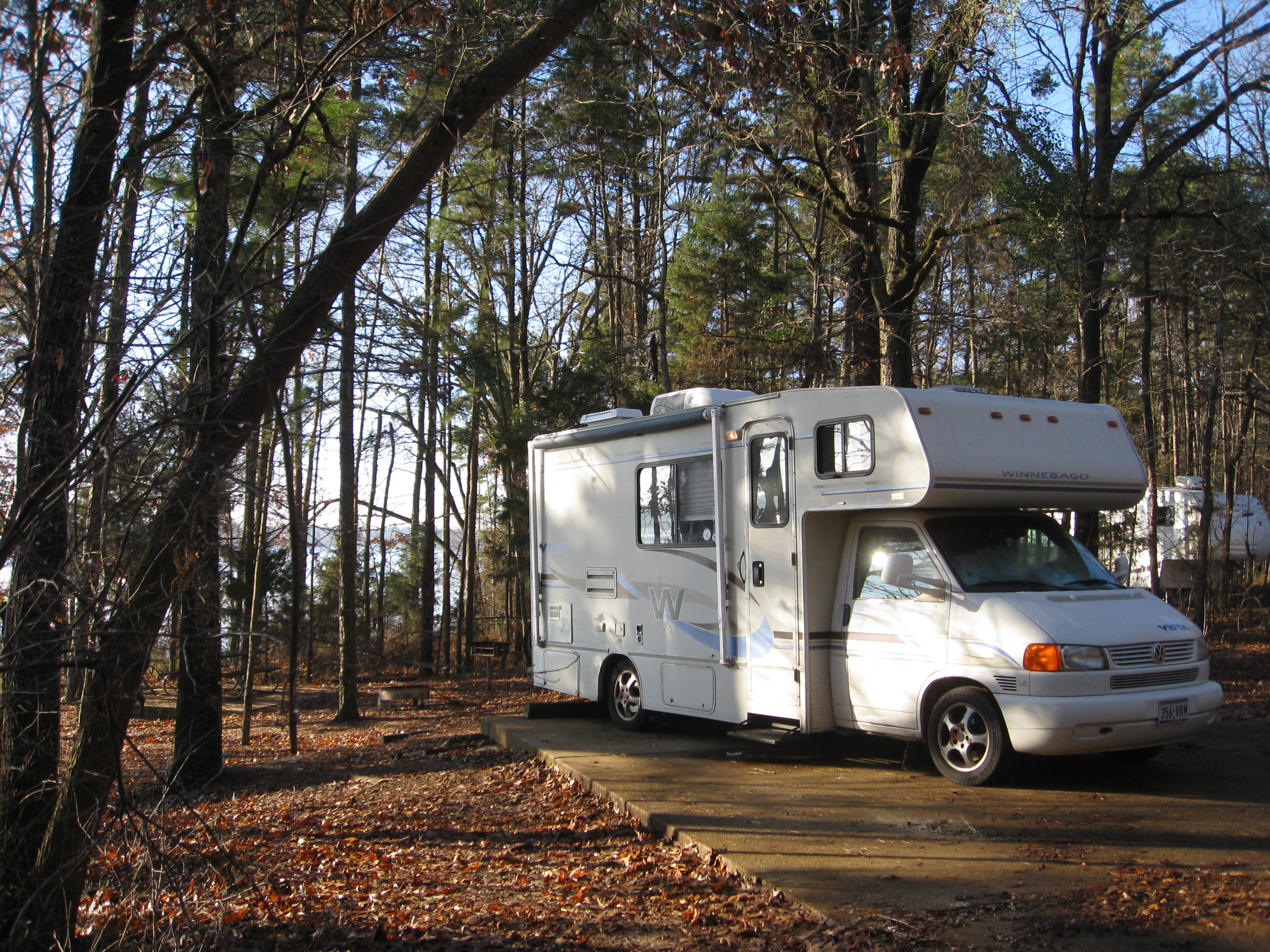
These days, the only one I have to annoy with my early morning zest is my dog, Maggie. She and I have spent the last five years alone together traveling this great country of ours in a small RV. When I pop down from our over-the-cab bed, she snuggles deeper into the covers. It’s at least 9 a.m. before she’ll emerge and give me that look that says, I have to go for a walk – right now!

Before that happens, I’ve finished off a pot of coffee, which I’ve heavily laced with cream, answered e-mail and updated Facebook. If it’s been a good morning, I’ve written a couple of pages on my current writing project, and if it’s been an especially good morning, I’ve also watched the sun come up out my RV window.

There’s something about a sunrise that touches my soul. It’s as if all my heart’s desires are bound up in the pink, the purple, the orange layers spread out across the eastern sky. It’s Mother Nature’s way of saying the dark won’t last forever.

So wake up already and watch it with me.

A brighter patch of colorA patch of color

Fall in Texas is nothing like the season Utah celebrates. Before retiring and going on the road, I enjoyed the cacophony of colors that painted this Rocky Mountain state’s hillsides and forests for 25 years. The change between summer and winter there blared out like a cannon being shot off on the Fourth of July.

Texas’ fall plays a pale game of hide and seek. The lush leaves of summer seem to simply turn brown overnight, and then fall to the ground when the next wind whistles through their branches. Thankfully, a few leaves choose instead to fight back against winter’s call with one last show of fire.

I’ve been watching two such patches for the past week on my daily walk from my camp site here at Cedar Hill State Park on a loop that takes me down Joe Pool Lake and back. One is a sprinkling of orange against a background of tree trunks and light green foliage; the other a scarlet-leaning-toward-maroon patch that sits in front of a stand of evergreens.

 They halt me in my tracks every time I pass by. Because such fall color is rarer here in Texas, when I do see it, I always appreciate it. While I still miss the vibrancy of Utah’s fall, I’ve discovered you can find beauty anywhere you look, even if it’s nothing more than a litter of horse apples lying on the ground after falling from a Bodark tree.

And that’s not a sight I ever saw in Utah.

IMG_1855

Horse apples that fell from a Bodark tree here at Cedar Hill State Park

Lonesome George

Lonesome George  ….   Nov. 9, 2009

Lonesome George

Lonesome George, the Pinta Island giant tortoise who's the last of his kind. Photo from Wikipedia

This month’s Audubon magazine has a post about Lonesome George possibly becoming a father. I saw George during a visit to the Charles Darwin Research Center on Santa Cruz Island in the Galapagos a few years back. He’s a 90-year-old tortoise and the last of his kind, although he does have some close cousins, two of these being a pair of female Isabella Island tortoises who share his enclosure.

 George was discovered as a sole survivor of his subspecies in 1972. From that time on, it’s been hoped that he would pass on his unique genes, and the Isabella females were selected as potential mates. George, however, proved to be no Don Juan.

Perhaps he’s just a late bloomer, I thought when I read the Audubon nature note. Some of us are. And it’s not that he doesn’t still have a lot of time left to do his begatting. While he’s nearing in on the century mark, these huge tortoises, which never stop growing, can reach the two-century mark.

 Before seeing George at the center, I was privileged to walk among – close enough to touch – the tortoises that roam free on Santa Cruz. One big fellow, who was blocking the trail, hissed at us as we detoured around him. He weighed close to 500 pounds and I gladly gave him the right of way.

 Of the 14 subspecies of Galapagos tortoises know to have existed, 11 survive today. Without the captive breeding program at the center, the number of survivors would certainly be fewer. While it would be nice if George was once again roaming free, it’s nice to know that one day his kind might have the opportunity of doing so.

It’s also comforting to know that there are other humans like myself who share such a hope.

Great Egret

Great Egret

Taken at Brazos Bend State Park, Texas

Nov. 5, 2009 …. Cedar Hill State Park and Painted Buntings

It was a painted bunting that first drew me to this Texas State Park. It took three days of breaking spider webs on trails and one day of slogging through mud after a night of rain, but I eventually found one of these clownish-colored birds.

When in the open, you can’t miss the male of this species. He has a bright blue head, a scarlet breast, a green back and a red rump. The female is more subdued, dressed all in shades of green, with the breast leaning toward yellow on the color wheel. These birds, however, feel more comfortable when ensconced in thick foliage.

I finally found the bird that would become No. 383 on my birding life list in a tree near a small pond. The painted bunting is nicknamed nonpareil (without equal) in French and mariposa pintado (painted butterfly) in Spanish because of its spectacular appearance.

Sad to say, its beauty has made it a hot item with the international pet trade and its numbers have declined over 50 percent during the last 30 years. The birds are particularly popular as pets in Asia and Europe.

I’m now up to bird 682 on my life list, the result of a lot more traveling around the country in an RV with my black cocker spaniel, Maggie, as my copilot.

Recently, however, I decided to sit for a few months and let the birds come to me. I jumped at an opportunity to volunteer, in exchange for a free RV camp site at Cedar Hill. This is where I’ll be through mid-December. It’s the wrong time of year for painted buntings, but the crows that have been landing on the roof of my RV are keeping me entertained in the meantime.

Mockingbirds, cardinals, chickadees, roadrunners and phoebes are still hanging around as well.


Hello world!

Hi!

My name is Pat Bean. I’m a writer and a full-time RV-er.  I’m also a passionate birder who chases life birds in her travels. My goal with this blog is to write about travel, nature and birds bi-weekly. I’d love to hear your comments.