Feeds:
Posts
Comments

The Three Gossips at Arches National Park -- Photo by Pat Bean

 “Nature is not only all that is visible to the eye … it also includes the inner pictures of the soul.” — Edvard Munch

 Day 21

At this point in my journey, I had traveled 1,546 miles toward my destination – plus several hundred more miles in side trips. As always seems to happen to me in my dawdling journeys, I was now faced with a deadline. Because of commitments, I needed to be in Ogden, Utah – 260 miles away – today. It left me with too little time to visit Arches National Park.

I did so anyway.

Even if it was to be just a quick run-through, there was no way I was going to miss this spectacular place where wind, water and time have carved out a fantasy landscape. Just from the road, one can see arches, bridges, potholes, hoodoos and precarious balancing rocks. This day, roadside wildflowers added yet another dimension to this red-rock

Roadside flowers added yet another dimension to the wonders of Arches -- Photo by Pat Bean

 architect of nature.

Arches is a place I visited many times when I lived in Utah. It was where I always took visiting friends and relatives, knowing that they couldn’t help but be awed – as once again I was this day. When it comes to fantastic scenery, this braggart Texan is always forced to admit that in this category Utah wins the Oscar, Pulitzer, America’s Cup and all the other awards out there rolled into one.

 My few hours spent this day in Arches stayed etched on my senses all the way to the Wasatch Mountains, which cast their pleasant shadow on my life for the 25 years I lived in Ogden. I was eager to renew my acquaintance with these serene giants; and because my trip would include a 10-day stopover in Ogden, I rejoiced that I would have time to do just that.

 I have a fickle heart when it comes to Mother Nature’s wonders.

“To my mind, the greatest reward and luxury of travel is to be able to experience everyday things as if for the first time, to be in a position in which almost nothing is so familiar it is taken for granted.” — Bill Bryson

Day 20 

My drive today took me onto the Devil’s Highway, a route whose New Mexico portion includes steep, twisting sections. The high number of fatalities along the southern portion — along with the road’s original, satanic-mark-of-the-beast 666 numbered designation — earned it the nickname.

In 2003, transportation officials came up with the bright idea of renaming it Highway 491, their thinking being to end its cursed reputation. I guess they never read Shakespeare’s “… that which we call a rose by any other name would smell as sweet.”

The 53-mile section I drove – from Cortez, Colorado, to Monticello, Utah – was not devilish at all, just hilly and lonely, giving one ample opportunity to drink in the high desert landscape from various vantages. I’ve driven it many times and always have found it a relaxing stretch of road.

At Monticello I turned north onto Highway 191, which I would follow this day into Moab. Western kingbirds and kestrels watched me go past as the drive took me through a landscape of red rock gardens set off by the snow-covered peaks of the La Salle Mountains in the background.

That night, from my RV window, I watched those same snow-clad mountain fade into pink as the sun set opposite them behind yet more red rocks.

It was yet another perfect day.

Wilson's Arch as seen from Highway 191 20 miles south of Moab -- Photo by Pat Bean


Pueblo cliff dwellers left a mysterious legacy for us to unravel. Where did they go from here? Photo by Pat Bean

 “If the sight of the blue skies fills you with joy, if a blade of grass springing up in the fields has power to move you, if the simple things in nature have a message you understand, rejoice, for your soul is alive.” Eleanora Duse

While I know the landscape will eventually recover, the extent of scenes such as this saddened me. -- Photo by Pat Bean

Day 19

 The 15-mile twisting, steep drive up to Mesa Verde’s Farview Visitor Center was a cruel lesson about the destructive nature of fire. In the year 2000, over one-third of the park’s 52,000 acres burned. Unlike the Yellowstone fires, this Colorado park’s pinyon pine landscape has not done much visible recovery.

As one who had visited the park before the lightning caused fire, I was devastated to see the drastic changes. And I had plenty of time to look as my drive up was often interrupted by road construction crews. I saw one lone squirrel in a burned out tree surrounded by a forest of burned out trees and wondered about its survival, and about those animals that didn’t survive.

 A view from Park Point, at 8,572 feet and the highest spot in the park, showed the immensity of the lifeless, black devastation. I would have gasped in pain at the sight if the short hike up to the fire lookout hadn’t left me without gasping air.

 The up side – I’m always looking for one – is that the fires were kept away from the park’s other treasures. Mesa Verde protects hundreds of 12th and 13th century Pueblo cliff dwellings. I also know that fire plays a role in the environment and that eventually, like Yellowstone after its fires, Mesa Verde will recover. It’s just doing it much slower.

An RV neighbor in the valley below where I was staying said he watched the huge 2000 fires. “You could see the flames and feel the heat. ” He also noted that the fires that had scarred the landscape revealed hundreds of additional Pueblo historical sites.

Meanwhile, as if to say she was sorry for the devastation,  Mother Nature made it a blue bird day for me. In areas where green still ruled the day, I saw a Steller jay, a pinyon jay and a western bluebird, each wearing its brightest and unique shade of blue.

I arise in the morning torn between a desire to improve the world and a desire to enjoy the world. This makes it hard to to plan the day.” — E.B. White

A cheery cafe to go with a dawdling morning. -- Photo by Pat Bean

A cheery cafe to go with a dawdling morning -- Photo by Pat Bean

 Day 18

It was going to be a short drive today, so I got a late start and then stopped for a late breakfast in the little town of Mancos. It’s the kind of town I imagine Park City as once being. With just a little over 1,000 residents, it plays host to those visiting nearby Mesa Verde National Park for sight-seeing, Jackson Gulch Reservoir for fishing, Mancos State Park for mountain biking, or Chicken Creek resort for skiing.

 I visited the co-op gallery located on its funky main street. Called Artesians of Mancos, the shop features the work of 17 local artists. My favorite pieces were Jan Wright’s watercolors. Sadly, there’s no room in my RV for such luxuries.

 I actually walked into the gallery by mistake. I was looking for the cafe, which was in back of the former bank building, a bit of trivia I guessed from a sign at the top of the building. It was a delightful mistake.

The Absolute Cafe and Bakery in the rear of the building was a good choice. The walls were full of art, and the décor included shelves full of used books for sale – which I perused while waiting for my food – and live plants. There’s something very sad about plastic greenery.

My sausage, egg and hashbrown breakfast was superb, with enough to take back to my RV for the next morning. Before I left, I also bought a blueberry-lemon bar that was to die for. I had it for dinner. I seldom eat out, but this experience left me wanting to do it more.

Native American scupture at the entrance to Mesa Verde RV Park -- Photo by Pat Bean

Later that day, at Mesa Verde RV Park, I saw my first magpie of the year. It’s my favorite bird but not one that can be seen in Texas. . I also watched the brightest yellow-rumped warbler I have ever seen playing around in the window beside my motor home.

 Have I told you lately that life is good?

Copyrighted by Pat Bean

Through the window of my RV, which was parked about 10 miles south of Durango, Colo., I had a magnificent view of the Rocky Mountains' San Juan Range. -- Photo by Pat Bean

Be your name Buxbaum or Bixby or Bray or Mordecai Ali Van Allen O’Shea, you’re off to Great Places. Today is your day! Your mountain is waiting. So … get on your way.” — Dr. Seuss


Day 17

It was with eagerness that I finally said good-bye to the dreaded Interstate 40, which I would never have driven except for Mother Nature’s tantrums. Not knowing when I would have to stop because of her semi-toppling winds, I wisely, if sorrowfully, chose to avoid my usual backroad routes where RV parks were few and far between.

But today I left Albuquerque, New Mexico, and its gentle Sandia Mountains behind me as I traveled down Highway 550 toward Durango, Colorado — and the more rugged Rockies. These are the mountains that stir my soul to exhilaration.

 Highway 550 is a easy-going four-lane, lightly traveled road that passes through the Santa Ana, Jemez, Zia, Jicarilla Apache, and Southern Ute Indian reservations. It took me from Albuquerque’s 5,314 feet to above 7,300 feet, and across the Continental Divide a couple of times. Sagebrush, juniper and oil wells dotted the landscape. If not for the shape of the landscape, steep hills and high mesas, it would have echoed my drive through West Texas.

I stopped for the night about 10 miles south of Durango, and drooled for awhile out my RV window at my first impressive sight of the Rockies. Corny as it may sound, tears come to my eyes every time I meet them again after an absence.

On the Road: The past and the present side by side on Route 66's Enchanted Trails RV Park. -- Photo by Pat Bean

  “A person has to do what a person has to do.” — Pat Bean

Days 13-16

I was on the road for only about 20 minutes before yesterday’s wind resumed. It tricked me into thinking it was going to be a calm day. My RV and I wrestled with while headed west on Interstate 40 for 125 miles. In Tucumcari, New Mexico, I surrendered to a roadside KOA. The place quickly filled with other RV-ers who also hollered “Uncle!”

The next day again started calm, but once again the wind picked up before I had traveled far. This time I gave up after 85 miles, stopping at the Enchanted Trails RV Park on the west side of Albuquerque. A look at the upcoming weather forecast convinced me I needed to stay put for the next three days.

It was a good thing I did because my revered Mother Nature rained, snowed, hailed and blew over semis all around me for the next couple of days. Fortunately, my camp site only experienced an hour or so lightning show and 15 minutes of a light rain. The wind, however, rudely shook my RV around for the full three days.

Leftover Route 66 memories -- Photo by Pat Bean

Interstate 40, roughly follows the colorful and historic Route 66, where business such as reptile zoos, Indian trading posts and old-fashioned ice cream shoppes made traveling an adventure. Enchanted Trails is one of those businesses that survived by catering to present day travelers. The former trading post sits on the original 66 highway in view of today’s Interstate 40, where travelers have forgotten the journey in the rush to reach the destination.


Walks around the camp to take care of Maggie’s business — and fill my ears up with blowing sand — revealed bits of Route 66’s colorful past. I’m glad I got to travel the original route in its heyday. What you didn’t miss is the up side of aging. I’m also glad that I still understand the importance of the journey.

Life is good, even when one finally gives in and screams at the noisy wind rattling their tiny home to “Just stop it already!” Sometime you have to do what you have to do, even if your canine companion looks at you as if you’re crazy.

Copyrighted by Pat Bean


Y'all come for dinner, Big Tex says to visitors headed west on Interstate 40. He was the landmark just before my exit to the Amarillo Ranch RV Park

 “Botanists say that trees need the powerful March winds to flex their trunks and main branches, so the sap is drawn up to nourish the budding leaves. Perhaps we need the gales of life in the same way, though we dislike enduring them.” — Jane Truax

 Days 10-11

The first thing I saw on hitting Interstate 40 heading east into Amarillo was Big Tex, urging y’all to drop by the Big Texan Steak Ranch. It was one of the numerous billboards advertising this restaurant that I had seen as soon as I reached the Panhandle. The restaurant’s gimmick is a free 72-ounce steak if you can eat the whole thing in an hour. The odds, like in Vegas, are in the establishment’s favor. If you lose the cost of the steak is $72.

 I kept my money and fixed myself a bowl of my homemade crab and shrimp gumbo soon after I checked into the Amarillo Ranch RV Park – they throw the word ranch around a lot in this part of Texas. I planned to stay two nights so I could catch up on chores, but ended up staying three because of a wind storm.

 The next day, the only good one weatherwise,  I did  laundry, grocery shopping and got a haircut. I now had clothes that once again were lavender-smelling clean, a full  food cupboard, an overflowing tiny refrigerator – and bad hair.

“I want my bangs to touch my eyebrows and leave some fullness on the side,” I told the stylist.

 She was either deaf, unskilled or mad at the world and wanted to take it out on me. I left the beauty shop with too much forehead in front and too little hair above my ears. Thankfully my hair grows fast.

Cadillac Ranch, another I-40 landmark. This one a public art installation that says much about Texas. Photo by Richie Diesterheft, Wikipedia

 My plans to get back on the road the next morning were then thwarted by Texas-sized winds that kept my motor home rocking and rolling all day even though it stayed parked. They also took me down.

I was going out to walk Maggie when the wind grabbed control of the door, slamming it up against the side of my RV and tossing me 20 feet across the grass when I didn’t let go of the handle quick enough.  I landed, thankfully, on my padded bum but still with a  clumsy kid’s scratched knee.  Maggie nuzzled me, then gave me a look that said,  I thought we were going for a walk.

 Amarillo in my rear-view mirror the next morning wasn’t a bad sight.

Copyrighted by Pat Bean

A golden-fronted woodpecker visit to my Palo Duro Canyon camp site -- Photo by Pat Bean

“I don’t ask for the meaning of the song of a bird or the rising of the sun on a misty morning. There they are, and they are beautiful.” — Pete Hamill

 Day 10

 As I was getting my RV travel ready for my trip to Amarillo, I glanced out my window – and then did the thing I so often forget to do. I grabbed my camera. Luck was with me this day for I actually captured the image of the golden-fronted woodpecker visitor through a window from inside my tiny home.

 I once was in a canoe coming around a bend on the Green River when what sounded like a loud shotgun blast drew my attention shoreward. Before my very eyes a cliff-side avalanche was taking place. I watched in awe, totally forgetting the camera hanging around my neck.

Such has been my relationship with so many awesome events in my life. The truth is, I carry a tiny even-dummies-can-do-it digital camera with me almost everywhere I go. For those who need to know, it’s a Canon PowerShot SD850.

The canyon has her secrets -- Photo by Pat Bean

I purposely leave it in my pocket most of the time. When I do take it out, I quickly snap a picture and put it back. Having worked often with journalistic photographers, I know it’s not the way to capture award-winning shots. It is, however, my chosen way of seeing the world.

 Looking through a camera lens, at least for me, dims the world around me. Mostly, when I think of taking a photograph, I’ve missed the perfect action moment. This time I didn’t.

Copyrighted by Pat Bean

A Palo Duro Canyon view provided by Mother Nature ... Photo by Pat Bean

“There is something infinitely healing in the repeated refrains of nature – the assurance that dawn comes after night, and spring after the winter.” — Rachel Carson

Day Nine

 Today was the day I explored the park. I took pictures, hiked a few trails and let nature’s special medicine cleanse my brain of the world’s chaos. No chemicals could do as thorough a job.

The birds serenaded me. The spring budding of trees fed my soul, and the canyon’s rock cliffs, sluggish red creeks, and colorful wildflowers continually kept my eyes entertained. I looked for the coyotes that had howled during the night, but saw only deer, jackrabbit and of course birds, including a spotted towhee that was a new addition for my trip list.

Water carved the canyon, and continues to do so ... Photo by Pat Bean

 Palo Duro Canyon is a big Texas surprise. Hidden below a flat landscape of sagebrush and cactus, and blowing tumbleweeds when the wind howls, one has to be in it to see it.

 Have you ever felt that you were exactly in the place you were meant to be? This day felt like that.

Copyrighted by Pat Bean

The view from my camp site in Palo Duro Canyon ... Photo by Pat Bean

“Palo Duro … is a burning, seething cauldron, filled with dramatic light and color.” — Georgia O’Keeffe

Day Eight

Yesterday’s high winds continued today in the park so I stayed close to my No. 26 camp site in Palo Duro Canyon State Park’s Hackberry Campground. There was still plenty to see, however.

 As I often do when I’m in a campground, I throw out some birdseed to see what I can attract. When I did it this day, and while I was still spreading it around, several wild turkeys rushed out from nearby bushes and practically were eating out of my hand. They probably would have if I hadn’t been a bit concerned about their sharp bills.

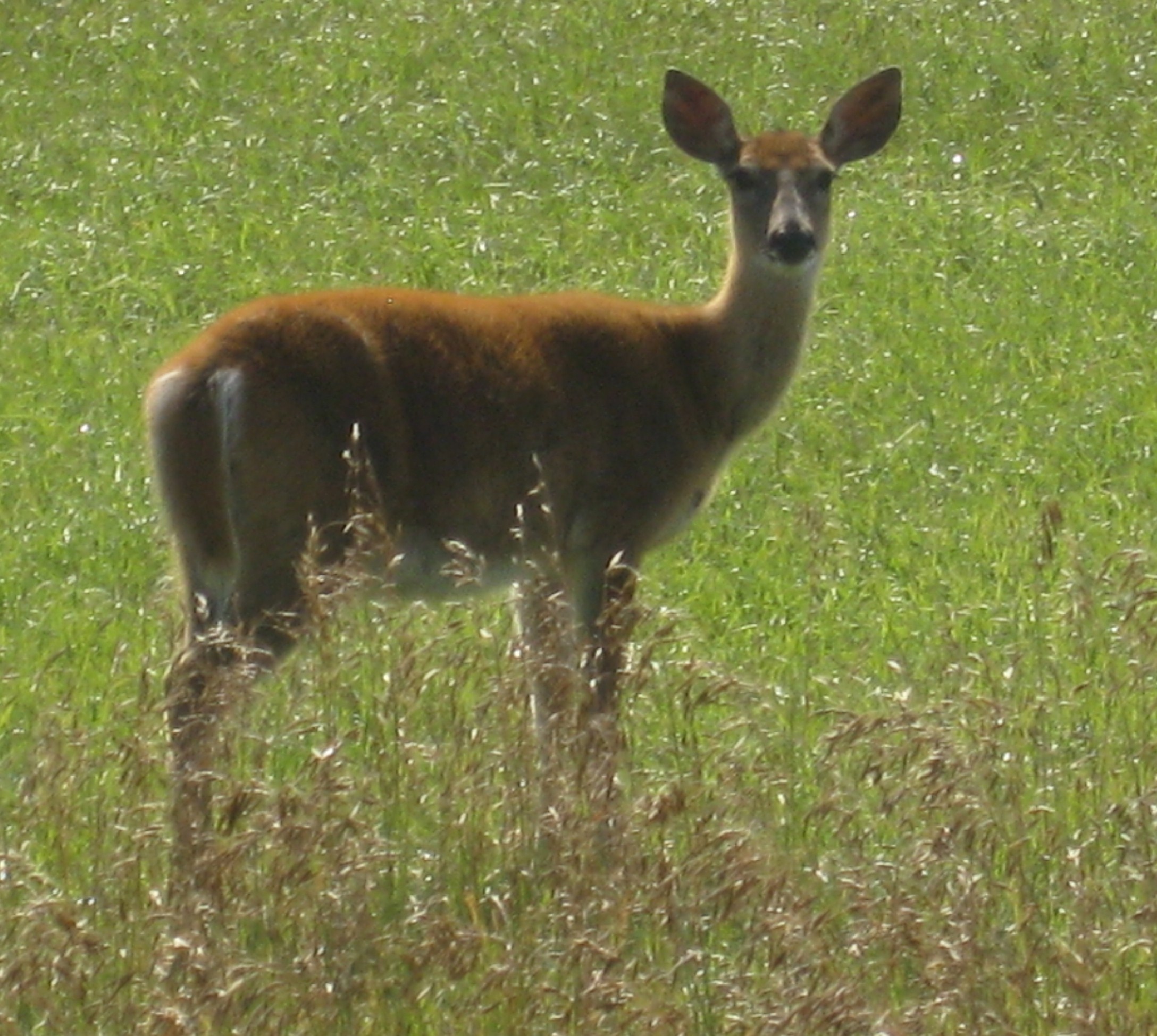
 A little later, after I retired to my RV to watch the show out my window, a deer came up and joined the turkeys. What fun. Chipping sparrows and cardinals dropped by later to glean the leavings.

At 120 miles long and 800 feet deep, Palo Duro is Texas’ Grand Canyon. Spectacular, but in un-Texas-like fashion only a miniature when compared to Arizona’s big ditch. It pains a Texan to admit this but as one who has seen both, I must tell the truth.

Like Georgia O’Keeffe, however, I found Palo Duro’s intensity stirring my soul.

Visitors to my camp site ... Photo by Pat Bean