Feeds:
Posts
Comments

 “It’s pretty hard to tell what does bring happiness. Poverty and wealth have both failed.” – Frank McKinney “Kin” Hubbard 
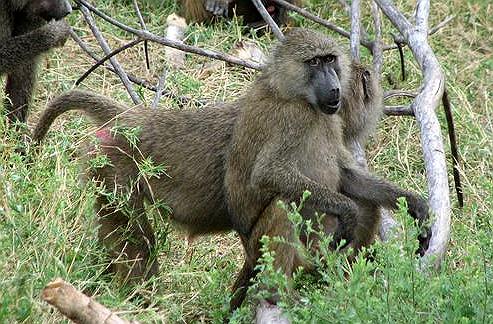
Baboons were a frequent sight on the outskirts of towns. -- Photo by Kim Perrin

African Safari: Ngorongoro to Tarangire

 Our morning drive with Bilal took us on a paved road for a change. It seemed, what with no apparent traffic rules, more dangerous than driving among the lions and other wild beasts. Our destination was Tarangire National Park.

 On the way we passed an overloaded bus – I never saw one that wasn’t – with a rhino painted on its rear and the message: “More money, more problems.” It started another one of those enlightening conversations with Bilal. I mentioned that while so many of the Africans we had seen had so very little, they seemed happy.

 “Why do you say that,” he asked.

 “Because they seem so cheerful and always have big smiles on their faces,” I replied.

 “Just because they smile a lot doesn’t mean happiness,” he said. His words gave me a lot to think about, and has changed the way I look at people.

I think of bananas as coming from South America, but Tanzania, Kim and I learned, has its share, too. -- Photo by Kim Perrin

 A bit later, in one of the small towns we passed through, Bilal stopped and bought some bananas from a roadside business run by women. “I like to support the women,” he said, “because they are often mistreated by men.”

 The bananas were good, and Bilal’s words had yet again endeared him to Kim and I.

 Then our attention was drawn to a couple of baboons making it in the middle of the road. We all laughed.

As I’ve aged, I’ve begun to think of laughter as a great indicator of happiness, especially the ability to laugh at oneself. But even today, four years after my conversation with Bilal, his words about smiles and happiness not meaning the same thing still lingers with me.
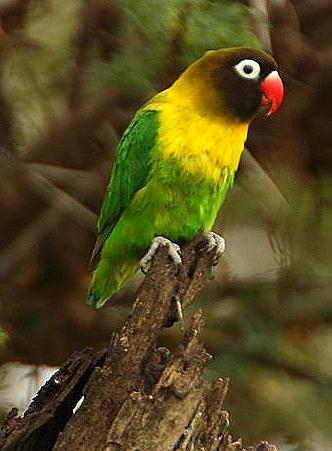
A yellow-collared lovebird photographed in Tanzania. -- Wikipedia photo

We stopped for lunch at a small tented lodge, where I had time to do a bit of birdwatching. The morning turned up four new life birds, including a yellow-collared lovebird that kept us company while we ate in a rustic dining room open to the outdoors.

 Bilal then picked us up for an afternoon game drive in Tarangire National Park, where we would have our most frightening encounter with wildlife of our entire safari. Stay tuned and I’ll tell you all about it next.

Bird Log of New Lifers: White-naped raven, pygmy falcon, white-bellied canary, blue=spotted wood dove, yellow=collared lovebird, Aug. 27, 2007, drive from the Ngorongoro Crater to Tarangire National Park.

“This life is yours. Take the power to choose what you want to do and do it well. Take the power to love what you want in life and love it honestly. Take the power to walk in the forest and be a part of nature. Take the power to control your own life. No one else can do it for you. Take the power to make your life happy.” – Susan Polis Schutz

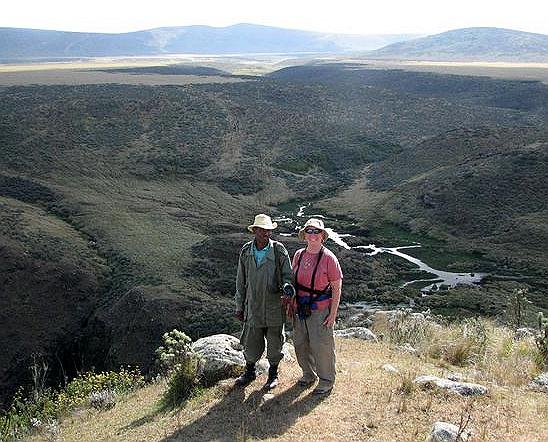
Our hike up the escarpment started in tall grass. Adrian, with his rifle, poses for a picture with me before we begin. -- Photo by Kim Perrin

African Safari: A Pleasant Afternoon Walk

This afternoon’s wildlife drive included a hike, a rare opportunity for us to to truly to get close to Africa’s landscape. Bilal was not happy about it. He had to stay with the Land Rover, and he kept telling us we didn’t have to go if we didn’t want to go.

Kim and I suspected he was nervous about trusting his two ladies to another guide, this time one armed with a rifle. I also suspected – since the hike was uphill to the top of the Ngorongoro escarpment for a view of the smaller next door Olmoti Crater – that he didn’t believe this old “mama” could make it.

Kim in front of one of the big trees we passed on the way up. -- Photo by Pat Bean

While I was admittedly slow on the steeper sections, we made it to the top in 50 minutes, 10 minutes short of the hour allotted to get up there. As a veteran hiker, I subscribe to the philosophy of just putting one foot in front of the other until you reach your destination, and as always it worked. .

The hike took us through tall grass, which had me thinking about snakes, and then into a forest of giant trees. The trees were awesome. As was the view from the top. And my body enjoyed the exercise after several days of bouncing around in our metal beast.

Our guide, Adrian, who seemed quite pleased to have two women to guard, asked if we wanted to hike down into the crater. Both Kim and I were tempted but decided against it. Kim was worried that Bilal would be worried, but I was more worried about the climb back up.

The view from the top was spectacular. -- Photo by Kim Perrin

It only took us 30 minutes going back down, where Bilal had our chariot waiting for us – and a welcoming smile.

Then it was more sight-seeing of birds, monkeys, buffalo, zebras and other wildlife – but still no rhinos – on our drive back to the lodge for another delicious dinner and a night of restful sleep in our soft, mosquito-netted beds.

Purple Passion: St. Louis Botanical Gardens -- Photo by Pat Bean

Pansies


 “…You praise the ones that grow today
  Here in the garden; had you seen the place
    When Sutherland was living!
       Here they grew,
        From blue to deeper blue, in midst of each
          A golden dazzle like a glimmering star,
            Each broader, bigger than a silver crown;
              While here the weaver sat, his labor done,
                Watching his azure pets and rearing them,
                  Until they seem’d to know his step and touch,
                    And stir beneath his smile like living things:
                      The very sunshine loved them, and would lie
                        Here happy, coming early, lingering late,
                          Because they were so fair.”
      – Robert Williams Buchanan

 “A journey is best measured in friends than in miles.” Tim Cahill

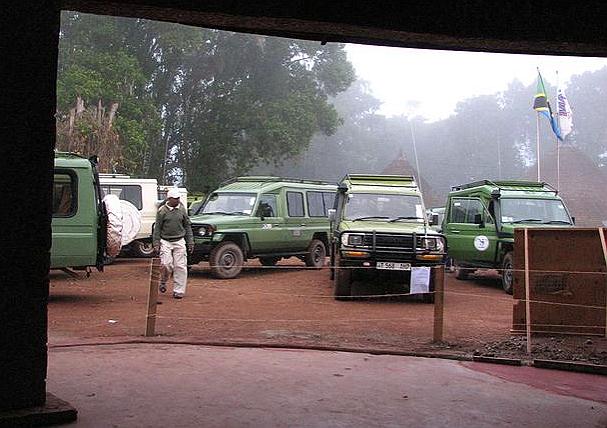
Morning pickup at the large Ngorongoro Sopa Lodge was somewhat of a traffic jam. -- Photo by Kim Perrin

African Safari

Our morning started early, supposedly with a packed breakfast. We thought Bilal would provide it, and he thought we were supposed to pick it up at the lodge before we left, which is the most likely.

Anyway, it was a day without breakfast, although thanks to another guide whom we met up with during a wildlife watching stop we did get coffee. He had brought some along for his two safari clients and was kind enough to share.

Zebras enjoying a patch of green grass in the crater. -- Photo by Pat Bean

His passengers were a delightful Irish couple, Des and Karen. Des had bought an African spear souvenir, and joked that he wanted to be able to protect his own woman and not have to depend on the guide.

The remark jogged my memory about Bilal’s comment about women guides, and so I asked his fellow guide what he thought about the idea.

Mom and young wildebeest. We would see a lot more in Kenya where most of the wildebeest had already migrated for the season. -- Photo by Pat Bean

“Oh they would be too scared,” he replied, echoing Bilal’s comment.

Karen, meanwhile, commented that Des actually bought the spear “to protect his beer from me.”

After we parted from our friendly interlude with the other safari team, Bilal began seriously searching for the rhinos that supposedly make their home in the Ngorongoro crater. I say supposedly because we never saw any.

Sacred ibis -- Photo by Steve Garvie

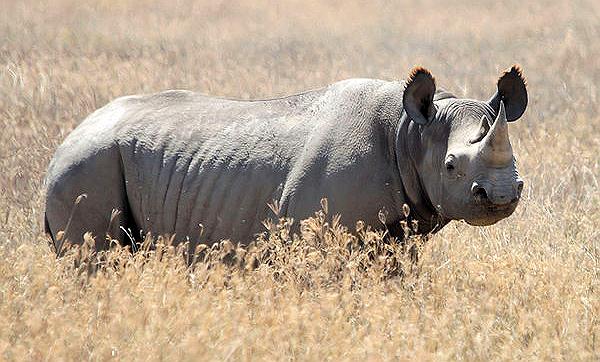
The crater is one of the very few places left in Africa where one can see black rhino, and the fact that we couldn’t find any brought home the fact that this species has been dwindling significantly in recent years.

Bilal, who kept muttering “no rhino” all morning seemed more disappointed than we were. He was on the radio frequently quizzing fellow guides in the area, but everyone it seemed no one was seeing any rhino .

One of the black rhinos in the Ngorongoro Crater that we didn't see. -- Wikipedia photo

But what we did see this morning included wildebeest, zebra, giraffe, elephants, hyenas, lions, buffalo and jackals. The latter always came in pairs with one leading and one following. Bilal said the female is always in front.

“She leads the male.”

The morning’s drive also turned up another nine life birds for me, as well as a lot of those I had already seen. Some of my new birds were now becoming old friends that I recognized on sight without the help of my bird field guide. That make me feel good.

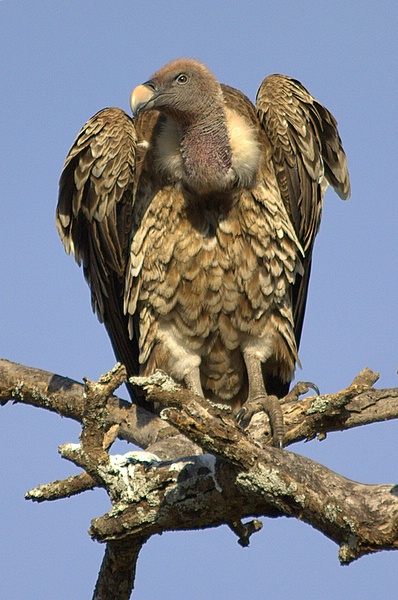
Ruppell's griffin vulture -- Photo by Rob Schoenmaker

Bilal, however, was still bemoaning the lack of any rhino sighting when he dropped us off for lunch back at the lodge. I don’t remember what we had, except that it was good and Kim and I ate enough to make up for our skipped breakfast.

Bird Log of New Lifers: Rufous-tailed weaver, grey-crowned crane, black-bellied bustard, chestnut-bellied sandgrouse, Ruppel’s griffin vulture, sacred ibis, black-headed heron, wattled starling, and common stonechat. Aug. 26, 2007, Ngorongoro Crater.

Coke from the bottle is how we were always served it in Africa, and it tasted so much better than it ever did in America. -- Photo by Kim Perrin

All the pathos and irony of leaving one’s youth behind is thus implicit in every joyous moment of travel: one knows that the first joy can never be recovered, and the wise traveler learns not to repeat successes but tries new places all the time.” – Paul Fussell

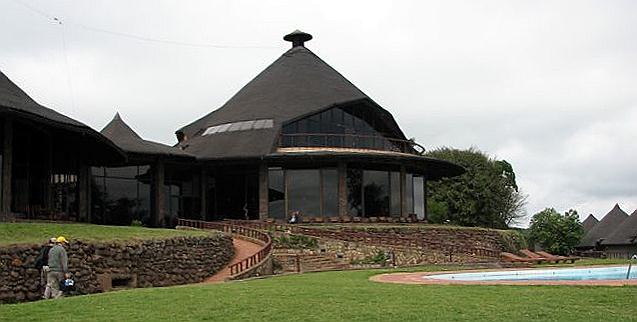
Ngorongoro Sopa Lodge's main building. Our suite was at the end of a long row of rooms barely visible on the right. -- Photo by Kim Perrin

African Safari:

Besides having a marvelous morning visiting the site where human life may have begun, and dancing with the Maasai women in the afternoon, I still had time to watch for birds – and to add another dozen birds to my life list.

Bilal was happy because I had seen more than the 100 new life birds that he had promised he would find for me. Of course I was pleased, but I kept telling him I wanted 200.

“No, no,” he said. “I only promised 100.”

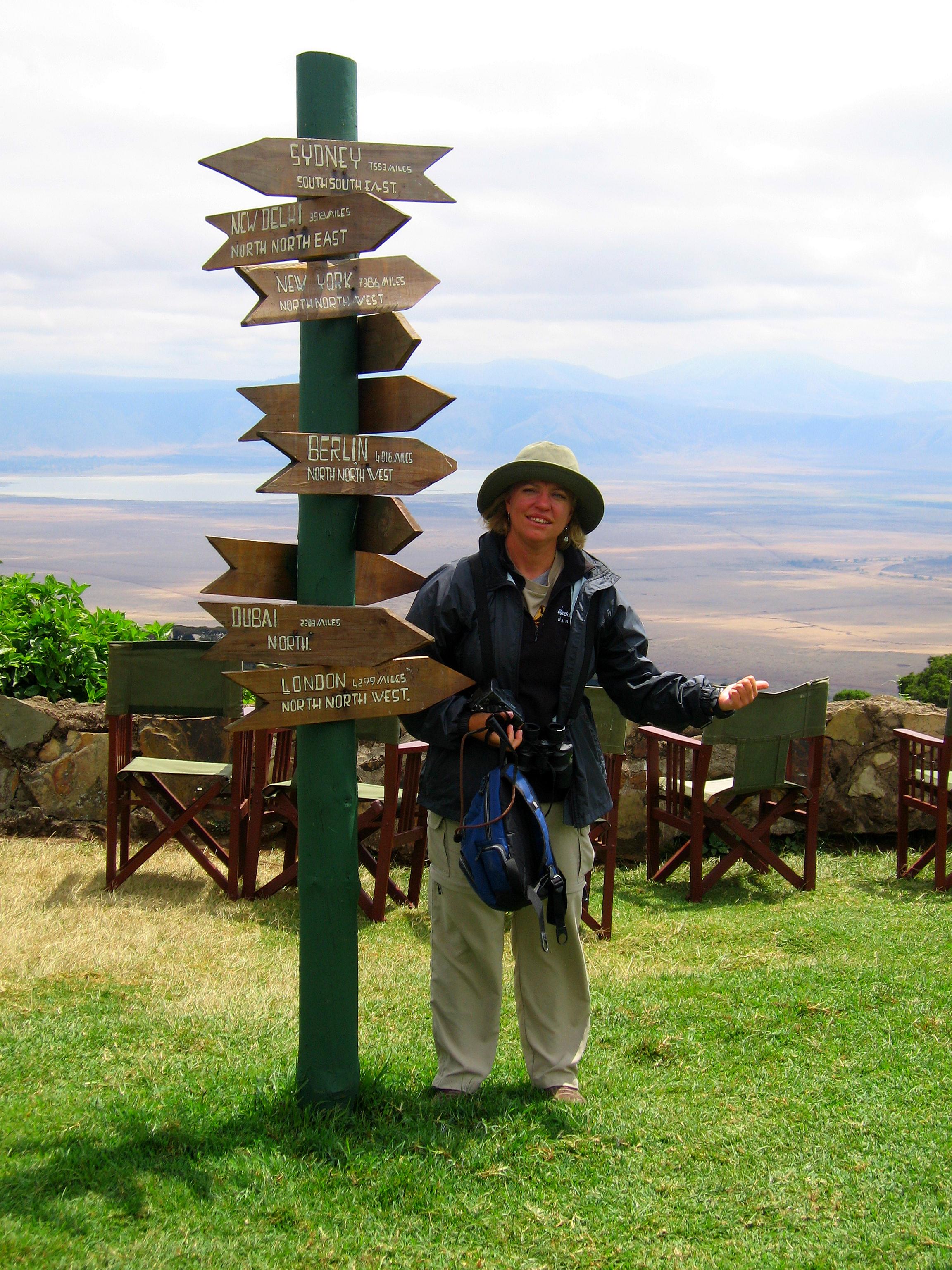
Kim hamming it up in front of a mile-marker on the lawn of the Ngorongoro Sopa Lodge that overlooks the Ngorongoro Crater and its vast herds of wildlife. -- Photo by Pat Bean

. We ended our day at the Ngorongoro Sopa Lodge, which sat on the rim of the Ngorongoro Crater, with each of its suites having a glass-enclosed porch for wildlife watching.

We were told when we arrived at the lodge that buffalo were in the area and that we shouldn’t wander. As an extra precaution, a guard walked us to and from our rooms. His weapon, however, was just a thick night stick. Kim and I saw only two guns our entire stay in Africa.

As we did each night, we dressed for dinner, and had a nice rum and Coke to go with it. The Cokes, which came in bottles, were much better tasting than the ones we get in America. While we never had more than a couple of selections of meal choices, I was never served anything I didn’t like.

Cardinal woodpecker

 Of course we were not eating standard African fare. The five-star luxury lodges that were part of our arranged safari had gourmet cooks I’m sure. Dinners always began with a delicious soup, then a main entree that was often beef, and usually something chocolate for dessert.

It was a far cry from the bologna sandwiches, faded canvas tent and quilt sleeping bags that were part of my very first traveling adventures.

Bird Log of New Lifers: Northern anteater chat, yellow-rumped seedeater, black-lored babbler, Kendrick’s starling, common drongo, cardinal woodpecker, grey-headed sparrow, Speke’s weaver, green-capped eremomela, white-throated robin shining sunbird, cape robin chat, Aug. 24, 2007, Serengeti and Ngorongoro Crater.

 “No journey carries one far unless, as it extends into the world around us, it goes an equal distance into the world within.” Lillian Smith.

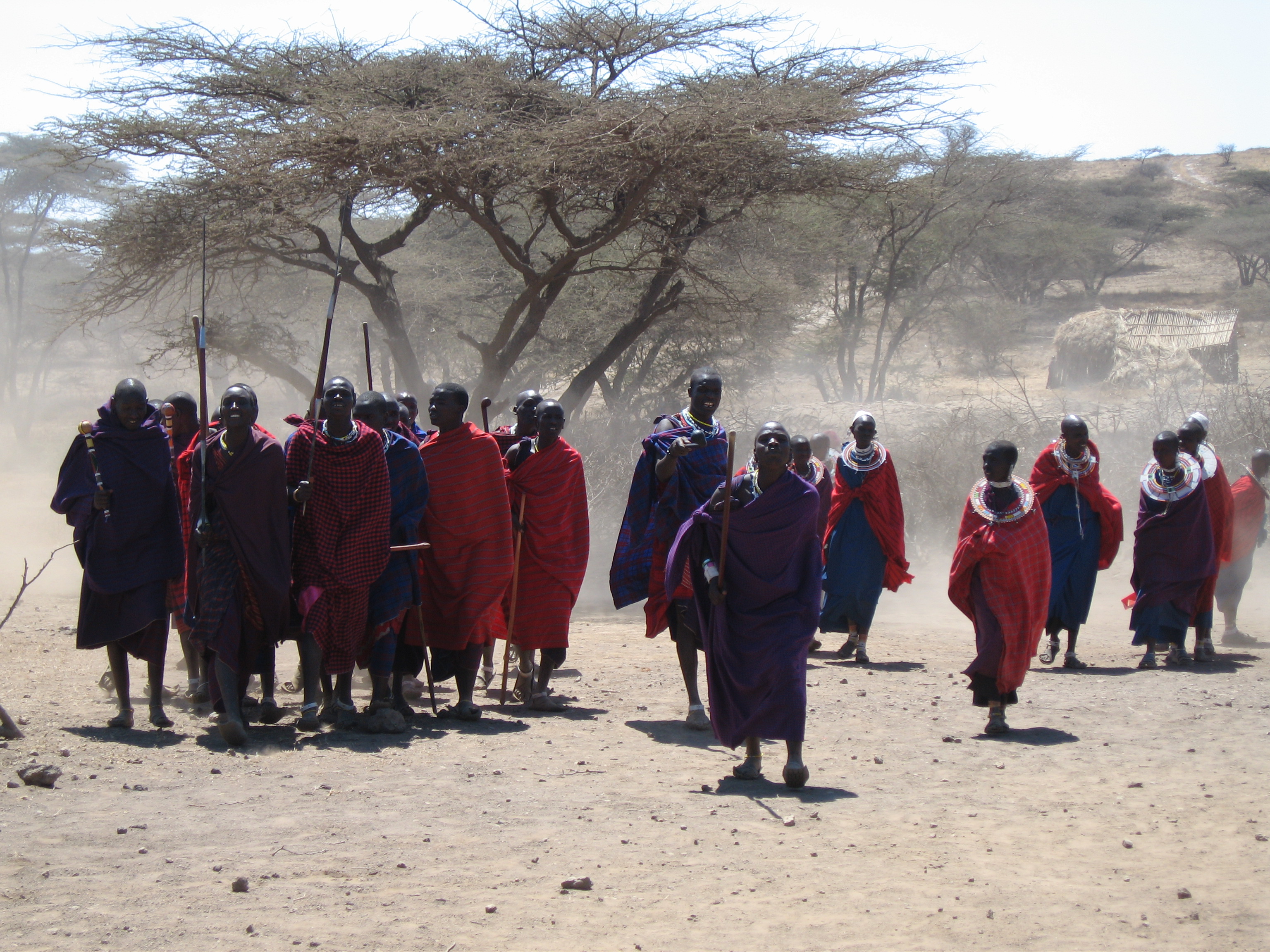
A Maasai community -- one set up to show tourists how the Maasai live -- welcomed us with a dance. -- Photo by Pat Bean

African Safari :

There’s a scene in the 1962 John Wayne movie, “Hatari,” in which co-star Elsa Martinelli, dances with Maasai women. In the dance, the women jump up and down making their wide, bead collar necklaces bounce.

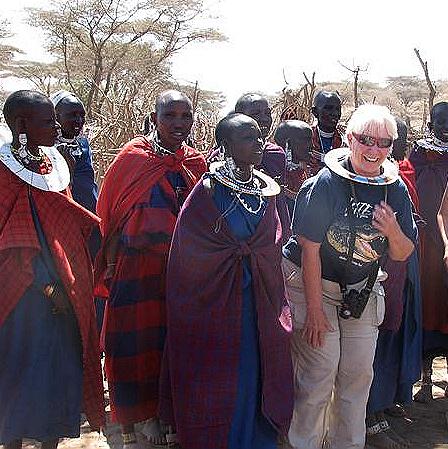
Graceful I was not, but one of my best memories of Africa was getting to dance with my Maasai sisters. -- Photo by Kim Perrin

I had long thought that would be a fun thing to do. In what was pretty much a recreation of the movie scene, Kim and I watched a group of Maasai women dance and jiggle their bead collars for us when we visited a model Maasai community as part of our guided tour activities. .

The native leader of the small group, which lived in traditional, dark, dung and twig huts built by the women behind a barricade of thorn bushes to keep out wild animals, asked if someone wanted to dance with them. And then he approached Kim.

I was crest-fallen because he hadn’t approached me. .

But Kim, who has never been quite the ham that I am, shook her head and stepped back. Before he could ask anyone

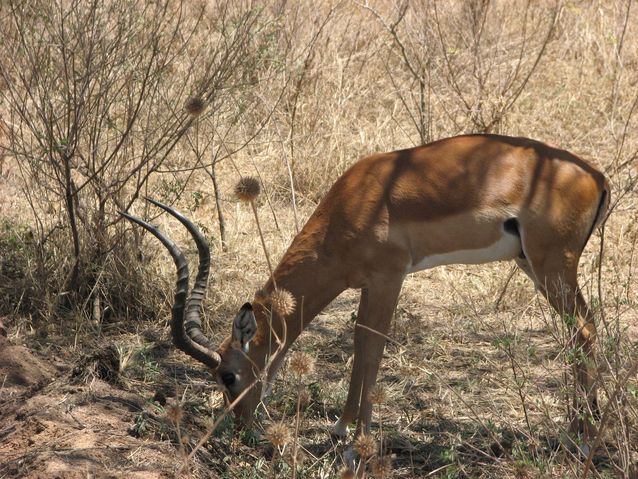
An impala quietly grazes near the Maasai village. -- Photo by Kim Perrin

else, I eagerly stepped forward and volunteered.

What had looked so easy watching the women get that necklace bouncing wasn’t easy at all to accomplish. My collar ornament barely moved at all.

But then the beautiful bald-headed woman standing next to me gave me a quick lesson, and soon my necklace was bouncing up and down, too – although not with quite the rhythm and grace as those of my African sisters.

After the dance, I bought one of the collar necklaces that was handmade in the village by one of the women. It was the only souvenir I bought for myself on the entire trip.

It was such moments as dancing with the Maasai women, along with watching a leopard stalk a gazelle, adding new birds to my life list, and gazing at Africa’s amazing sunsets at the end of a long day, that drilled a piece of Africa into my heart.

That piece, now four years old, is still there and shining bright with memories.

Weekly Photo Challenge

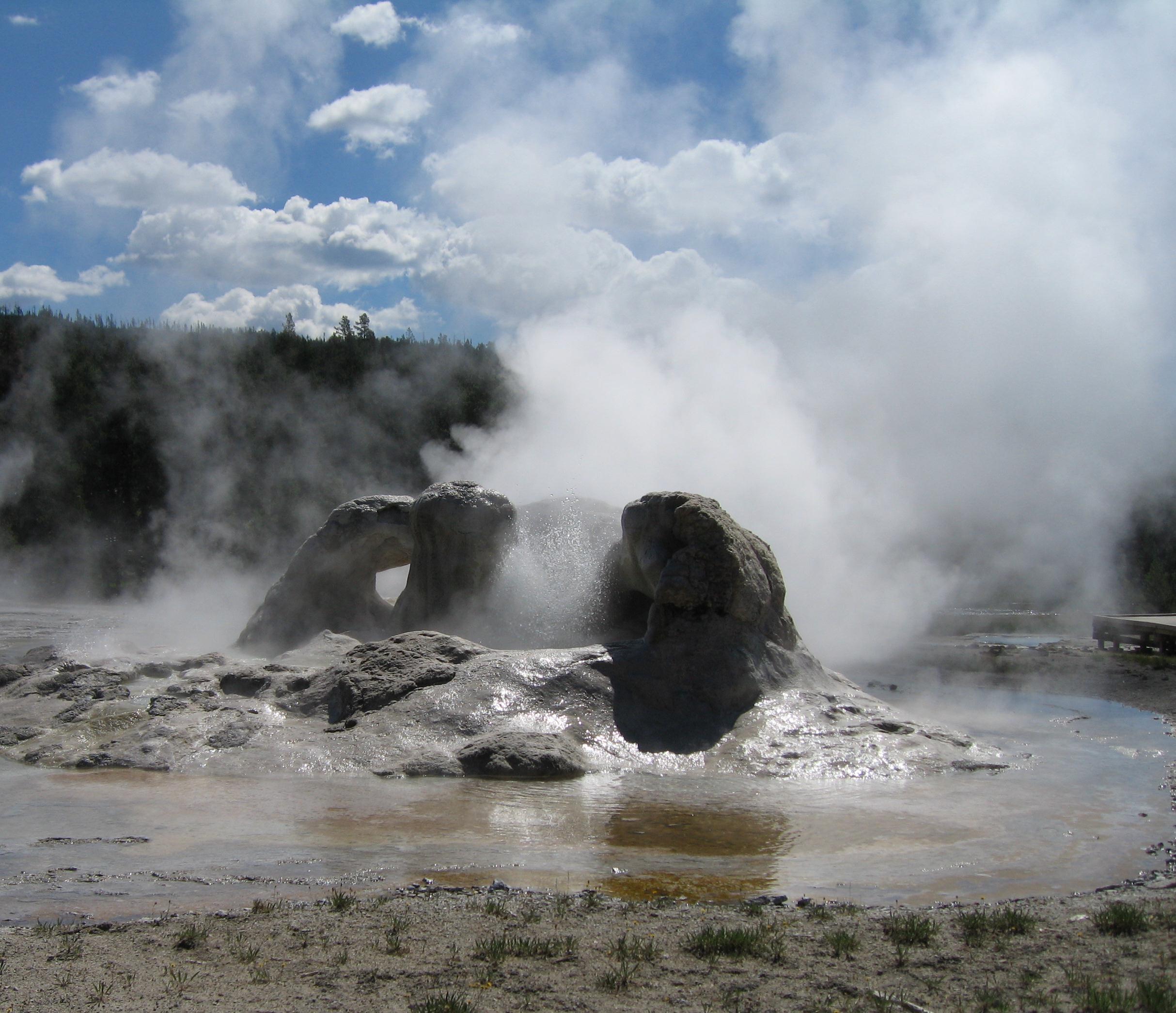
Earth's hot breath: Grotto Geyser in Yellowstone National Park -- Photo by Pat Bean

 “Earth leaps like a geyser for those who drill through the rock of inertia.” Alexis Carrell

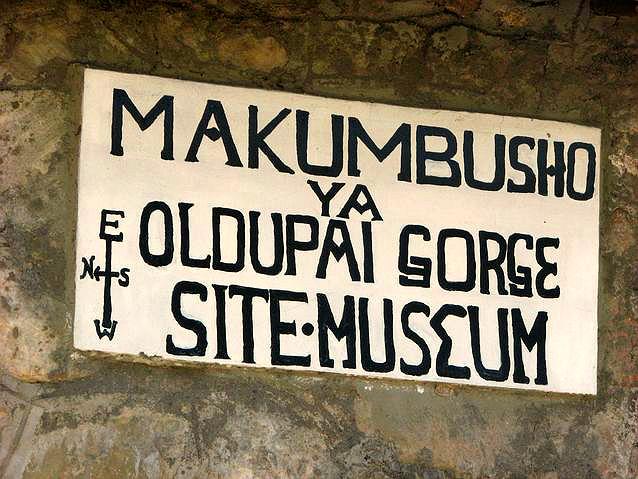
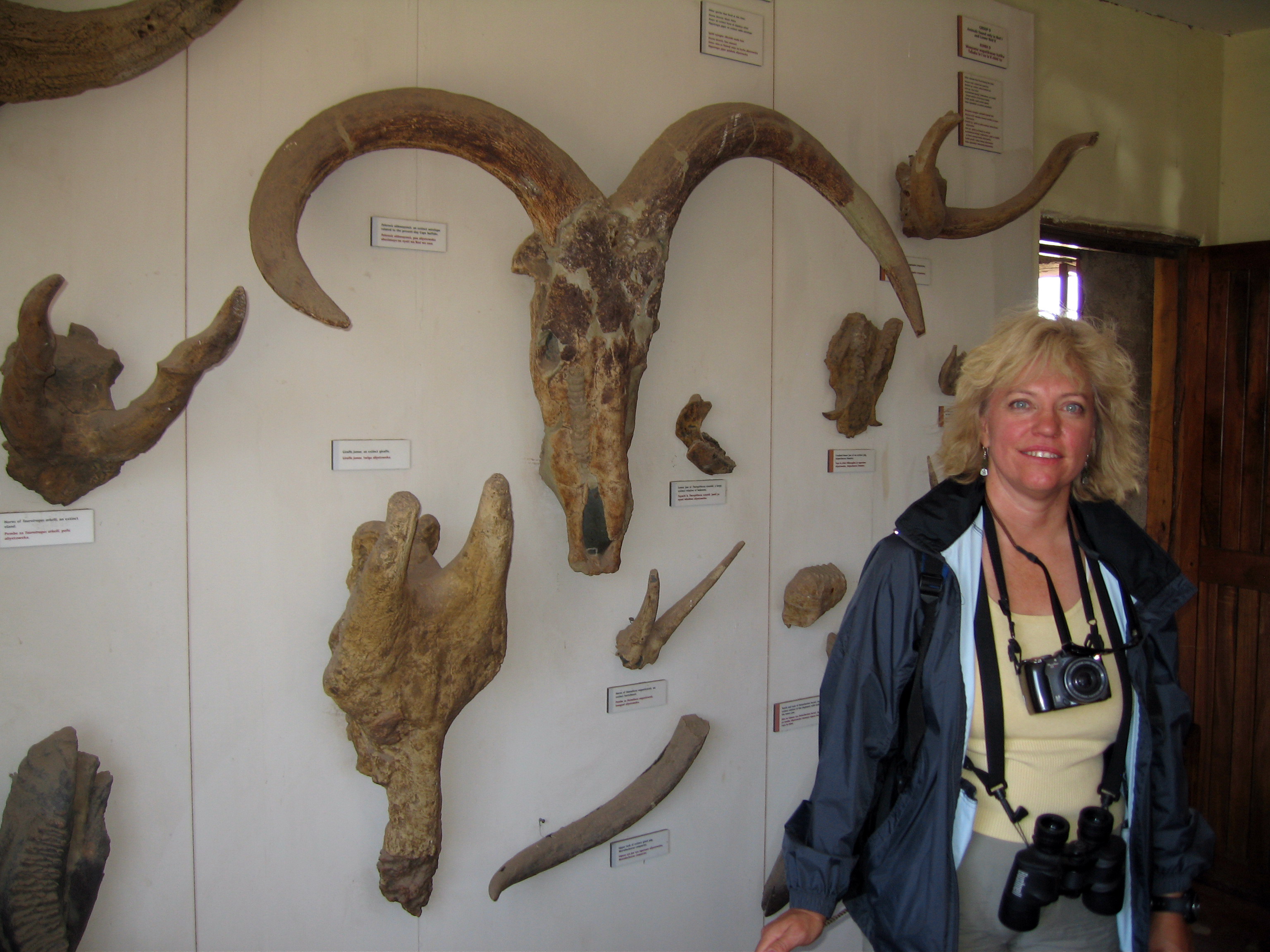
Museum sign

 “We are the only beings on the planet who lead such rich internal lives that it’s not the events that matter most to us, but rather, it’s how we interpret those events that will determine how we think about ourselves and how we will act in the future.” Anthony Robbins

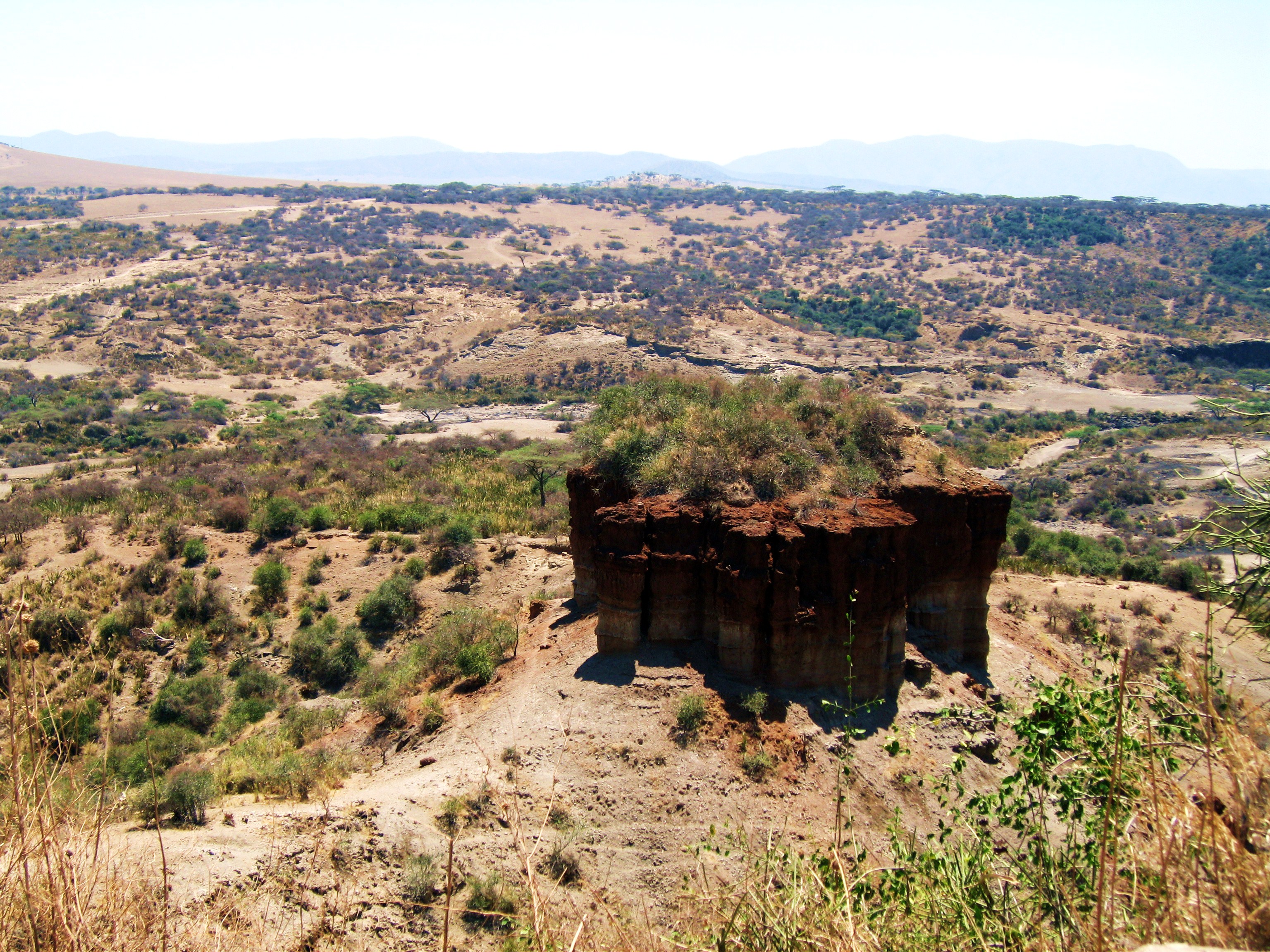
The monolith in Oldupai Gorge, the view behind the young man who told us the story of the landscape here. -- Photo by Pat Bean

African Safari: A Place of Beginnings

Places call to me. Africa called twice. The second call was for the wildlife safari adventure Kim and I enjoyed for two weeks in 2007, which also answered the first call.

I had long had a desire to see Africa’s Great Rift, where human life is thought to have begun. I had read much about the anthropology discoveries of Mary and Louis Leaky in Oldupai (also called Olduvai) Gorge in Tanzania, and wanted to see this place for myself.

The rift, a continuous geographic trench, stretches across Africa for over 3,000 miles, but the section in Tanzania’s Ngorongoro Crater is where the most important discoveries about our human beginnings have been made.

It was why, of the many safari choices offered of Africa, I had chosen the one that brought us to Tanzania.

And now I was here, looking out over the spot where in 1975 Mary Leakey had discovered a series of footprints showing our pre-human ancestors walking upright over 2 million years ago. .

Kim standing in front of some non-human remains found in Oldupai Gorge. -- Photo by Pat Bean

I even got to see a replica of these footprints in the small Leaky Oldupai Museum – after listening to a young man, whom I assumed was an anthropology student, explain the wonders found in this landscape.

I could hardly understand his heavily accented English, but it was accompanied by a theatrical performance that filled in the details of the words I missed. It was one of the most unusual, and delightful, lectures I ever sat through.

It was given on a high overlook of the gorge, beneath a thatched shelter for shade, looking out at

landscape that once was a lake. The lake was covered by a succession of volcanic ash; then, about a half million years ago, seismic activity diverted a stream that cut down into the sediments, revealing seven layers of the past. In doing so, it created an awesome research lab for the Leakeys and other anthropologists.

The site was used as the first monolith in the movie “2001: A Space Odyssey.” And the small Oldupai Museum here reminded me of those one used to find, and occasionally still does, while traveling across America on Route 66.

It’s both strange and wonderful how all of life seems to connect.

 “It’s a strange world of language in which skating on thin ice can get you into hot water.” – Franklin P. Jones

Duma -- Photo by Pat Bean

African Safari: The Power of Words  

In Swahili, the national language of both Kenya and Tanzania, the word for hello is jambo. It was a word we heard frequently, and one we spoke in reply, accompanied by a nod of the head.

I liked the word, and the acknowledgment of human recognition it implied between two people who did not speak a common language.

But on our third morning in Africa, one polite man used two words in greeting me.

“Jambo mama,” he said. Then turned to Kim and simply said: “Jambo.”

I asked Bilal later what that was all about. And he said “mama” was a term used to show respect to elders. While my vanity was a bit hurt, the respect offered me was appreciated. After that Bilal started calling me Mama, too, while Kim remained Kim.

I guess she couldn’t help it that she was 21 years younger than me and still a “hottie.”

Another Swahili word I was already familiar with was simba, meaning lion.


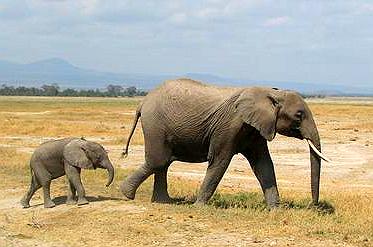
Big tembo and little tembo -- Photo by Kim Perrin

Other than those three words, Bilal’s radio conversations in Swahili while talking to other guides out in the field, was a lot of mumbo jumbo, which is a good old English phrase for confusing and meaningless.

Since all our guides spoke excellent English, I never had any reason to use any of the other Swahili words listed in my African travel guide, such as:

Duma, meaning cheetah

Twiga …giraffe

Impala … swala

Elephant … tembo

Kiboko -- Photo by Pat Bean

Mister … bwana

Hippopotamus …  kibuko

Rhino … kifaru

Then there is choo, the word for toilet, and chui, the word for leopard.

I already have a Texas twang that can sometimes be misunderstood, so I can easily imagine myself mispronouncing these two words, and telling someone that I had to use the leopard.

The Swahili word for beer, meanwhile, is prombe.  Kim and I, however, learned to call it Tuskers.


 “There is just something spectacular about seeing wildlife in its natural environment that thrills us … Arun Kejriwai

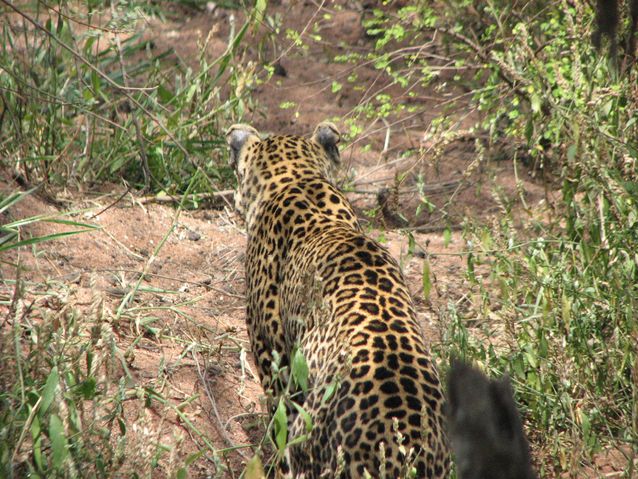
We were too late to catch our leopard up in a tree, but I couldn't resist sharing this Wikipedia photo of this magnificent one out on a limb.

African Safari: A Day to Remember

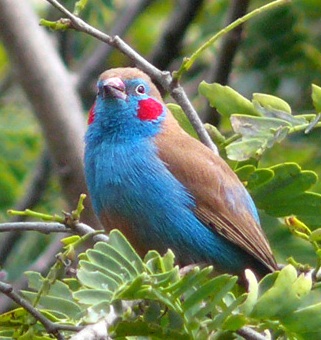
I welcomed my first morning in the Serengeti from the balcony of our spacious Sopa Lodge suite, breathing in Africa’s morning light that left me eager to start the day. Red-cheeked cordon bleus – what a strange name for a bird – welcomed the morning with me.

After breakfast, and more great African coffee, Bilal picked Kim and I for a full day of wildlife viewing.

Red-cheeked cordon bleu

The day’s fantastic wildlife started as we exited the lodge compound’s gate – beginning with a green wood- hoopoe (another strange bird name) and a troop of baboons that included several babies being lugged around on an adult’s back – and never let up.

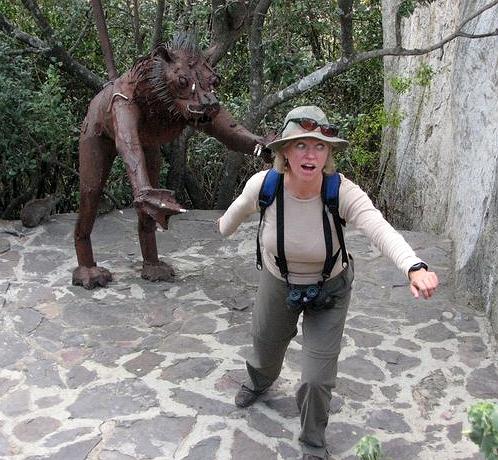
We saw impalas, water buffalo, hippos, lions, cheetahs, ostriches, dik-diks, zebras, wildebeest, Nile crocodiles and of course many species of birds – all before we stopped for a nature hike in a developed tourist area where the wildlife were sculptures, well except for the monkeys, one of which tried to steal Kim’s box lunch.

Kim being funny during our nature walk among the wildlife sculptures. -- Photo by Pat Bean

After lunch, I wandered around doing my usual bird hunting until Kim came rushing up telling me to come quick.

Back at the Land Rover, Bilal said “Come on mama,” and then we were off on yet another wild ride.

This time we were racing toward a leopard sighting, which Bilal had learned about while talking Swahil on his radio with other guides. We weren’t the only racers. Only about one in five visitors to Tanzania are lucky enough to see a leopard, we had been told.

Our leopard intently watching a Grant's gazelle. -- Photo by Kim Perrin

It was like a traffic jam at the sighting site when we got there, and learned the leopard had just jumped out of a tree and disappeared.

Then suddenly, as all binoculars were turned toward the distant landscape trying to find the animal, it walked right in front of our Land Rover. Our spot in the traffic turned out to be the best one for leopard watching.

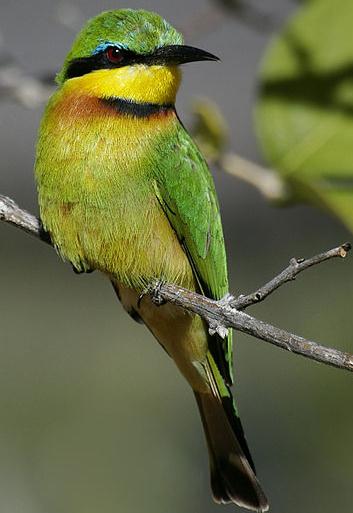
Little bee-eater

Ignoring all the human fuss going on around it, the leopard stayed in the area for the next 30 minutes or so, patiently stalking a Grant’s gazelle. The gazelle finally spotted it, however, and was off and running, while the leopard simply slunk out of sight.

For once, I forgot to look for birds.

Bird Log of New Lifers: Red-cheeked cordon bleu, green wood-hoopoe, red-billed oxpecker, spotted redshank, brown snake eagle, lilac-breasted roller, black crake, sooty chat, blue-capped cordon bleu, speckled-fronted weaver. Verreaux eagle owl, Hilderbrandt’s starling, speckled pigeon, grey-capped social weaver, purple grenadier, lesser masked weaver, wood sandpiper, yellow-breasted apalis, white-headed vulture, hoopoe, little bee-eater, white-bellied bustard, bare-faced go-awaybird, white-browed coucal, Aug. 24, 2007, Serengeti National Park, Tanzania.

Next: Swahili