Feeds:
Posts
Comments

Archive for the ‘Birds’ Category

“I think we are bound to, and by, nature. We may want to deny this connection and try to believe we control the external world, but every time there’s a snowstorm or drought, we know our fate is tied to the world around us.” Alice Hoffman
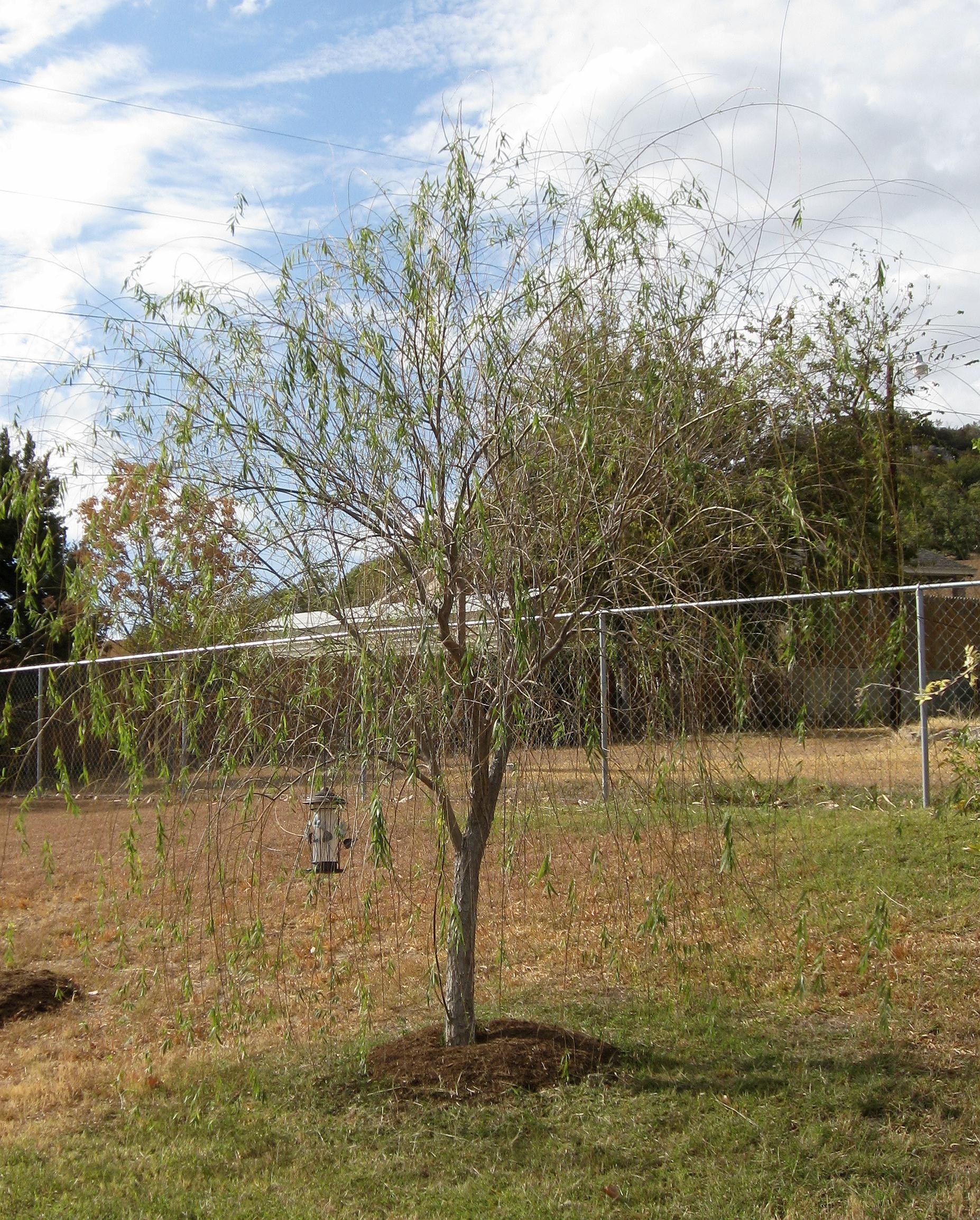
This isn't how a willow tree is supposed to look. -- Photo by Pat Bean

Travels With Maggie

From the heights of the morning’s glorious Texas sunrise, my first since mid-April, my journey to just north of Austin descended into horrifying reality of the drought the state has been suffering.

The sights hit me especially hard when I left Interstate 10 to follow Highway 190 for over 200 miles.

The scorched earth, brown and dying cedar trees, total lack of grass and yellow and stunted cactus were hard to stomach.. While I had been luxuriating beside a lake enjoying a mild Idaho summer, my native Texas had been suffering record temperatures without rain.

My Texas family had frequently informed me that this was so, but seeing it still broke my heart, especially when I saw skinny deer wandering the roadside huddled around one small patch of grass. It was very close to the road, and the deer stayed nearby instead of scampering away as my RV approached.
Laughter is not a bad thing when faced with hard times.

It made me glad I was traveling a lonely stretch of highway, especially since a bit farther on I passed two deer that had given their life for staying too close to the road. The turkey vultures seemed to be the only ones prospering on the landscape.

At my oldest son’s home in Harker Heights, I found his usual green lawn brown, and the limbs of the vibrant willow tree in his back yard scantily clad. And today, the water pipes buried in his front yard sprung a gigantic leak.

“It’s happening a lot all over the place,” said the plumber, who was too busy to come until the next day. As the landscape dries, it shifts around, often breaking things in the process.

Even Maggie noticed how things were different. A bit of a tenderfoot, she found the stiff dry grass on the edges of the road we walked not to her liking.

I watched as she carefully place one paw down, and then looked for a softer spot to place her next step. When she didn’t find it, she quickly came back onto the paved road to continue our evening walk.

In some places, this beautiful lantana plant is considered an invasive weed. It looked awfully good to me, however, when all else was suffering from the drought. -- Pat Bean

My daughter-in-law, meanwhile, has still managed to maintain a bit of color around their house. Her backyard flower bed , filled with what she called hardy plants, hinted that all was not lost.

 As I looked out on them this morning, I saw house wrens playing among the blossoms, while bright cardinals, finches, mockingbirds and sparrows visited the yard as well.

. I think they liked the color, too. And perhaps the bird feeders scattered about the yard as well.

Read Full Post »

 “Sometimes it’s important to work for that pot of gold. But other times it’s essential to take time off and to make sure that your most important decision in the day simply consists of choosing which color to slide down on the rainbow.” Douglas Pagels

Travels With Maggie`

A walk around Silverbell Lake helped clear the cobwebs from my crowded brain. -- Photo by Pat Bean

Life caught up with me this past week. Too many miles in not enough days, too many amazing sights and not enough time to linger among them, and only three days to enjoy loved ones before I’m back on the road.

My preferred style of travel – no more than 150 miles a day with a couple of days sitting in between – has been blown to hell in a hand basket, the same one my grandmother said would take me there if I didn’t shape up.

Something had to give. And it did. I stayed off my computer and missed two days of daily blogging.

Instead, I lazed around my youngest daughter’s Tucson home, took Maggie for short walks, enjoyed the company of three grandsons, hiked around Silverbell Lake while everyone else fished, read a lot, and watched the turkey vulture and red-tailed hawks soar above, and doves, rock wrens, curved-bill thrashers, gila woodpeckers, northern flickers and rabbits play among the saguaro cactus.

My daughter, Trish, lives on the outskirts of the city and coyotes and bobcats often visit, she said. As do quail that usually trot past their back porch daily.

My son-in-law, Joe, described them for me, and I suspect they’re Gambel’s quail, although they could just as easily be California quail. Both species have the C-shaped plume dangling forward over the front of their heads.


A landscaped yard without grass. Drought-stricken area residents should take note. -- Photo by Pat Bean

I haven’t seen them yet. I think they’re taking a break from their daily routine – like me.

It’s back on the road tomorrow. I’m heading to Texas’ Gulf Coast and a grandson’s wedding. It will be another four days of 300-mile a day drives, although thankfully, well except for the first 50 miles, it will not be freeway driving.

Interstates were something I could not avoid for two entire days on my way from Yosemite to Tucson. It made me never want to go back to California, that and the fact I was paying $4.15 a gallon for gas there. The cost immediately dropped to $3,39 a gallon once I crossed the border into Arizona.

I’ll post pictures nightly of my next four days of driving so you can enjoy the road with me. Just don’t expect me to be too wordy. I’ll save those for later when life has once again slowed down.  


Read Full Post »

“Morning is when the wick is lit. A flame ignited, the day delighted with heat and light, we start the fight for something more than before.” Jeb Dickerson 

One of the two northern flickers that visited me just as the sun was coming up this morning. -- Photo by Pat Bean

Travels With Maggie

My morning began at 5 a.m. with a phone call when I was still deep asleep, By the time I stumbled out of bed and figured out where my phone was – in the cab beneath my RV’s upper bunk – it had stopped ringing.

After crawling back into bed and snuggling back beneath the covers because it was quite a chilly morning here in Pendleton, Oregon, where I’m parked in the farmyard of a friend’s mother, I hit the redial button.

It was my daughter-in-law, Cindi, in Texas who rang to tell me the books I had ordered from Amazon had arrived. They included Susan Albert’s “Bleeding Heart,” the next in the China Bayles’ books I’m reading and one that hadn’t been available on Kindle.

A much better look at a northern flicker, this one a male. -- Photo by Joanne Kamo

I said, perhaps a bit snippy: “It’s o-dark-hundred here. I’m in the Pacific time zone and two hours earlier than where you are.”

“Oh,” she responded. But then of course we chatted for a while. I couldn’t be too angry because she’s my traveling guardian angel and has handled all my mail for the past seven years. .

After we hung up, I tried to go back to sleep, but unlike my dog, Maggie, who never even lifted her head at the phone call, sleep had vanished for the day. So I got up, fixed coffee and sat down in front of my computer, alternating between answering e-mails and watching the day arrive out my window.

I was rewarded with a pair of northern flickers messing around a tree near my RV. I tried to get a picture, but it was dark and my photo turned out poorly. I thought you might want to see it anyway, but I added a photo taken by Joanne Kamo  http://www.pbase.com/jitams to give you a better look.

Meanwhile, I did enjoy watching the pair of large woodpeckers – that’s the family to which northern flickers belong. They stayed around for quite a while poking around the tree, and sticking their heads into a couple of holes it contained. If Cindi hadn’t called I would have missed them all together.

Life’s like that. It throws you a curve ball, then apologizes with a slow pitch you can’t miss.

Read Full Post »

 “There are two lasting bequests we can give our children. One is roots, the other is wings.” Hodding Carter.

Bald Eagle in Baytown, Texas. -- Photo by Joanne Kamo

Travels With Maggie

I spotted a bald eagle yesterday. It was just outside the park hanging around the Snake River below the Minidoka Dam in Southern Idaho.

It’s a bird that always makes my heart beat a little faster. It was sitting up on a utility pole, then flew away to the other side of the river as I passed by.

I don’t know whether it was an early migrant from Alaska, where huge numbers of eagle spend the summer, of if it was one that had stuck around the area for the entire year. There’s always a few that do.

It really didn’t matter. Either way it was a magnificent sight. It’s pure white head caught the sunlight as it flew across the water and my breath ceased for a few seconds. The bird’s brilliant white head feathers indicated it was at least four years old. Before that age, bald eagles are ratty brown all over.

Of course there wasn’t time for me to get a picture, as if I even could take a decent shot of a moving target. So I turned to Joanne Kamo’s online art gallery http://www.pbase.com/jitams to illustrate my blog. Joanne, whose bird photos are among the most awesome I’ve ever seen, has given me permission to occasionally use one of her copyrighted pictures. She didn’t fail me.

While bald eagles are beyond my photographic capabilities, even I can take a decent picture of a wild turkey, such as this one in Palo Duro Canyon State Park in Texas. -- Photo by Pat Bean

Her bald eagle photo took my breath away as quickly as did the real thing. If it doesn’t also cause you to gasp in delight, you’re as cold-hearted as a glacier and not someone I care to meet.

The sight of yesterday’s bald eagle made me grateful Ben Franklin didn’t get his way in having the wild turkey be our nation’s symbol. He thought the bald eagle was too much of a thief to represent our country.

I know he was right because I was once privileged to watch a bald eagle snatch a freshly caught fish from an osprey as it flew. The osprey was so frustrated that it chased the eagle until it came to its senses.

But the bald eagle today is also a symbol of what’s best in humankind. These birds were on the verge of becoming extinct when we Americans acted. Since the passage of the Endangered Species Act in 1973, bald eagles have regained healthy populations.

Sightings of them in the lower 48 states are becoming more common. And so I wish you good luck in having one of them fly your way.

Read Full Post »

It may be hard for an egg to turn into a bird. It would be a jolly sight harder for it to learn to fly while remaining an egg. We are like eggs … We must be hatched or go bad.” C.S. Lewis

Travels With Maggie

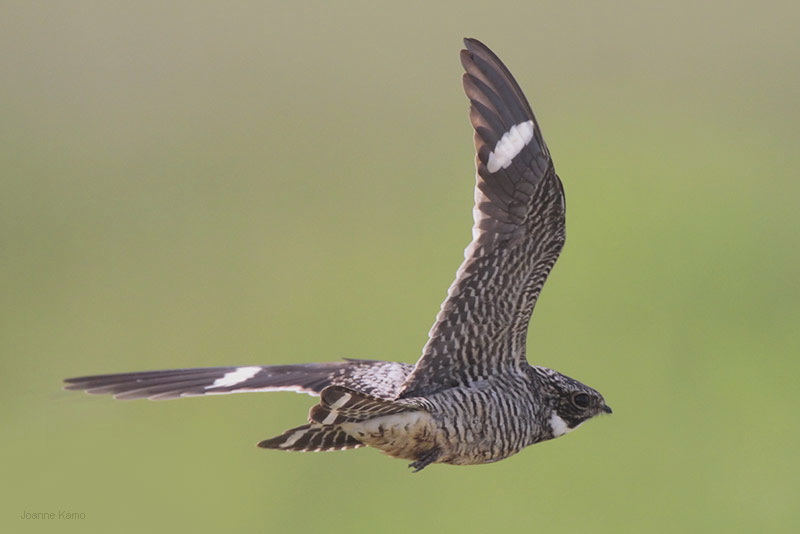
Common nighthawk -- Photo by Joanne Kamo, whose many other wonderful bird photographs can be seen at http://www.pbase.com/jitams

I try to time my last walk with Maggie so that it ends just as the sun goes down so as to catch the sunset. The days, in my opinion, are best when they begin with a sunrise and end with a sunset.

But late evening is also the time of day here at Lake Walcott State Park in Southern Idaho when the nighthawks come out to feed. For a kettle of common nighthawks that regularly takes place over the campground where my RV, Gypsy Lee, is parked.

They dine in the air on the many insects that also call this small park home. It’s always a treat to see them. Not only are they awesome to watch, my brain knows that every bug they eat is one that won’t bite me.

A fellow lone-female traveler, not a birder, who stopped by recently to visit me, asked what the birds flying overhead were as we shared our evening walk.

Common nighthawks, I told her. Then pointed out how to easily recognize them when in flight.


Common nighthawk -- Photo by Joanne Kamo

About the size of a robin, these birds have long, forked and pointed wings with a distinctive broad white bar about a third of the way up from the tip of the wing. The white bars are very prominent.

“Do they always fly that low,” she asked, as a couple of the birds zoomed in front of us at about head level.

“Nope. Usually they fly much higher,” I replied. “I guess the bugs are flying low tonight.”

The first time I saw these birds, whose large heads seem to lack a neck, they were flying even lower, however. I was fairly new to birding at the time, having only become addicted to the passion in 1999. The life sighting occurred while I was walking a trail at the Arizona-Sonora Desert Museum, where they were flying low over a small pond.

After watching them for a while, I realized they were skimming bugs off the water. Looking in my field guide to identify them, I discovered they were a member of the goatsucker family, whose name tickled my funny bone. According to folklore, these birds were thought to suck a goat’s milk at night.

The image this false legend flashed through my brain gave me an even more robust chuckle.

There are so many reasons why I’m passionate about birds, and such oddities as this, which I swear each species seems to enjoy, is just one.

Lake Walcott, meanwhile, has treated me to more common nighthawks in one night than all the others I’ve seen elsewhere. If you visit, I hope you take advantage of the nightly summer show.

Read Full Post »

 “You can know the name of a bird in all the languages of the world, but when you’re finished, you’ll know absolutely nothing whatever about the bird .. So let’s look at the bird and see what it’s doing – that’s what counts. I learned very early the difference between knowing the name of something and knowing something.” Richard P. Feynman

Hippos in the Mara River -- Photo by Pat Bean

African Safari: Busy Morning

Our morning game drive with Joseph started off with a lion chase, always exciting. While I’m not exactly blood thirsty, I was rooting for the lion. The gazelle won, however, and lived to run another day. I wasn’t all that disappointed actually.

We saw our first mongoose, and over 50 hippos in the Mara River, just up a bit from where we made daily crossings to and from our tent lodge. Just how close they were to our camp we would learn later that night when several hippos left the swamp and were wandering through the tent area.

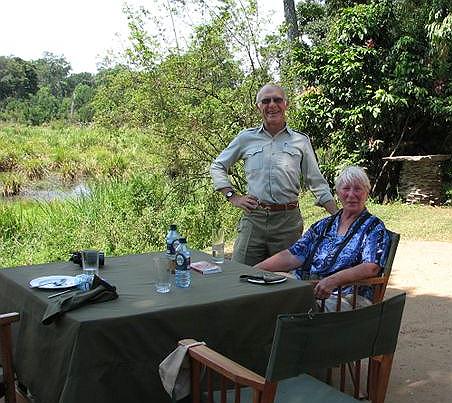
Kim snapped a photo of Dave Richards and me at the end of our bird-watching lunch. -- Photo by Kim Perrin

We were required to stay in the main lodge area, where we saw one of the guards caring a large rifle. It would be only the second gun, and the last one we saw while in Africa. Our lodge hosts said the animals were allowed to come and go and we were simply warned to stay out of their way.

Lunch, after our morning game drive, was a real treat this day. And not because of the excellent food. On checking in I had learned that the lodge had an expert ornithologist on staff and that he was sometimes available for a guided bird tour.

Sadly he was all booked up during our stay, but he had agreed to have lunch with us this day.

My copy of Dave Richard's book.

He was Dave Richards, author of “A photographic Guide to Birds of East Africa.,” which of course I had bought at the lodge’s small gift shop and studied the night before. As promised, he joined us for lunch.

Dave was a small, gray-haired older man who quickly put us at ease. He had great charisma. At one time he had been a safari guide who specialized in birds. He said he tired of that because too many people just wanted to tick off birds.

As a number ticker on this trip, I later told Kim that long-time birders always seem to distain bird listers, but that’s always after they have their achieved their own lengthy lists. Besides, I said, there’s a difference between tickers who are only interested in seeing new birds, and true birders who also enjoy looking at the same birds over and over, even sparrows. I count myself among the latter.

In fact, at this point in our safari, I was as excited to recognize a bird I had seen earlier as I was to find a new one – well almost.

Ross' turaco -- Wikipedia photo

Meanwhile, our pleasant lunch was frequently interrupted as Dave would spot a special bird in the trees or swamp around us, and he and I would go off to look. Kim, who continued her lunch, snapped a few pictures of the two of us with our binoculars pointed up one tree or another.

Our luncheon bird sightings included white-faced whistling ducks, white-browed robin (which sat on a tree right next to our table), spectacled weaver, an da Ross’s turaco.

I had seen one of Richards’ photos of this latter bird in the gift shop earlier. They are truly a magnificent sight. Ours here at the lodge was way up in a tree and without Dave’s help I’m sure I would never have spotted it.

All in all it was one of the best lunches I’ve ever not eaten.

Read Full Post »

 “We all have our time machines. Some take us back. They’re called memories. Some take us forward. They’re called dreams.” – Jeremy Irons

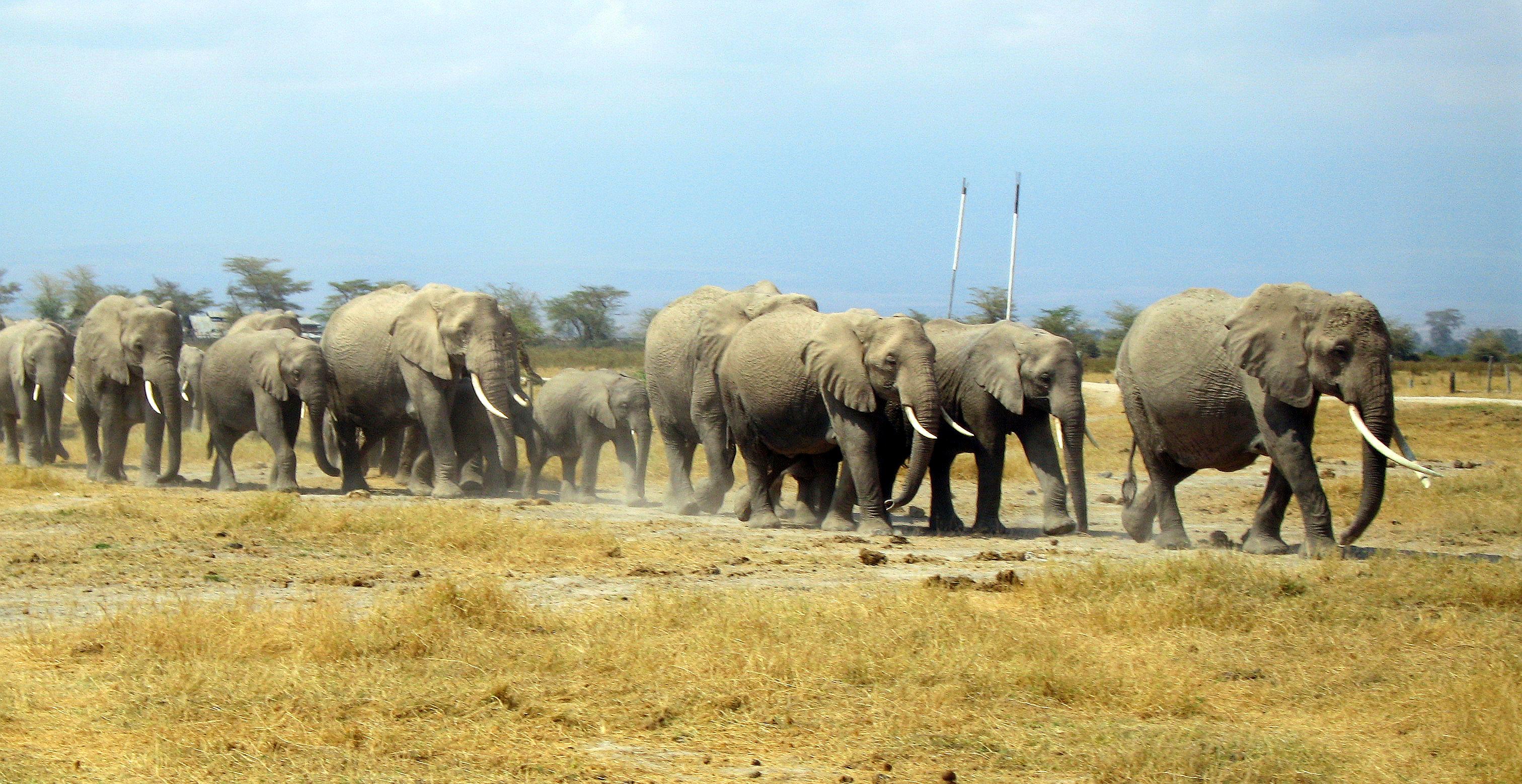
Elephants on the move in Amboseli -- Photo by Pat Bean

African Safari: Amboselli

The next morning we were up early for breakfast, served family style in open air tent, and eagerly ready for a day in Amboseli National Park, which was about an hour away from our Porini camp. Our driver was Emanuel, whom I was delighted to discover was more interested in birds than Bilal. I never once had to ask him to stop when one was in sight.

Emanuel, our driver/guide for Amboseli. He was a real birder. Yea! -- Photo by Pat Bean

In fact, even before we left the camp he had pointed out a blue-naped mousebird that I had missed seeing. I knew then it was going to be a great day, like every other day I’d so far spent in Africa.

We were accompanied in the Land Rover by a husband and wife couple, whom I barely remember except that they were pleasant. Kim remembered, when I asked, that he had a lot of expensive cameras and was heavily into photography.

The other person who also accompanied us was Jackson, who was nearing the end of a five-year internship to become a guide. Jackson was a Maasai, and would be one of the very first of his tribe to become a guide.

From a distance hippos looked like big gray rocks, especially since sometimes only their backs were visible in the sunken swamps that dotted the Amboseli landscape. -- Photo by Kim Perrin

While it was an hour’s drive to the park from our Porini camp site, there was plenty to see along the way, including two, then three, cheetahs stalking a gerenuk, which escaped all of them once the pursuit race began.

Our first sighting in the park was a large herd of female elephants migrating across the landscape with a lot of young ones in tow. Following behind was one huge male with a huge desire to sire yet another one.

Amboseli is a Maasai word for salty dust, and refers to the volcanic ash from past Mount Kilmanjaro eruptions. Snow melt flowing down into the landscape here from the mountain makes it an excellent habitat for wildlife, and rarely were we out of sight of the four-legged and winged creatures that call Amboseli home.

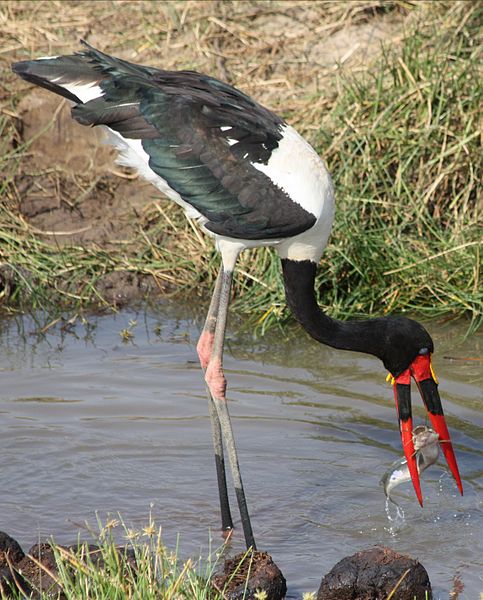
Saddle-billed stork catching a fish -- Wikipedia photo

Looking across the savannah, we often saw what at first glance were big gray rocks. In reality they were hippos lazing in the swamp areas of the park. 

Among our more fun bird-watching experiences was watching a saddle-backed stork fight with a snake. The stork won.

We also saw an African jacana walking on lily pads, a jewel colored malachite kingfisher and a squacco heron, which looked an awfully lot like our American bittern.

 Lots of memories were made this day.

Bird Log of new lifers: Lizard buzzard, red-billed hornbill, August 28, 2007,  during the drive to Porini; crested francolin, blue-naped mousebird, crested bustard, black-faced sandgrouse, Fischer’s starling, plain-backed pipit, Fischer’s sparrow -lark, grassland pipit, saddle-billed stork, long-toed plover, common greenshank, malachite kingfisher, African jacana, squacco heron, eastern pale chanting goshawk, pied kingfisher. August 29, 2011, Amboseli National Park. We also saw a sandwich tern, which is a common bird along the Texas Gulf Coast.

Read Full Post »

It was peaceful watching this mom and young charges splashing in the water until ... -- Photo by Pat Bean

 ” We live in a world full of beauty, charm and adventure. There is no end to the adventures that we can have if only we seek them with our eyes open. ” – Irving Wallace

"Hey guy's! There's a hammerkop over there with the zebra." -- Photo by Pat Bean

African Safari: Holding Our Breaths

Our afternoon game drive with Bilal took place in Tarangire National Park, which is known for its elephants. The park , except during its rainy season, is mostly hot and dry. We missed the rainy season, and our August visit during Africa’s winter was made before the heat and dryness claimed the land.

The elephants, as almost all of the park’s wildlife did, made their way daily to the park’s only water source, the Tarangire River for which the park is named. Bilal knew exactly where to go and where to park for spectacular views of wildlife visiting the river.

One of the places was in the shade of a tree right next to a bank. On the far side of the river, we watched zebra and waterbuck peacefully drinking together. While we were watching a couple of giraffe joined them. It was fun to watch how they splayed their legs apart so as to be able to get low enough to drink.

Kim got this photo of a really big elephant that didn't scare us a bit. Perhaps because it was shot with her zoom lens. -- Photo by Kim Perrin

As I watched in awe, my eye was drawn to a bird at the feet of the zebras. It was a hammerkop, a strange looking bird with an elongated head. It was yet another lifer, which I excitedly pointed out to Kim and Bilal, both of whom failed to see birds when larger, more exotic, wildlife was in view.

On our side of the river were three elephants, a mom and two young ones. They were splashing in the water near were Bilal had parked the Land Rover. They looked like they were having so much fun that even I forgot to look at birds for awhile.

As we watched, the three began to climb out of the river beside our vehicle. As the young ones made their way up the bank, the mom got in front of our vehicle and engaged us in a stare off. She was close enough that she could have easily touched the hood of the vehicle with her trunk.

We could hear her snuffling as she glared intently into each of our eyes.

We can't say we weren't warned. -- Photo by kim Perrin

Kim and I, who were both standing up in the vehicle, stopped breathing we were so still. Bilal had his hand on the keys in the ignition but he didn’t move a muscle either. While this wasn’t the largest elephant we had seen, we all knew how fierce the protective mom could turn in an instant if she thought we were a danger to the young ones she had in tow.

After what seemed like an eternity, but in reality was only about two or three minutes she turned and led her charges off. All three of us took a big breath.

Bilal said he had been afraid if he started the vehicle to get us away, it would have caused her to charge.

Kim and I had wanted to have an adventure when we came to Africa, and this day certainly provided one. But we were both irked that neither of us had taken a photo of the face off. I would remember that later during another close-up wildlife encounter

Read Full Post »

Overview of Lake Manyara -- Wikipedia photo

There are no foreign lands. It is the traveler only who is foreign.” – Robert Louis Stevenson.

African Safari: A Morning of Firsts

These tall fellows that eat leaves shape the acacia trees so they look like umbrellas. -- Photo by Pat Bean

Our morning agenda, according to the carefully arranged plans detailed in the booklet of our journey prepared by the African Adventure Company, was a two-hour drive to the Serena Lodge at Lake Manyara for lunch.

Such a terse description now seems obscene.

On our way there, we saw our first lions, a mating pair, which made the sighting more special, even if it also made us voyeurs. We also got our first view of giraffes and cheetahs, the later being a mom with three youngsters.

New life birds, meanwhile, were coming into view so fast that I truly couldn’t keep

The Serena Lodge as viewed from the compound's pool. -- Photo by Pat Bean

up with identifying them. Bilal helped, but I later realized that while he was great at putting a name to the larger and more common birds, he was not quite as good at the smaller, obscure birds of interest only to crazily addicted birders like myself.

Lake Manyara, located along an escarpment of the great rift, and called “the loveliest … setting in Africa” by Ernest Hemingway, provides habitat to over 400 bird species, including marabou storks, which when I saw a flock of them in some overhead trees thought were the ugliest birds I had ever seen.

White-headed buffalo weaver -- Wikipedia photo

They were hanging about an outdoor market just outside the Serena Lodge compound. As we passed it, my attention was taken away from the birds to an exhibit of colorful African paintings. When I expressed interest in them, Bilal quickly cautioned us not to visit the market unescorted.

As we passed through a fence and guards to get to our accommodations, I realized that our safety was important not just to Bilal, but the country’s entire tourist interests. Harm to any one safari participant would mean bad publicity for business.

As beautiful as this superb starling is, it soon list its glamour because it was so common. We saw them everywhere. -- Wikipedia photo

The Serena Lodge, where we were to spend the night, was owned by India businessmen and staffed by local natives – as were most of the places we stayed at during our trip. It was a grandiose eye-popper.

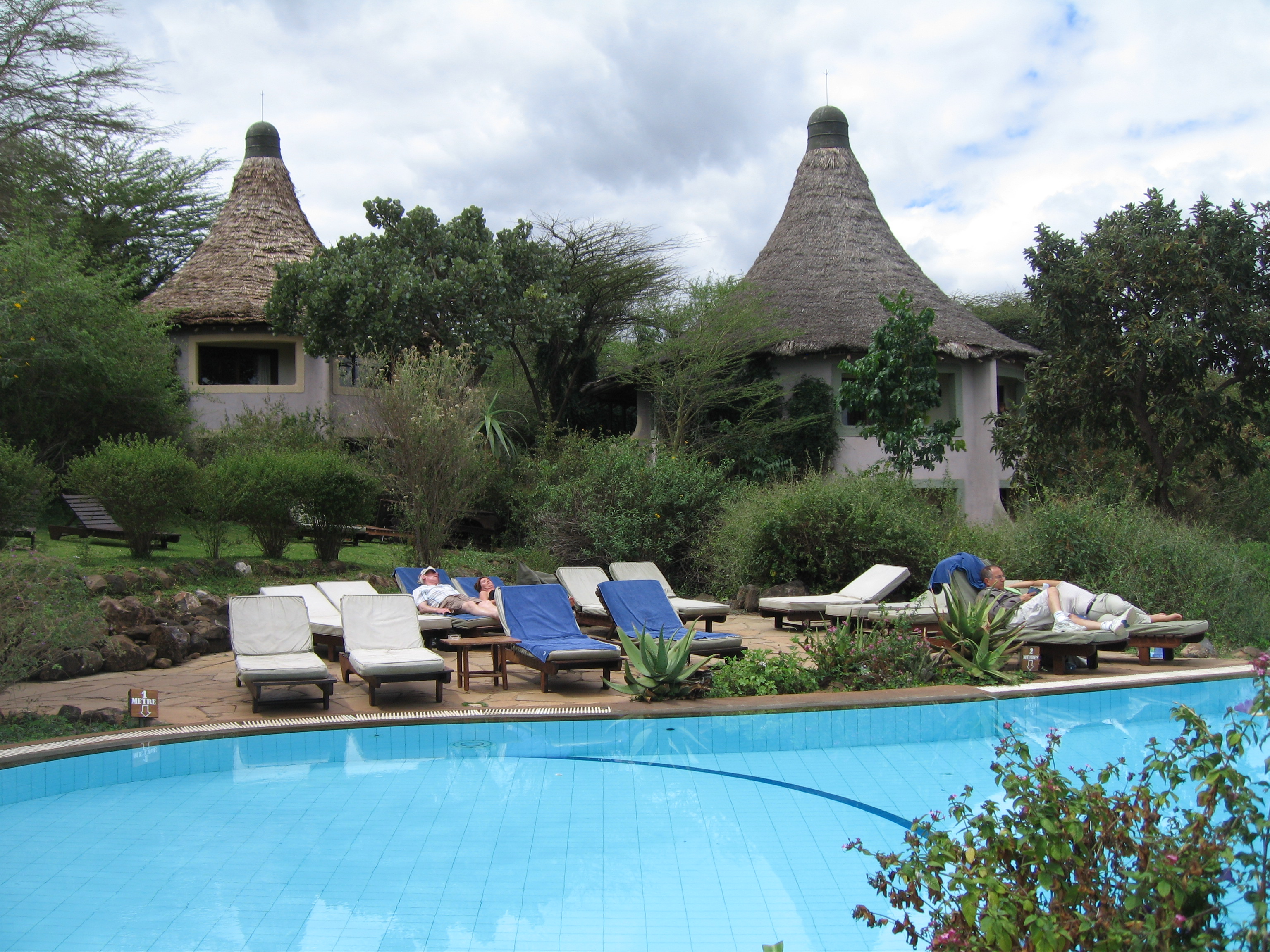
Our rooms were circular, situated in tall, white-washed roundavels with thatched roofs. The structures sat on a cliff that provided panoramic views of the landscapes and wildlife below. A large swimming pool went right up to the edge of the escarpment.

Taita fiscal -- Wikipedia photo

Lunch was served in an outdoor setting, with birds frequently flittering about. It made for very distracted eating, but a perfect meal, especially with the bottled Coke we ordered to go with it. It was so much tastier than the ones we get in America.

Everything about the Serena Lodge was delightful, and everyone catered to our slightest needs. But the real Africa, both Kim and I knew, lay outside this guarded sanctuary where Bilal didn’t want us to go without him.

I had that decadent feeling again – but I was enjoying every minute of it.

Bird log of New Lifers: Augur buzzard, gray heron, yellow-necked spurfowl, black-shouldered kite, white-headed buffalo weaver, African gray hornbill, superb starling, northern white-crowned shrike, taita fiscal and marabou stork. (August 22, drive from Arusha Coffee Lodge to Serena Lodge near the main entrance to Lake Manyara National Park).

We also saw lots of cattle egrets, is a bird now common in North America, having first migrated to the United States from Africa in the 1940s. I would see many more of them on our wildlife outings while in Africa.

Next: An Afternoon in Lake Manyara National Park.

Read Full Post »

“Let your mind start a journey thru a strange new world. Leave all thoughts of the world you knew before. Let your soul take you where you long to be … let your spirit start to soar, and you’ll live as you’ve never lived before.” Erich Fromm

Bilal, in an unguarded moment. He was a bit camera shy. -- Photo by Pat Bean

African Safari: Bilal

Breakfast the next morning was interrupted by a black and white bird strutting around on the open-air dining room floor. I chased it out to the pool, East Africa guide book in hand, before finally identifying it as an African pied wagtail. Cute little black and white bird.

This interruption of meals for bird and other wildlife watching would become a common, and delightful, routine for the next two weeks.

After breakfast we met up with Evans, a Ranger Safaris supervisor who carefully went over our arranged itinerary with us, and then introduced us to Bilal, our native guide and driver for the rest of our stay in Tanzania.

“Bilal’s our best guide, but don’t let him push you around,” Evans said.

I figured Evans said that about all the guides when introducing them to their clients. As for pushing us around, well both Kim and I are assertive women not prone to letting anyone direct our actions.

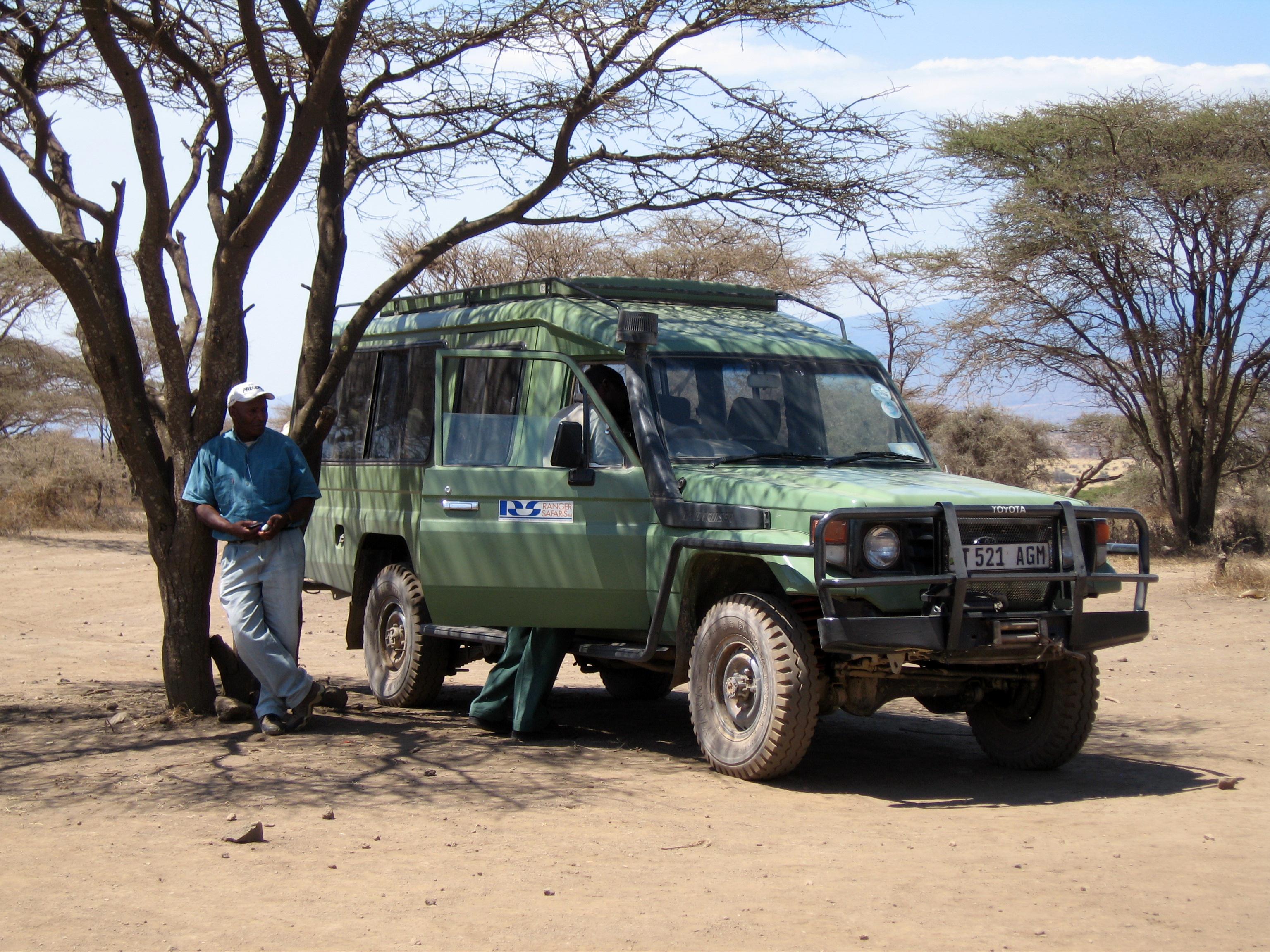
Bilal standing beside his Land Rover, whose top and sides were removed for our sight-seeing pleasure as he bounced the two of us across the African landscape. -- Photo by Pat Bean

Bilal actually did try to push a few times, but it was always only out of concern for our safety. Mostly we let him, but a few times we didn’t. As to him being the best guide, Kim and I quickly came to the conclusion that Evans had spoke the absolute truth.

Bilal, who was older and looked out after some of the younger guides working in our general area, spoke very good English, drove his Land Rover down rutted roads and rough off-road terrain with great skill, and always knew where to find wildlife.


African pied wagtail -- Wikipedia photo

Some of the best moments of my time in Africa were spent standing up and bouncing around in his Land Rover – overjoyed at the lack of seat-belt rules – as Bilal rushed to a lion, cheetah or leopard sighting.

Kim and I finally discovered that Bilal was divorced. While he expected his son to look out for him in his old age – he worried that we also had sons to take care of us in our later years – it was his daughter, who had recently presented him with a grandson, whom he talked with regularly on his radio

Like Africa, Bilal was a bundle of contradictions. But then aren’t we all.

Next: The drive to Lake Manyara

Read Full Post »

« Newer Posts - Older Posts »