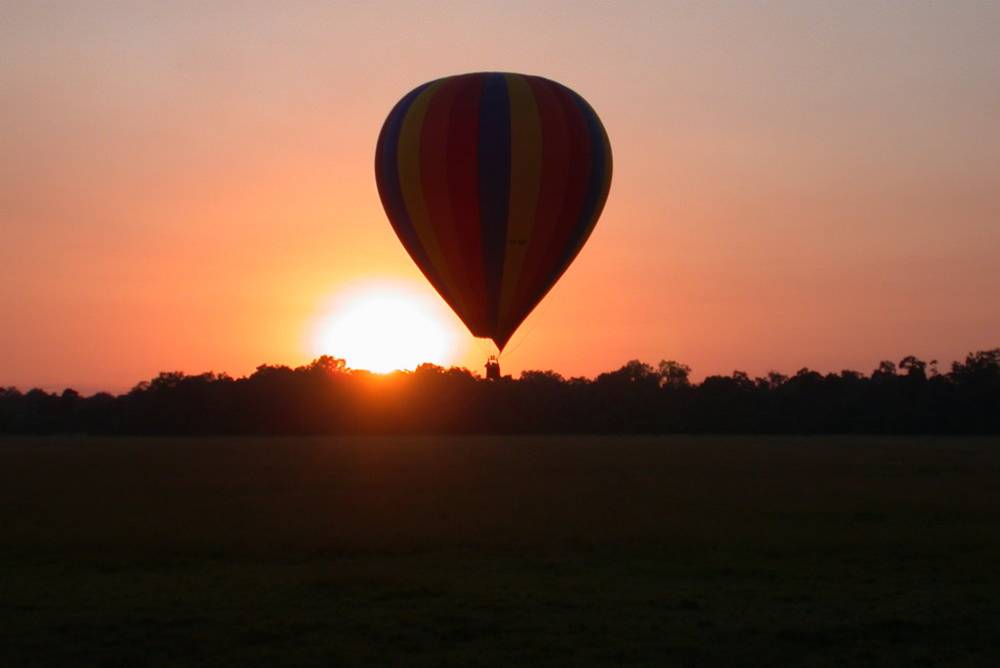
Early morning balloon ride over the Serengeti toward the rising sun.
Posted in African Safari, tagged african safari, hot air balloons, postaday2011, Serengeti, Week;y Photo Challenge: Sky on July 3, 2011| 3 Comments »
Posted in African Safari, Birds, Lakes, Nature, Travel, tagged African birds, African safariTanzania, cheetahs, giraffes, Lake Manyara, lions, marabou stork, postaday2011, Serena Lodge, superb starling, taita fiscal, white-headed buffalo weaver on July 2, 2011| 4 Comments »

Overview of Lake Manyara -- Wikipedia photo
“There are no foreign lands. It is the traveler only who is foreign.” – Robert Louis Stevenson.
African Safari: A Morning of Firsts

These tall fellows that eat leaves shape the acacia trees so they look like umbrellas. -- Photo by Pat Bean
Our morning agenda, according to the carefully arranged plans detailed in the booklet of our journey prepared by the African Adventure Company, was a two-hour drive to the Serena Lodge at Lake Manyara for lunch.
Such a terse description now seems obscene.
On our way there, we saw our first lions, a mating pair, which made the sighting more special, even if it also made us voyeurs. We also got our first view of giraffes and cheetahs, the later being a mom with three youngsters.
New life birds, meanwhile, were coming into view so fast that I truly couldn’t keep
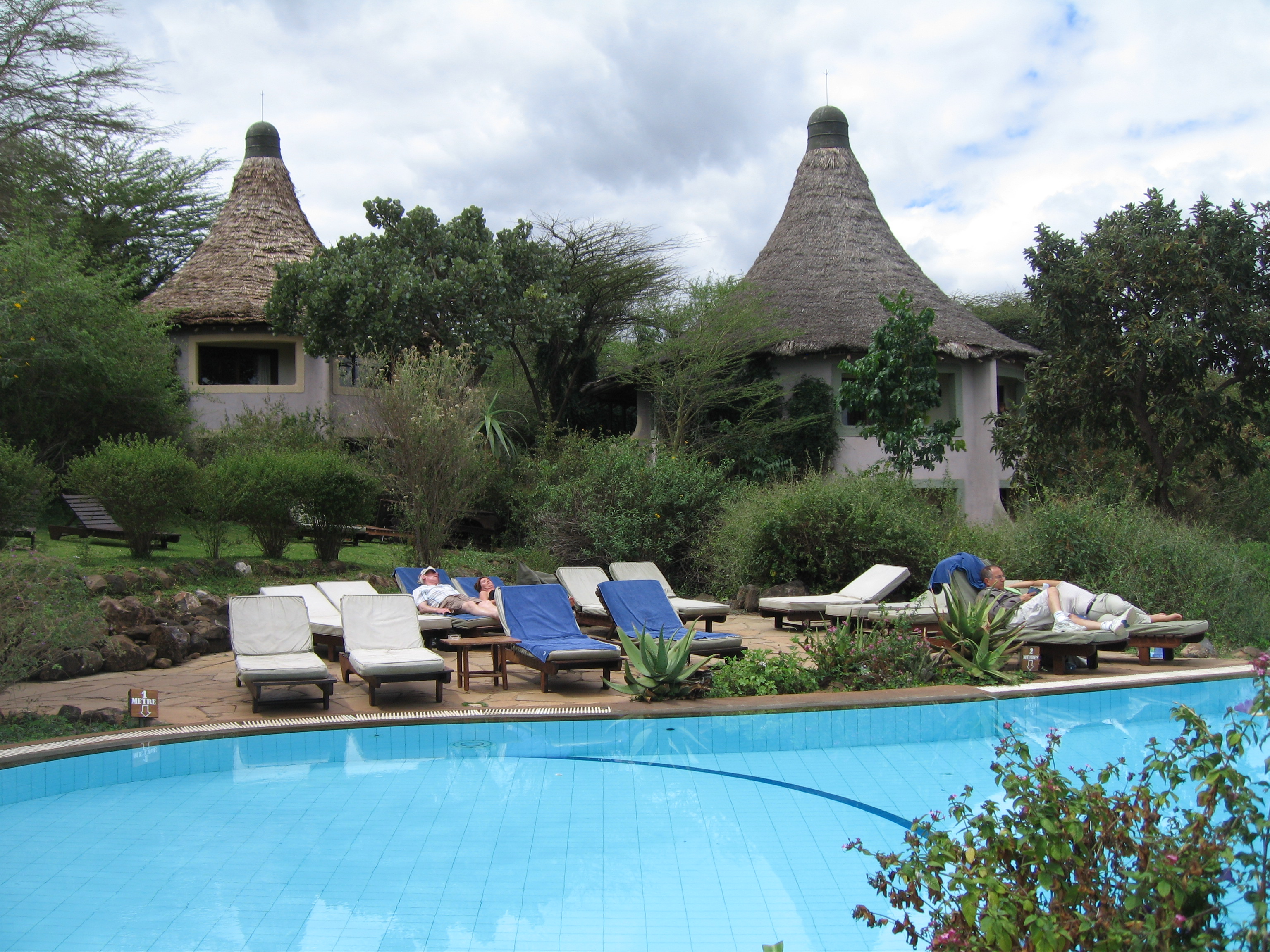
The Serena Lodge as viewed from the compound's pool. -- Photo by Pat Bean
up with identifying them. Bilal helped, but I later realized that while he was great at putting a name to the larger and more common birds, he was not quite as good at the smaller, obscure birds of interest only to crazily addicted birders like myself.
Lake Manyara, located along an escarpment of the great rift, and called “the loveliest … setting in Africa” by Ernest Hemingway, provides habitat to over 400 bird species, including marabou storks, which when I saw a flock of them in some overhead trees thought were the ugliest birds I had ever seen.

White-headed buffalo weaver -- Wikipedia photo
They were hanging about an outdoor market just outside the Serena Lodge compound. As we passed it, my attention was taken away from the birds to an exhibit of colorful African paintings. When I expressed interest in them, Bilal quickly cautioned us not to visit the market unescorted.
As we passed through a fence and guards to get to our accommodations, I realized that our safety was important not just to Bilal, but the country’s entire tourist interests. Harm to any one safari participant would mean bad publicity for business.

As beautiful as this superb starling is, it soon list its glamour because it was so common. We saw them everywhere. -- Wikipedia photo
The Serena Lodge, where we were to spend the night, was owned by India businessmen and staffed by local natives – as were most of the places we stayed at during our trip. It was a grandiose eye-popper.
Our rooms were circular, situated in tall, white-washed roundavels with thatched roofs. The structures sat on a cliff that provided panoramic views of the landscapes and wildlife below. A large swimming pool went right up to the edge of the escarpment.

Taita fiscal -- Wikipedia photo
Lunch was served in an outdoor setting, with birds frequently flittering about. It made for very distracted eating, but a perfect meal, especially with the bottled Coke we ordered to go with it. It was so much tastier than the ones we get in America.
Everything about the Serena Lodge was delightful, and everyone catered to our slightest needs. But the real Africa, both Kim and I knew, lay outside this guarded sanctuary where Bilal didn’t want us to go without him.
I had that decadent feeling again – but I was enjoying every minute of it.
Bird log of New Lifers: Augur buzzard, gray heron, yellow-necked spurfowl, black-shouldered kite, white-headed buffalo weaver, African gray hornbill, superb starling, northern white-crowned shrike, taita fiscal and marabou stork. (August 22, drive from Arusha Coffee Lodge to Serena Lodge near the main entrance to Lake Manyara National Park).
We also saw lots of cattle egrets, is a bird now common in North America, having first migrated to the United States from Africa in the 1940s. I would see many more of them on our wildlife outings while in Africa.
Next: An Afternoon in Lake Manyara National Park.
Posted in African Safari, Birds, Travel, tagged African pied wagtail, african safari, Bilal, Eric Fromm, guide, Land Rover, postaday2011, Ranger Safaris on July 1, 2011| 3 Comments »
“Let your mind start a journey thru a strange new world. Leave all thoughts of the world you knew before. Let your soul take you where you long to be … let your spirit start to soar, and you’ll live as you’ve never lived before.” Erich Fromm

Bilal, in an unguarded moment. He was a bit camera shy. -- Photo by Pat Bean
African Safari: Bilal
Breakfast the next morning was interrupted by a black and white bird strutting around on the open-air dining room floor. I chased it out to the pool, East Africa guide book in hand, before finally identifying it as an African pied wagtail. Cute little black and white bird.
This interruption of meals for bird and other wildlife watching would become a common, and delightful, routine for the next two weeks.
After breakfast we met up with Evans, a Ranger Safaris supervisor who carefully went over our arranged itinerary with us, and then introduced us to Bilal, our native guide and driver for the rest of our stay in Tanzania.
“Bilal’s our best guide, but don’t let him push you around,” Evans said.
I figured Evans said that about all the guides when introducing them to their clients. As for pushing us around, well both Kim and I are assertive women not prone to letting anyone direct our actions.
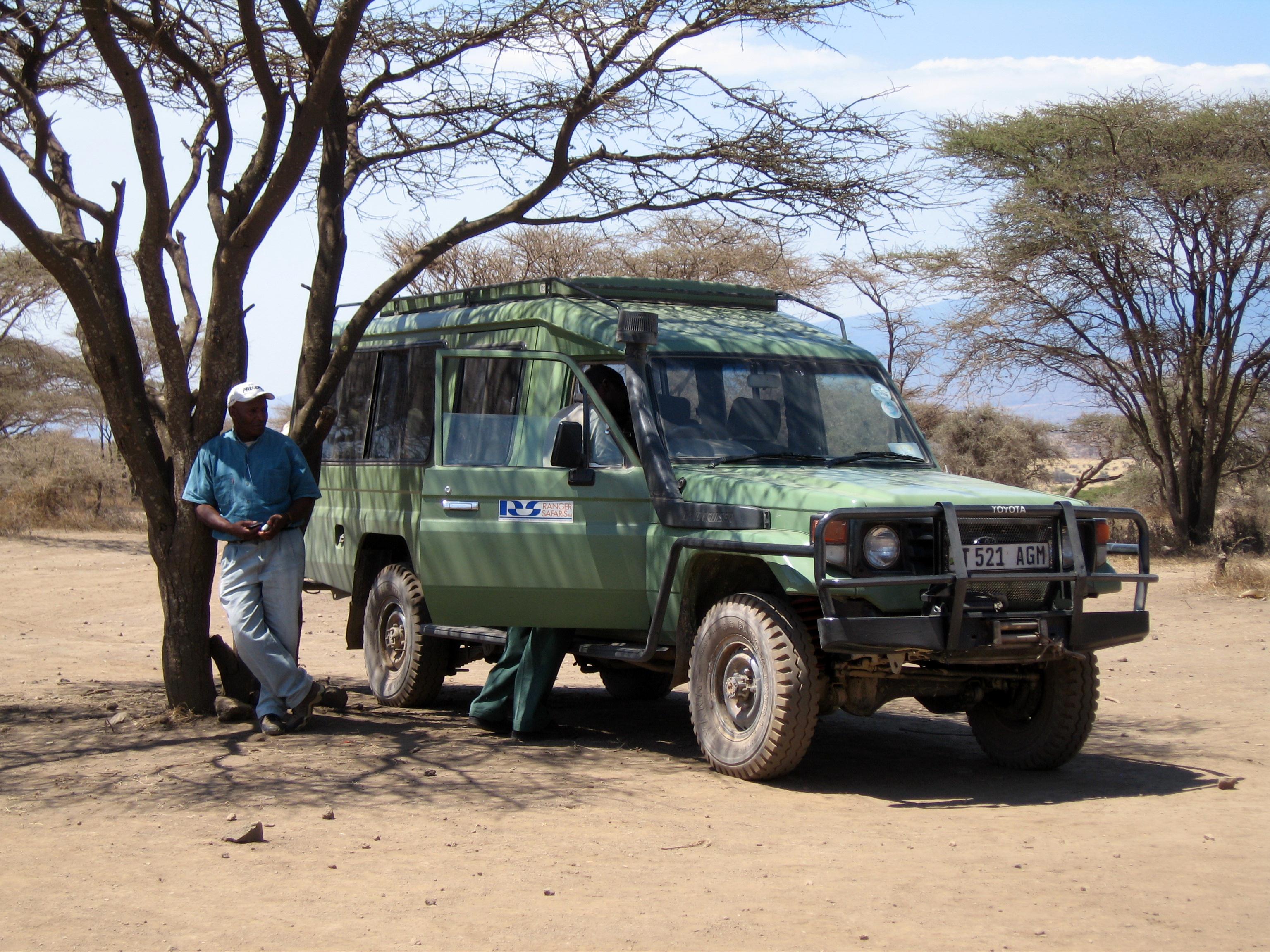
Bilal standing beside his Land Rover, whose top and sides were removed for our sight-seeing pleasure as he bounced the two of us across the African landscape. -- Photo by Pat Bean
Bilal actually did try to push a few times, but it was always only out of concern for our safety. Mostly we let him, but a few times we didn’t. As to him being the best guide, Kim and I quickly came to the conclusion that Evans had spoke the absolute truth.
Bilal, who was older and looked out after some of the younger guides working in our general area, spoke very good English, drove his Land Rover down rutted roads and rough off-road terrain with great skill, and always knew where to find wildlife.

African pied wagtail -- Wikipedia photo
Some of the best moments of my time in Africa were spent standing up and bouncing around in his Land Rover – overjoyed at the lack of seat-belt rules – as Bilal rushed to a lion, cheetah or leopard sighting.
Kim and I finally discovered that Bilal was divorced. While he expected his son to look out for him in his old age – he worried that we also had sons to take care of us in our later years – it was his daughter, who had recently presented him with a grandson, whom he talked with regularly on his radio
Like Africa, Bilal was a bundle of contradictions. But then aren’t we all.
Next: The drive to Lake Manyara
Posted in African Safari, Nature, Travel, tagged African birds, african safari, Arusha Coffee Lodge, black-headed oriole, postaday2011, rufous-backed mannikin, tanzania, vervet monkeys on June 30, 2011| 4 Comments »
“A leaf fluttered in through the window this morning, as if supported by the rays of the sun, a bird settled on the fire escape, joy in the task of coffee, joy accompanied me as I walked.” Anais Nin
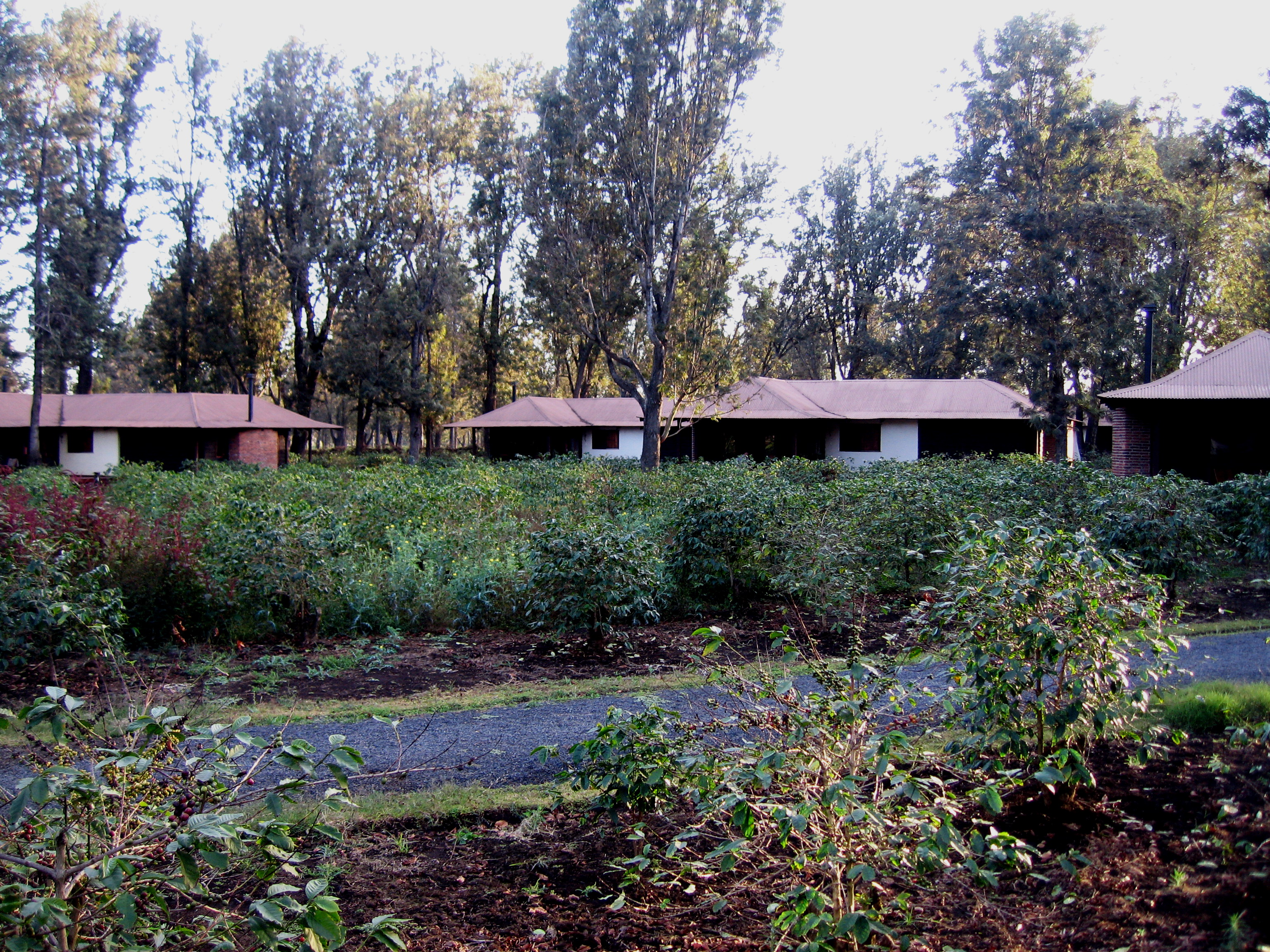
A rock path took us through the coffee plants to our luxurious suites. -- Photo by Pat Bean
African Safari: A Night Among the Coffee Beans
Our final destination for this our first full day in Africa was a working coffee plantation on the outskirts of Arusha, where we were warmly greeted after our chaotic ride with wet wash rags to wipe the dust from our hands and faces, and a delicious glass of iced coffee to soothe our parched throats. .
I immediately became addicted to African coffee, so much so that I usually drink nothing but whenever possible. In fact, as I’m writing this recap of my days in Africa – while also watching a pair of magpies investigating the picnic table beside my RV here at Lake Walcott in Idaho – I’m drinking a cup of it, generously laced with cream, right now.
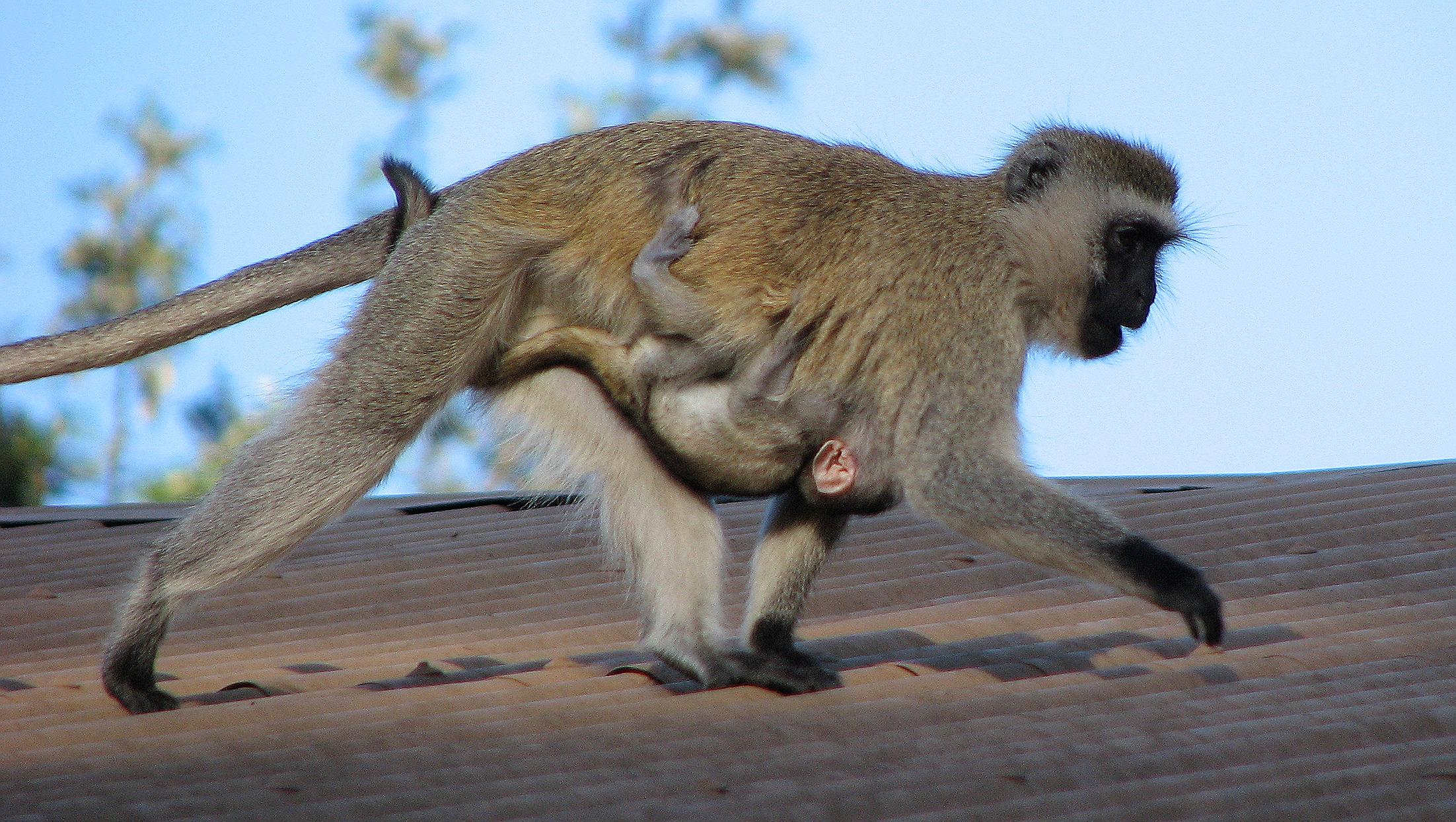
Vervet monkey mom with hitchhiking baby -- Photo by Kim Perrin
Life is good.
Back in Africa, meanwhile, after the greeting and the refreshment offered by our coffee plantation hosts, Kim and I were led to our assigned sleeping quarters, a large, bedroom, bath and sitting room duplex suite reached by a rock path that wound through the coffee plants.
Ours was No. 18, the last one to be reached. Beyond it was a dirt path that led to employee quarters for the coffee plantation, which, we were told, is the largest one in Tanzania. Our driver, before letting us off, said the operation was owned by Greeks, who once had a large community in the area.
Our six-course dinner that evening, served in the main lodge, was a formal affair. I can’t recall what we had, but I do remember it was delicious
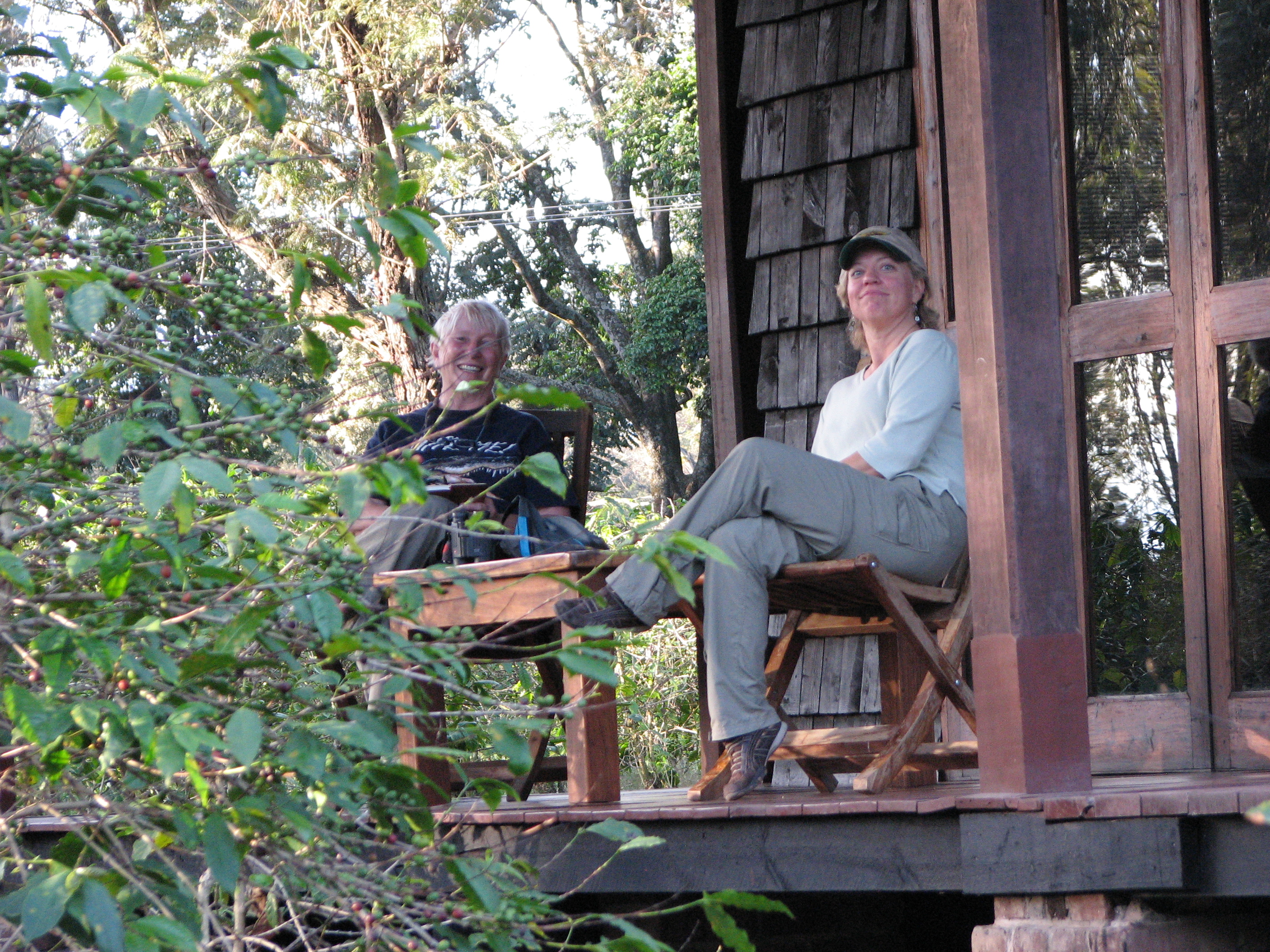
Kim set the timer on her camera so she could get a photo of the two of us on the porch of our lodge accommodations.
Afterward, Kim and I walked among the plants – and the vervet monkeys. The black-faced agile climbers were delightful to watch as they scampered around on the roof tops. Our favorite was a mom carrying a youngster beneath her belly as she gadded about.
Back at our suite, we sat on its porch together watching birds, listening to what sounded like party noises from the employee quarters, and then watching the sky for the stars to come out. While we were sitting there, quite enamored with our present state of being, a lodge employee came and sprayed our room for mosquitoes and arranged the insect netting around our beds.
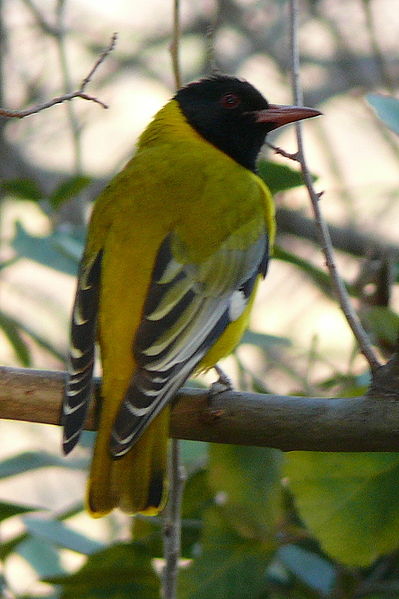
Black-headed oriole -- Wikipedia photo
I don’t know about Kim, but once I got beneath its filtered walls, I slept deeply. Life was really good.
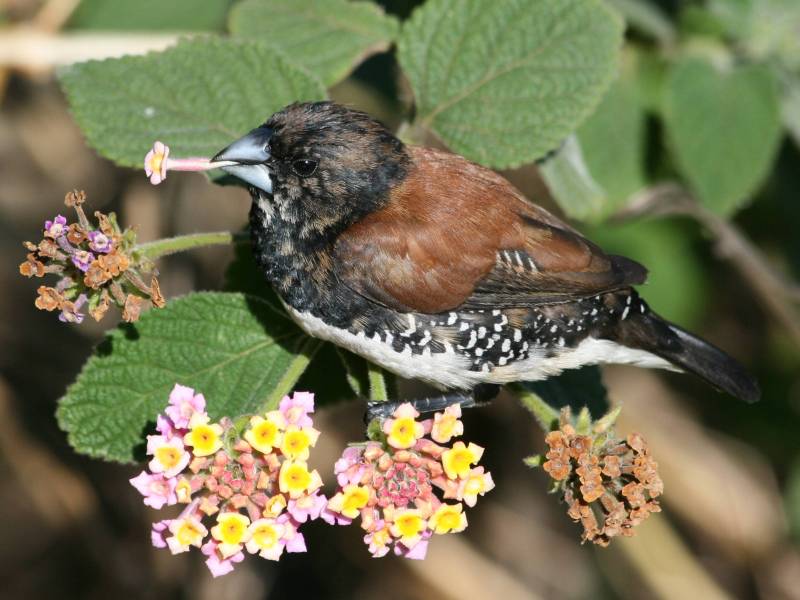
Rufous-backed mannikin -- Photo by Alan Manson
Bird Log of new lifers for the day: hadada ibis, baglaflecht weaver, pied crow, black kite, rufous-backed mannikin and black-headed oriole.
Next Episode: Our Native Driver/Guide, Bilal
Posted in African Safari, Travel, tagged african safari, Apple Computers, bllue zoisite, jewely, Mark Twain, Michael Scott, postaday2011, Queen of Mount Kilimanjaro, tanzania, tanzanite, Tiffany & Co. on June 29, 2011| 4 Comments »
“Honest poverty is a gem that even a king might be proud to call his own – but I wish to sell out.” – Mark Twain
African Safari: No Sale
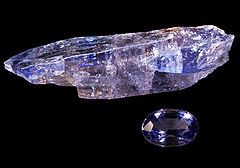
Tanzanite: The rough stone and a polished stone. -- Photo courtesy Wikipedia
Tourists to Africa, like Kim and myself, are valued for the dollars they bring. Knowing that made it easier for me to understand the royal and polite treatment we received at all the places we stayed, and helped erase the guilt I frequently suffered for having so much while others had so little.
I would like to think that some of the kindnesses extended us was real, but I’m sure some of it was just for the generous tips both Kim and I diligently handed out. It seemed only just that we do so.
The Africa Adventure Company that had arranged our tour, meanwhile, had gone the extra mile to make sure we traveled safely and enjoyed our stay. This included providing us an opportunity to spend our money on souvenirs from sanctioned local shops and native co-ops. .
I realized this fully for the first time when our Ranger Safaris’ driver stopped at a place where they sold tanzanite, a rare gem first discovered in 1967 in the hills near Mount Kilimanjaro. Neither Kim nor I had ever heard of this brilliantly blue and violet crystal-like stone.
The mining of the gem was nationalized by the Tanzania government in 1972; and its original name of blue zoisite, was changed to tanzanite by Tiffany when the company began marketing the jewel.
Company big wigs thought a stone named after the country where it was found would sell better than one whose name sounded like “blue suicide.”

Monkeys by the side of a road were a common sight in Tanzania. -- Photo by Kim Perrin
According to Wikipedia, “the mining of tanzanite nets the Tanzanian government $20 million annually,” while retail sales, mostly in the United States, total “approximately $500 million annually.”
The largest tanzanite stone discovered, 252 carats and known as the “Queen of Kilimanjaro,” sits in a tiara owned by Michael Scott, Apple Computers’ first CEO.
I found the tanzanite trivia fascinating, but wasn’t interested in owning one. Both Kim and I, after noting the cost of the jewelry, agreed we would rather spend our money on more travel instead.
Next Episode: Coffee Plantation Lodging
Posted in African Safari, Travel, tagged african safari, Arusha, David Ewing Duncan. swaahili, Kilimanjaro, postaday2011, Ranger Safaris, tanzania on June 28, 2011| 1 Comment »
“At dawn in East Africa the sky bleeds raw swatches of color … the sun rises with passion, like a reckless dangerous lover. It ignites the world in reds and golds and vaporizes cool mists collected overnight. Within minutes the passion burns itself out.” –David Ewing Duncan
African Safari: The President Passes By

An African sunrise, enough in itself to warrant traveling to the Dark Continent. -- Photo by Pat Bean
As I look over the notes I took about the drive from the Kilimanjaro airport, through Arusha, to a coffee plantation where we were to spend the night, I find myself almost as overwhelmed again as I was observing it originally.
Color was everywhere. African men and women on bicycles wrapped in blue, red, orange and purple robes making their way over packed red earth. A pickup truck with a gigantic load of yellow oranges bouncing on the rutted road ahead of us. Grey burros plodding beside the road with green leaves of some sort loaded on their backs.
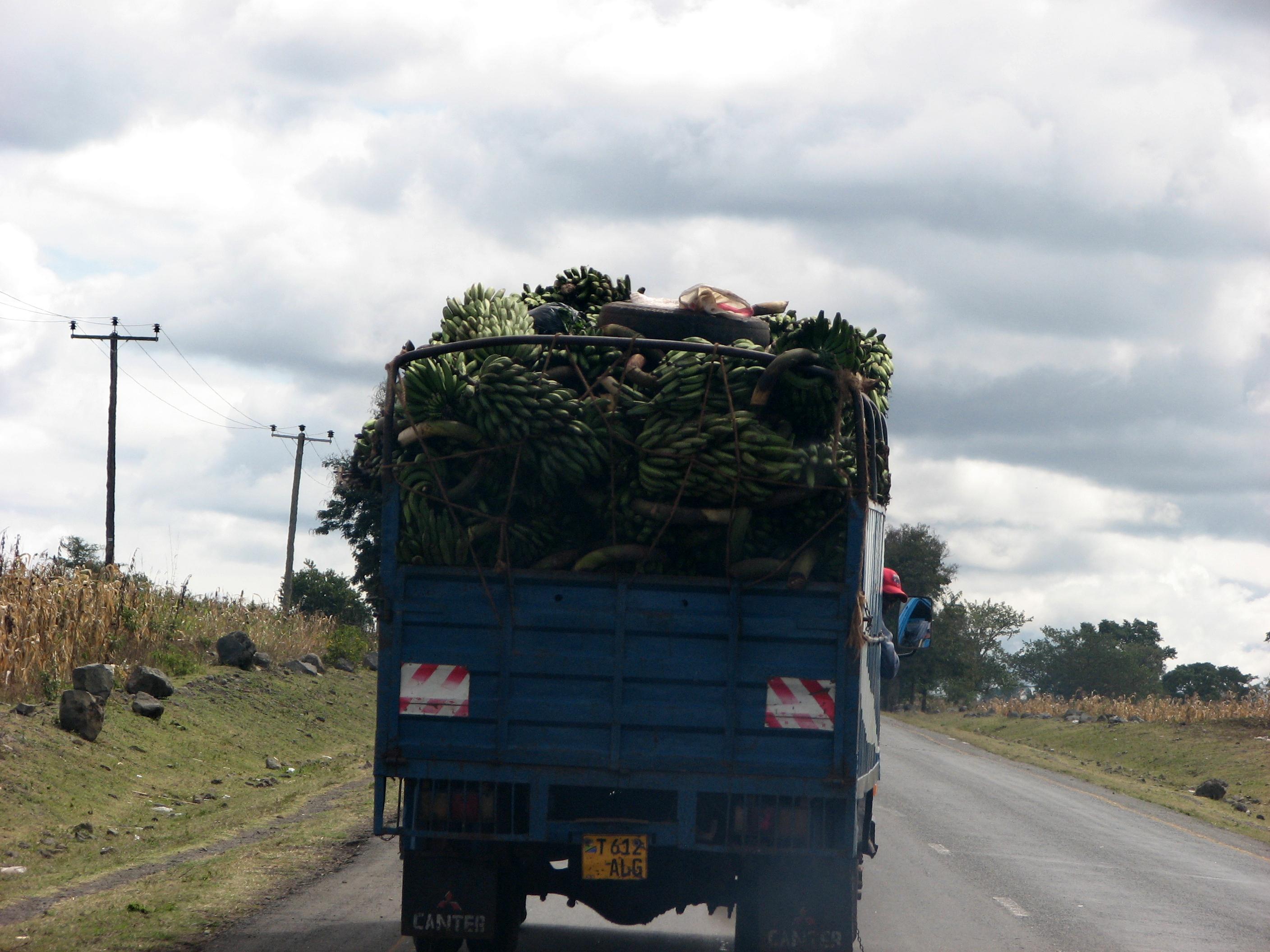
The banana truck -- Photo by Kim Perrin
There were small boys, whom I thought should have been in school, herding cattle and goats; and women in long dresses walking purposefully with huge bundles on their heads, sometimes with an empty-handed man walking ahead of them.
I watched, and smiled to myself, as a man pulled a load of squawking chickens down from the top of one of the smoke-belching over-packed buses we frequently passed.
And I was amazed at the way our Ranger Safaris driver weaved in and out among traffic and people. I was sure he was going to hit something or someone. But he didn’t. Even when a car decided to create a passing lane down the middle of our narrow two-lane highway and we passed him three abreast.

From my journal -- Photo by Pat Bean
But the strangest thing of all was when a bully of a policeman came along and made everyone pull off to the side of the road. Our driver, who was on the cell phone at the time, didn’t respond quick enough and so was singled out for a Swahili chastising.
Kim and I sat unusually quiet during the confrontation, wondering what was going on. .
A few minutes later, a pickup truck with armed guards standing in the back passed us, and soon traffic was back to its chaotic normalcy.
“That was the Tanzania president,” our unfazed native driver said.
Next Episode: African Tanzanite
Posted in African Safari, Travel, tagged Aarusha, african safari, kenya, KLM, Mount Kilimanjaro, Nairobi, postaday2011, poverty, tanzania on June 27, 2011| Leave a Comment »
“Travel is more than the seeing of sights; it is a change that goes on, deep and permanent, in the ideas of living.” – Miriam Beard
African Safari: From Nairobi to Kilimanjaro

This is a view of Mount Kilimanjaro that Kim and I did not get to see. I post it so as not to disappoint readers, including one who was looking forward to seeing it,. The Wikipedia photo was taken by Muhammad Mahdi Karim.
Our plane to Tanzania from the small Wilson airport on the outskirts of Nairobi was a Twin Otter with single seats separated by a narrow aisle that held much of our luggage. It was a bottleneck one late-arriving passenger had to stumble through to sit down.
The aircraft’s non-uniformed, Anglo pilot, a grin on his weathered face, twisted around and gave us our flight briefing. He ignored the luggage. It was as different from our KLM attendant’s memorized agenda on our flight to Africa, as our scrumptious breakfast at the Norfolk was to the in-flight meal we were served in a paper sack on boarding.
The entire lunch consisted of a slice of zucchini, a slice of carrot and a leaf of lettuce on a miniature hamburger bun.
The meal reminded me of the sign noting that millions of Kenyans lived in poverty that I had seen on arrival in the city. Just how thankful some people would be for just such a meal was impressed even more on me as the plane flew over an area of Nairobi where salvaged crate box homes were crowded on top of one another.
I decided right there and then that there would be no complaints from me during my stay in Africa. Kim had the same reaction.
Meanwhile, my seat near the front of the plane gave me a pilot’s view of the 50-minute flight. I could easily tell I was not flying over the United States. The landscape below lacked the tidy borders of fences, parallel streets and plowed fields that consume Americans’ sense of tidiness.
But by my own personal criteria and desire for adventure, today’s flight was perfect – even though Mount Kilimanjaro was hidden by clouds, both from the air and when we landed at the tiny Kilimanjaro airport near its base.
“Perhaps it will be less cloudy tomorrow,” said our pilot as he bade us good-bye. I think he was more disappointed than his passengers. Kim and I were already thinking about our next leg of the day’s journey, one in which all traffic rules, if there were any, were broken.
Next Episode: The Chaotic Drive to Arusha
Posted in African Safari, Birds, Travel, tagged african safari, baglasflect weaver, black kite, hadada ibis, kenya, Nairobi, Norfolk Hotel, pied crow, postaday2011 on June 26, 2011| 3 Comments »

The Norfolk Gardens
“Every man’s life ends the same way. It is only the details of how he lived and how he died that distinguish one man from another.” Ernest Hemingway
African Safari: Rum and Chocolate at Midnight

A hadada ibis. -- Photo courtesy of Wikipedia
As late as it was, and as tired as we were, Kim and I weren’t ready for bed when we finally got checked into the Norfolk Hotel. We stood awhile on the balcony drinking in the night air and looking out over a lush garden beneath us.
Then we raided the room’s mini bar, making ourselves a couple of Captain Morgan Jamaican rum and cokes, and toasting ourselves on the adventure we were about to begin. There’s something to be said for not being rich enough to be well-traveled. The excitement of finally getting away to strange and exotic places that once existed only in your dreams is delicious – as was the small box of “Out of Africa” chocolates that we ate with our midnight drinks.
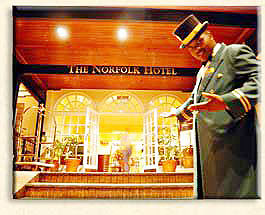
We were met in the evening and seen off the next morning by the Norfolks Green clad doorman.
It all felt a bit decadent. But I loved the feeling. .
The next morning I roamed through the hotel, where it seemed the décor and furnishings were of another era. The Norfolk Hotel opened on Christmas day 1904. It is said no other hotel in Kenya captures as much of Nairobi’s past. President Teddy Roosevelt, Lord Baden-Powell, the Earl of Warwick and the Baron and Baroness von Blixen are all part of the Hotel’s history.
And so is Ernest Hemingway. As a writer, I got a thrill peeking into the bar where he is said to have sat for hours at a time. I was only brought back to the present day when I observed a maid talking on a cell phone.
Out in the garden, I saw my first African bird. It was a hadada ibis, and a dozen or so of them were hanging out in the garden’s trees. I identified it using the East Africa bird guide Kim had given me for my birthday earlier in the year.
My second and third lifers (bird species seen for the very first time) were a baglaflect weaver and a pied crow.
I was as eager to see birds as I was to see Africa’s more famed four-legged wildlife. So much so that I occasionally annoying to my traveling companion, who likes watching birds but was more excited about Africa’s four-legged wildlife than its winged species on this trip.

A modernistic wildlife scupture on the University of Nairobi campus. -- Photo by Pat Bean
There’s the possibility I might also annoy my blog readers. It’s a risk I’ll take, however. I came to Africa to see birds every bit as much as to see lions and elephants.
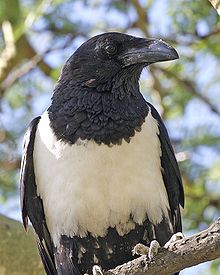
Pied crow -- Photo courtesy of Wikipedia
Meanwhile, Kim joined me in the garden, and we went into breakfast, which included some yummy African sausages that we would eat many times again during our African stay.
Afterward, we took a short walk on the grounds of the University of Nairobi across the street from the hotel. Our stroll was accompanied by a black kite flying overhead, whose sighting I added to my daily bird log.
And then it was off to the small Wilson Regional Airport for our flight to Tanzania to begin our safari for real.
Next episode: A view of Mount Kilimanjaro
Posted in African Safari, Travel, tagged african safari, Meryl Streep, Nairobi, Norkfolk hotel, Out of Africa, Pollman's Safaris, postaday2011, robert redford, Stanley Hotel, William Least Heat Moon on June 24, 2011| 4 Comments »
“When you’re traveling, you are what you are right there and then. People don’t have your past to hold against you. No yesterdays on the road.” – William Least Heat Moon
African Safari:The Dark Continent Beneath Our Feet
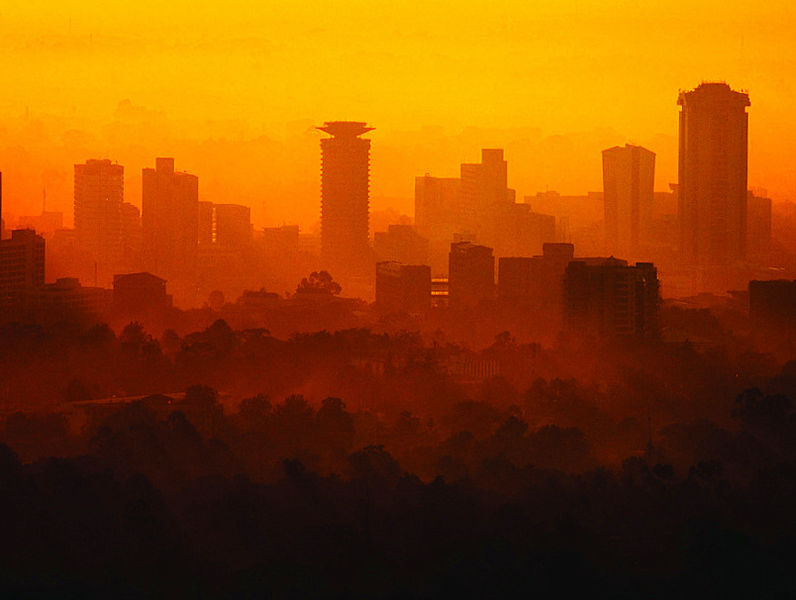
Nairobi skyline at dust. It was all so different, and colorful, and chaotic. I loved it. -- Photo courtesy Wikipedia
A nine-hour, cattle-car flight – well that’s what it feels like if you fly economy – deposited us in Amsterdam, where we caught an eight-hour connecting flight to Nairobi, Kenya. We had left Houston at 3:30 p.m. on August 19, but with the 17 hours of flight time, a short layover and the eight-hour time zone difference, it was late evening on the 20th when our feet first touched Africa.
A Pollman’s Safaris’ driver met us at the airport for the ride to our hotel. He stuffed our luggage and six other passengers into a van that had seen better days. In fact, I don’t recall seeing a single vehicle in Nairobi that didn’t look like it had seen better days.
But the color and intensity of Nairobi at night stirred my blood, as did our driver who would have put a New York taxi driver to shame when it came to dodging oncoming traffic as he zoomed in and out among vehicles that seemed to follow no set rules.
The word Nairobi comes from the Maasai phrase “enkare nyorobi,” which means the place of cool waters. The city, founded in 1899, is better known however as the Green City in the Sun, or the Safari Capital of Africa. It has a population of about 3.5 million and is the fourth largest city in Africa.
The other three pairs of travelers, who had flown in on the same flight as we had, were each staying at different hotels, and they were dropped off first.
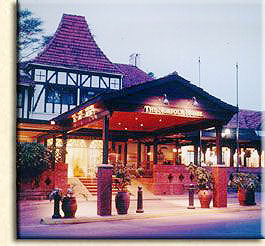
The Norfolk Hotel in Nairobi, Kenya, where Robert Redford and Meryl Streep stayed while filming "Out of Africa."
At one of the hotel stops, guards looked under our van with mirrors. At the next stop, the Stanley Hotel, there was no such safety precautions and we could hear partying and music coming from inside. It sounded like a fun hotel.
As we drove through the city, I observed a sign that said 16.7 million Kenyans live in poverty. In contrast we passed huge well-lighted Toyota and Yamaha factories. More interesting, however, was one car driving on a flat as if nothing was wrong.
Like Dorothy, we weren’t in Kansas, or Texas, any more.
It was about 10 p.m. when our driver finally took us past a guarded barrier to let us off at the elegant Norfork Hotel. The precautions emphasized the travel warning to Kenya which Kim and I had chosen to ignore.
The armed guards made the warning seem more real, but any fleeting thoughts of danger quickly faded when we were graciously greeted to the quaint hotel by a doorman in a long green coat and a tall green top hat.
Next Episode: Hemingway Slept Here
Posted in African Safari, Birds, Travel, tagged Blue Water Highway, Galveston, George Bush International Airport, Houston, Hurricane Ike, Johnson Space Center, laughing gulls, postaday2011, Rainforest Cafe, Texas, Ursula K. LeGuin on June 23, 2011| 1 Comment »
“It is good to have an end to journey toward; but it is the journey that matters.” Ursula K. leGuin
African Safari: A Texas Prelude

The Johnson Space Center was busy the day Kim and I visited, and dreamed of what it would be like to leave this planet's gravity. -- Photo by Pat Bean
Kim’s arrival at the George Bush Intercontinental Airport in Houston in August should have been greeted with 100-degree temperatures and 90 percent humidity. Instead the temperature was about 80 with little humidity.
The sadist in me was disappointed. I had told Kim what to expect of Texas summers, and now my native state was making me into a liar. Oh well, much better for the two days of sight-seeing before we left for Africa.
Our first stop was the Johnson Space Center.
I was living south of Houston, near all the glamorous astronaut happenings, when Neil Armstrong set the first human foot on the moon, uttering the historic words: “That’s one small step for man, one giant leap for mankind.”
I’ve been fascinated with space travel ever since. And Kim and I both expressed awe at the idea of an adventure in space. She even oohed in awe when she actually touched a moon rock. I had taken a couple of grandkids to the center previously and recalled doing the exact same thing.
Our sight-seeing continued the next day with a trip to Galveston via the Blue Water Highway that runs from Surfside, parallel to the Gulf of Mexico, to San Luis Pass and then across a bridge to Galveston Island. My son and his family came along, and we did some birding on the way over to the island.
I had earlier infected my son, Lewis, with my passion for birds, and the others in the party were patient with our dawdling drive. They might even have enjoyed the sight of brown pelicans flying low over the horizon, snowy egrets gathered in the shallows and a lone great blue heron patiently fishing along the shore that we saw this day.
Hurricane Ike, just as a matter of trivia, took out the Blue Water Highway the next year, but it has since been rebuilt.
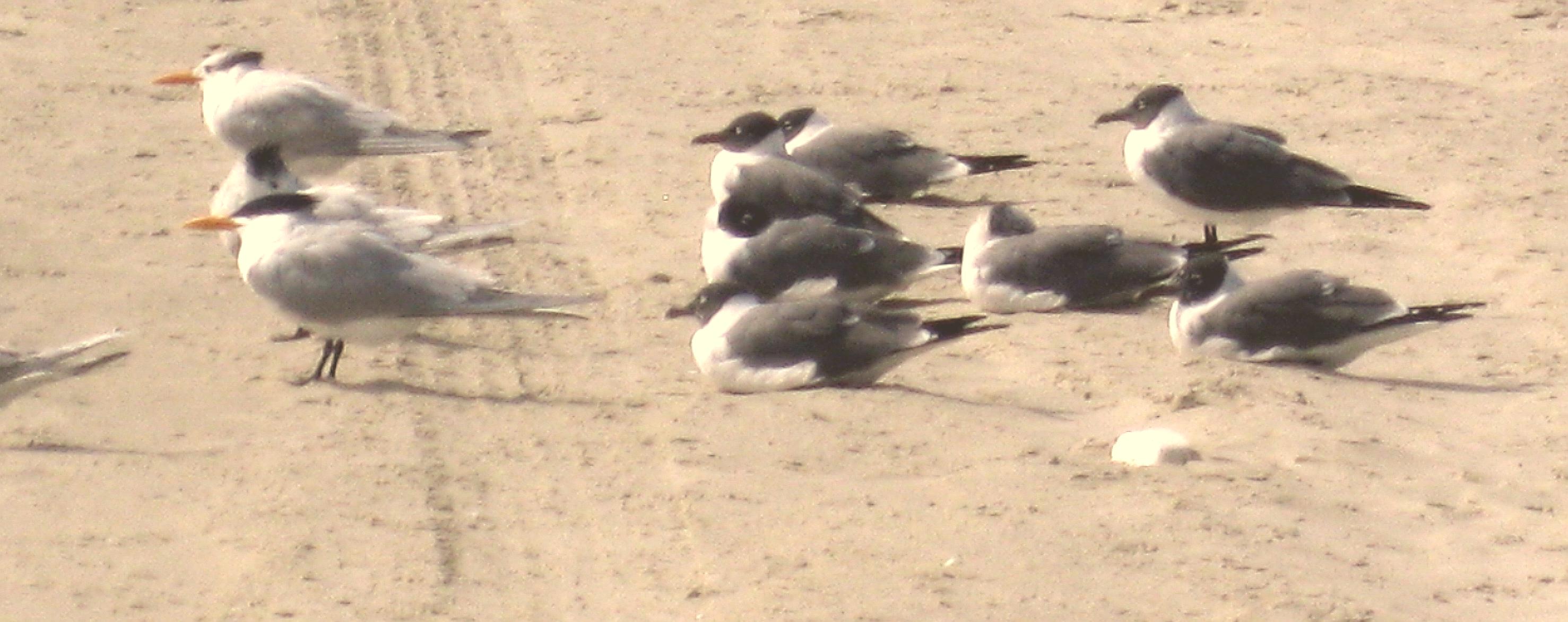
Laughing gulls and royal terns are common beach-side sides along the Blue Water Highway. -- Photo by Pat Bean
In Galveston, we walked along the sea wall, whose water-front sandy beach has been disappearing in recent years. Afterward, we stopped at the Rain Forest Cafe for dinner.
The cafe, which looks out on the Gulf and has an amazing rendition of an exploding volcano on its outside facade and a waterfall and computer animated wildlife on the inside is a popular place. We had an hour wait to be seated.
What helped make the wait worth the time was how the hostess finally announced that our table was ready.
“Bean, party of seven, your safari is ready to begin,” she said.
It seemed so apropos, as tomorrow Kim and I would fly to Africa and our safari would begin for real.
Next Episode: Flight to Nairobi
“It is good to have an end to journey toward; but it is the journey that matters.” — Ursula K. Le Guin
Pat Bean is a writer, avid birder, hiker and passionate nature observer with wanderlust in her soul. She spent nine years living and traveling in a small RV. She now lives in Tucson with Scamp, a rescue who was supposed to be a Schnauzer mix but turned out to be a Siberian Husky-Shih Tzu mix who is as stubborn as his owner, her granddaughter says. She was also a journalist for 37 years, and can be reached at patbean@msn.com
 | Rosepoint Publishing on A Two-Pronged History |
 | Dawn M. Miller on A Two-Pronged History |
 | ethel on A Two-Pronged History |
 | Linda Hoye on Perhaps Thinking is Overr… |
 | Susan Storyteller on Perhaps Thinking is Overr… |


 Pat Bean's blog