Feeds:
Posts
Comments

Bar Harbor, Maine

Bar Harbor park at the pier. — Photo by Pat Bean

“A minute of thought is greater than an hour of talk.” — John C. Maxwell

A Lesson in a Watchful Moment

I spent a week on Desert Island, home of Acadia National Park, at a campground  just outside of Bar Harbor, Maine. It was an awesome week that included visits to the park, a boat tour around Frenchman Bay, a lobster lunch at the pier, lots of bird watching, and free shuttle rides that let me explore the entire island while my canine companion stayed behind in Gypsy Lee, my small RV.

View from Acadia National Park on Desert Island in Maine. — Photo by Pat Bean

But travel is more than just being a tourist. And while I have fond memories of all the sights and activities I saw and did, when I think of Bar Harbor, the first thing I remember is watching two women trimming hedges on the village green, where I was waiting at the shuttle stop.

After the pair had finished, they walked to the other side of the street for an overall look back at their efforts. Their actions struck me as what should be a life axiom. Sometimes we need to stand back from our current activities and potential decisions so we can see the whole picture.

There have been many times in my life that I’m sure I would have made better decisions if I had done just that.

Bean Pat: Your voice https://www.janefriedman.com/you-have-a-voice-and-it-means-something/ I follow several blogs on writing, and this is one of my favorites – and most useful/

Pat Bean is a Lonely Planet Community Pathfinder, who spent nine years traveling North America from coast to coast and border to border in a small RV. You can read more about her Maine adventures in her book, Travels with Maggie, now up on Amazon at http://tinyurl.com/y8z7553y  You can contact her at patbean@msn.com
Birds: Ibises

“The soul becomes dyed with the color of its thoughts.” – Marcus Aurelius

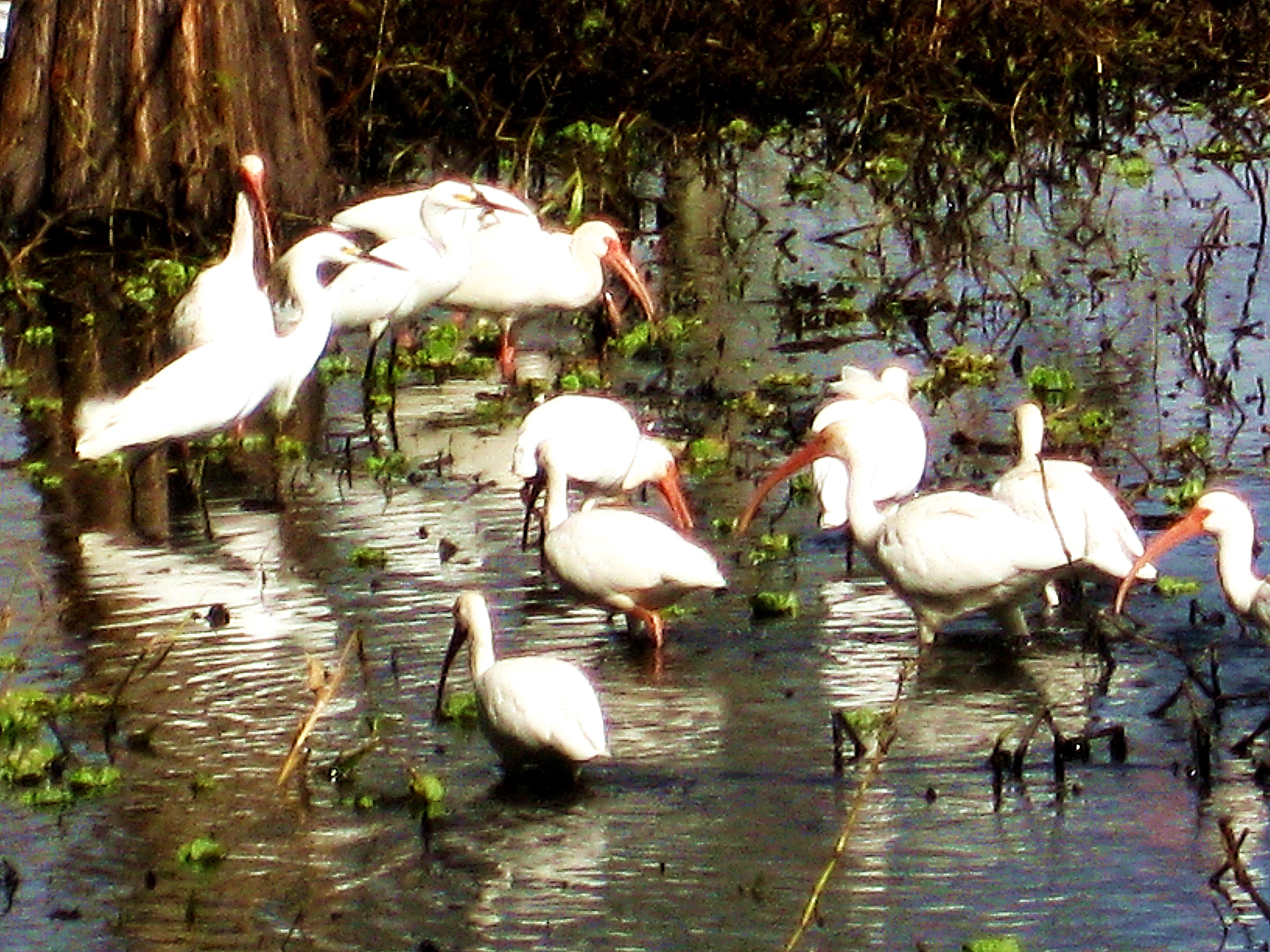
One is not like the other. Among this flock of white ibis at Brazos Bend State Park in Texas, is a lone snowy egret. — Photo by Pat Bean


One is Not Like the Other

I lived in Northern Utah – where you might see 463 different bird species – when I first started birding in 1999. The

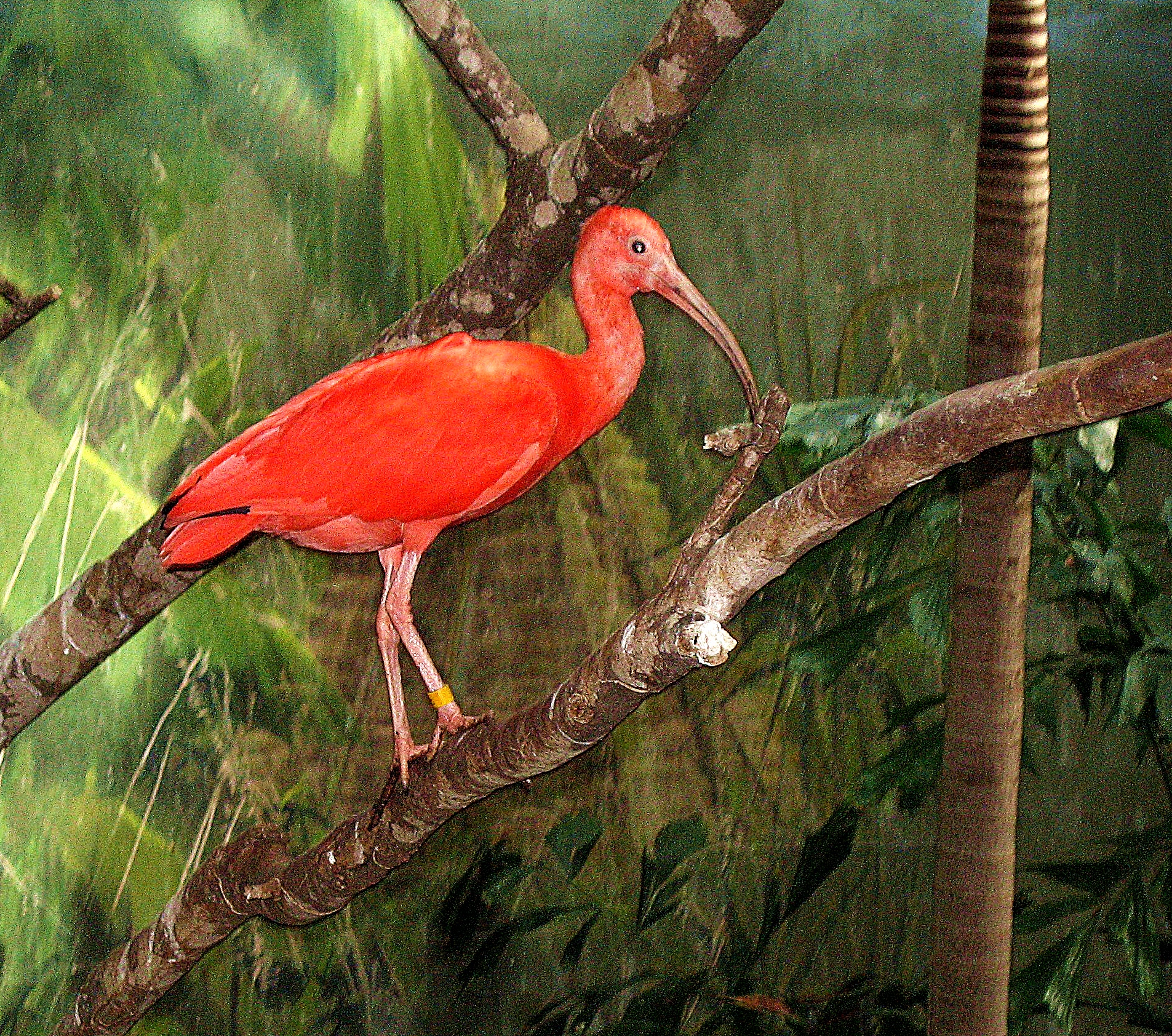
Scarlet Ibis at zoo in Dallas, Texas. — Photo by Pat Bean

white-faced ibis was one of the first ones to make my Life List. Like so many other strange things I was learning about birds, I couldn’t understand why this ibis one was so named. The amount of white on this long-legged, curved-bill bird was so tiny that I usually couldn’t see it with the naked eye, and not always with binoculars.

But this maroonish-brown shore bird, with flashes of green in its feathers, is fun to watch. I often saw flocks around the shallow waters of Great Salt Lake. Its distinctive profile, and the fact that it looks like a flying stick when in the air, makes it an easy bird to identify.

I saw my first white ibis, even easier to identify, and the second of

White-faced ibis ner the shoreline of Great Salt Lake.

America’s four species of ibis to make my list, in 2001, and my third, a glossy ibis, in 2005, both on Texas’ Gulf Coast. I have only seen the fourth, the scarlet ibis, in zoos and aviaries. This brilliant colored ibis only rarely visits North America from its habitats in the Caribbean and South America.

Two other ibises are also on my life list: the hadada and the sacred. The hadada ibis was the first bird I saw after landing in the middle of the night in Nairobi, Kenya. It was up a tree in the courtyard of the Norfolk Hotel. A few days later, I saw the sacred ibis in the Ngorongoro Crater in Tanzania.

Of the now estimated 10,000 birds in the world, 28 of these are ibises. Sadly, including the five ibis, (the scarlet ibis doesn’t count because I haven’t yet seen a wild one), I only have 710 birds on my Life List.  I guess this old broad still has a lot of birding to do.

Bean Pat: Gulls of the World http://www.10000birds.com/gulls-of-the-world-a-photographic-guide-a-gull-book-review.htm?utm_source=feedburner&utm_medium=feed&utm_campaign=Feed%3A+10000Birds+%2810%2C000+Birds%29  Just in case you’ve ever wondered what gull you are looking at.

Pat Bean is a Lonely Planet Community Pathfinder. Her book, Travels with Maggie, is now up on Amazon at http://tinyurl.com/y8z7553y  Currently, she is writing a book, tentatively titled Bird Droppings, which is about her late-bloomer birding adventures. You can contact her at patbean@msn.com
“There is nothing to writing. All you do is sit down at a typewriter and bleed.” – Ernest Hemingway.

The Good Old Days

So many writing quotes, like the one above by Hemingway, have become outdated. While I do know a few writers who still write their first drafts by hand, I know none who still use a typewriter. The computer has made that once miracle machine obsolete.

I vividly remember my first encounter with a computer. The year was 1978, and I was working as a reporter for the Fort Worth Star-Telegram. One day I was typing my stories on a typewriter, and the next day I was told that I had to use a computer.

My first thought was I can’t write on a computer. So, I continued writing my stories on a typewriter — and then retyping them into that dang computer. This lasted for about two weeks before I finally caught on to the fact I was doubling my work load.

A couple of years later, I accepted a job as features editor at the Standard-Examiner newspaper in Ogden, Utah, where I was introduced to a Mercenthaler computer system, which was always breaking down and eating my words. I blame it for teaching me how to cuss at the late-blooming age of 40.

During these years, I continued using my old Remington typewriter at home for my personal writing. By 1985, however, the difference in the feel of the two keyboards forced me to give in and buy my first home computer, one that didn’t have a hard drive, but ran on floppy disks. Every couple of years after that I upgraded to a newer computer.

I bought my first laptop, paying $2,300 for a top-of-the-line machine in 2004, the week I retired from journalism so I could continue to freelance while I traveled the country in my small RV with my canine companion Maggie. For two years, I used my phone as a modem to connect to the world, but then I got my own hot spot. Comcast is the provider of my current Wi-Fi system, and costs me $70 a month.

My current laptop, a Toshiba I bought in 2011 for $800, and which is the longest lasting computer I have ever had, is just about ready for replacement.

Today, I don’t just use a computer as a writing tool, but also to do research, stream movies and tv, play games, stay in contact with family and friends, read the news, and to export my freelance articles directly to magazines and publishers, which is what I did when I finished my book, Travels with Maggie.

I went from wondering what in the heck I was going to do with a computer, to wondering how I can live without one. Ditto for air conditioning — I lived on the Texas Gulf Coast in the 1950’s without it.

I also grew up knowing how to change a tire on my car because tires were not as reliable as they are today, and we didn’t have mobile phones.

Yup. My world has changed a lot. Perhaps the good old days are here and now — or waiting for us in the future.

Bean Pat: Pileated woodpecker https://belindagroverphotography.com/2018/06/03/young-pileated-woodpecker-three-photographs/

Now available on Amazon

One of my favorite photography blogs. And an amazing bird that catches my breath every time I see one.

Pat Bean is a Lonely Planet Community Pathfinder. Her book, Travels with Maggie, is now up on Amazon at http://tinyurl.com/y8z7553y  Currently, she is writing a book, tentatively titled Bird Droppings, which is about her late-bloomer birding adventures. You can contact her at patbean@msn.com

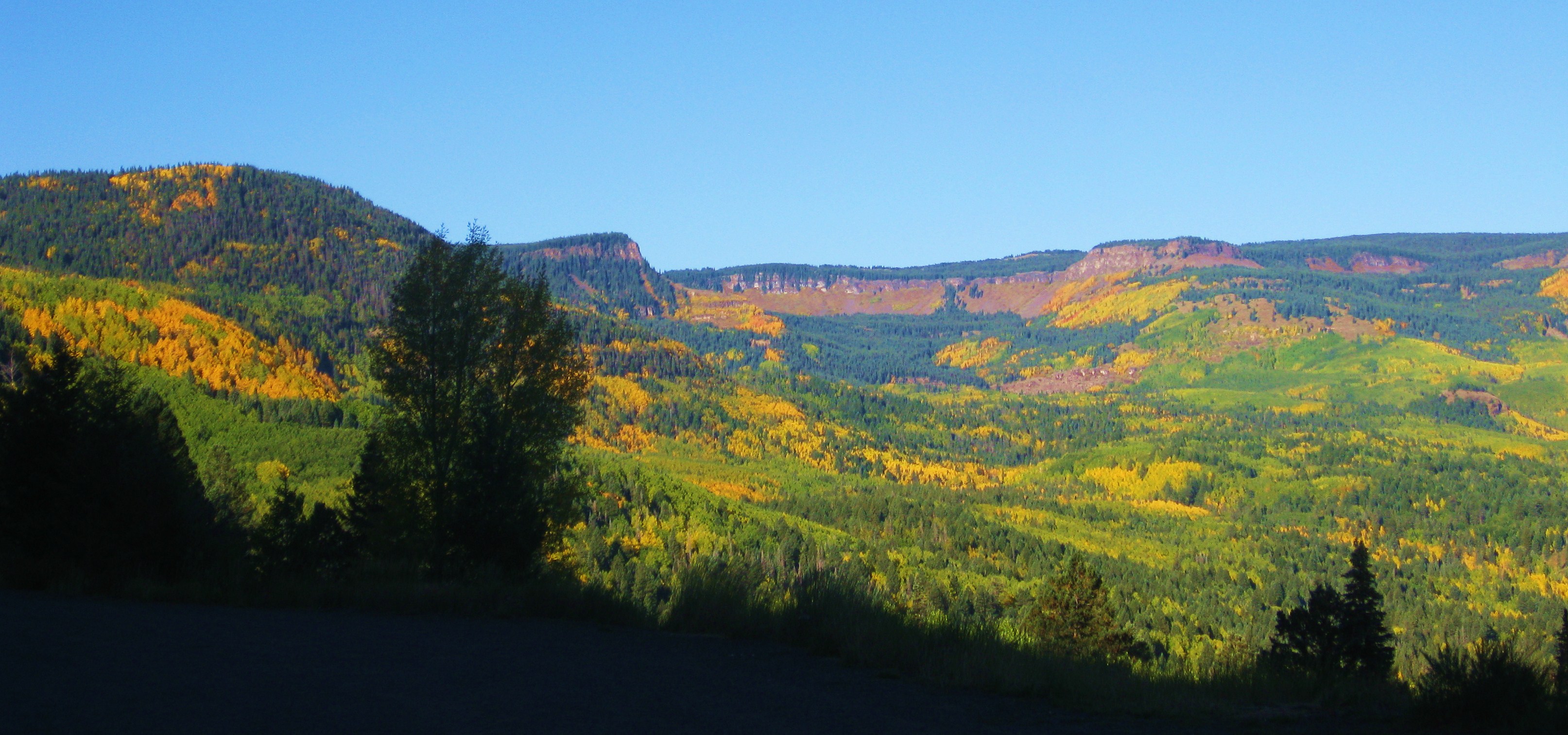
View looking down Conejos Canyon. — Photo by Pat Bean

“The more I draw and write, the more I realize that accidents are a necessary part of any creative act, much more so than logic or wisdom. Sometimes a mistake is the only way of arriving at an original concept, and the history of successful inventions is full of mishaps, serendipity and unintended results.” — Shaun Tan

Following the Road 

Hmmm. I think I took a wrong turn a couple of dozen miles back. — Photo by Pat Bean

One lovely fall day a few years back, I took a wrong turn in Chama, New Mexico, a quaint village with a population of not much more than a thousand residents. After a bit of exploring the town’s charm by dawn’s light, I set off again toward my Texas destination.

My lack of directional sense, however, sent me driving in the opposite direction.

It was an awesome drive, and my fascination with the scenery distracted me so much that it wasn’t until I was near the top of Cumbres Pass, high in the San Juan Mountains, that I realized my mistake.

Instead of backtracking, I decided to simply continue on and discover what else the road had in store for me this day. While I usually carefully charted my daily routes during this  wandering without deadlines period in my life, I occasionally let the road decide my path.

However, with scenery like this, I think I’ll just keep going. — Photo by Pat Bean

This day was one of those, and I soon found myself in Conejos Canyon, one of the wildest places in the United States, and where grizzly bears once roamed.  I have seen a gazillion stunning landscapes in my travels across North America, but this day’s drive might have topped them all with its kaleidoscope of color and surprises.

I learned early on not to bemoan my flawed sense of direction, but to enjoy the unexpected wonders it brought. This day made me especially thankful for the lacking gene – and also for my willingness to simply go with the flow.

Bean Pat: Paperback Reader https://dereid99.wordpress.com/2018/05/24/paperback-reader/  Usually it’s just the opposite, so this tickled my funny bone.

Pat Bean is a Lonely Planet Community Pathfinder. Her book, Travels with Maggie, is now up on Amazon at http://tinyurl.com/y8z7553y  Currently, she is writing a book, tentatively titled Bird Droppings, which is about her late-bloomer birding adventures. You can contact her at patbean@msn.com

“Stop waiting for the perfect day, or the perfect moment … Take this day, this moment and lead it to perfection. – Steve Maraboli

Red-headed woodpecker. — Wikimedia photo

A Page From my May 2005 Journal 

            I was sitting on a bluff above the Oauchita River in Camden, Arkansas, listening to bird song. Low clouds still carried the pink glow of the rising sun, and I watched as the airy cotton-like puffs transformed, first to golden and then to the blue tinge of the morning sky. It was cool and a gentle breeze ruffled tree leaves. All around me were clumps of wisteria, a vigorous tree-climbing vine with drooping lilac-hued blossoms that scented the morning air. Here and there, small dogwood trees with their dainty white flowers added to the enchantment of the landscape. .

Morning sky beside the Oauchita River in Arkansas. — Photo by Pat Bean

I was sitting where once stood a Confederate fort, aptly named Lookout because it provided the perfect spot to keep an eye on the river below.  It was also this very same bluff that had been visited in 1541 by the Spanish explorer, Hernando De Soto. I thought about all this as I surveyed the landscape from my blanketed, cocooned perch in a lawn chair. All troubles, politics and wars of the world were put on hold….

Then I heard a tap-tap-tap coming from a grove of trees. I had seen northern flickers and downy woodpeckers in the area and assumed it was one of them. Instead, I got a nice surprise. I found myself looking at a red-headed woodpecker. Because there is no gender field mark in this species, as there are in many birds, it could have been either a male or female.

The bird was in a typical woodpecker stance, with its strong opposing talons gripping the tree trunk while it leaned back on its stiff tail. It’s head and throat were a brilliant shade of red, in stark contrast to the bluish-black and white feathers that covered the rest of its body.

I watched until the woodpecker flew off across the river, after turning an ordinary morning into an extraordinary one, a perfect start for the day. From their hiding places, a host of other birds chattered, whistled, twittered and sang in agreement.

Bean Pat: The planning fallacy https://tierneycreates.com/2018/05/15/the-planning-fallacy/?wref=pil This made me laugh because it’s so true of my own planning in whatever endeavor.

Blog pick of the day.

Pat Bean: is a Lonely Planet Community Pathfinder. Her book, Travels with Maggie, is now up on Amazon at http://tinyurl.com/y8z7553y  Currently, she is writing a book, tentatively titled Bird Droppings, which is about her late-bloomer birding adventures. You can contact her at patbean@msn.com


The Write Words


“Writing is an exploration. You start with nothing and learn as you go.”  — E.L. Doctorow


Some days when the butt doesn’t want to sit in the chair,, I doodle around with art while standing in front of a tall table. Art by Pat Bean 

The First Rule of Writing

I’ve sat in front of a typewriter, or a computer, almost every day now for over half a century. Sometimes my fingers fly across the keyboard in an effort to keep up with words bursting with eagerness to get out of my brain. Other times, the words come at the rate of a dying clock.

As long as the words keep coming, I feel good. It’s the days when I forget the first rule of writing that leaves me in the dumps.  A writer needs to write, so that first rule of writing is simple Butt in Chair.

But some days I have to trick myself into getting it there. So, I tell myself to simply write one sentence, and then go walk the dog. Then, write a second sentence and water the plants. Usually by the third or fourth sentence my butt actually stays in the chair for a few more sentences, and the essay, blog or book review that is my current work in progress eventually gets done.

Thank gawd!

Bean Pat: Flamingos in Bolivia https://bellaremyphotography.com/2018/05/14/flamingos-in-bolivia/#like-15644 A great arm-chair travel treat.

Pat Bean: is a Lonely Planet Community Pathfinder. Her book, Travels with Maggie, is now up on Amazon at http://tinyurl.com/y8z7553y  Currently, she is writing a book, tentatively titled Bird Droppings, which is about her late-bloomer birding adventures. You can contact her at patbean@msn.com
Looking out over the Badlands in South Dakota. — Photo by Pat Bean

“History is a cyclic poem written by time upon the memories of man.” – Percy Bysshe Shelley

And Touching History

I have sat in the Old North Church in Boston, a landmark of the American Revolution. I have stood where Americans shed blood fighting each other over the issue of slavery. I have floated down the Mississippi River in a steamboat in the wake of Mark Twain. I have shed tears while standing in front of the black Lincoln in which JFK was riding when he was fatally shot. And I have walked on an Atlantic Beach near where The Virginia Company made its first landing in the New World.

In other words, I have traveled.

The Mark Twain Bridge over the Mississippi River at Hannibal, Missouri — Photo by Pat Bean

But it’s only now that I am coming to realize just how much history I was touching during the nine years I crisscrossed this country in a small RV – from ocean to ocean and border to border. Back then I was more interested in finding birds, camping beside a lake, admiring Mother Nature’s art, and exploring new hiking trails. Learning about history was never foremost in my mind.

My reasons for taking to the road, after retiring from my 37-year journalism career, were to satisfy my lifelong wanderlust and to see America’s wondrous landscapes – from gawking at a sunset over the Pacific from a cliff-top campground in Oregon, to wandering through the South Dakota badlands on a day so windy that my RV did a rock-and-roll dance.  Satisfying my late-blooming bird-watching addiction was an unexpected surprise bonus.

Yet looking back now, I realize that the history of the sites I visited almost always prompted additional research that ended up being what I wrote about in my blogs and in my book, Travels with Maggie.

I came to realize early on that travel is as much about discovering oneself as it is about seeing new vistas and meeting new people. So, it seems strange that I am only just now realizing how much traveling is also like taking a ride in a time machine through the pages of history.

Bean Pat: Don’t take life too seriously https://bebloggerofficial.com/2018/05/11/dont-take-life-too-seriously/  Good advice, especially these days.

Pat Bean: is a Lonely Planet Community Pathfinder. Her book, Travels with Maggie, is now up on Amazon at http://tinyurl.com/y8z7553y  Currently, she is writing a book, tentatively titled Bird Droppings, which is about her late-bloomer birding adventures. You can contact her at patbean@msn.com

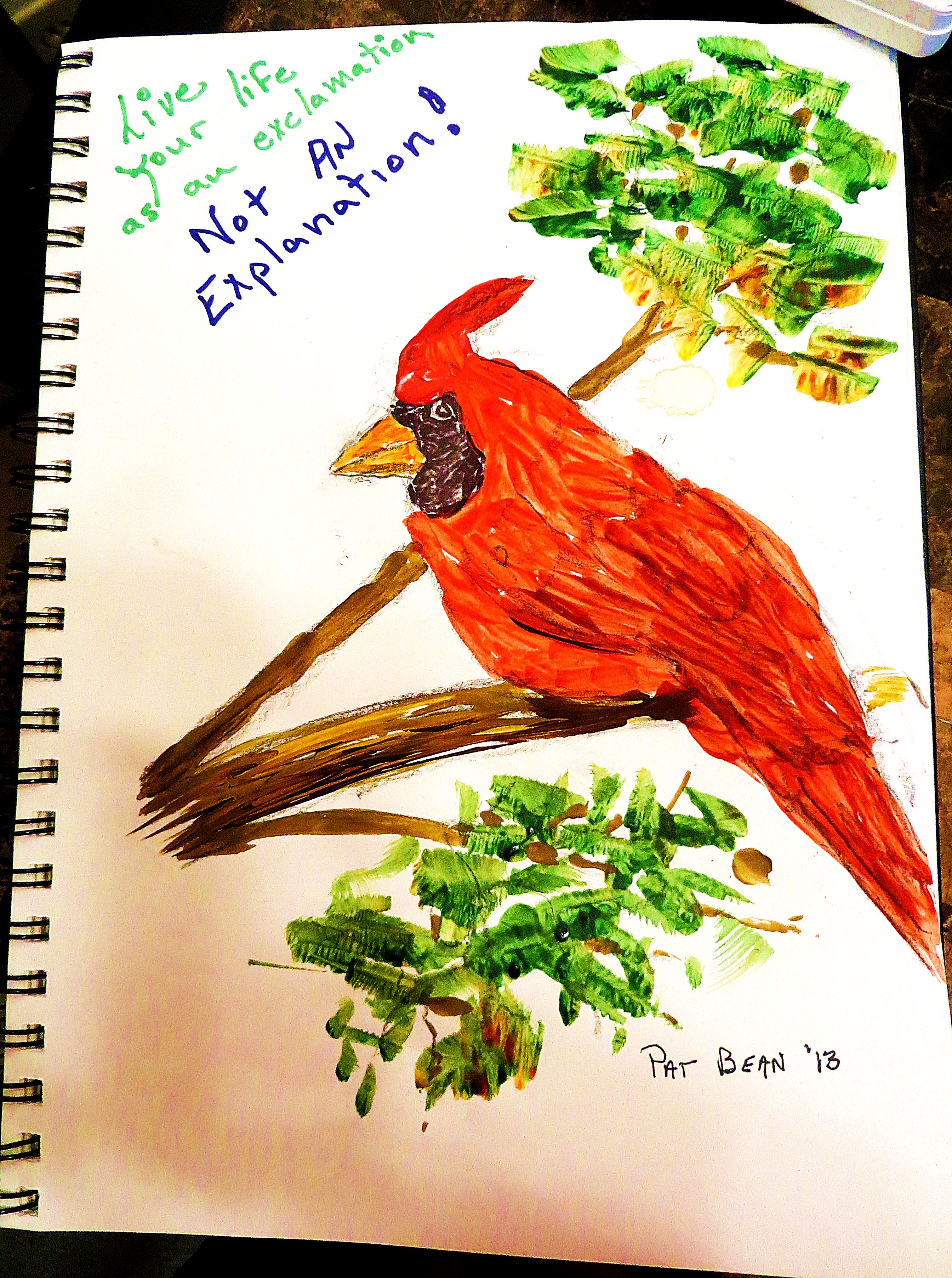
A Red Bird!!!!!

“It is better to know some of the questions than all of the answers.” – James Thurber

A page from one of my journals. — Sketch by Pat Bean

Northern Cardinal? Or Hepatic Tanager?

“I just saw a brilliant red cardinal on my way over,” my friend, Jean, said, a couple of days ago.

Hepatic tanager. — Wikimedia photo

“What color was its beak?” I asked, since I had earlier in the day identified a hepatic tanager flying about. Both the cardinal and the hepatic, well at least the males, are a dazzling red.

“Don’t confuse me! It was a cardinal. Its beak was black … now I don’t want to talk about birds,” she said, and continued on with her idea of a more interesting conversation. And I must admit, my friend is an interesting conversationalist – and chatterbox.

Jean, meanwhile, isn’t the only one I sometimes annoy with my obsession about identifying birds. I have sometimes annoyed other friends … and sometimes my kids … and probably strangers, as well. But this time, since I didn’t want to further annoy Jean, I didn’t continue on and tell her that if the bird had a black beak it wasn’t a cardinal. They have orange bills.

I thought of this brief interchange this morning when I sat on my balcony and saw a bright flash of red whiz past and land in a tree behind a fresh crop of spring-green leaves. I never did see its beak.

Now I’m going to annoy myself all day wondering if the bird was a cardinal or a tanager.  What can I say? I’m a crazy birder – and I love that I am.

Now available on Amazon

Bean Pat: Howard Prairie Lake https://anotefromabroad.com/2018/05/03/howard-prairie-lake-southern-oregon/ My kind of day. Nature, peaceful hike and educational. I learned what a morel mushroom looks like.

Pat Bean: is a Lonely Planet Community Pathfinder. Her book, Travels with Maggie, is now up on Amazon at http://tinyurl.com/y8z7553y  Currently, she is writing a book, tentatively titled Bird Droppings, which is about her late-bloomer birding adventures. You can contact her at patbean@msn.com

The Right Words: Voice

            “Words mean more than what is set down on paper. It takes the human voice to infuse them with deeper meaning.” – Maya Angelou

Fence and blue flowers … Painting by Pat Bean

It Wasn’t Easy Finding Mine

When I wrote the first draft of Travels with Maggie, I was inflicted with 37 years of personal journalism ethics that required me to keep my opinions out of any newspaper story I wrote.  But the book I was writing was all about me, and my RV travels as a lone woman living on the road with only a small canine companion.

Now available on Amazon

I believed my writing was good, but I knew something was not quite right. Still, after the draft was completed, I entered it into a Mayborn non-fiction competition, where it came in as one of the best top 10 entries. The ranking entitled me to be part of a workshop with nine other writers who would all critique each of the book proposals. I received excellent comments from the other writers on mine — with one exception. They almost all said my proposed book lacked voice.

I immediately knew they were right. I also realized that the few times I had tried to interject voice into the writing, I had tried to deny that I was the old broad I had become, and not the sexier hiker and white-water rafter I once had been. Now I’ve discovered that being an old broad is still sexy – in a way that has nothing to do with actual sex.

Anyway, it took me four more drafts before I sufficiently found my voice. Along the way, I did a lot of soul-searching that also let me realize that the voice of an old broad, who had fully experienced life, was the much better choice for the narration of Travels with Maggie.

Bean Pat: Silence https://bebloggerofficial.com/2018/04/23/the-lost-art-of-silence/ I share this blog today because I have come to enjoy silence’s rare moments, and have learned how much those moments enrich my life.

Blog pick of the day.

Pat Bean: is a Lonely Planet Community Pathfinder. Her book, Travels with Maggie, is now up on Amazon at http://tinyurl.com/y8z7553y  Currently, she is writing a book, tentatively titled Bird Droppings, which is about her late-bloomer birding adventures. You can contact her at patbean@msn.com


 “Maybe you weren’t born with a silver spoon in your mouth, but like every American, you carry a deed to 635 million acres of public lands.”  — John Garamend

Dragon Mouth Spring in Yellowstone. — Photo by Pat Bean


For over 20 years I lived just five hours away from Yellowstone. I’ve visited this national treasure over 25 times, long enough to see Mother Nature redecorate and remodel her landscape.

Black Dragon Caldron, which can also be seen along the Mud Volcano Trail. — Photo by Pat Bean


The changes have been many, but one that has been personal to me are the changes that took place at Dragon Mouth’s Spring. I first saw this steam-spurting, hissing feature in the late 1960s. It is located along the Mud Volcano Trail, a 2/3-mile loop through a varied landscape of mud pots and geysers.

It was easy for me, the first time I saw this sight, to imagine a dragon huffing and puffing as steam and water sloshed out from the entrance to a small cavern. But each time I revisited, which I always did when in Yellowstone, the dragon seemed mellower than the time before. And the dark green boiling water of the spring, which was easily envisioned as acidic dragon slime, began turning a bubbling light gray, the color of my hair today.

Interpretive sign along Mud Volcano Trail. — Photo by Pat Bean

Scientists reported the changes, but weren’t exactly sure why the dragon had stopped huffing and puffing so strenuously

As I watched the dragon settle, I began to imagine it as an old broad like me, no longer always on the run, but settling into contentment with no need to continually prove one’s worth — and with time to simply enjoy life.

So, it was that each time I hiked the Mud Volcano Trail, I took more and more time to enjoy the sights along the remainder of the trail, and not just the more memorable dragon. Each hike seemed to offer a new surprise: a fox lazing beneath a tree barely visible through my binoculars, a Clark’s nutcracker flying between hillside trees, the yellow hues of rocks painted by the minerals whose aroma taints the air with rotten eggs.

I can’t imagine visiting Yellowstone without revisiting the Mud Volcano Trail. While not as colorful as the Fountain Paint Pot Trail, or as spectacular as the geyser-dotted trail to Morning Glory Pool – which of course I can’t miss either – there be a dragon that calls to me.

Bean Pat: Boondocking https://nomadadvocate.wordpress.com/2018/04/18/boondocking-love-it-or-hate-it/   I boondocked at Lone Rock at Lake Powell the very first night I spent in my RV. What a wonderful time. And this blog brought back all those good memories.

Pat Bean: is a Lonely Planet Community Pathfinder. Her book, Travels with Maggie, is now up on Amazon at http://tinyurl.com/y8z7553y  Currently, she is writing a book, tentatively titled Bird Droppings, which is about her late-bloomer birding adventures. You can contact her at patbean@msn.com