Feeds:
Posts
Comments

“When the man walked up he said, ‘What is Wild Dog doing here?’ And the Woman said, ‘His name is not Wild Dog any more, but the First Friend, because he will be our friend for always and always and always.” — Barbara Kingsolver.

I knew it had gotten too quiet. — Photo by Pat Bean

It’s morning. My coffee is brewing. I am sitting at my computer checking email while waiting for it to be ready. It is quiet. I look down.

The scene is easily described in two words: New Puppy.

And now you know why I renamed him Scamp.

*Available on Amazon, 

Bean Pat: Reading with a dog. http://lindahoye.com/readingunwanted/

Pat Bean is a retired journalist who lives in Tucson. She is a wondering-wanderer, avid reader, Lonely Planet Community Pathfinder, Story Circle Network board member, author of Travels with Maggie available on Amazon, enthusiastic birder and is always searching for life’s silver lining. She can be reached at patbean@msn.com
 

And Maiden to Crone

Happiness is a butterfly, which when pursued is always just beyond your grasp, but which if you will sit down quietly may alight upon you.” — Nathaniel Hawthorne

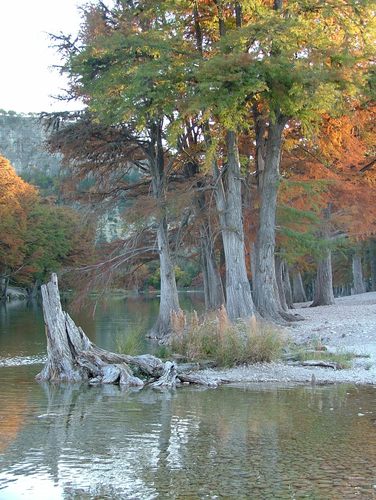
Bald cypress trees along the Frio River at Texas’ Garner State Park. — Wikimedia photo by John Bonzo

I was camping at Garner State Park, back in my full-time RV-ing days, looking for birds when I came upon one of nature’s many surprises.

Pipevine Swallowtail Butterfly — Photo by Pat Bean

Chomping down on tiny ground plants hidden among the short grass were a dozen or so pipevine swallowtail larvae. That morning, I had seen, and photographed, the end result of all this chomping and transformation business, an awesome pipevine swallowtail butterfly.
To become that beautiful butterfly, it had to first give up being a caterpillar.

I thought about this as one of those lessons Mother Nature shows us if we look to her for advice. Just as the landscape and wildlife change from season to season – the land from green to white between summer and winter, and birds molt their feathers for drabber ones and foxes change their fur color, so we

Pipevine larva

are changing with the years.
There are even names for the female cycle, maiden, mother and crone. I’m definitely in the latter cycle right now, although I prefer the term old broad to crone. I’m the butterfly to the caterpillar. I like thinking of myself that way. While time may have left me a bit worn and tattered, happiness has alighted upon my shoulder with the quietness and beauty of a butterfly.

And now this wandering-wondering old broad wonders if the butterfly enjoys its final cycle as much as I am enjoying mine.

Bean Pat: Nature has No Boss https://naturehasnoboss.com/2019/06/12/luminous/#like-12113 Yellow is my favorite color

The Book

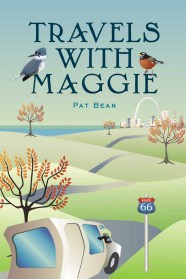
*Available on Amazon, Travels with Maggie features a list of birds saw each leg of the journey.

Pat Bean is a retired journalist who lives in Tucson. She is a wondering-wanderer, avid reader, Lonely Planet Community Pathfinder, Story Circle Network board member, author of Travels with Maggie available on Amazon, enthusiastic birder and is always searching for life’s silver lining. She can be reached at patbean@msn.com
 

Mornings with Scamp

“I have always been delighted at the prospect of a new day, a fresh try, one more start, with perhaps a bit of magic waiting somewhere behind the morning.” — J.B. Priestley 

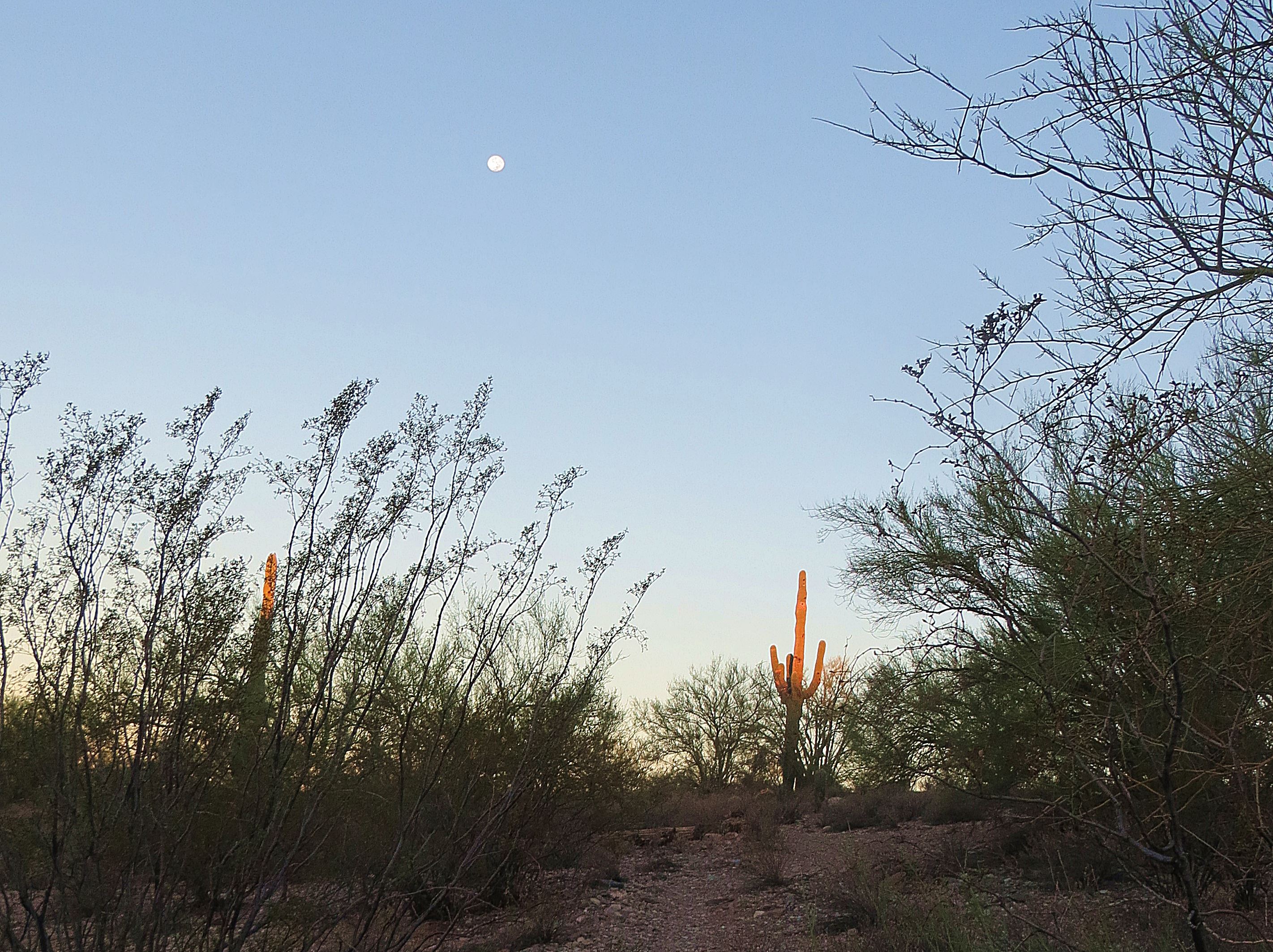
Morning coming over the desert behind my apartment complex in the Cataline Foothills in Tucson. — Photo by Pat Bean

Sunshine and Doves

I’m a morning person, most often up before the sun peeks above the horizon. At the first upward flick of an eyelid, I’m ready and eager to bounce out of bed. It’s as if I can’t wait to discover what surprises the day will bring. It probably helps that I an optimist who usually thinks all glasses are half full and not half empty.

Scamp, with his head cocked in curiosity. — Photo by Shanna Lee

“I have always been delighted at the prospect of a new day, a frsh try, one more start, with perhaps a bit of magic waiting somewhere behind the morning.” — J.B. Priestley

This early morning exuberance has not helped me win friends over the years, especially among coworkers who only came to life just before quitting time. It might have helped if I hadn’t always been so verbosely cheerful, but the bratty kid in me was usually in charge.

My early morning enthusiasm these days, however, is greeted with equal enthusiasm from my new canine companion Scamp, who in my introductory blog https://patbean.net/2019/05/13/loss-and-joy-and-a-true-friend/  about him, I then called Harley.

He was called Smidge at the shelter when I adopted him, then Harley by me because I simply liked the name and couldn’t think of a better one – until a few days ago.  He was acting like a scamp, and I realized that he actually looked a bit like the dog Scamp in Disney’s movie “Lady and the Tramp.” This is particularly true of his silver-gray coloring and the cute way he cocks his head when looking at you.

Scamp reminds me of Scamp in Disney’s Lady and the Tramp.

The name fit like a paw in wet cement — perfectly.

When I first got Smidge/Harley/Scamp on May 11, I had to walk him almost hourly as he hadn’t been house-trained, although he was eight months old.  The walk schedule is now up to about every three hours, and he is sleeping all through the night. I am very happy, wildly happy, to say Scamp was a quick learner and we haven’t had an accident in over a week. Now if I could just teach him the meaning of the word NO!

But when he and I wake up, we are both ready to get outdoors and watch the sun come up. Well, I like to watch the sunrise, Scamp likes to chase the mourning doves that are still snoozing on the ground. The important thing is mornings make both of us happy.

Life is good.

Bean Pat:  Badlands National Park https://anotefromabroad.com/2019/06/10/south-dakota-badlands-national-park/  One of my favorite places.

Blog pick of the day.

Pat Bean is a retired journalist who lives in Tucson. She is a wondering-wanderer, avid reader, Lonely Planet Community Pathfinder, Story Circle Network board member, author of Travels with Maggie available on Amazon, enthusiastic birder and is always searching for life’s silver lining. She can be reached at patbean@msn.com

             “Color is a power which directly influences the soul.” – Wassily Kandinsky

Painted bunting — Wikimedia photo

The Bunting Came with a Bonus

Back in my early birding days, I spent some time at Texas’ Cedar Hill State Park near Dallas in search of a painted

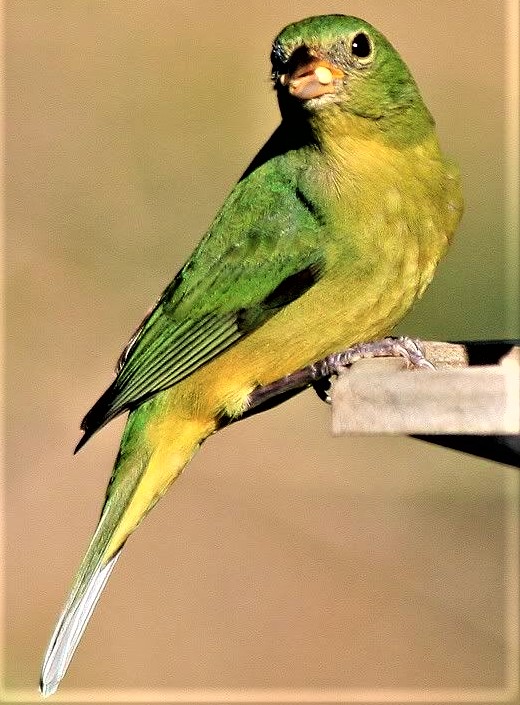
Female painted bunting. — Wikimedia photo

bunting. It took three days of breaking spider webs on trails in the early mornings, and one day of slogging through the mud after a night of rain, but I eventually found one of these clownish-colored birds.

When in the open, you can’t miss the adult male.  He has a bright blue head, a scarlet breast, a green back, and a red rump. The female and first-year males are more subdued, dressed in shades of green, with the breast leaning toward yellow on the color wheel. These birds, however, feel more comfortable when ensconced in thick foliage, thus my difficulty in finding one.

The colorful bird I finally found on my fourth day of looking was an easily identifiable adult male perched in a tree near a small pond.  The painted bunting became bird species No. 383 on my life list (which now numbers 710). The painted bunting is nicknamed nonpareil (without equal) in French and mariposa pintado (painted butterfly) in Spanish because of its spectacular appearance.

Appropriately, a group of painted buntings is called a mural or a palette.

Green heron — Wikimedia photo

Sad to say, the bird’s beauty made it a popular caged bird until its capture and captivity became illegal in the United States. It is still, however, a hot item with the international pet trade, and the birds are particularly popular as pets in Asia and Europe, which may be one of the reasons its numbers are dwindling.

Meanwhile, as I was enjoying my front-row view of the Cedar Hill painted bunting years ago, it was suddenly displaced on the limb by another bird. I would have been upset, except this bird was a green heron – bird species No. 384.

Some days, life is really good.

Bean Pat: Traveling with dogs. https://jamieandthedogs.wordpress.com/2019/06/05/yep-just-me-and-four-dogs-heading-east/  This reminds me of my years on the road in my small RV, only I just had one dog.

*Available on Amazon, Travels with Maggie features a list of birds saw each leg of the journey.

Pat Bean is a retired journalist who lives in Tucson. She is a wondering-wanderer, avid reader, Lonely Planet Community Pathfinder, Story Circle Network board member, author of Travels with Maggie available on Amazon, enthusiastic birder and is always searching for life’s silver lining. She can be reached at patbean@msn.com

            “The daily hummingbird assaults existence with improbability.” Ursula K. Le Guin

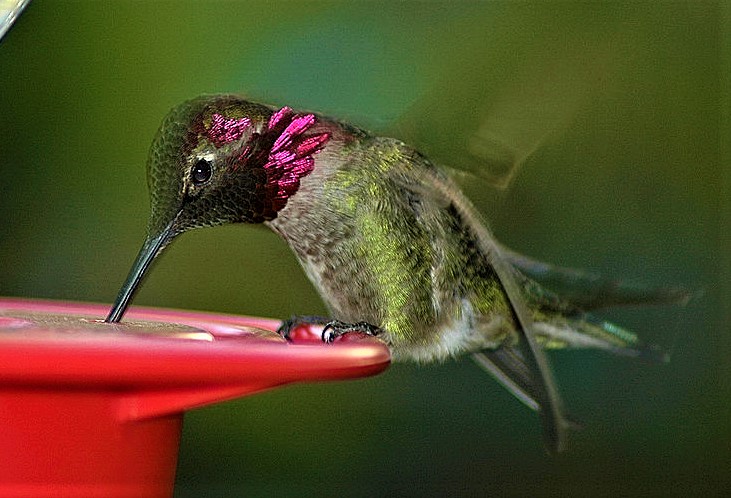
Male Anna’s hummingbird. — Wikimedia photo

A Constant Delight at my Nectar Feeder

            If you want to see hummingbirds in North America, then Southeastern Arizona is the best place to be. While there are over 300 species of hummingbirds that can be found in South America, only about 17 come north across the Mexican border. Of that number, at least 13 of these species can be found around Tucson, where I currently live.

Female Anna’s hummingbird — Wikimedia photo

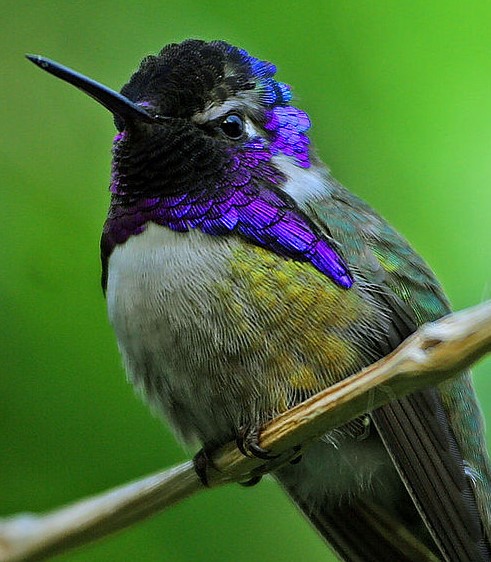
In my home state of Texas, the only hummingbird I would likely see is the ruby-throated.  Here in Tucson, I get six species regularly visiting my third-floor balcony nectar feeder every year: broad-billed, black-chinned, Costa’s, Anna’s, broad-tailed and rufous. Although it didn’t come to my feeder, I even spotted a Lucifer hummingbird in the tree next to my balcony two years ago. That was a life bird for me, and a one-time event so far in my life.

Of the hummingbirds that visit my apartment, I may only see one or two rufous during an entire year. The other five, however, are more common, especially Anna’s. This feisty little bird doesn’t migrate so I get to see it almost daily throughout the year.

The females are dainty things, with glittering green and white feathers with perhaps a few sparkling magenta gems around their necks. The

I saw my first Costa;s hummingbird from my third-floor Tucson balcony. — Wikimedia photo

males are agile dive bombers who guard my nectar feeder against other hummers, and they have brilliant crimson-red crowns and necks that shimmer in the sunlight. I never tire of watching them.

Perhaps because Anna’s favorite food is nectar from feeders put out by humans, they have had no problem surviving loss of habitat, as so many other birds have. In the early 20th century, Anna’s could only be found on the Baja California Peninsula but they have slowly been spreading northward and inward.

The hummers were named after Anna Massena, Duchess of Rivoli. Why? This wondering-wanderer immediately asks. I didn’t find the answer. Do you know?

Bean Pat: https://naturehasnoboss.com/2019/06/04/as-the-snow-melts/  It’s time to visit Yellowstone.

*Available on Amazon, Travels with Maggie features a list of birds saw each leg of the journey.

Pat Bean is a retired journalist who lives in Tucson. She is a wondering-wanderer, avid reader, Lonely Planet Community Pathfinder, Story Circle Network board member, author of Travels with Maggie available on Amazon, enthusiastic birder and is always searching for life’s silver lining. She can be reached at patbean@msn.com

Keeping Bird Lists 

Black-bellied whistling ducks at Brazos Bend State Park. — Photo by Pat Bean

I first started keeping a list of all the bird species I saw in 1999. Sadly, that was after I had visited Hawaii and a few other hot birding places or my list might be much longer today. My world list of bird species currently totals 710.

It’s not a particularly awesome number, but it’s still growing. The list pleases me, as I suspect the list President Theodore Roosevelt put together of the birds he saw during his White House occupancy pleased him.

Spotting the pink of a lone roseate spoonbill, as Lewis and I did among a flock of white ibis, was pure delight. — Photo by Pat Bean

I only recently learned of Teddy’s list, which was printed in 1910 by Audubon’s magazine, Bird-Lore.  Of course, I had to check it out, and so can you at:  https://www.birdnote.org/blog/2014/04/president-theodore-roosevelts-bird-checklist-white-house

The White House list contains 93 birds, of which I have seen all but five. I’m still looking for a saw-whet owl, a whippoorwill, an orchard oriole, a Cape May warbler and a Kentucky warbler.

When I first started birding, I kept individual lists of the birds I saw on each field outing, later adding any new ones to my life list. Most of those lists have disappeared, making me as sad as Darwin was about not separating the bird specimens that he collected on the first two Galapagos Islands he visited. He had simply assumed the species would not differ from island to island – but they did.

Wiser now, with 20 years of birding behind me, I add field trip bird lists directly into my journals.* Such a practice let me compare my last two Texas Gulf Coast bird outings with my son, Lewis, who shares my birding addiction.

A flock of white ibis at Brazos Bend State Park. — Photo by Pat Bean

The first field trip was on a very hot July 11th day in 2018, with high humidity and mosquitos, when we birded the Bay City Bird Sanctuary in a golf cart, followed by a quick drive through San Bernard National Wildlife Refuge.  We saw only 19 bird species, the best sighting being that of a Cooper’s hawk circling above the wooded path we were driving on.

The most recent outing took place on May 2 this month, when we briefly explored the Elm Lake Trail at Brazos Bend State Park, drove through Brazoria National Wildlife Refuge (where Lewis and I had our first bird outing and he began his life list with a summer tanager), then watched birds as we ate lunch at Pirates Cove on Surfside Beach. This time our list numbered 47 for the morning, the final bird being a reddish egret at Christmas Bay off the coastal Blue Water Highway between Freeport and Galveston.

While this was a better birding day, it was still nowhere near the record 100 birds Lewis and I once saw in a single day birding the same area. The recordings of these more recent bird days in my journals are alike, however, in one aspect. Both contained entries that noted the best part of the day was simply getting to spend time with my son.

Bean Pat: Cadillac Ranch and Palo Duro Canyon https://anotefromabroad.com/2019/05/22/texas-cadillac-ranch-and-palo-duro-canyon/#like-108774 Two of this native Texan’s favorite places. One for laughs and the other for peace, nature and bird-watching.

*Available on Amazon, Travels with Maggie features a list of birds saw each leg of the journey.

Pat Bean is a retired journalist who lives in Tucson. She is a wondering-wanderer, avid reader, Lonely Planet Community Pathfinder, Story Circle Network board member, author of Travels with Maggie available on Amazon, enthusiastic birder and is always searching for life’s silver lining. She can be reached at patbean@msn.com
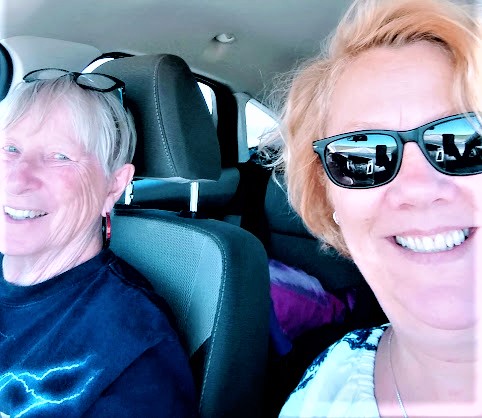
“Before you get a dog, you can’t quite imagine what living with one might be like; afterwards, you can’t imagine living any other way.” – Caroline Knapp

His name was Smidge at the animal shelter. He’s now mine and I call him Harley.

My New Dog, Harley

Almost two months ago, I lost my canine companion Pepper. It was a sad time in my life, but almost immediately I began looking for a new dog to rescue. Sadly, I discovered the shelters were filled with pit-bull mixes and chihuahuas, while I wanted a 20 to 30-pound female dog, as I have always owned, one full of energy and life and love.

I finally put a notice on Facebook asking friends if they knew of a dog that needed rescuing, and almost immediately received a picture of Wilma, who seemed perfect. But after I had filled out a ridiculously long adoption application, I was notified that someone else’s application was accepted over mine.

Harley likes laying by the patio door so he can listen to all the outside activity here at my apartment complex.

Then early Thursday morning, when I opened my email, I was informed that Suzanne, the mother of one of my best friends in the world, had tagged me in a Facebook post. When I checked it out, I saw the dog, then called Smidge, you see above. I immediately knew that was the dog for me – and soon I started crying, which is how my friend Jean found me when she dropped off her dog Dusty, whom I watch during the day while Jean works.

Like me, Dusty has been grieving for our beloved Pepper, The two were besties who had played together almost daily for five years.

“So why are you crying?” Jean asked. I want this dog, I said, as I showed her the photo, and she (at that time I thought it was a she) is at a shelter in Ogden, Utah, 800 miles away. I had already called my friend, Kim, who lives in Ogden, and my former coworker, Charlie. Kim didn’t answer her phone and Charlie said he would love to go get the dog for me except he just had a shoulder replacement and couldn’t drive.

I was pondering who else to call in Ogden, where I lived and worked for 25 years, when Kim woke up and called me back, asking what the emergency was, noting that I had called her four times. After I explained, she said, “I’m on my way to the shelter now.”

And it was a good thing she was, because just minutes after she arrived and asked to see Smidge, and took the dog out for a walk to see how it behaved. another woman showed up wanting to adopt him.

After walking him, Kim called and said the dog seemed perfect although he was a male. “Do you still want him?  “She asked. I did.

So, she got him, kept him Friday, and Saturday drove 300 miles south with him to her brother’s house in St. George, Utah, while I drove 500 miles north to St. George. Talk about a good friend! I am truly blessed.

And she was right about Smidge, who now is called Harley, although his puppy ways might get him nicknamed Dufus. He is perfect — well almost.

He’s seven months old, still with a puppy’s chewing ways, weighs 18 pounds, but looks bigger because he badly needs a haircut, and I have to have him neutered within the next 30 days as part of the adoption agreement. But he’s mostly house trained, loves to cuddle and wants to greet and play with every person and dog he meets, which was a Pepper trait that I dearly loved. He also likes to play tug of war with my socks when I’m putting them on.

Edith Wharton said her little dog was a “heartbeat to her feet.” Since Harley now follows me everywhere, that fits him, too. Just having him around has already made my heart beat happier.

Bean Pat: Mothers and Daughters https://onewomansday.wordpress.com/2019/05/13/may-13-that-baby-stuff/  A Mother’s Day blog

Pat Bean is a retired journalist who lives in Tucson. She is a wondering-wanderer, avid reader, Lonely Planet Community Pathfinder, Story Circle Network board member, author of Travels with Maggie available on Amazon, enthusiastic birder and is always searching for life’s silver lining. She is also currently looking for a new canine companion. She can be reached at patbean@msn.com

An overcast day at Brazoria National Wildlife Refuge. — Photo by Pat Bean

 “To my mind, the greatest reward and luxury of travel is to be able to experience everyday things as if for the first time, to be in a position in which almost nothing is so familiar it is taken for granted.” -Bill Bryson

Road Trip: June 21 – July 6, 2002

In Dallas, I found myself visiting the Museum of Natural History, which is located on the Texas State Fairgrounds, with my youngest daughter T.C. and her oldest daughter Heidi, and my oldest grandson David and his then-girlfriend. I know this because there is a photo of them in my journal in front of the museum.

A postcard of the Dallas Museum of History from my 2002 journal. Sadly, the museum is now closed.

I also took some photos of the museum’s bird dioramas because this trip was as much about seeing birds as it was spending time with family. And I noted in my journal, that this morning of June 25 began with me adding a blue jay to my life list. The blue jay is common in Texas, and I saw many growing up, but not a bird normally found in Northern Utah where I had done the majority of my birding after joining the ranks of birdwatchers in 1999.

I’m sure I had a delightful visit with family in Dallas, but I didn’t write anything more about it other than the birds I saw and a bit about the museum outing. While I write in my journal almost daily these days, in earlier years there are big holes in my recorded thoughts.

A quick blue jay drawing by me from my journal.

I wrote quite a bit in the 2002 trip journal, however, about my visit to Lake Jackson to see my son, Lewis and his family – perhaps because it included a landmark moment that turned my son into as addicted a birdwatcher as his mom.

It was a dreary morning, with rain threatening, but Lewis said: “Come on. I want to see what this bird-watching hullabaloo, or something to that effect, is all about. The two of us then drove to the Brazoria National Wildlife Refuge that was less than 15 minutes away.

The first bird we saw on this overcast day, just as we entered the refuge grounds, was a red male (females are yellow) summer tanager, a showy bird that was impressive enough to interest even a non-birder like Lewis.

It was while I was oohing and aaahing over a yellow-crowned night heron that Lewis asked me what the large bird sitting near the pond was. I glanced over and saw that it was a double-crested cormorant, a bird that I had seen many times – or so I thought.

Instead of answering him — after all the yellow-crowned was a new night heron for me as I had only seen the black-crowned – I tossed him my bird field guide, saying, “See for yourself,” and went back to studying the heron. A couple of minutes later, Lewis said, “It’s a neotropic cormorant.”

“What!” I turned my binoculars from the heron to the cormorant and realized he was right. This is the moment Lewis claims as addicting him to birding. I’m so glad for that moment, and not just because the neotropic was another life bird for my list.

Lewis and I will get to go bird-watching together once again during my upcoming trip to Texas. We probably won’t see 100 bird species as we identified on a past April marathon day of birding, but we’ll surely make good memories that I can record in my journal.

Bean Pat: Retronaut https://considerable.com/the-gargoyles-of-notre-dame-witnesses-to-so-much/  The gargoyles of Notre Dame Cathedral.

Pat Bean is a retired journalist who lives in Tucson. She is a wondering-wanderer, avid reader, Lonely Planet Community Pathfinder, Story Circle Network board member, author of Travels with Maggie available on Amazon, enthusiastic birder and is always searching for life’s silver lining. She can be reached at patbean@msn.com
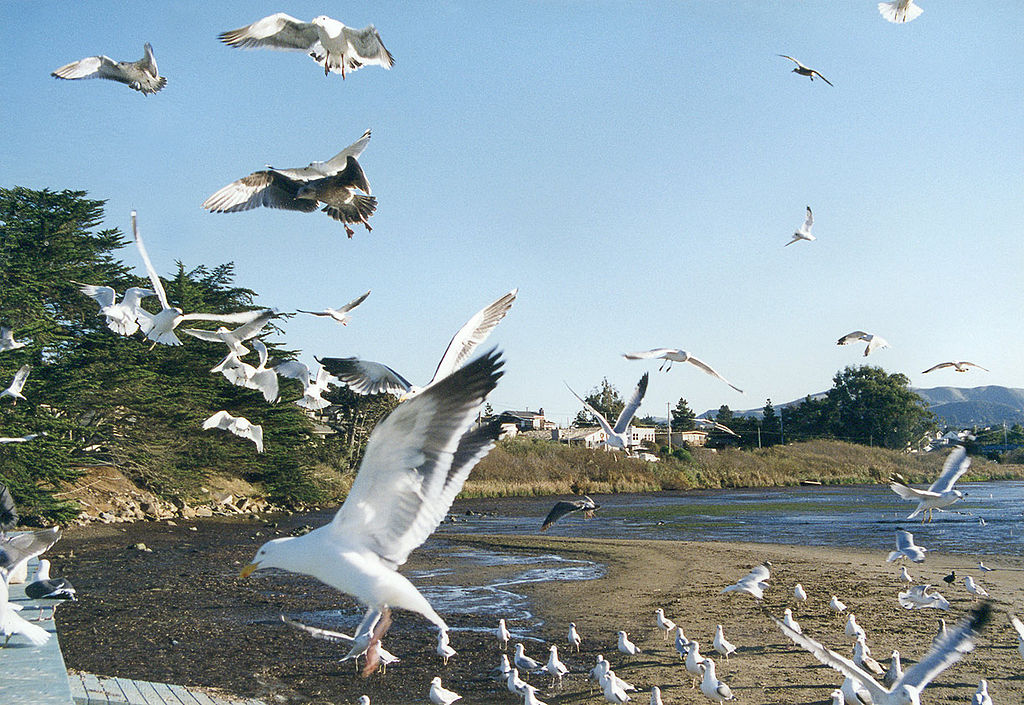
Texas Bluebonnets

The bluebonnet is “a kind of floral trademark almost as well known to outsiders as Cowboy boots and the Stetson hat,” —  Texas historian Jack Maguire.

Texas bluebonnets. — Photo by Pat Bean

Road Trip: June 21 – July 26, 2002

My next journal entry takes me into Texas, my home state where the majority of my family still lives. Today, that includes three of my five children, 11 of my 15 grandchildren, and five of my seven great-grandchildren.

In 2002, however, the numbers were fewer and I only had to visit Dallas, Fort Hood, and Lake Jackson to see them all. This coming Thursday, I’m flying home to Dallas, where I was born, and then will rent a car for trips to San Antonio, Lake Jackson, and West Columbia to see all my Texas family, except one granddaughter who will be on a delayed honeymoon to Disneyland in Florida.

I’m excited to be going at this time because this is prime bluebonnet season. However, I noted in my 2002 road trip journal that one of the first things I saw when I crossed the border from New Mexico into Texas were bluebonnets, even though it was then late June.

Texas late singing governor W. Lee O’Daniel (1939-41), sang; “You may be on the plains or the mountains or down where the sea breezes blow, but bluebonnets are one of the prime factors that make the state the most beautiful in the land that we know.”

Indian paintbrush is often seen blooming with bluebonnets. — Photo by Pat Bean

The bluebonnet, all five varieties of them, are Texas’ state flower. And thanks to former First Lady Ladybird Johnson, the roadsides are abundant with them. She encouraged Texans to toss flower seeds all across the state – and they did. But how all five bluebonnets became the state flower makes for a good Texas tall tale.

According to the Aggie Horticulture web site, the story goes like this:

In the spring of 1901, the Texas Legislature got down to the serious business of selecting a state flower, and the ensuing battle was hot and heavy. One legislator spoke emotionally in favor of the cotton boll, since cotton was king in Texas in those days. Another, a young man from Uvalde, extolled the virtues of the cactus so eloquently that he earned the nickname of “Cactus Jack,” which stuck with him for the rest of his life. He was John Nance Garner who later became vice president of the United States.

But the National Society of Colonial Dames of America in Texas won the day. Their choice was Lupinus subcarnosus, generally known as buffalo clover or bluebonnet. And that’s when the polite bluebonnet war was started.

While you’re looking for bluebonnets, don’t miss the butterflies, like this swallowtail at Brazos Bend State Park.

Lupinus subcarnosus is a dainty little plant which paints the sandy, rolling hills of coastal and southern Texas with sheets of royal-blue in the early spring. But some folks thought it was the least attractive of the Texas bluebonnets. They wanted Lupinus texensis, the showier, bolder bluebonnet. So, off and on for 70 years, the Legislature was encouraged to correct its oversight. But the solons weren’t about to get caught in another botanical trap, nor did they want to offend the supporters of Lupinus subcarnosus. They finally solved the problem with typical political maneuvering.

In 1971, the Legislature added the two species together, plus any other variety of bluebonnet not heretofore recorded, and lumped them all into one state flower. What the many things the Legislature did not know then was that Texas is home to three other species of lupines and the umbrella clause makes all five of them the state flower.

A bit of interesting history that I only learned when doing some research for this blog. It adds a bit of pondering to my upcoming bluebonnet viewing.

Bean Pat: Sunrise at Bryce Canyon http://www.trailsunblazed.com/sunrise-at-bryce-canyon/ One of my favorite places.

Pat Bean is a retired journalist who lives in Tucson. She is a wondering-wanderer, avid reader, Lonely Planet Community Pathfinder, Story Circle Network board member, author of Travels with Maggie available on Amazon, enthusiastic birder and is always searching for life’s silver lining. She is also currently looking for a new canine companion. She can be reached at patbean@msn.com

“I chose the road less traveled. And now I’m lost.” — Darynda Jones

Living Desert Zoo and Gardens, Carlsbad, New Mexico

Road Trip June 21 — July 6, 2002

If you’re in Carlsbad, New Mexico, the No. 1 place to visit is Carlsbad Caverns National Park. But since I had already done this, I decided to forgo the cave tour and instead visit the city’s Living Desert Zoo and Gardens. It was a good choice as I added three new bird species to my life list — and got an educational experience about the landscape, plants, and animals of the Chihuahuan Desert.

Barn owl. — Wikimedia photo

It was late afternoon when I arrived, giving me only a couple of hours to walk the 1.3 loop trail around the park’s variety of desert habitats that included sandhills, marsh areas and arroyos. But it was a good time to see daytime birds getting ready to nest for the night, or nighttime birds coming awake for their night of activity.

The first stop was an aviary near the visitor center that featured native birds of prey including golden and bald eagles. While these were fun to see, it was the birds that flew free around the avian-friendly park that interested me more. One of these, a barn owl flew right in front of me as I rounded a curve in the trail, which I seemed to have all to myself. A little farther on, a couple of scaled quail scurried off when they saw me coming, but not before I had a satisfying look at them.

Because back then I was still new to birding, both of these species were lifers for my growing bird list. So were the common nighthawks skimming the water at Waterfowl Pond near the prairie dog homes. I easily identified the nighthawks, well after a quick look at my bird field guide, by the broad white stripes visible near their wing tips as they flew.

Bank swallow

Also circling around the ponds were quite a few cliff and bank swallows. I had seen quite a few of these birds during trips to Bear River Migratory Bird Refuge in Northern Utah. On one outing there had been a huge flock of five species of swallows circling around and under a small bridge. I had spent hours learning how to tell them apart. The bank and swift swallows, I had decided were the easiest to identify.

The bank swallow has a gray, necklace-like stripe on its white breast, which I came to think of as a banker’s bow tie. The mature cliff swallow, meanwhile, has a prominent white spot on its bluish-black head that flashes when its flying toward you. 

Other birds I saw as I followed the winding trail through the desert landscape included a Harris hawk, burrowing owls, black-chinned hummingbirds and an Eastern kingbird. It was a delightful late afternoon that ended far too quickly.

According to my journal notes, I paid a $4 entrance fee to be admitted to the park. I certainly got my money’s worth, and I noted that the admission fee today is only $1 more. A bargain I would say.

Available on Amazon

Bean Pat: Seaman https://sarah-angleton.com/2019/04/11/a-classy-post-about-a-loyal-dog-with-an-unfortunate-name. A dog story and a travel story in one, and it made me smile.

Pat Bean is a retired journalist who lives in Tucson. She is a wondering-wanderer, avid reader, Lonely Planet Community Pathfinder, Story Circle Network board member, author of Travels with Maggie available on Amazon, enthusiastic birder and is always searching for life’s silver lining. She is also currently looking for a new canine companion. She can be reached at patbean@msn.com