Feeds:
Posts
Comments

Stupid Birds … Or Not

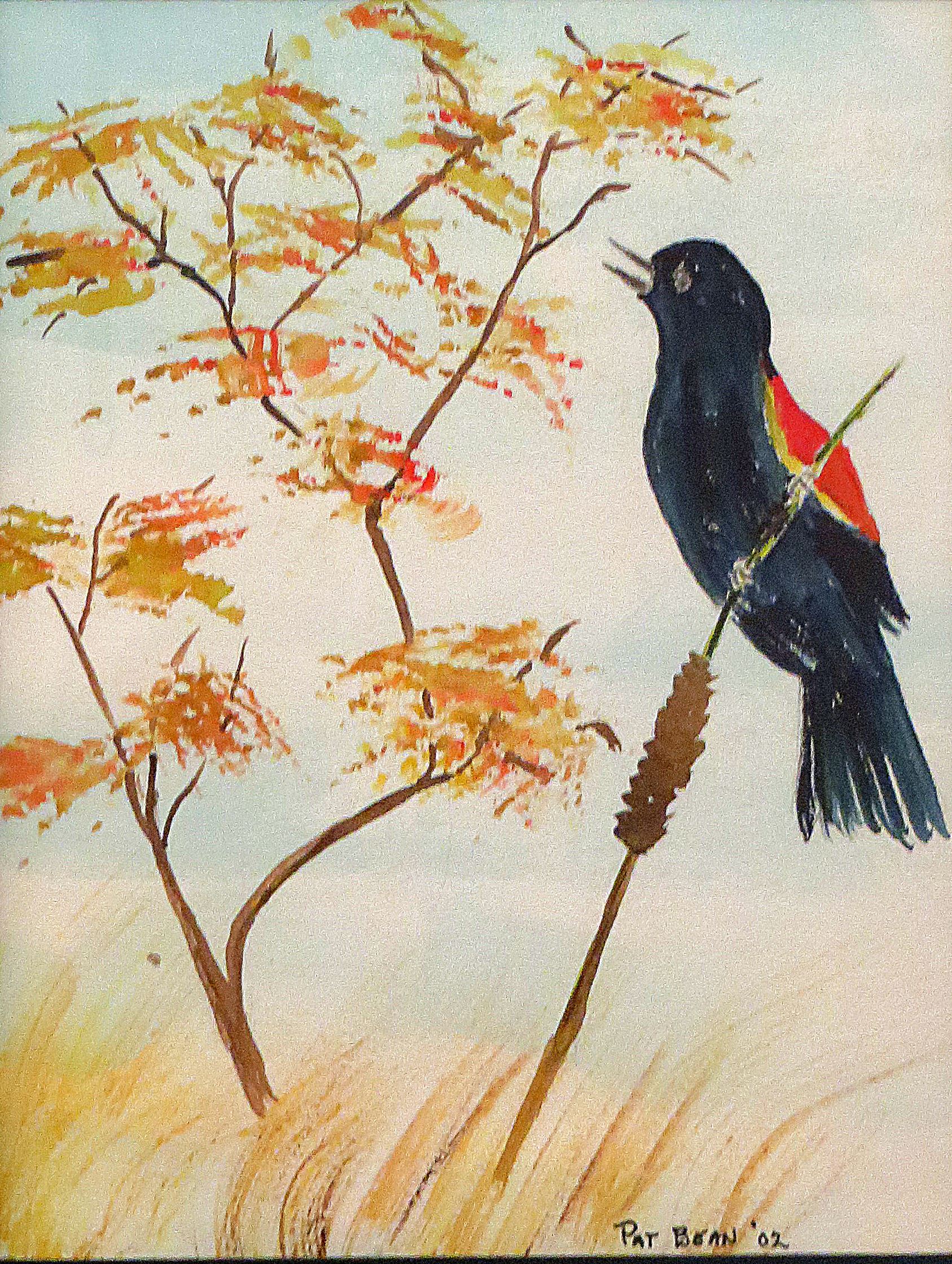
I sketched this red-winged blackbird on an outing to Antelope Island in Utah’s Great Salt Lake on one of bird outings.

An old friend, whom I often dragged on many of my bird outings, told me that he only liked seeing the big birds. Translated that meant such birds as great blue herons, tundra swans, bald eagles and double-crested cormorants, all frequent sights around Northern Utah’s Great Salt Lake and Bear River areas where I frequently used to go to watch birds.

His comments were also a gently hint to me that he didn’t enjoy standing around for hours trying to get a glimpse of and identify any small bird that preferred to stay out of sight – like the tiny ruby-crowned kinglets that never stopped moving as they flitted between thick tree foliage, or the marsh wrens that sang duets from their hiding places in a patch of phragmite or cattails.

I thought about that while reading May Sarton’s Journal of a Solitude with my morning coffee. She was an avid gardener and also one who kept a supply of seed on hand to feed wild birds. But for this April day entry, May had noted that there were only starlings, red-winged blackbirds and cowbirds at the feeder. “Too stupid,” she wrote.

Now as much as I’m a May Sarton fan, I think she misspoke here. I think her disgust was not because these are stupid birds, but because they are some of the birds that everyone can see almost daily in this country, from ocean to ocean and border to border.

 Here in Tucson, I have three bird species that I see every day: house sparrows and mourning doves when I take my canine companion Scamp for his first walk of the day, and an Anna’s Hummingbird that tries to guard the nectar feeder hanging on my balcony every day from all intruders.

 When I also catch a glimpse of a bright yellow and black American goldfinch, or a Cooper’s hawk skimming overhead, my morning walk seems more special. Like this morning when a broad-billed hummingbird visited my balcony feeder. While the broad-billed is not as brightly colored as the Anna’s – the male of which has brilliant magenta head feathers – I was more thrilled because I don’t see this species every day.

 We humans are a funny lot. Perhaps we are more stupid than the birds. For sure we’re not so fond of the saying: “A bird in the hand is worth two in the bush.

And just what does that mean anyway?

Pat Bean is a retired award-winning journalist who lives in Tucson with her canine companion, Scamp. She is a wondering-wanderer, avid reader, enthusiastic birder, Lonely Planet Community Pathfinder, Story Circle Network board member, author of Travels with Maggie available on Amazon (Free on Kindle Unlimited), and is always searching for life’s silver lining.


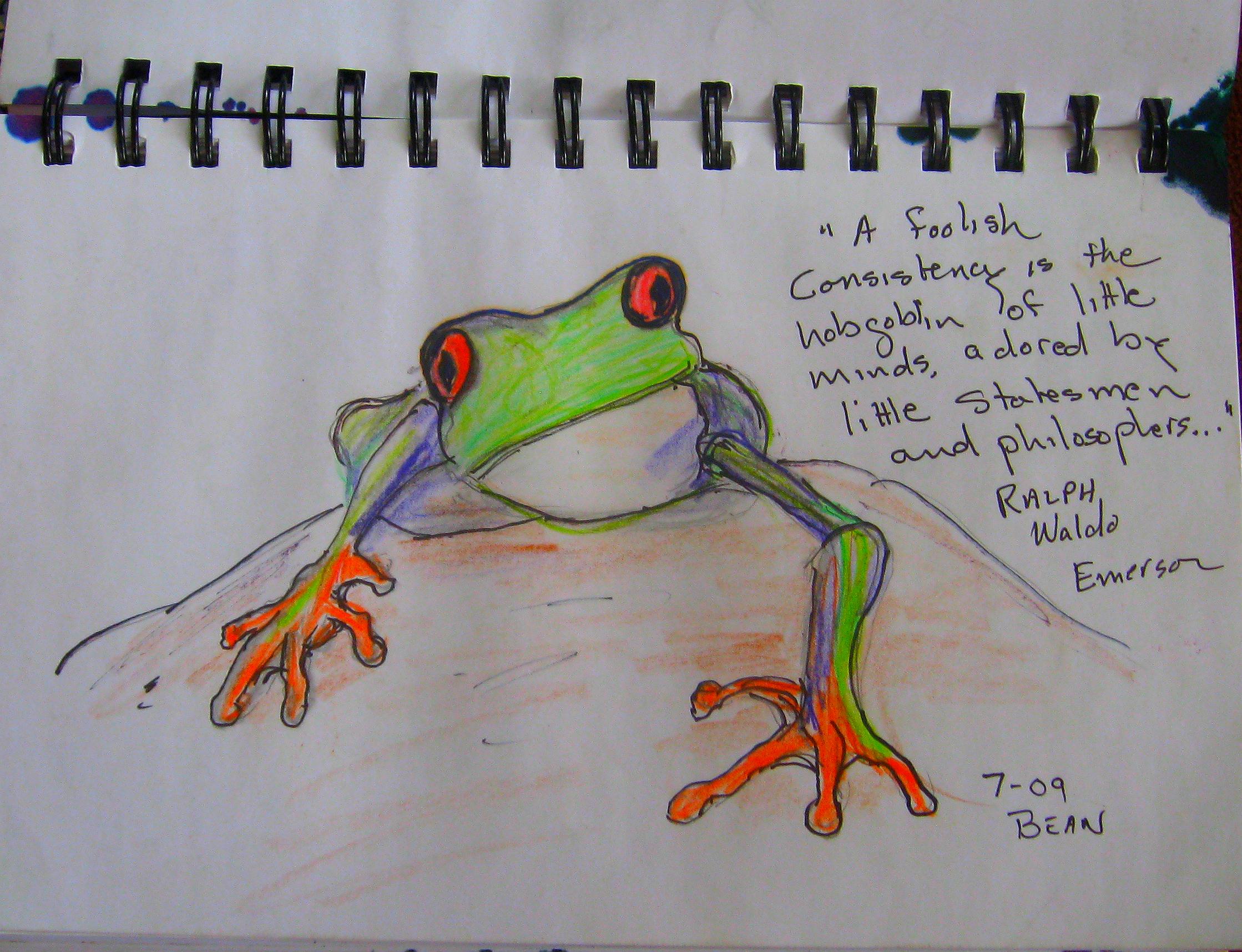
A page from an earlier journal containing quotes from another author.

I’m listening to Madeleine Albright’s Hell and Other Destinations, and finding lots of wisdom, humor and thoughts that I want to add to my journal. It was my book of choice with morning coffee today.

One incident Madeleine, who narrates the book, said, had me laughing. So, I turned off my Kindle and wrote down what I recalled about it. I wrote: “When a woman asked Madeleine if she were proud of herself for not getting a facelift, Madeline said she wished she had asked the woman if she was proud of the results of hers.”

The quotes indicated the exact words I wrote in my journal. After turning my Kindle back on, and relistening to the incident, I realized I hadn’t quoted Madeleine correctly. Here’s what she actually said about the incident.

“When at a party, a woman, half socialite half journalist, told me how brave she thought I had been for not getting a facelift, I was tempted to comment on the courage she had shown in dealing with the results of hers.”

I relistened to the recording several times to make sure I finally got it correct.

This incident brought up one of my former journalist mantras. “Just because you heard what I said doesn’t mean you heard what I said.” Much less understood what was said.

It also reaffirmed my understanding of why the stories of my five children, who all participated in the same activity or incident at the same time, varies in five different ways — and all five are different from mine.

It’s a miracle the world is not in more chaos than it is.

Pat Bean is a retired award-winning journalist who lives in Tucson with her canine companion, Scamp. She is a wondering-wanderer, avid reader, enthusiastic birder, Lonely Planet Community Pathfinder, Story Circle Network board member, author of Travels with Maggie available on Amazon (Free on Kindle Unlimited), and is always searching for life’s silver lining.
Refinding My Mojo

Watching — and drawing — birds is good for my mojo. Art by Pat Bean

          My mojo is in the toilet because of Covid isolation – for the second time given the Delta variant going around strongly here in Tucson. Because I’m 82, even my good friends and family, who are daily out in the world –including one who is a teacher and had had six students come down with Covid within a week of school starting – are staying away from me.

          I’m a social person and it is getting to me. And then there is what’s going on in the world with war and politics. Keeping up with current events is a downer, but closing a blind eye is not an option for this former journalist.

          Ok. Enough is enough.

It’s time to start counting my blessings. That always helps.

          Beginning with the basics: I have a comfortable roof over my head, more than enough food to eat, air conditioning to keep the Sonoran Desert heat at bay, money enough to at least buy a book when I want it, decent health insurance, and I’m loved.

          I have a fantastic canine companion, beautiful views of both sunrises and sunsets, heated water for a bath every night, internet access to the world, birds to watch from my third-story balcony, and an inquisitive mind that usually keeps me from ever becoming bored.

          I’m the last person in the world who should be feeling sorry for herself.

           Even isolation hasn’t been all bad. It’s given me time to learn how much I do enjoy my own company. I just don’t want it to go on forever. Plus, I still believe in silver linings.

          One has to be out there — somewhere.  

           Pat Bean is a retired award-winning journalist who lives in Tucson with her canine companion, Scamp. She is a wondering-wanderer, avid reader, enthusiastic birder, Lonely Planet Community Pathfinder, Story Circle Network board member, author of Travels with Maggie available on Amazon (Free on Kindle Unlimited), and is always searching for life’s silver lining.

An up close look at a pair of Eurasian Wigeons. — Wikimedia photo

          I was a reporter following former Congressman Jim Hansen around for the day for a newspaper story back in the early 1990s, during which we stopped for lunch at the Bear River Duck Club near Northern Utah’s Bear River Migratory Bird Refuge.

          As Hansen and I stepped outside to take in the birdy wetlands view after our meal, a number of nearby members of the club — locally known as the Millionaire’s Duck Club because of the status of its members — suddenly became animated and excited. One of them, looking in our direction, shouted: “Hey Jim!  There’s a Eurasian Wigeon among that flock of ducks out there.” It was a quite rare find for Utah, I was told.

I took a quick look, and noted it down in my notebook for possible inclusion into my story.

Some years later, April 1, 1999, to be exact, I admitted I was addicted to bird watching, and started my life list of birds. The list began with the birds I saw on an outing to Antelope Island in Great Salt Lake. But then I remembered that day at the Duck Club with Hansen and added Eurasian Wigeon at the end of that day’s list.

It was an addition that I soon regretted. I could only identify an American wigeon with a field guide handy, and wouldn’t have recognized a Eurasian species if one stood two feet in front of me.

This early episode in my birding adventures was brought to the forefront of my brain while reading the latest issue of Bird Watcher’s Digest. There is an article in it by Dawn Hewitt called The Curse of the Least Bittern, in which she writes about adding this particular bird to her life list on Dec. 31, 1982, at a pond thick with birdwatchers. Someone yelled out “Least Bittern,” and while Hewitt says she has no memory of seeing the bird, she added it to her list.

Not sure why either of us didn’t later just scratch the dubious birds off our lists, but we didn’t. We both went on a hunt to actually get a good look at our respective birds. I was the luckier of the two, I spotted the Eurasian Wigeon five years later in a group of ducks at Yellowstone National Park. It took Hewitt 22 years for her to get a good look at the more secretive Least Bittern, which by the way is not one of the 700 plus birds on my current life list.

Hewitt and I are alike in another way, too. We both remember the sighting of that first bird on our lists. Mine was an American Avocet and hers was a Red-Bellied Woodpecker.

          Pat Bean is a retired award-winning journalist who lives in Tucson with her canine companion, Scamp. She is a wondering-wanderer, avid reader, enthusiastic birder, Lonely Planet Community Pathfinder, Story Circle Network board member, author of Travels with Maggie available on Amazon (Free on Kindle Unlimited), and is always searching for life’s silver lining.
Guts and the To-Do List

The Cacti are blooming in Tucson on this overcast morning. Photo by Pat Bean

What would you do if you had the guts to do it?

          That was the question I read a couple of days ago. It gave me a pause that tickled my brain. If I had been asked that question when I was younger, I could have easily come up with a list of exciting ideas.

Come to think of it, I even followed through on a few of them, like taking up skiing when I was 40, rafting quite a few wild rivers, doing a 20-mile day hike with a physically-fit boyfriend when I was 50. I survived – both the hike and the boyfriend. I even skydived on my 70th birthday and got a tattoo on my 75th.

 But when I think about guts these days, as an 82-year-old whose body, if not mind, is winding down, it has nothing to do with physical accomplishments.

My guts these days tell me only to live each day to the fullest in whatever way I can.

          Poet and novelist May Sarton talked about this idea of planning a day when one doesn’t have a job or commitments. It’s not easy, she wrote, in Journal of a Solitude.

          I agree.

          So it is that I start each day with coffee, my journal, and my to-do list, beginning it with the top priority for the day — which can be anything from write a book review to clean the toilet — followed by things I simply want to do. The guts come in when it gets down to the doing.

          Some days I succeed – and some days I don’t.

          Today I succeeded. The first thing on my list was post a blog.

 Pat Bean is a retired award-winning journalist who lives in Tucson with her canine companion, Scamp. She is a wondering-wanderer, avid reader, enthusiastic birder, Lonely Planet Community Pathfinder, Story Circle Network board member, author of Travels with Maggie available on Amazon (Free on Kindle Unlimited), and is always searching for life’s silver lining.
Scamp, all zonked out after a round of ball chasing

Like Dorothy Martin’s cats – I’m currently reading her take on life in the cozy mystery Trouble in Town Hall – my canine companion Scamp makes sure I lead a balanced life. I thought about that this morning as we took our 6 a.m. walk around my apartment complex.

Scamp is an almost three-year-old Siberian Husky/Shih Tzu mix who is finally learning my only speed these days is slow. I make up for it by extra walks and lots of soft-ball throwing down my hall, lasting until he gives out and doesn’t retrieve the ball.

Scamp’s the most social dog I’ve ever owned, and a handsome fellow who charms almost everyone he meets here in my large apartment complex. Most of them stop to say hello and give him an ear scratch, which makes his day. Some even carry treats especially for him.

Because of Scamp, I’ve come to know a lot of people I wouldn’t have otherwise.

 I also have to get up and get dressed to walk him every day, whether I feel like it or not. By the time we get back from our walk, I’m ready to face the day.

If I didn’t have Scamp, I would probably sleep in and stay in my pajamas all day. Sounds lovely, but I think taking a walk, enjoying the birds and flowers, and smiling at my neighbors is much healthier for this old broad.

Later, when Scamp curls up in my large recliner beside me while I read, the human need for touch is fulfilled. They say petting a dog or cat reduces blood pressure, and since I’ve had to take high-blood pressure pills for 40 years now, this has to be a good thing.

My vocal cords also get daily exercise because I talk to Scamp. And he never disagrees. He simply tilts his head and gives me a questioning look, as if to say: Oh. I understand.

And sometimes I read out loud to him – like Qwillian does with Koko in Lillian Jackson Braun’s Cat Who books.

Come to think of it, a lot of fictional characters have pets that make their lives better: like Tank, in Tinker Lindsay and Gay Hendricks’ Tenzing Norbu’s murder mystery series; or Nick and Nora Charles’ dog Asta in Dashiell Hammet’s Thin Man novel; or Little Orphan Annie’s dog Sandy.

I guess you could day Scamp and I are in good company.

Pat Bean is a retired award-winning journalist who lives in Tucson with her canine companion, Scamp. She is a wondering-wanderer, avid reader, enthusiastic birder, Lonely Planet Community Pathfinder, Story Circle Network board member, author of Travels with Maggie available on Amazon (Free on Kindle Unlimited), and is always searching for life’s silver lining.

I Don’t Understand

Perhaps I should take a long drive to the top of Mount Lemmon to clear my head after all my pondering to understand. — Photo by Dawn Lee

          I simply don’t understand all the hate toward people who are different or think differently going around in this country today.

          Why, why, why? I keep asking.

          Is it fear? Is it a lack of self-esteem? Is it greed? Is it a feeling of supremacy? Is it what people were taught or learned growing up? Is it narcissism? Is it plain old meanness? Is it a desire for political power?

Is it all of the above? Or none of the above?

It’s certainly not what I thought Christianity stood for – and I say that because I’m seeing some church leaders standing at the forefront of the hatred movement. What happened to loving one another?

America, and the world, is a melting pot of races, cultures, beliefs, genders and political leanings. We never will all agree on things, but that doesn’t mean we can’t respect one another – excepting, of course liars and cheaters and those who purposely do harm to others.

But what’s going on today goes far beyond those exceptions.

Will someone please help me understand.

Pat Bean is a retired award-winning journalist who lives in Tucson with her canine companion, Scamp. She is a wondering-wanderer, avid reader, enthusiastic birder, Lonely Planet Community Pathfinder, Story Circle Network board member, author of Travels with Maggie available on Amazon (Free on Kindle Unlimited), and is always searching for life’s silver lining.

Me in the Standard-Examiner Newsroom back in the 1980s, — Photo by Charlie Trentelman, another old journalism coot

          I had an interview this week for the Media Scrum, a podcast created by Don Porter and Mark Saul, whom I worked with at the Standard-Examiner newspaper in Ogden, Utah, for almost 20 years, I call them old journalist coots although they’re a good bit younger than me.

          They stayed on at the paper for a while after I retired in 2004 but both are now working in other fields, mostly I suspect because of all the cuts, downsizing and other diminishing factors the majority of newspapers have experienced in recent years.

          Two large newspapers, the Pulitzer-winning Dallas Times Herald that I grew up with, and the Houston Post that I was a stringer for back in 1970, no longer exist. And when I first went to work for the Standard-Examiner, it had a circulation of over 65,000 subscribers. Today, it’s circulation is below 30,000.

          It’s been a sad quarter of a century for journalists. And Don and Mark’s podcast project make me think they still have a bit of ink left in their blood. I know I do.

          The interview with them left me thinking about my first four years as a green-behind-the-ears reporter. No one ever had time to tell me how to do things right until I made a mistake. Then everyone told me how it should be done.

          I learned fast because I made a lot of mistakes, but never the same one twice.

        After sneaking in the backdoor of the Brazosport Facts, a small local newspaper on the Texas Gulf Coast, I started getting sent out to chase down insignificant, sometimes crazy, assignments but I always managed to come back with a story.

          Four months after I was hired in March of 1967 — for $1.25 an hour — I was promoted to reporter and given a 35-cent an hour raise. I didn’t learn until four years later that this was a fraction of what male reporters made at the paper.  

          But those four years I spent at the Facts, prepared me for what would become a 37-year career as a journalist. Those years, I sincerely believe, were equivalent to a master’s degree in journalism, certainly more valuable than the community college journalism classes I immediately started squeezing into my busy schedule.

 I went from a naïve mom of five, who retreated to the darkroom to cry when she was yelled at by then city editor Roberta Dansby, to a confident reporter who finally stood up and yelled back.

 Thinking back on those days, I recall a major power outage from a storm when everyone scrambled to put the paper’s pages together by candlelight. They were then rushed 50 miles away to a printer with operating power.

          No one missed their newspaper the next day…nor any other day at any one of the six newspapers for which I worked. These include, besides the Facts and the Standard-Examiner, The Herald Journal in Logan, Utah; The Fort Worth Star-Telegram in Texas, The Sun in Las Vegas, and The Times News in Twin Falls, Idaho

          If you’re interested in Don and Mark’s podcast, here’s the link. https://www.buzzsprout.com/1215551/8771914-pat-bean Just remember, I’m a better writer than a talker. In fact, colleagues used to say: “It’s a good thing Bean writes better than she talks.

But the interview was fun, and the three of us laughed a lot. Laughing is important at any age, but even more so when you’re my age.

Pat Bean is a retired award-winning journalist who lives in Tucson with her canine companion, Scamp. She is a wondering-wanderer, avid reader, enthusiastic birder, Lonely Planet Community Pathfinder, Story Circle Network board member, author of Travels with Maggie available on Amazon (Free on Kindle Unlimited), and is always searching for life’s silver lining.

Gila Woodpeckers favor saguaro cacti for their homes, which is one reason I’m always looking at them. — Photo by Pat Bean

          One of the many delightful things about living in Tucson are the Saguaros, a slow-growing cactus that at about the age of 50 develops tree-branch arms. The cactus then lives on for another hundred years or so, continuing to grow more arms and stretch up toward the sky.

          They are visible all-around Tucson’s Sonoran Desert landscape. In the area’s monsoon seasons– sadly absent the past couple of years – the trunks of the cactus take in and store water to last it during the dry spells. You can visibly see the saguaros trunk bulge after a heavy rain.

For the nine years I’ve now lived in Tucson, I’ve also watched these cacti sprout enchanting white flowers with golden centers on the tips of their arms for a few weeks each spring.

This spring the blossoms were more abundant than I’ve ever seen them, plus the blossoms were also growing elsewhere on the cacti. It’s something I haven’t seen before, and neither have others. The phenomena has been strange enough that desert ecologists are trying to come up with an answer for it.

 One thought is that the area’s drought and above-average heat are behind the changes in the saguaros.

Meanwhile, I’ve noticed another phenomena here at my apartment complex in Tucson’s Catalina Foothills. We have an abundance of house sparrow babies. I can’t step outside my apartment without seeing a host (the name for a group of sparrows) littering the grass where I walk. I would enjoy them more if my canine companion Scamp didn’t think it would be fun to try and catch one, an action I highly oppose.

I do, however, enjoy waking up in the mornings to their cheery chirp…chirp…chirps.  

I suspect that their parents took advantage of the many thick bushes around the complex for nesting and the abundance of water sprinklers that are used to keep two of the apartment’s three courtyards green. I also suspect the abundance of sparrows is probably why our resident great horned owls continue to raise their young in the tall trees that look down on those courtyards.

So what is Mother Nature up to where you live?

Pat Bean is a retired, award-winning journalist who lives in Tucson with her canine companion, Scamp. She is a wondering-wanderer, avid reader, enthusiastic birder, Lonely Planet Community Pathfinder, Story Circle Network board member, author of Travels with Maggie available on Amazon (Free on Kindle Unlimited), and is always searching for life’s silver lining.

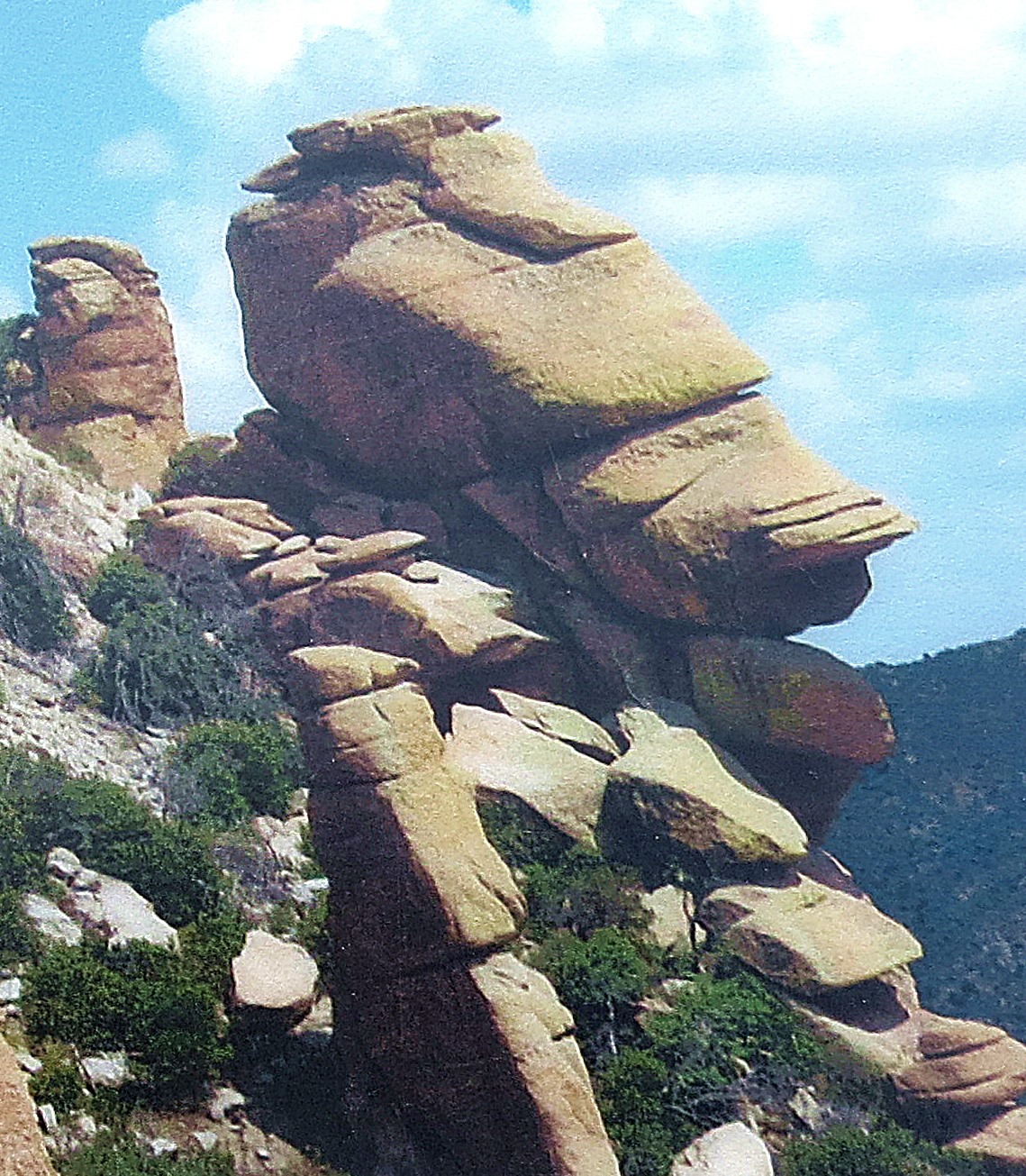
An old saguaro that I thought looked like an old man, whose death I watched over a period of several months.
During my traveling days, I did manage a few train trips, like the one to the top of Colorado's Royal Gorge. I took this photo as the train curved around a bend while on the train itself. -- Photo by Pat Bean

          “There is nothing permanent except change.” – Heraclitus, an ancient Greek philosopher who lived between 535-475 B.C.

          I’m currently reading Paul Theroux’s The Great Railway Bazaar by Train Through Asia, which was published in 1975. It recalls a four-month trip the author took in 1973.

          Almost half a century has passed since then, which makes the book as much about history as travel. At times, it’s a bit confusing because names of countries have changed, and the places Paul visited are not the same today as they were then. Some sites have died out, while others have grown into giant cities.

To keep track of everything, and because armchair travel has become the most comfortable way for this 82-year-old-broad to continually be exposed to new places, my reading is constantly being interrupted with questions. I’m continually chasing down the answers to my curiosity by checking up-to-date maps (I have a good atlas) and internet resources, the latter being one of the reasons why I don’t long for the “good old days.”

Having the time to do this is one of the upsides of aging to offset the downsides.

But the changes that happened in the world since Paul’s book was written, makes me wonder about the changes time has brought to the places I visited in my own rambling journeys in a small RV between 2004 and 2013. My book, Travels with Maggie, is about a slice of that traveling life that took place during six months of 2006, but the book wasn’t even published until 2017.

I wonder if someone will read my book with questions, and if they will take the time to find the answers as I do? No idea how to answer this question.

Meanwhile, I noted that Paul’s journey began with him taking the 1530 -London to Paris Train, and him writing: “Ever since childhood, when I lived within earshot of the Boston and Maine, I have seldom heard a train go by and not wished I were on it.”

Those words made me think of when I was a young child and the Texas Zephyr that blow its whistle each day as it roared behind my grandmother’s home in Dallas.

I always wondered where it had been and where it was going, and yearned to go along for the ride. Perhaps that’s why I’m enjoying my trip across Asia with Paul.

Photo: Train to the top of Colorado’s Royal Gorge, which I rode in 2007. I took the photo from the train as it curved around a bend.

Pat Bean is a retired journalist who lives in Tucson with her canine companion, Scamp. She is a wondering-wanderer, avid reader, enthusiastic birder, Lonely Planet Community Pathfinder, Story Circle Network board member, author of Travels with Maggie available on Amazon (Free on Kindle Unlimited), and is always searching for life’s silver lining