Feeds:
Posts
Comments

 “Between the great things we cannot do and the small things we will not do, the danger is that we shall do nothing.” Adolph Monod
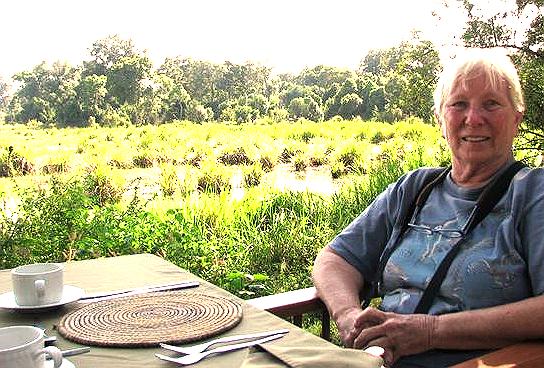
Final Breakfast at Little Governor's Camp. -- Photo by Kim Perrin

African Safari: Karen Blitzen Museum

Joseph got us back to Little Governor’s Lodge in time for breakfast, where Kim and I ate the last of those great little sausages that had become a breakfast standard since first we had them back at the Norfolk Hotel.

As usual, breakfast here was served beneath the open sky with a grand look at the swamp in front of us. It was full this morning with sacred ibises, rufus bellied herons and white-faced whistling ducks, which were in fact whistling.

At the landing strip with Joseph and the "Kids" from London, Frankie and John.

All too soon, however, it was time to gather our belongings and make out last crossing of the Mara River, where we would be met by Joseph for the ride back to the tiny airstrip where we would catch our fight back to Nairobi.

In Nairobi, since our flight back home, didn’t leave until midnight, we would check into the Karen Blixen cottages to spend the rest of the day. Like most of the tourist hotels in Nairobi, this one was located behind guarded gates.

After lunch, I wanted to go curl up on the bed in our cottage suite, and take a nice long, and I thought well-deserved nap. Kim wanted to walk a half mile down the road to the Karen Blixen Museum. I suggested that there were guarded gates around our complex for a reason but Kim would not be deterred.

Our ride back to Nairobi touches down. -- Photo by Pat Bean

I certainly wasn’t going to let her go wandering off by herself, so off we went, two white women in a sea of black, sometimes scowling faces, walking on the edge of a narrow road. This was the real world, not the sheltered tourist wonderland where we had roamed for two weeks.

I was nervous at first, but then relaxed and went with the flow. I’m so glad I did.

Blitzen as Isek Dinesen, wrote “Out of Africa,” which was made into a movie starring Meryl Streep and Robert Redford.

“”I had a farm in Africa,” her book began. The museum was that farm, and we were told it is little changed today from what it looked like then. Blitzen turned the farm into a coffee plantation, and because it provided jobs was much-loved by the locals.

Minutia from the Streep and Redford movie was mingled in with the museum’s displays. But it was the one huge photo of Blitzen, slender and sophisticated and smoking a cigarette in her later years, that captured my attention. It made me think of Auntie Mame, Patrick Dennis’ fictional aunt whom I’ve always admired. .

Kim in front of Karen Blitzen's home, which was the setting for her book, "Out of Africa." -- Photo by Pat Bean

There’s a mental game I’ve often played that calls for you to name six people you would like to invite for dinner. Margaret Mead, Carl Sagan, Shirley MacLaine, John Muir, Maya Angelou, Ralph Waldo Emerson, Eleanor Roosevelt, Barbara Jordan, Molly Ivins, Sean Connery, Gloria Steinem, Gandhi, Golda Meir, Agatha Christie and Charles Darwin, among others, have all at various times received mixed and matched invitations.

I added Karen Blitzen to my address book today.

Still digesting the things we had observed during our visit to the museum, the walk back to our day cottage actually seemed pleasant.

Later in the year, Kenya would erupt with protests about electoral manipulations after President Mwai Kibaki was re-elected. Nairobi would see some of the worst violence, and over 800 people were killed during the protests.

Kim and I, in a long-distance phone conversation, both expressed thankfulness that the riots hadn’t occurred while we were there. Suddenly our State Department’s travel warning didn’t seem as trivial. While we had both enjoyed flirting with danger while on safari, the violence humans can inflict on one another was not the kind of adventure we would ever want to impinge on our memories.
 “There is always something new out of Africa.” Pliny the Elder, 23 Ad – 73 AD


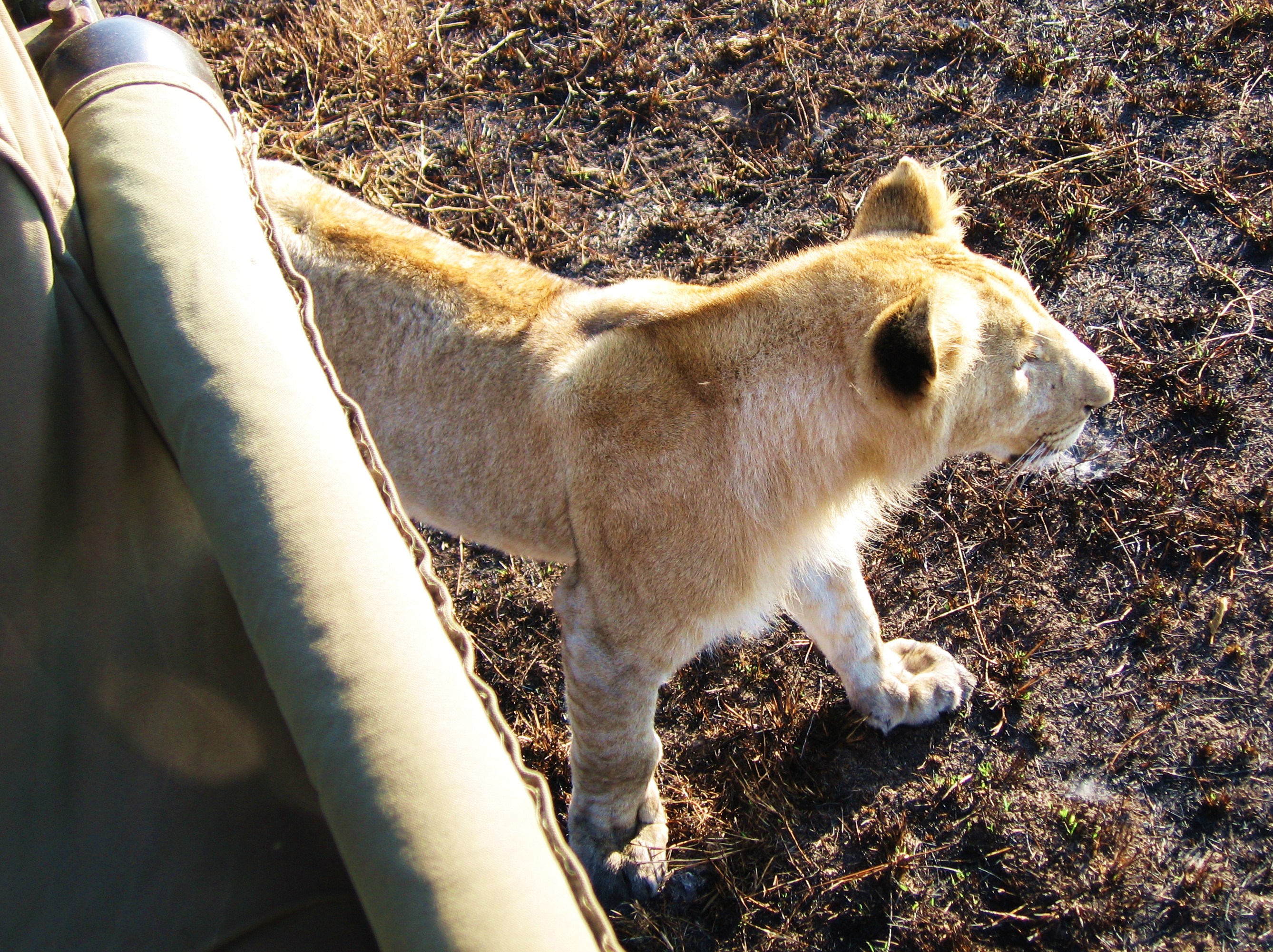
An up close and personal big cat experience. -- Photo by Pat Bean

African Safari: Photo Souvenir

We had the “Kids” with us for our wildlife drive yesterday and again this morning. The young couple, newlyweds, were Frankie and John from London, and as excited as Kim and I about the wildlife and landscape.

I caught Kim’s eye as John bounced around from one side of the Land Rover to the other, and may even have smirked. .

I had done exactly the same thing until Kim strongly let me know that my bouncing was interfering with her photo taking. She was as serious about photographing our adventure as I was about seeing Africa’s birds. I tried to be more sedate after her scolding, but enthusiasm is hard to contain.


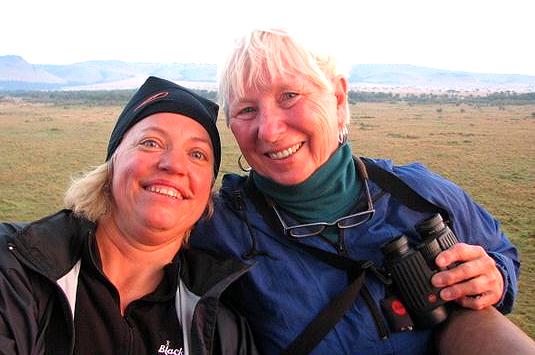
Friends still on our very last wildlife safari outing. -- Photo by John

Today, as John bounced, Kim resignedly smiled back at me and ruefully shook her head. Some times you just have to go with the flow.

And today’s flow was perfect – from a wake of Ruppell’s griffin vultures feasting on a dead wildebeest to a lion mom and two young sons strolling past our vehicle. Joseph had seen them and had parked near where he thought they would pass. He was right on, as he had been so many times in selecting our viewing sites. It was as if he could read the animals’ minds.


One last cheetah -- Photo by Kim Perrin

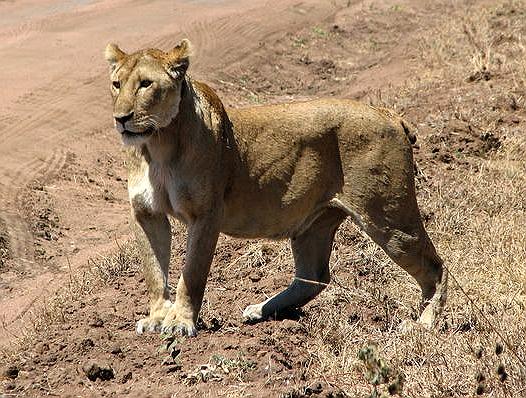
It was one of the young males that gave me my final tall cat tail. Just as the trio were passing, it veered toward our Land Rover and casually scratched its back on a rear tire – the one I was standing over. It looked right straight up at me and I stopped breathing. I was sure hoping, that as we had been told, the wildlife considered us just a part of the non-digestible metal beast they saw everywhere.

When it finally looked down and started to walk away, however, I snapped its picture. It’s not a great shot, but I considered it one of my favorite African souvenirs. When I showed the picture to Joseph on my digital camera, he was surprised. From his seat in the front of the Land Rover, he hadn’t seen it. Neither had Frankie or John, whose names always made me want to burst out in song “”Frankie and Johnny were sweethearts ….”

But Kim had seen it. So I had a witness to my tallest cat story of all.

 “Most of us don’t need a psychiatric therapist as much as a friend to be silly with.” – Robert Brault.


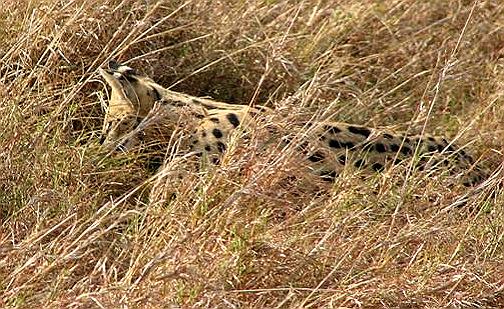
Sharp-eyed Kim spotted this serval in the bush. It was a rare daytime find. -- Photo by Kim Perrin

African Safari: The Rest of the Day

Joseph picked us up after the hot air balloon ride for yet another exciting Safari day. Right off Kim spotted a cheetah – No, we quickly saw it was a serval, a rare daytime find, said Joseph, who quickly followed it off the road to give us a better look before it slunk off.

Then we watched a river full of crocodiles dining on a dead hippo, the same dead one we had seen them guarding the day before. Joseph had told us that hippos’ thick hides were too tough for the crocs to eat, and that they were waiting for it to rot a bit so they could tear it apart.

I thought you might enjoy this picture of a live hippo enjoying its spa day better than the one of the dead hippo being chomped up by crocodiles. -- Photo by Pat Bean

And that’s exactly what they were doing. Several toothy snouts had hold of it and were twisting their bodies in circles to tear off chunks. Really gruesome to watch, but Kim and I were fascinated.

Our big event for the day was to watch wildebeest on migration cross the Mara River. We watched for hours but it never happened. All it would take is for one wildebeest to start across and the all the rest would follow in a mad dash. Such a crossing is prime dinner time for the Nile crocodiles, but the mass swim allows most of the wildebeest to survive the day.

The animals make the crossing twice a year.

Today's wildebeest preferred dry land to water -- Photo by Kim Perrin

But this day, despite many a wildebeest approach right up to the river, they all skittishly turned back.

Finally Joseph gave up, as disappointed as Bilal was at not finding rhinos for us to watch, and went in search of lions and cheetahs for us to watch. He always found them, and watching their feline ways was never disappointing.

It was a wise choice because we heard over dinner that night the wildebeest never did get up the nerve this day to cross the river. The cat-watching, meanwhile had been great, Among other things, we got a glimpse of a hyena that was stalking a cheetah that was stalking a tommy.

The gazelle ran, the cheetah slinked away, and the hyena decided there might be easier prey around and trotted off as well.

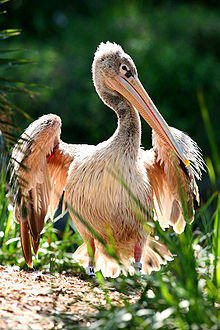
Pink-backed pelican -- Wikipedia poto

Toward the evening, Joseph lingered in a swampy area of the park, where birds were plentiful.

I spotted what I thought was a pink-backed pelican, which would be a lifer for me. Joseph, however, thought it might be a white pelican, which would have been a lifer for him.

So off we went for a closer view. While I felt sorry for Joseph, I’m glad my identification proved right. It would be one of only two lifers I would get this day, the other being a black-chested snake eagle. I was still happy, however. We saw lots of birds I had seen earlier and it was becoming easier for me to recognize the common ones.

Back in camp, Kim and I bemoaned that our African Safari was coming to an end. We only had one more wildlife drive with Joseph in the morning and then we would be flying back to Nairobi, and from there home to the United States. .

We made it a two Jack and Coke night, celebrating both the adventure and the fact that our friendship had survived over two weeks of 24-hour togetherness. Given how quirky and different from each otherwe are, that was as important to celebrate as was our fantastic safari.

South Llano River State Park

Entrance to the visitor center at this Texas state park made me feel as if I had come into a world of faries. In addition to the colorful wildflowers, I was welcomed by a scarlet tanager that hung around the building. -- Photo by Pat Bean

“Earth Laughs in Flowers.” — Ralph Waldo Emerson

“I perhaps owe having become a painter to flowers.” Claude Monet  


 “The balloon seems to stand still in the air while the earth flies past underneath.” – Alberto Santos-Dumont.

The two balloons behind us as we made our way over the Serengeti. -- Photo by Pat Bean

African Safari: Moving with the Wind

Kim and I were up well before dawn this day. We were going ballooning over the Serengeti. It was one of the costly extras not included in our already expensive African Safari package. So, foolishly, or wisely, depending on how you consider these things, we signed up for the adventure.

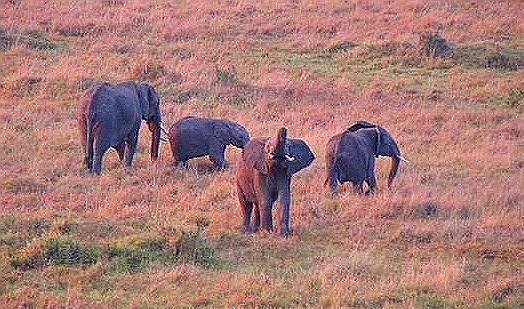
One large elephant trumpeted in unison with the whoosh of flames that lifted our balloon higher. -- Photo by Kim Perrin

I, as did Kim, knew that if we didn’t do it we would probably suffer regrets for passing up the rare experience for the rest of our lives. It took me until about 40 to realize that I had a lot more regrets for things I hadn’t done than for any things I had done. And I had remembered the lesson well.

The balloons were still being blown up when we arrived at the take-off field, and we got a briefing from Captain Neal, who would pilot our balloon, one of three going up this day. I thought him kind of cocky, but then I’ve never met a pilot who wasn’t.

Having survived our windy landing, and with smiles all around, we pose for a group photo we will receive as a souvenir.

Perhaps they need to be to have the necessary confidence to believe they can fly without wings.

It was still fairly dark when we took off. So when the flames roared to give the balloons an extra burst of hot air to keep them aloft, they took on a colorful glow in the gray morning light. It started the day like a fairy tale, and images of the hot air balloon in “Around the World in 80 Days” flashed through my head.

Our balloon flew low over the landscape, passing over a small herd of elephants. At the whoosh of flames as Captain Neal turned up the burner to take us up a bit higher, one of the larger elephants looked up at us and trumpeted.

To celebrate our successful hot air balloon ride over the Serengeti, we are all treated to a champagne breakfast. -- Photo by Pat Bean

The wind was fairly brisk this morning, and not only did we arrive at our destination more quickly than normal, we overshot the landing site. And then when it landed, the wing dragged the basket a way and then it tipped over.

All was well, however, and we posed for a group picture before crowding into a land rover to be taken back to the landing site, where a champagne breakfast had been set up for us.’

What a fantastic morning. I’m so glad I didn’t miss it.

Le Figaro said it best in 1908: “I have known today a magnificent intoxication. I have learnt how feels to be a bird. I have flown .. I am still astonished at it, still deeply moved.”

Lioness Moms Fight Back


“Toughness is in the soul and spirit, not in muscles and an immature mind.” Alex Karras


The young male lion struts his stuff -- Photo by Kim Perrin

African Safari: Female Power

The Lion fight occurred when we were still in Tanzania with Bilal. We were watching three female lions with several cubs when we noticed a young male, his mane still not developed, watching them.

Slowly he began making his way toward the females and their cubs. His actions didn’t go unnoticed. One of the lionesses took all the cubs off away out of harm’s danger while the other two stood guard.. Male lions are quite protective of their own young, but will kill the young of any other males so their moms will be ready to breed again so he can sire his own cubs.

One mama takes the cubs away -- Photo by Kim Perrin

It was likely this is what the young male had in mind this day – and since the cubs’ father was no where in sight he evidently saw this as an ideal opportunity.

Bilal, as we watched the action, said that the lack of the cubs’ father when another male was in his territory was probably because something had happened to him.

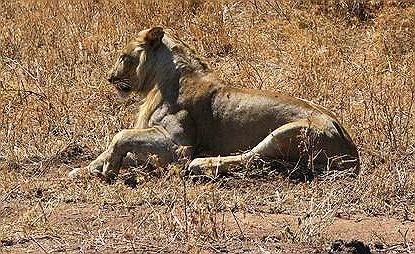
Suddenly, as the young male shortened the distance between him and the two lionesses, the females attacked. In a matter of seconds, the young male was limping away, and soon he lay down to lick his wounds.

Kim and I cheered, but Bilal said the male would eventually get his way. We chose to believe that the females

The male licks his wounds. -- Photo by Pat Bean

would hold out at least long enough to raise their cubs.

“They gave him a pretty good licking,” we said.

Of course Bilal might have been right, but we had faith in mom power. We thought the lionesses were tougher than Bilal gave them credit for – just like Kim and I.

As Mahatma Gandhi said” “Strength does not come from physical capacity. It comes from an indomitable will.”

This wide awake youngster reminded me of my oldest son, who would never take a nap. -- Photo by Kim Perrin

 “Travel, in the younger sort, is a part of education; in the elder, a part of experience.” – Francis Bacon

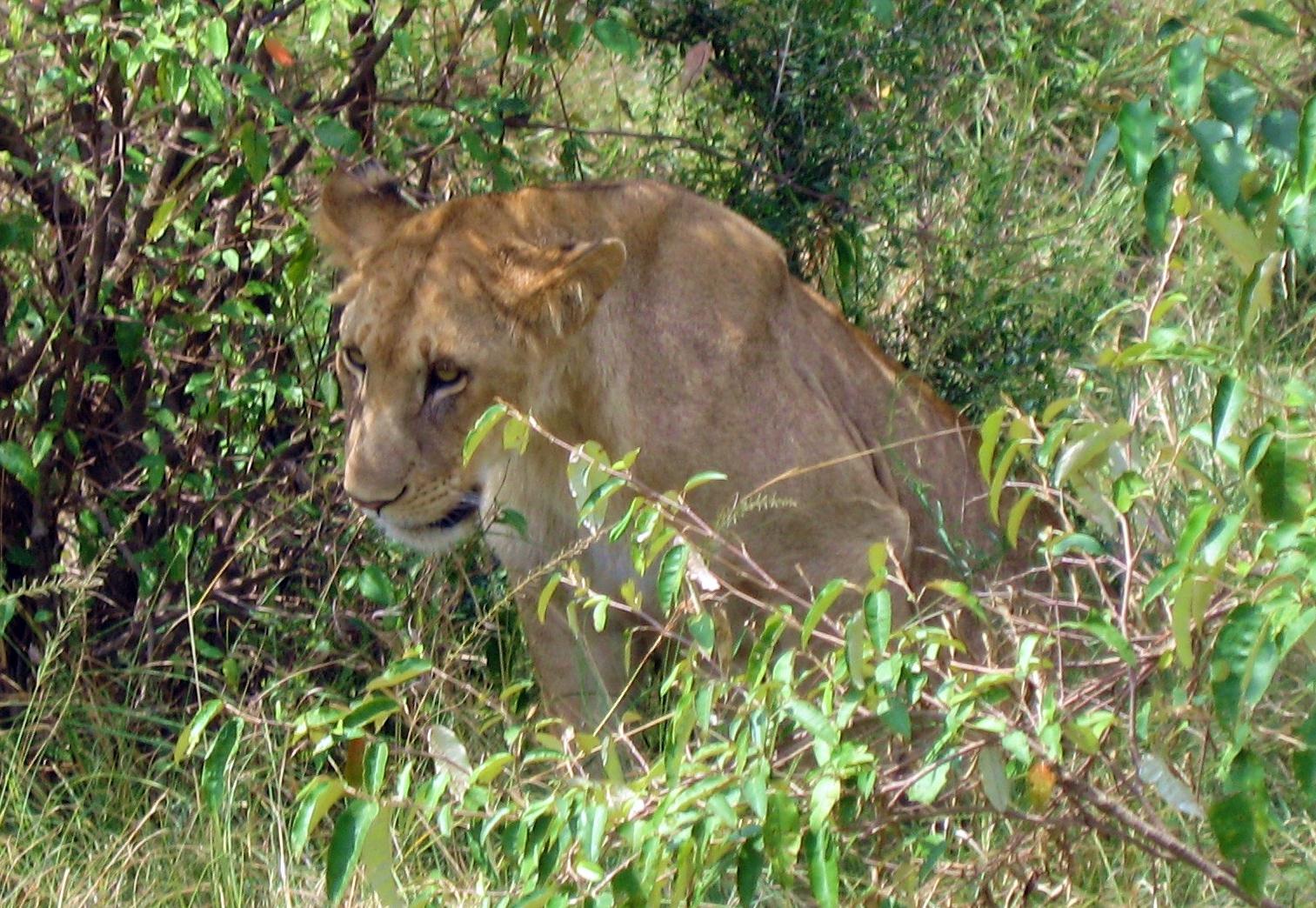
The lionesses, about half a dozen of them, with several cubs were camouflaged well beneath some bushes. -- Photo by Kim Perrin

African Safari: The Sneaky Lionesses 

I lost track of how many lions we saw in Africa. It was a lot. But several of the sightings will live on in my memory forever

Kim and I saw mating lions, fighting lions, sleeping lions, sneaky lions, yawning lions, stalking lions, full-belly lions, mama lions, baby lions and one young male who made a detour from the path he was walking with his mom and sibling to scratch his back on the tire of our Land Rover.

The sneaky lions were actually the most scary. We had been watching several female lions, tucked away beneath some thick bushes snoozing. They had several cubs among them, all also sleeping except for one frisky little bugger.

As we watched, the youngster played around by itself for a while, then decided it was hungry and began crawling all over the sleeping lionesses looking for a titty. .

One of the two mama lions who crept up to keep a close eye on us. It was spooky when we suddenly spotted her. -- Photo by Pat Bean

Three of the mamas flicked it away with their paws when it tried to nurse, but a fourth – I’m not sure if it was the cub’s actual mama or not as the nursing seemed to be a communal activity – finally allowed it to suckle.

Joseph, who was our guide for this lion viewing, decided to drive around the back of the bushes, on the far side of a short trench, for a better view. As we sat there watching the lion pride snoozing in the bush, we suddenly realized that two of the concerned mamas had crept up from the ditch and were watching us.

Our Land Rover suddenly felt a little less safe. Joseph must have felt so, too, for he turned the ignition to drive us away. But the engine sputtered instead of starting.

Carefully, keeping the vehicle between himself and the lions, he got out and opened the hood, then fiddled with something for a moment or two before getting back in the driver’s seat.

The vehicle started and Joseph, whom we could almost hear sigh in relief, drove off to a spot with a clear view of the surrounding landscape and got out and fiddled with the engine some more.

“Just an excess of dust,” he commented as we got back in the Land Rover and drove on for some more wildlife viewing.

Next Tall Tale: The lion fight

Avoiding danger is no safer in the long run than outright exposure. The fearful are caught as often as the bold.” Helen Keller

Bateleur -- goafrica.com photo

African Safari:

Our afternoon safari with Joseph started off with some new life birds for me, including two eagles, a bateleur and a greater spotted eagle. Joseph said the first was known for its snake killing talent, and the latter was a rare find.

“I don’t get to see to many of them,” he said.

Since the spotted eagle was in its winter plumage and its spots not clearly visible, I probably would have missed the identification without Joseph’s help.

The bateleur, however, was a much easy bird to identify, and I had been looking for one ever since I had hit Africa. It was great to finally see one of these magnificent birds. It reminded me of our own caracara just a bit.

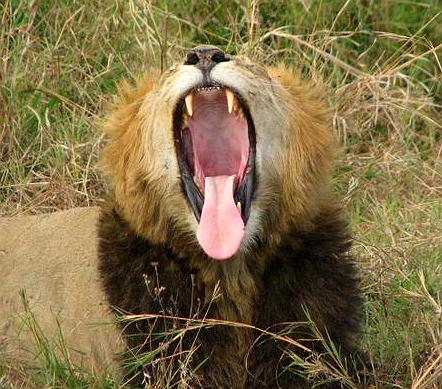
Joseph then decided it was time to go look for some cats. First on the agenda were some lions, including one whose yawn looked ferocious. It provided us with a good view of its deadly fangs – and made me glad I wasn’t a warthog or a gazelle.

Just a yawn, but he's not your average pussycat. -- Photo by Kim Perrin

Next on Joseph’s mission were a mom and three young cheetahs. It started to rain and the territory, where he suspected they were hanging out, was extremely rough but Joseph wouldn’t give up.

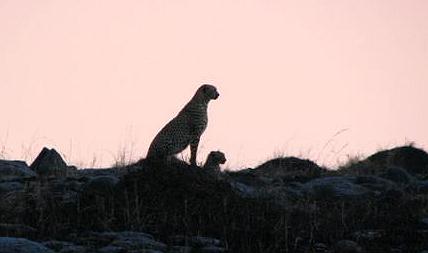
And to Kim and my delight, we finally came across the cheetahs just as the sun was beginning to set. Kim got a fantastic photo of the mom and one of the young ones, who mostly kept low in the rocks.

The rain followed us back to camp, and Kim and I got a bit wet since the sides of the Land Rover were open for better game viewing. I didn’t mind at all. And neither did Kim. It had been a marvelous day – and a little rain wouldn’t melt us. .

A cheetah mom and one of her three young charges at sunset in the Masai Mara. -- Photo by Kim Perrin

Bird Log of New Lifers: Grey-headed bush shrike, woodland kingfisher, red-throated tit, yellow-throated longclaw, greater blue-eared starling, wooly-necked stork, rosy-breasted longclaw, bateleur, spur-winged goose, black-winged plover, rufus-bellied heron, sand martin, wire-tailed swallow, white-faced whistling ducks, white-browed robin, northern black flycatcher, Ross’ turaco, double-toothed barbet, spectacled weaver, African blue flycatcher, greater spotted eagle.

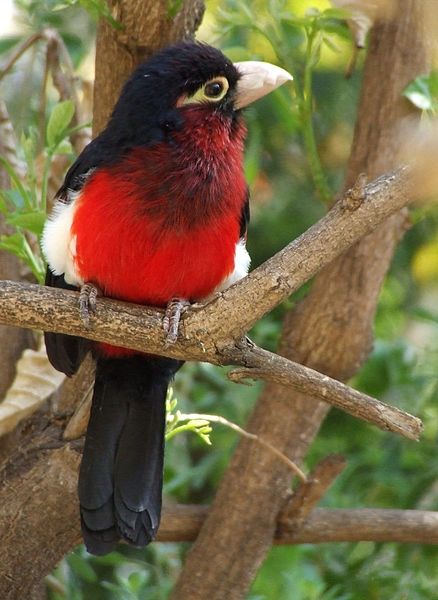
Double-toothed barbet, yet another of Africa's flamboyant birds. -- Wikipedia photo

“Don’t be over self-confident with your first impressions of people.” – Chinese proverb

African Safari: Bird-Watching Guard

Before Dave Richards had left us after lunch, he introduced us to David, the tall, muscular guard who had been the one to walk Kim and I from the lodge compound down to the river for our game drives.

“He’s a birder,” Dave said, causing me to finally notice the pair of binoculars around his neck. “If you see that barbet again,” he told Dave, “tell Pat here.”

David, who had been quiet and stoic during our walks, smiled and promised to come get me if he saw it. Later, as Kim and I were watching a large elephant on the outer edge of our marsh, he did just that.

It was a double-toothed barbet that had built a nest near one of the tents. It was shy, but finally I got half a decent look at it. Enough to see why it was so named. Its bill has two jagged points.

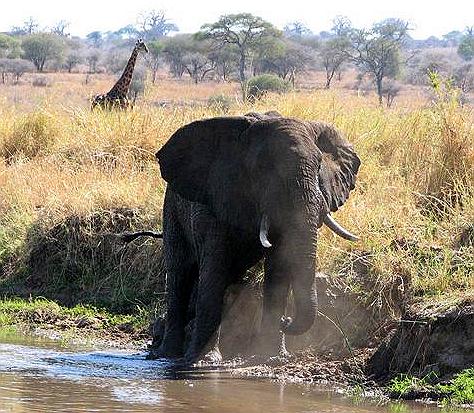
Elephant watching was always fun. Note the giraffe in the background behind this one. -- Photo by Kim Perrin

David was more talkative with us after that, stopping along the way to point out a bird for me, and discussing other wildlife habits with Kim She particularly wanted to know how often hippos visited our tent area.

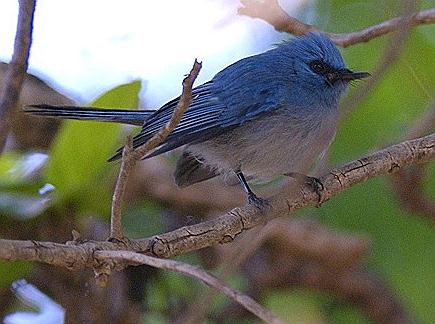
I didn’t hear the answer because I had come across a little blue and white bird perched beside the trail, and I was madly flipping through Dave’s book to identify it. It kind of looked like a mountain blue bird. I finally saw that it was an African blue flycatcher.

Meanwhile, as some days we made three trips back and forth across the river (before breakfast, after breakfast, and after lunch game drives with Joseph), we slowly got to know David a little better.

African blue flycatcher

For having such a tough-looking exterior, I found him to be a gentle soul. It gave me pause to wonder why my first impression of him had misidentified his nature so much that I had totally missed seeing the binoculars hanging around his neck.

It seems I needed to try harder not to let outer appearances play mind games with reality. Africa was teaching me a lot.

 “You can know the name of a bird in all the languages of the world, but when you’re finished, you’ll know absolutely nothing whatever about the bird .. So let’s look at the bird and see what it’s doing – that’s what counts. I learned very early the difference between knowing the name of something and knowing something.” Richard P. Feynman

Hippos in the Mara River -- Photo by Pat Bean

African Safari: Busy Morning

Our morning game drive with Joseph started off with a lion chase, always exciting. While I’m not exactly blood thirsty, I was rooting for the lion. The gazelle won, however, and lived to run another day. I wasn’t all that disappointed actually.

We saw our first mongoose, and over 50 hippos in the Mara River, just up a bit from where we made daily crossings to and from our tent lodge. Just how close they were to our camp we would learn later that night when several hippos left the swamp and were wandering through the tent area.

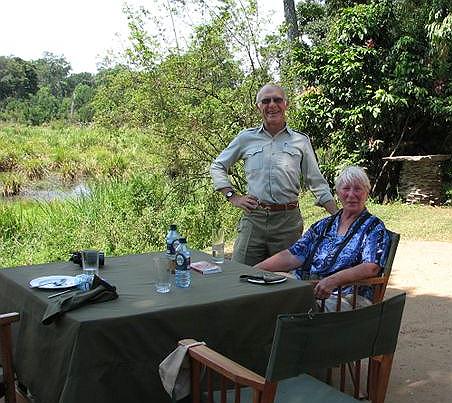
Kim snapped a photo of Dave Richards and me at the end of our bird-watching lunch. -- Photo by Kim Perrin

We were required to stay in the main lodge area, where we saw one of the guards caring a large rifle. It would be only the second gun, and the last one we saw while in Africa. Our lodge hosts said the animals were allowed to come and go and we were simply warned to stay out of their way.

Lunch, after our morning game drive, was a real treat this day. And not because of the excellent food. On checking in I had learned that the lodge had an expert ornithologist on staff and that he was sometimes available for a guided bird tour.

Sadly he was all booked up during our stay, but he had agreed to have lunch with us this day.

My copy of Dave Richard's book.

He was Dave Richards, author of “A photographic Guide to Birds of East Africa.,” which of course I had bought at the lodge’s small gift shop and studied the night before. As promised, he joined us for lunch.

Dave was a small, gray-haired older man who quickly put us at ease. He had great charisma. At one time he had been a safari guide who specialized in birds. He said he tired of that because too many people just wanted to tick off birds.

As a number ticker on this trip, I later told Kim that long-time birders always seem to distain bird listers, but that’s always after they have their achieved their own lengthy lists. Besides, I said, there’s a difference between tickers who are only interested in seeing new birds, and true birders who also enjoy looking at the same birds over and over, even sparrows. I count myself among the latter.

In fact, at this point in our safari, I was as excited to recognize a bird I had seen earlier as I was to find a new one – well almost.

Ross' turaco -- Wikipedia photo

Meanwhile, our pleasant lunch was frequently interrupted as Dave would spot a special bird in the trees or swamp around us, and he and I would go off to look. Kim, who continued her lunch, snapped a few pictures of the two of us with our binoculars pointed up one tree or another.

Our luncheon bird sightings included white-faced whistling ducks, white-browed robin (which sat on a tree right next to our table), spectacled weaver, an da Ross’s turaco.

I had seen one of Richards’ photos of this latter bird in the gift shop earlier. They are truly a magnificent sight. Ours here at the lodge was way up in a tree and without Dave’s help I’m sure I would never have spotted it.

All in all it was one of the best lunches I’ve ever not eaten.