Feeds:
Posts
Comments

The "Road" is calling. -- Photo by Pat Bean

“Not all those who wander are lost.” JRR Tolkien

Travels With Maggie

“Just can’t wait to get on the road again.”

If you’re a Willie Nelson fan and avid traveler like me, the above words should send a tune rolling through your head. The melody always begins rippling though mine when I start packing up my RV – which I’m doing this morning.

There’s few things that make me giddier than knowing I have “miles to go before I sleep.”

While I’ll just be traveling a short distance across the big state of Texas – from one child’s driveway to another child’s driveway – I ‘m going to take two days to do it.

A trio of web-footed friends -- Photo by Pat Bean

Better yet, I have a sight-seeing agenda of places I haven’t seen before planned for the drive. I could care less that I will be taking a 150-mile detour on what would have been just a 240-mile trip.

Maggie, familiar with the packing up routine, is already claiming her co-pilot’s seat.

So since she and I “just can’t wait to get on the road again,” today’s blog is going to end now. like the song I sang as a kid to the tune of Sousa’s “Stars and Stripes Forever.”

Remember?

“Be kind to your web-footed friends, for a duck may be somebody’s mother. Be kind to your friends in the swamp, where the weather is always damp. You may think that this is the end. Well it is.”

 “It doesn’t matter if the water is cold or warm if you’re going to have to wade through it anyway.” – Teilhard de Chardin


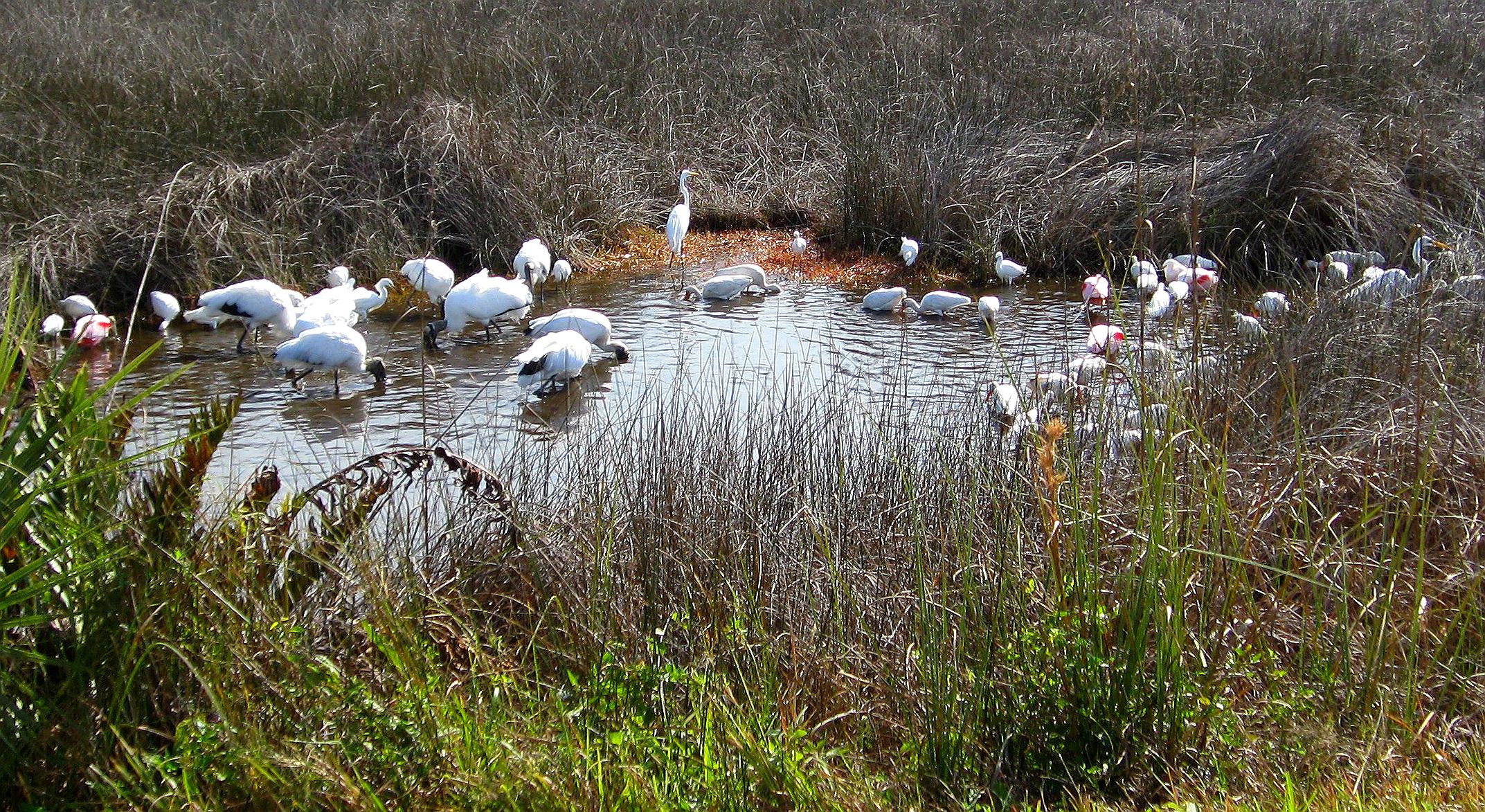
A gathering of storks, egret and ibis at a pond on Merritt island in Florida. -- Photo by Pat Bean

Travels With Maggie

It’s cold and windy today here in Harker Heights, Texas, where Maggie and I are parked in my oldest son’s driveway.

And it’s snowing in Chicago, my youngest son said in an e-mail he sent me today.

Wouldn’t it be nice, I thought, to be bird watching on Merritt Island in Florida. When I checked out the weather there, I discovered it was a balmy 78 degrees.

"I'll just lay here and sleep until it warms up if you don't mind." -- Photo by Pat Bean

My thoughts went back a couple of years to the winter day I actually did spend watching birds on the island, which is located near Cape Canaveral.

I can dream can’t I?

But there’s no getting around bundling up and taking my daily walks with Maggie. Even if she doesn’t care for the idea any more than I do.

 “Because they are primeval, because they outlive us, because they are fixed, trees seem to emanate a sense of permanence. And though rooted in earth, they seem to touch the sky. For these reasons it is natural to feel we might learn wisdom from them, to haunt about them with the idea that if we could only read their silent riddle rightly we should learn some secret vital our own lives …” – Kim Taplin, “Tongues in Trees,” 1989

I walked this path in the Lost Maples State Natural Area in search of a golden-cheeked warbler and was rewarded with peace and beauty that enriched my thoughts. -- Photo by Pat Bean

Favorite Places

Located in Texas’ Edwards Plateau, Lost Maples State Park has a magical aura. It’s a place where, besides seeing a golden-cheeked warbler, one can see physical evidence of the past. When I visited it, I felt like I had dropped into one of Mother Nature’s special places.

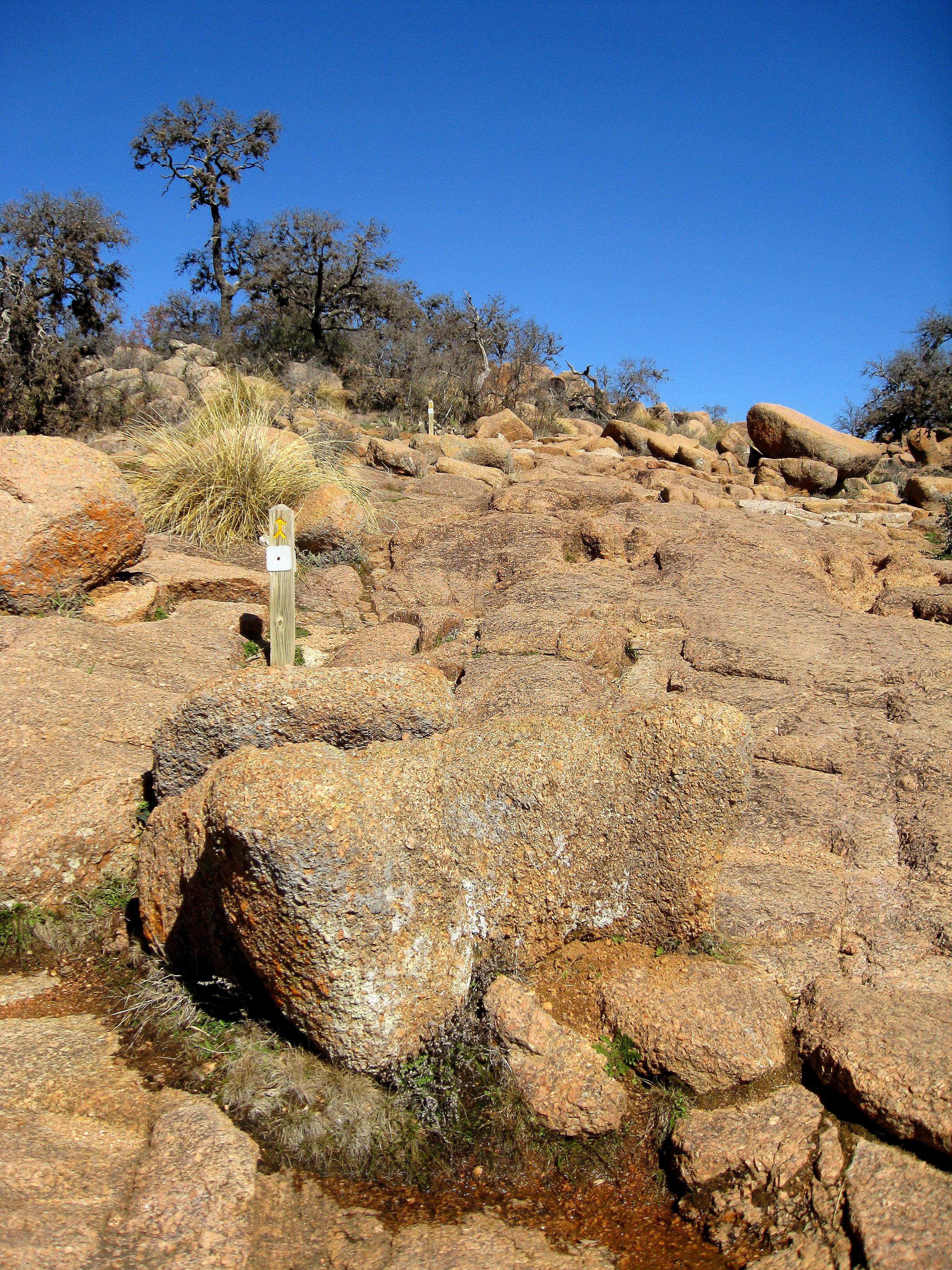
A rocky climb to the top of an Edwards Plateau Ridge in Lost Maples provides evident that this land once lay beneath a sea. -- Photo by Pat Bean

Lost Maples got its name because the maple trees there are far from other maple forests. While it’s most visited when the maple trees wear their brightest fall colors, I find it a place of calm beauty anytime of the year.

A Wigeon of a Tale

“Be like a duck. Calm on the surface, but always paddling like the dickens underneath.” – Michael Caine

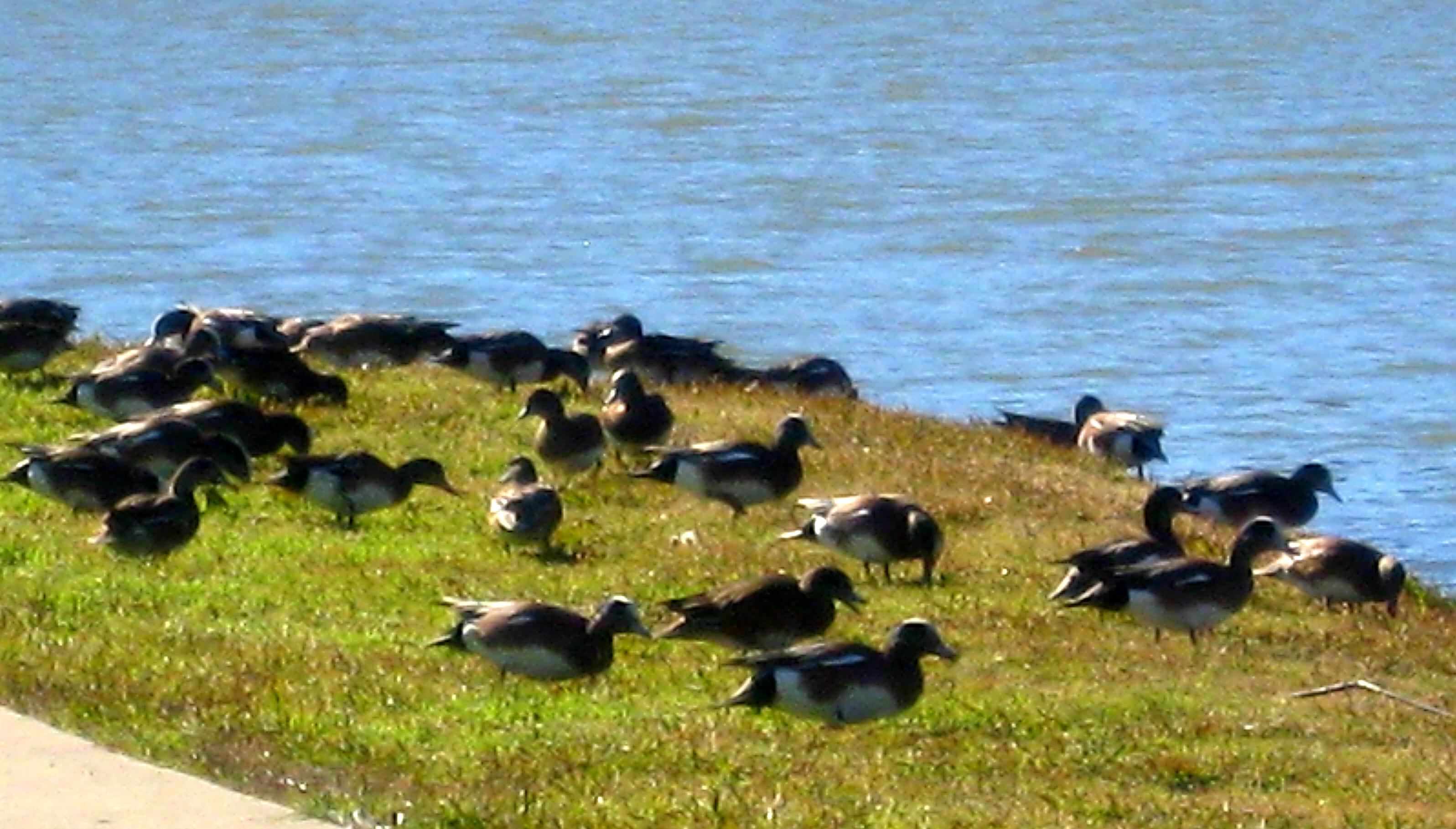
The flock of American wigeons I saw recently that reminded me of my five-year search for its Eurasion cousin. -- Poor photo by Pat Bean

Bird Talk

My kids tell me I have a better memory for where I’ve seen a new bird species than I do for their birthdays. Well, they’re wrong. I know the dates they were born very well. They just think I don’t because of how often I forget what day it is.

They are right, however, in thinking that I can remember where and when I’ve seen a new bird for my life bird list, which I started back on April 10, 1999.

The first bird on it is an American avocet. It and the next 67 birds on it were all seen when I went on a guided bird tour to Deseret Ranch in Northern Utah. I tagged along as a reporter assigned to do a story on sage grouse.

It was the first time I kept a list of the birds I saw — and the day I became a birder. I give

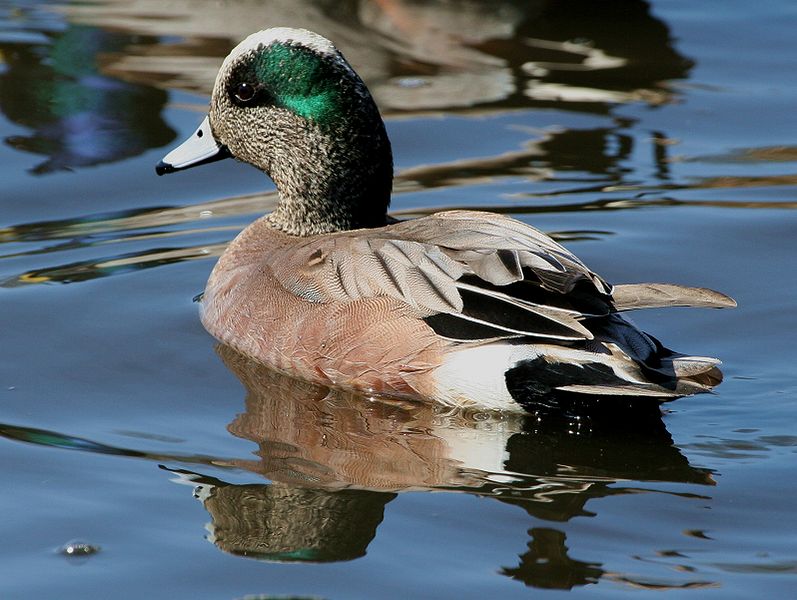
An American wigeon, a species that can be found all across the United States. -- Wikipedia photo

all credit for my newly found passion and addiction to birdwatching to Mark Stackhouse, who led the tour.

After I had listed the 67 birds, and had decided I would start my bird list, I did a very foolish thing. I added a Eurasian wigeon to the list.

A few years earlier, when I had been following Congressman Jim Hanson around during one of  his visits to Northern Utah, he made a stop at what was commonly known as the Millionaire’s Duck Club, a private hunting club located adjacent to the Bear River Migratory Bird Refuge.

Everyone was all excited that day because someone had spotted a rare Eurasian wigeon through a roof-top telescope. I was invited to take a look, and the wigeon became part of the story I eventually wrote. With written proof that I had seen the bird, I didn’t think twice about adding it to my list.

Eurasion wigeons, which can normally be found in winter along U.S. coastal areas. -- Wikipedia photo

But then I got into the spirit of birding, and realized I wouldn’t recognize a Eurasian wigeon if it dropped down from the sky five feet in front of me. And I knew that I didn’t want any bird on my list that I hadn’t personally identified. But to take it off, would be to mess up the entire order of my list.

It took me five years before I did finally see this duck. It was Oct. 4, 2004, in Yellowstone National Park. What a great day that was. And I remember it as well as I remember the days my children were born.

Dandelion Defective DNA

 “It gives one a sudden start in going down a barren, stony street, to see upon a narrow strip of grass, just within the iron fence, the radiant dandelion, shining in the grass, like a spark dropped from the sun.” Henry Ward Beecher

Why is a rose thought to be more beautiful than a dandelion? -- Photo by Pat Bean

Travels With Maggie

I’ve taken my daily walks with my dog, Maggie, while visiting my daughter here in the Dallas suburbs in Rowlett’s Springfield Park. There’s a nice pond, which on my visits has been full of wigeons, coots, cormorants and shovelers, and a paved path that goes all the way around it.

For variety, one can wander over to a slow-moving creek that borders the park and watch, if you’re lucky, a turtle or two, and perhaps spot a ruby-crowned warbler flitting among the tree branches.

Creek turtle -- Photo by Pat Bean

Despite being winter, the park still has green grass, although much of it lies beneath crackling brown tree leaves. On my most recent walk, I came across a sight that always delights me, the unloved dandelion.

Perhaps seeing dandelions springing up unwanted in someone’s lawn or in a landscaped park thrills me because I’ve always been for the underdog. Or perhaps it’s because their bright yellow color brings joy to my soul. Or perhaps it is because I love the wild freedom of a flower that can’t be tamed?

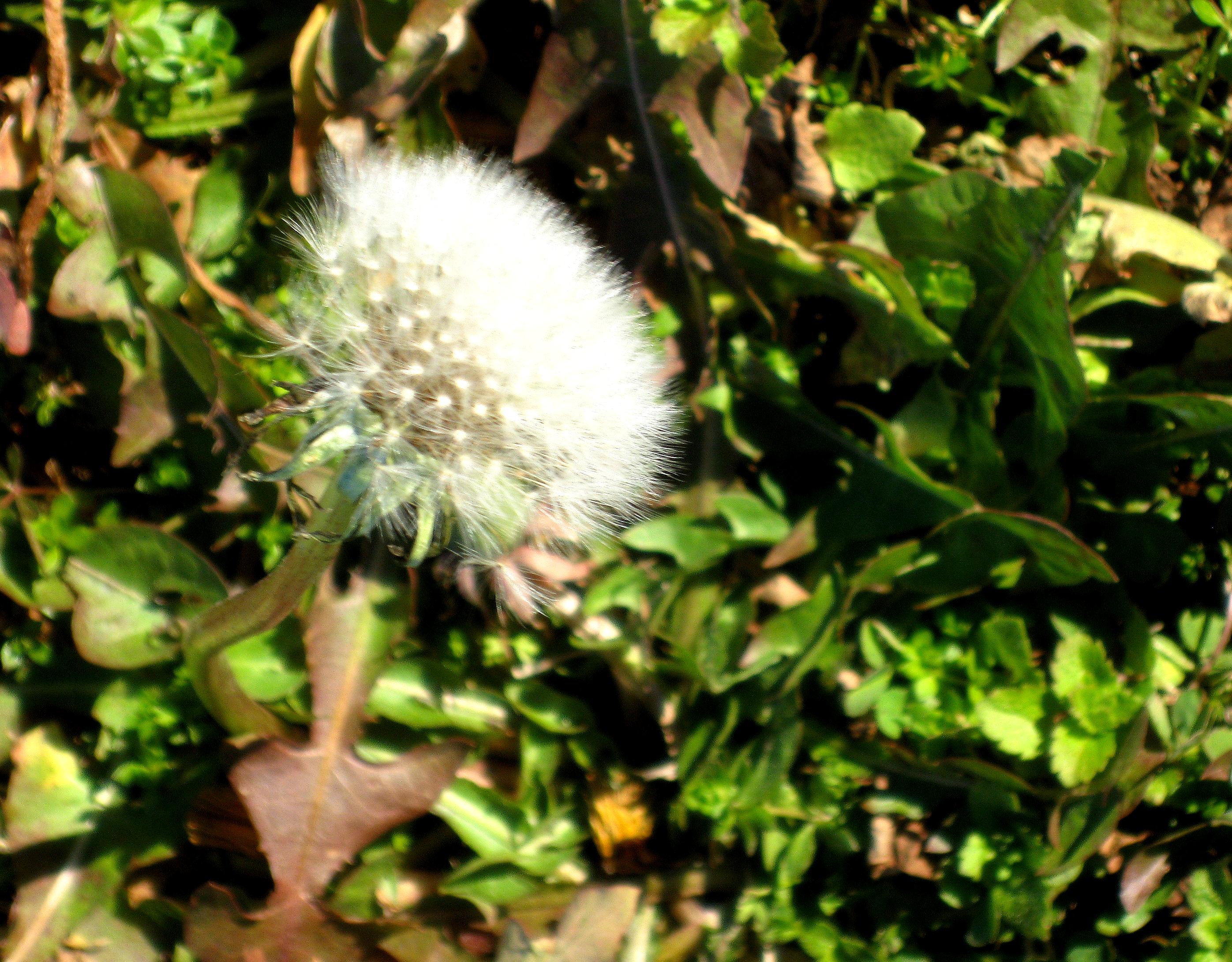
Future generations of dandelions waiting for the wind. -- Photo by Pat Bean

The dandelions were blooming, I suspected, because of Texas’ recent warm weather spell – which last night disintegrated to cold and rainy.

Along with spotting the few dandelions this past Friday, I also saw evidence that some of the golden youngsters had already passed their prime. The elderly among the dandelions had dropped their petals and were white-headed, and in various stages of dispersing their life forces to the wind. They do it with a promise that many more dandelions will invade many more lawns come spring.

How is it, I wondered, that we humans can ooh and aah over a field of bluebonnets but be turned off by a lawn full of dandelions? Who decided what is beautiful and proper and what is not?

Is there something wrong with my DNA because I can love a dandelion as much as a lily?

Aha, my wondering brain concluded as I pondered these questions, perhaps it is those who can’t appreciate the yellow glow of happiness that a dandelion symbolizes who inherited the defective DNA gene?


 “Shades of grey wherever I go. The more I find out the less that I know. Black and white is how it should be. But shades of grey are the colors I see.” Billy Joel

Of course the program was in black and white.

Stepping Back in Time

Remember the old riddle: What’s black and white and red all over? As I recall the answers included an embarrassed zebra and a newspaper.

But yesterday, the answer might have been a play performed at the Pegasus Theater in Richardson, Texas, which I attended with my daughter and son-in-law.

Using lighting and makeup, the play, “The Frequency of Death” by Kurt Kleinmann, was made to look as if it were an old black and white movie of the 1930s. It was delightfully creative with a corny script that had me frequently laughing or guffawing with delight.

Ben Bryant as Nigel Grouse, the smart assistant of the dumb detective. -- Photo by Pat Bean

The melodramatic murder mystery continues through Jan. 22, in the Eisemann Center in Richardson, and will be performed Jan. 26-29 in the MCL Grand Theater in Lewisville. If you’re anyway near the Dallas-Fort Worth Metropolitan area you might want to check it out.

The red, by the way, was the fiery and startling color of the dress worn by co-producer, Barbara Weinberger, when she came out at the end of the play to announce the winner of a T-shirt from among those who had correctly guessed who the murderer was during intermission.

I had guessed wrong. But that’s OK. So had my daughter and son-in-law.

You must live in the present, launch yourself on every wave, find your eternity in each moment.” – Henry David Thoreau

Launching myself out of an airplane was a scary moment -- but I smiled all the way down. -- Photo by NikNak

I’ve always thought the advice to do something that scares you at least once a year was good advice. Besides the jolt of adrenalin it gives your brain, it helps in gaining a true appreciation for life.

Following that advice wasn’t hard to do when white-water rafting was my passion. But with age, that activity drifted away with the currents. I found that canoeing was more in tune with my body.

When I turned 70, I got my annual  jolt of adrenalin by jumping out of an airplane, which I thought perfectly fit this week’s photo challenge.

But I now I face another challenge. What can this wandering/wondering old broad do this year to scare herself. I’m open to suggestions.

 “Birds are indicators of the environment. If they are in trouble, we know we’ll soon be in trouble.” – Roger Tory Peterson

Recent California condor hatchling born at the Oregon Zoo, which has released 10 condors back to the wild. -- Oregon Zoo photo

Bird Talk

Judy Liddel, an old-broad birder like myself, whom I met on an Audubon outing to check mountain bluebird boxes in Northern Utah quite a few years ago, wrote about California condors on her blog. http://tinyurl.com/6ra4lg4

Her writing took me back in time, first to 1983, when the first condor egg hatched in captivity, and then to 2002, when I saw my first condor flying in the wild. The latter incident, which occurred just outside Zion National Park’s east entrance, was like a miracle, as their population had gotten down to only 22 when it was decided to take all of them into captivity for their own protection.

My granddaughter, Jennifer, who was with me when I saw a pair of the condors circulating overhead, was startled by my reaction. I pulled over to the side of the road, hopped out of the vehicle with my binoculars in hand, and started jumping up and down with joy. It was a sight I had never expected to see.

My fascination with the condors began one night in 1983 when I was the editor putting out the Sunday morning edition of the Times-News newspaper in Twin Falls, Idaho. A story came over the Associated Press wire about the first California chick being hatched in captivity at the San Diego Zoo.

One of the California condors now flying free. The markers on its wings allow it to be recognized and tracked. -- Wikipedia photo

Given that there were no murders, earthquakes or other catastrophes going on, I used the birth as the lead story on Page One. With it, I ran an enlarged photo using the color separations AP had sent over with the article.

Would you believe that quite a few readers took offense. One even wrote that the sight of the bald-headed, wrinkle-skinned chick had spoiled their breakfast. In their defense, I have to admit the paper’s reproduction of the photograph (this was still years away from the instant digital process newspapers used later in my career) had not gone well. The chick came out looking like it had been drenched in witches blood.

The managing editor was also not pleased, but I stood firm and told him this was a historic moment in bird history. He frowned, but didn’t fire me.

I have been following the progress of the California Condor ever since that day, and am pleased to tell you that the original 22 condors remaining in the world, with the aid of man’s efforts to save them, have multiplied to about 400.

It delights me that my friend, Judy, was as excited to see one of these birds flying free as I had been at the sight. Thanks for the memories Judy.

An Uncozy Murder Mystery

“Everyone is a moon, and has a dark side which he never shows to anybody.” – Mark Twain

New York Times best seller, "Neon Rain"

Travels With Maggie

Last night, after Maggie and I had crawled into bed in the childhood bedroom of my grown granddaughter, Shanna, where I sleep at my oldest daughter’s home because I can’t plug into an electrical outlet, I turned on my Kindle.

My neck started getting uncomfortable after I had read for about a half hour. But since I still wasn’t ready for the sandman, I switched to one of the audible books I had downloaded.

I had put off getting a Kindle for a long time because I loved the magic of holding a real book in my hand. It took all of about 10 minutes, however, before I decided the Kindle had just as much magic, perhaps even more so because if I decided I wanted a certain book, I could be reading it in less than a minute.

But back to last night. My choice of listening pleasure was “The Neon Rain,” a Dave Robicheaux novel by James Lee Burke. The book had

New Orleans' Bourbon Street in 2003 -- Wikipedia photo

been on sale through Amazon’s Audible.com and on a whim I had bought it since I had already used my two monthly credits.

While I’m a big fan of murder mysteries, I quickly realized this one, whose hero is a New Orleans homicide detective with a Vietnam past, is darker than the cozy mysteries I favor. Burke puts into words what the authors I usually read keep hidden behind closed doors.

His descriptive phrases are gritty and complete, and Will Patton, the book’s narrator, captures Robicheaux’s dark character completely.

New Orleans French Quarter -- Wikipedia photo

What kept me reading, however, was that Burke had created Robicheaux in both black and white, and made him likeable. Underneath the toughness was a gentleman with depth, and Burke’s descriptive writing captured both sides.

I recently watched the movie “Salt’ with my daughter and her husband. At the end, the three of us sort of shook our heads.

“Not really a great movie,” my son-in-law, Neal, said.

“That’s because there was never any one to root for,” I replied.

The fact that I can root for Robicheaux, and that Burke is a writer’s writer, will keep me reading/listening  to the end of “The Neon Rain.”

I will, however, continue to favor my more cozy mysteries, where the object is to simply to figure out who-done-it. But I also recognize that it’s good to once in a while be jolted back to reality and the knowledge that there is a dark side to the world – and as Twain says, a dark side within each of us’

Thankfully, most of us keep that side hidden behind closed doors.

Maggie relaxing in my daughter's chair after today's grooming. I can't help but notice after each grooming these days, her once pure black muzzle gets grayer and grayer. -- Photo by Pat Bean

 “Anybody who doesn’t know what soap tastes like never washed a dog.” Franklin P. Jones

 Travels With Maggie

My traveling companion, Maggie, is a cocker spaniel with thick, fast growing fur that needs to be trimmed and washed every 10 days so as to keep both her ear infections and allergies at a minimum.

My previous cocker could go six weeks between groomings, and when I owned her I had a steady paycheck coming in weekly and a great groomer who charged only $25.

The cost of sending Maggie to a groomer these days ranges from a low of $42 to a high of $53 – and I live on a pretty low fixed income. So Maggie gets home, or shall we say RV-groomed since that is our home.

When the weather is warm enough, and when my RV, Gypsy Lee is hooked up to electricity, it’s an outdoor job. I sit on my RV step with Maggie in front of me and the clippers plugged into an outdoor outlet. The wind usually blows the clipped hair away.

On cold days, I sit on my toilet seat with Maggie propped up a bin in front of me and then sweep and vacuum the hair up afterward. It takes about three days before the last few pieces are finally discovered and discarded.

One or the other of those procedures works everywhere except my oldest daughter’s home, where I have no place to plug in Gypsy Lee. Today, since it was too cool to groom Maggie outside, I used the small downstairs half bath as my grooming saloon. I sat on the toilet and put Maggie on a stool in front of me. With the door closed, her cut fur was confined and didn’t get all over my daughter’s house. Clean up was much easier than in my RV.

I keep the grooming routine as simply as possible, using only two clippers blades for the job, a No. 10 for her back, throat, face and ears, and a No. 4 for the lower body and legs. Neither Maggie nor I have much patience, so on a scale of 1 (great) to 10 (disastrous), the outcome is usually in the above 5 range.

Today’s might have actually been a 4. But that’s not what pleases me. Every single time I have groomed her in the past, which is over 200 times in the nearly 12 years I’ve had her, today was the first time I didn’t have to fight her to get her right ear groomed. It has been extremely sensitive all her life.

I suspect the reason for her cooperation today when I was working on that ear is the new medicine that she was put on two weeks ago to fight her most recent ear infection. That infection was an extremely painful one for her, so much so that if it couldn’t be controlled it might have ended with me losing her.

I felt like shouting for joy when I finished. Maggie just wanted her treat. She always gets one afterward – whether she’s been good or not.