Feeds:
Posts
Comments

Archive for the ‘Travel’ Category

Mishaps are like knives, that either serve us or cut us, as we grasp them by the blade or the handle.” – James Russell Lowell

I well remember my day on Espanola Island with my new sea lion friends. 

A Journal Page from a Non-Wandering Wanderer

As I’m reading my journal from 2005, when I was more active as a wanderer, I came across an entry of a day I had forgotten. It came at the end of an 11-day trip to Ecuador and the Galapagos Islands, and while these days of wondrous sights are still etched in my brain, this last day slipped by without leaving much of an imprint.

Here is what I wrote about it in my journal the next day:

And I will never forget the blue-footed boobies. — Photo by Pat Bean

Yesterday was “interesting.” It took us from 9 a.m. to 5 p.m. to make a short flight from San Cristobal in the Galapagos Islands to Quito, Ecuador. Our plane was hit by lighting, and when we finally landed, our luggage was placed on the top of the van that drove us to our hotel.

A sudden heavy rain drenched everything in my luggage, and that of the other passengers as well.  Luckily a pair of my clean underwear dried out overnight.

And what a night it was. About 1 a.m. the hotel shook and I was almost tossed out of bed. A 6.1 earthquake had hit near Quito. Then at 4 a.m., without much more sleep, I got up and got dressed for the early morning flight back to Houston.

As I said, and “interesting” day.

I can’t help but wonder if I might have had a bit more to say about that July 13, 2005, day I I wasn’t still enjoying my memories of the Galapagos Islands.

Bean Pat: https://cheerstotraveling.com/2018/03/28/add-westman-islands-to-iceland-itinerary/  More Islands to visit. And Heimeay, too, just to see the colorful puffin statue if for no other reason.

Pat Bean: is a Lonely Planet Community Pathfinder. Her book, Travels with Maggie, is now up on Amazon at http://tinyurl.com/y8z7553y  Currently, she is writing a book, tentatively titled Bird Droppings, which is about her late-bloomer birding adventures. You can contact her at patbean@msn.com

Read Full Post »


Leon Dormido, also know as Kicker Rock. — Wikimedia photo

The Galapagos Islands provide a window on time. In a geologic sense, they are young, yet they appear ancient.” – Frans Lanting

Pages From My Travel Journal

Shortly after boarding the Archipell II, a 16- passenger catamaran in which I would spend the next eight days sailing around the Galapagos Islands, we motored around Kicker Rock, which is actually two volcanic rocks split apart.

Pages from my journal.

The English name refers to the rocks’ resemblance to a boot when viewed from one angle. Our guide, Luiz, called it Lion Rock, or Leon Dormido in Spanish, however, because viewed from another angle, the 400-feet tall rock towers look like a sleeping lion.

We had set sail for our adventure from the harbor at Puerto Baquerizo Moreno on San Cristobal Island, where sea lions seemed to be everywhere. One group of sea lions had even commandeered a small boat tied to a larger boat, and one, a young juvenile lying near where our group boarded a panga for the ride out to the Archipell, sniffed my leg when I passed it.

Sea Lion in Puerto Baquerizo Moreno. — Wikimedia photo

It was a bit chilling, but I was thrilled to have such an experience. My friend, Shirley Lee, who was behind me, was less thrilled. The sea lion nipped her instead of just sniffing. While we had dutifully been instructed not to touch the animals, someone forgot to pass the message on to the islands’ wildlife, which had absolutely no fear of humans.

By the time we got to Kicker Rock, I had seen dozens of birds, many that would go onto my life list, such as great frigatebirds, a striated heron, blue-footed boobies, Nazca boobies, and several of what are known as the Darwin finches, a group of about 15 birds studied by Darwin because of diversity in beak form and function.

And this was only day one. What fun it is to relive this great adventure. I’ll write more about it next week.

Bean Pat: Spring Equinox https://marinakanavaki.com/2018/03/20/spring-equinox-2018/?wref=pil An artist’s rendition.

Pat Bean: is a Lonely Planet Community Pathfinder. Her book, Travels with Maggie, is now up on Amazon at http://tinyurl.com/y8z7553y  Currently, she is writing a book, tentatively titled Bird Droppings, which is about her late-bloomer birding adventures. You can contact her at patbean@msn.com

Read Full Post »


The Corkscrew Boardwalk … Wikimedia photo

Lie on the bridge and watch the water flowing past. Or run, or wade through the swamp in your red boots. Or roll yourself up and listen to the rain falling on the roof. It’s very easy to enjoy yourself.” — Tove Jansson

Home of Wood Storks, Air Flowers and Cypress Trees

In 2008, I spent a month on Pine Island just across the water from Cape Coral, Florida. The location allowed me to explore the west side of the Everglades at my leisure. One place I visited twice was Corkscrew Swamp Sanctuary, home to the largest old growth bald cypress forest in North America and a favorite habitat of endangered wood storks. .

The Ghost Orchid

Both times I took over five hours to hike the 2.25-mile loop boardwalk that meandered through the sanctuary’s awesome and varied landscape. It seemed as if Mother Nature had a different spectacle for me to watch and observe every 100 feet or so.

While my goal for visiting was to bird watch, that often took a back seat to my gawking at the cypress trees that stood tall and wide. with moss-draped limbs and sometimes unrelated flowers that grew among the branches. I even got a glimpse – thanks to my birding binoculars – of the swamp’s famous ghost orchid, discovered just a year before I visited.

I was told where to look for it at the visitor center or I would have just thought it was one of the bromeliads that had attached their roots to tall branches in

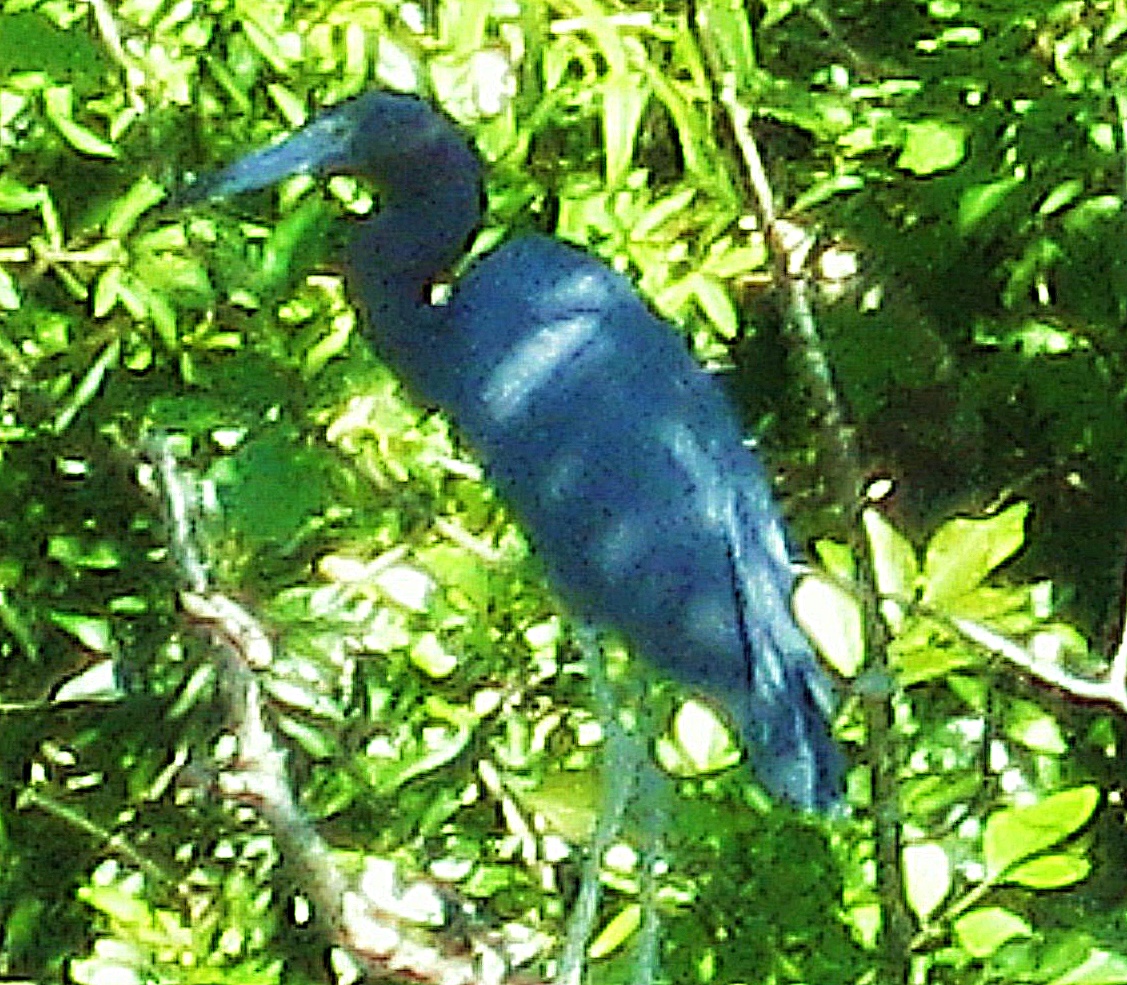
Little blue heron up a tree. — Photo by Pat Bean

the trees. These plants, which seemed to grow on nothing but air, fascinated me. But then so did the swamp’s birds, marsh prairies, otters (I saw two) and all the other wonders of a place that miraculously was saved when Florida’s cypress forests were being leveled for timber in the mid-1900s.

The National Audubon Society, recognizing the swamp’s value, worked to save the land and its inhabitants for future generations to enjoy.  Today, Corkscrew Sanctuary, is both a designated Wetland of International Importance and an Important Bird Area. I hope it will still be there when my grandchildren’s children, and their children, want to visit, like my six-year-old great-grandson Kaiden, whose mother and my granddaughter Keri spent a week touring the Everglades with me in 2008.

Bean Pat:  In the Forest https://forestgardenblog.wordpress.com/2018/03/06/blossom-xxxv-in-the-forest/ A perfect blog to accompany mine. They’re both about the beauty of a place.

Pat Bean is a Lonely Planet Community Pathfinder. Her book, Travels with Maggie, is now up on Amazon at http://tinyurl.com/y8z7553y  Currently, she is writing a book, tentatively titled Bird Droppings, which is about her late-bloomer birding adventures. You can contact her at patbean@msn.com

Read Full Post »

The river is constantly turning and bending and you never know where it’s going to go and where you’ll wind up. Following the bend in the river and staying on your own path means that you are on the right track. Don’t let anyone deter you from that.” — Eartha Kitt

The entrance to South Llano River State Park. — Photo by Pat Bean


Turkeys, Wildflowers and Dark Skies

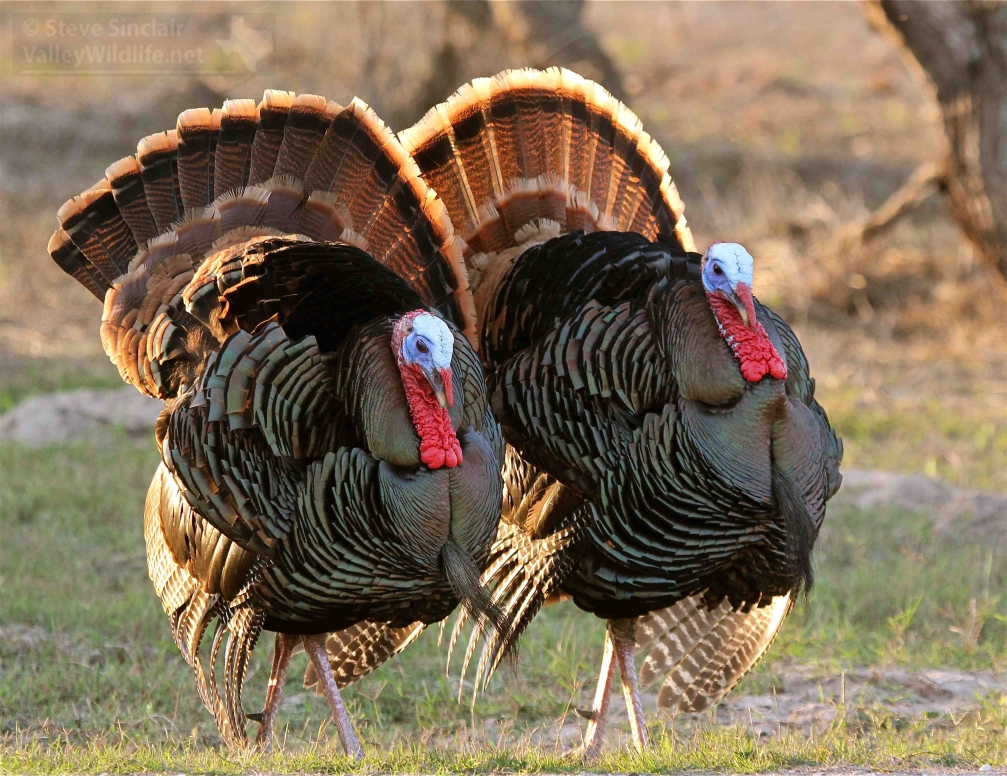
A pair of Rio Grande wild turkeys.

It was one of those days when my canine companion Maggie and I took off down the road in our small RV with no destination in mind. We were simply exploring Texas’ Hill Country. I was confident that I would come across the perfect place for us to camp before night overtook us.

As I recall, it was well before noon when I came upon South Llano River State Park, and on seeing the abundance of lavender wildflowers dominating the lawn in front of the small building near the entrance, I figured we had found the place. I brake for wildflowers the same as I do for birds.

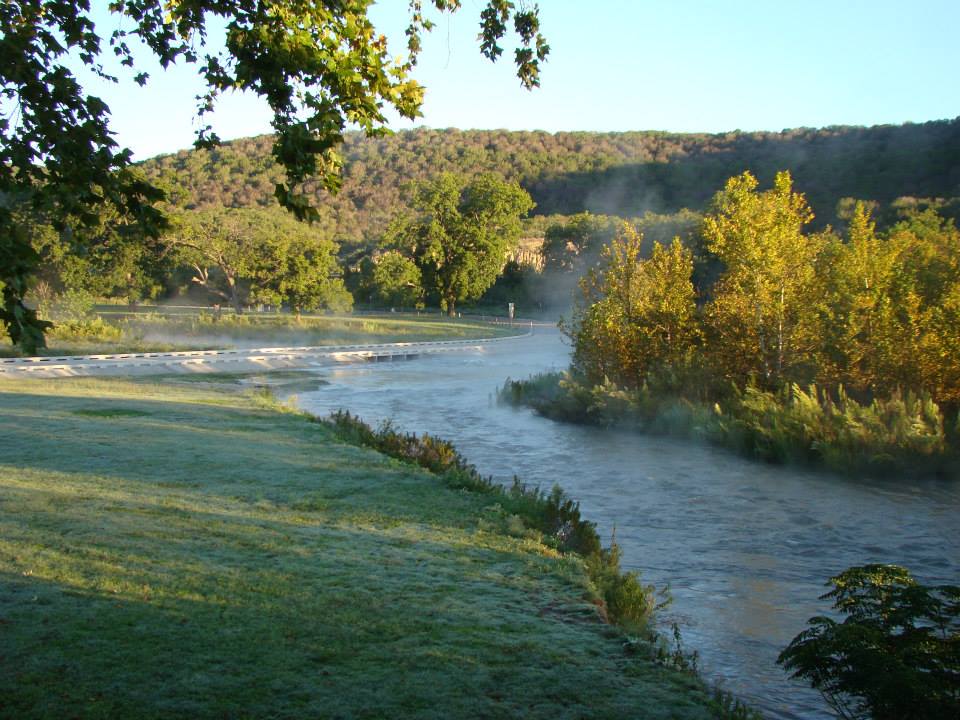
The South Llano River, a spring-fed tributary of the 105-mile Llano River that flows through Texas’ Hill Country.

And on checking into the park, I learned that here there were both. The park’s 500 plus acres of Hill Country river bottomlands, are home to the Rio Grande turkey, as well as habitat for wood ducks, white-tailed deer, squirrels, jackrabbits, javelinas, foxes, beavers, bobcats, cottontails and armadillos. It would be nice to see an armadillo walking around, I thought, recalling the roadkill one I had passed earlier in the day.

The park also had 18 miles of hiking trails, a few miles of which I explored, and modern campsites with electricity and water to feed my RV. I stayed for several nights, one of which I stayed up late watching a sky full of twinkling stars, a bonus of the park being a designated Dark Sky site.

Wildflowers, birds and stars – life doesn’t get much better for this fan of Mother Nature.

Bean Pat: You Gotta Live:  https://theenchantedoutlook.com/2018/02/20/you-gotta-live/ T0 this great post, I add my own mantra. Live so that when you die, you’ll know the difference.

Pat Bean is a Lonely Planet Community Pathfinder. Her book, Travels with Maggie, is now up on Amazon at http://tinyurl.com/y8z7553y  Currently, she is writing a book that she is tentatively calling Bird Droppings. It is about her late-bloomer birding adventures. You can contact her at patbean@msn.com

Read Full Post »

IMG_1115

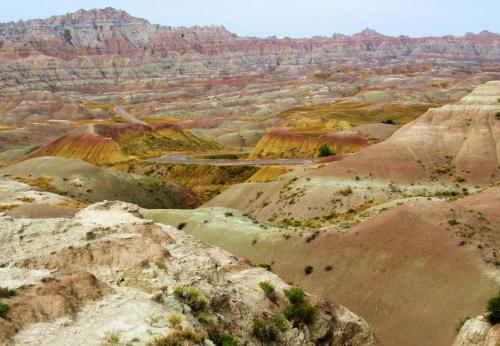
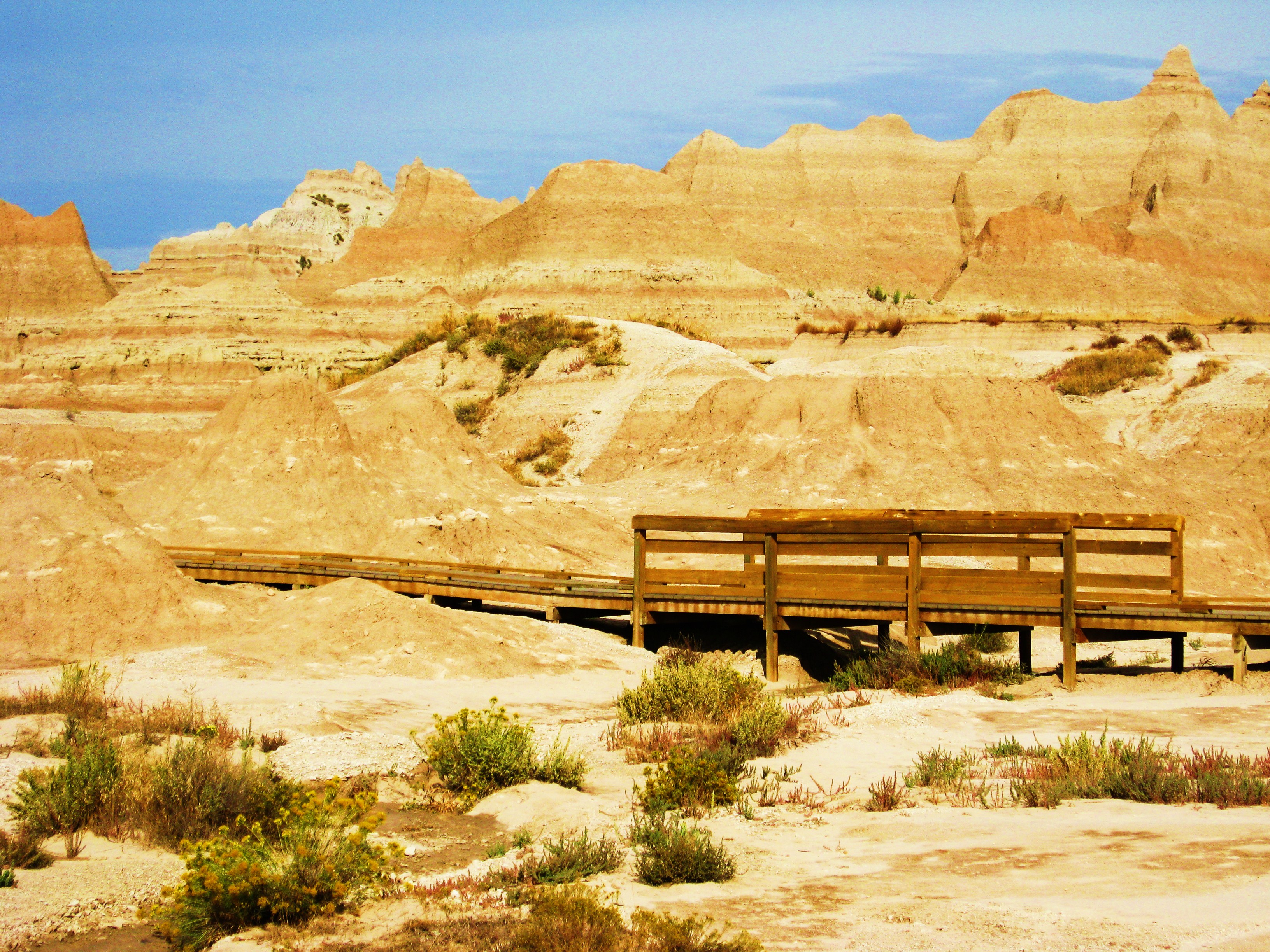
Candy-striped rocks in Badlands National Park. — Photo by Pat Bean

“Landscape is a piece that is emotional and psychological.” – Jim Hodges

IMG_1122

Remnants of an ancient jungle can be seen in the Badlands. — Photo by Pat Bean

Alone on a Windy Day

In the neighborhood of a million or more people from all over the world annually visit Badlands National Park, a rugged, colorful, wind scoured, sun-bleached, South Dakota landscape that took my mind back through endless eras of time. It felt magical, and the windy autumn day I drove, and hiked a bit, through it seemed as if I had the park’s entire quarter-million acres of rock and prairie to myself.

         I had spent the night at a small campground in Interior, a city of less than 100 residents that sits just outside the park. It is home to the Horseshoe Bar, whose sign out front said: “All Bikes Must Stop,” and a gas station, where I had to go inside to pay. The friendly clerk there old me to drop by for a hot meal later. I bypassed the bar, and did just that.

South Dakota is known as one of this country’s windiest states, and it was living up to the reputation when I awoke the next morning after a night of rocking and rolling in my over-the-cab bed. The smart thing to do was to stay put for the day. But the Badlands, which I had never visited before, was calling me.

My canine companion Maggie and I answered the invitation. We did get bounced around a bit in our undersized, 21-foot class C home on wheels. But, oh was it worth it! As more and more people seek relief from the world’s chaos in nature’s wild places, it is becoming rare to have time alone with Mother Nature. Well, unless you are a backpacker able to truly go into the backcountry, and age has put me at a point where that kind of adventure is behind me.

Besides the kaleidoscope of candy-striped boulders, remnants of an ancient jungle, and fossils of animals, like the saber-toothed tiger that no longer exist, I saw bison, prairie dogs, antelope, rock wrens and prairie falcons.

But the day’s furious winds, which calmed down for a bit every now and then, evidently kept other visitors away. I saw fewer than a dozen cars on the Badlands Highway 240 Loop Road, and only three other people during my several short hikes.

It rained shortly after I arrived back at the Interior campground, and I spent another night rocking and rolling as my RV danced with the wind. Then it was off for another day of exploring the “good” Badlands.

Bean Pat: An invitation https://natureontheedge.com/2018/01/27/ The adventure begins Feb. 16. Sounds like fun and a good cause.

Pat Bean is a Lonely Planet Community Pathfinder. Her book, Travels with Maggie, is now up on Amazon at http://tinyurl.com/y8z7553y  Currently, she is writing a book, tentatively titled Bird Droppings, which is about her late-bloomer birding adventures. You can contact her at patbean@msn.com

Read Full Post »

“I hear lake water lapping with low sounds by the shore … I hear it in the deep heart’s core.”  – William Butler Yates.

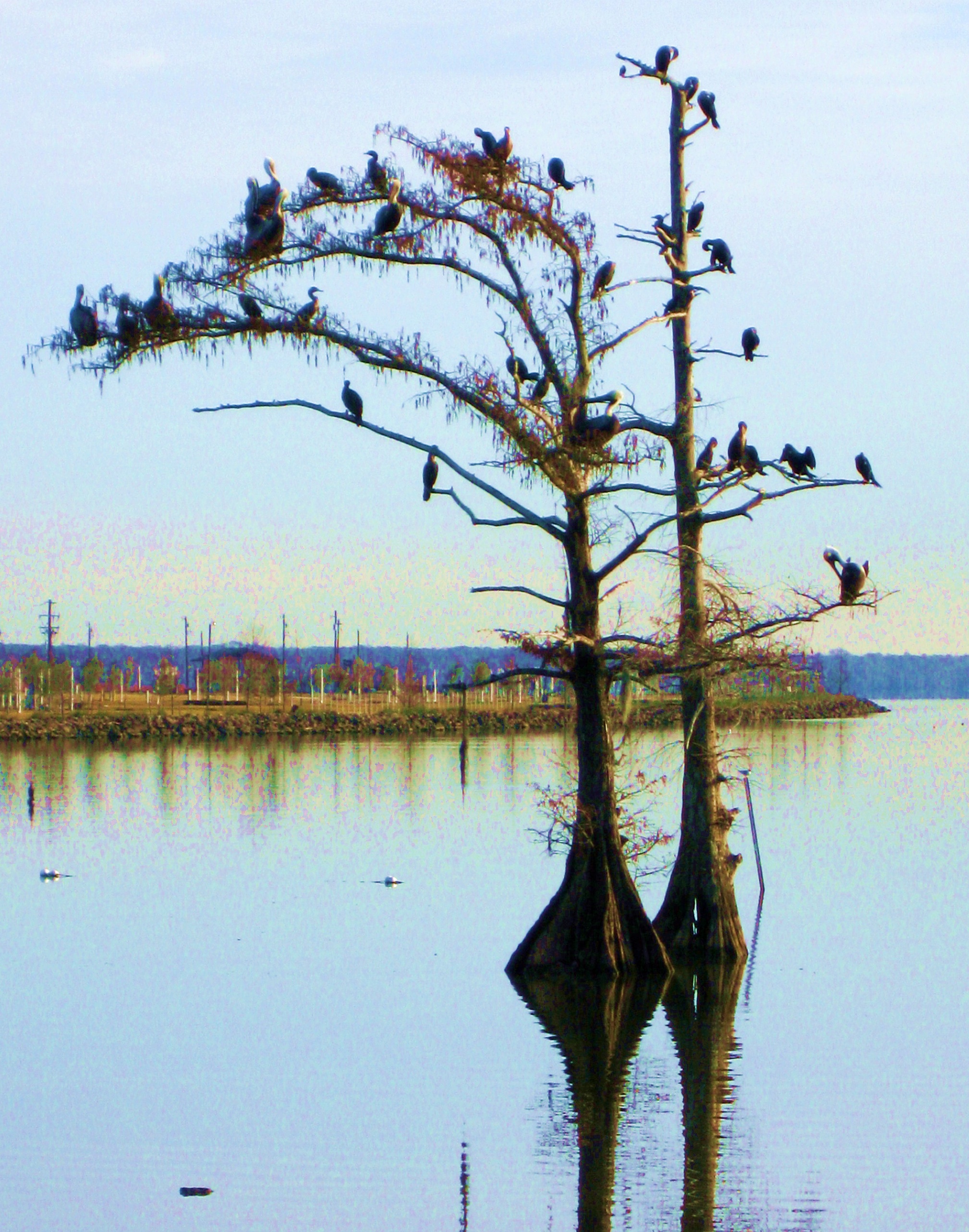
A tree full of double-crested cormorants at Lake End Campground. — Photo by Pat Bean  

Water and Birds for Double the Pleasure

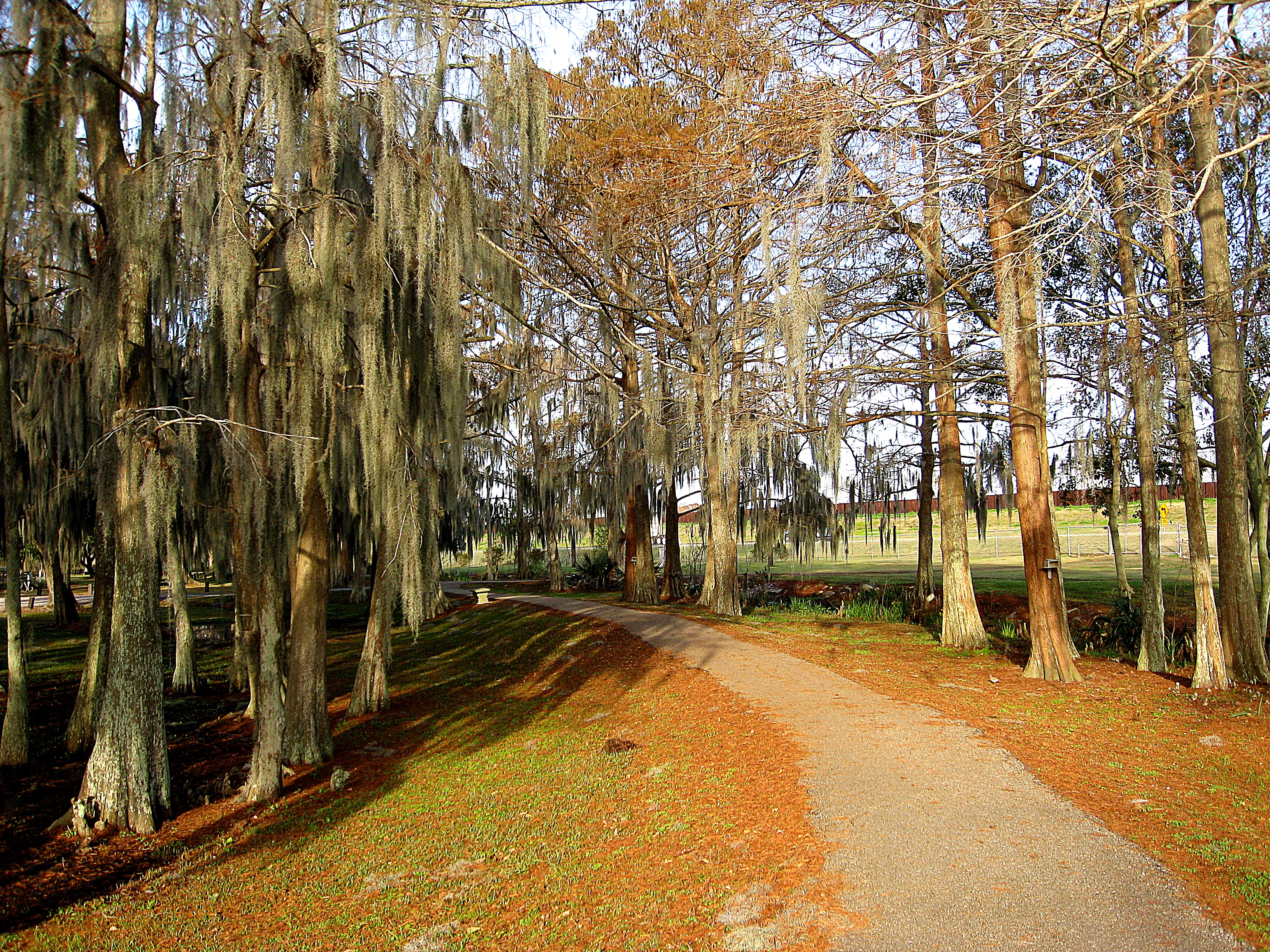
A walk among the moss-dripping trees. — Photo by Pat Bean

One of my favorite things to do when I traveled across this country in my RV was to spend the night parked where I could be lulled to sleep at night by the sounds of water gurgling, lapping and laughing. It was better than any sleeping pill, assuring me a good night’s sleep, and a morning eager to take a walk by the water.

It didn’t hurt either that lakes and ponds and oceans were also the stomping grounds of birds to feed my birdwatching passion.

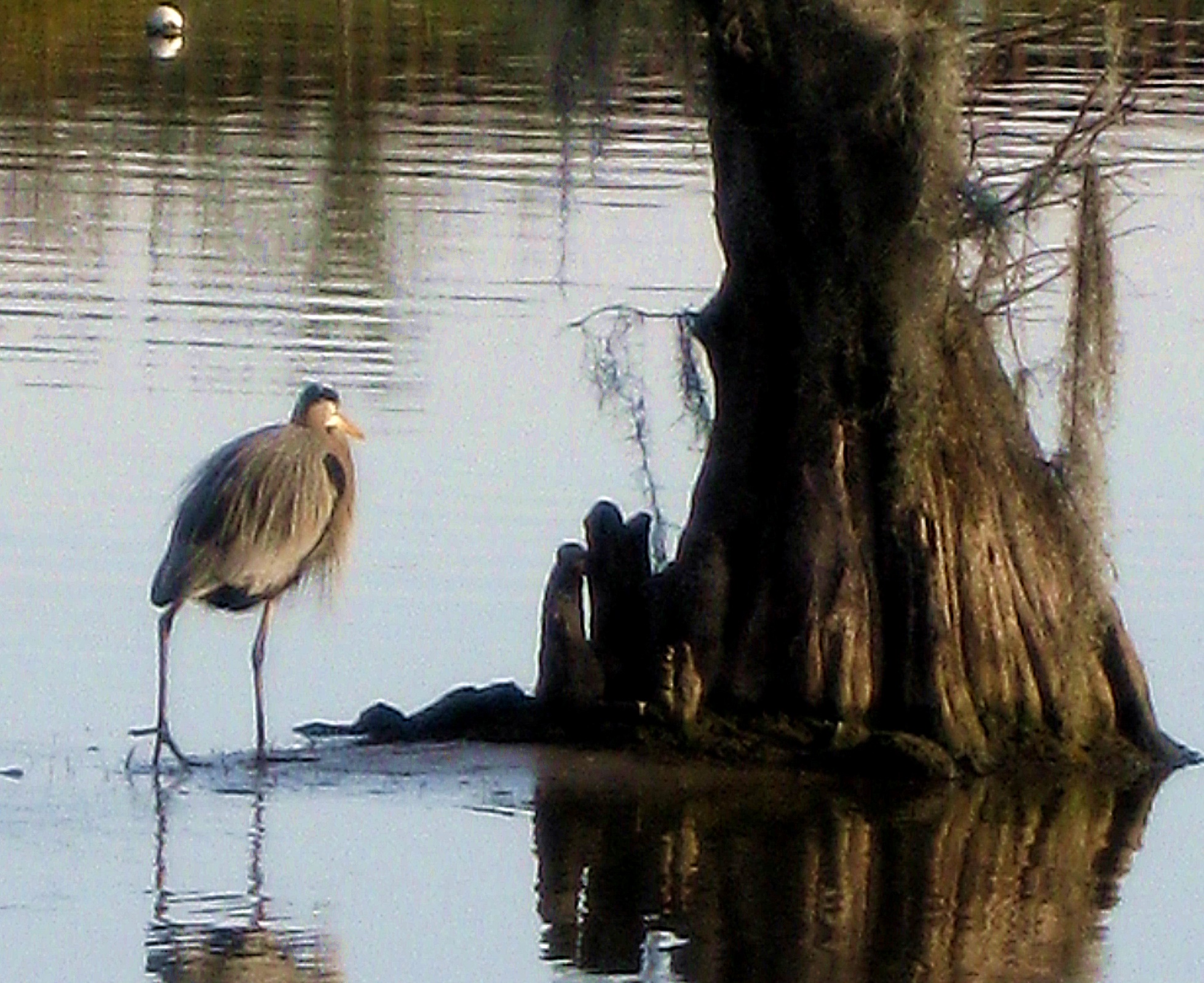
Great Blue Heron at Lake End Campground, Louisiana. — Photo by Pat Bean

So, it was that I found myself spending a few nights on the western edge of Louisiana’s Lake Palourde at Lake End Campground, sharing it with an abundance of double-crested cormorants and great blue herons. An additional bonus was its scenic walking trail.

Palourde is an 11,250-acre lake near Morgan City, Louisiana. It was originally called Lac Palourde by early French settlers, which means Lake Clam. The name came because of the abundance of clams that once lined the shore.

I didn’t see any clams, but I did see lots of birds – and I slept well.

Bean Pat:  Living outside the lines https://tinyurl.com/y9ho6t7r Be sure and listen to the music. I really loved this blog

Pat Bean is a Lonely Planet Community Pathfinder. Her book, Travels with Maggie, is now up on Amazon at http://tinyurl.com/y8z7553y  Currently, she is writing a book, tentatively titled Bird Droppings, which is about her late-bloomer birding adventures. You can contact her at patbean@msn.com

Read Full Post »

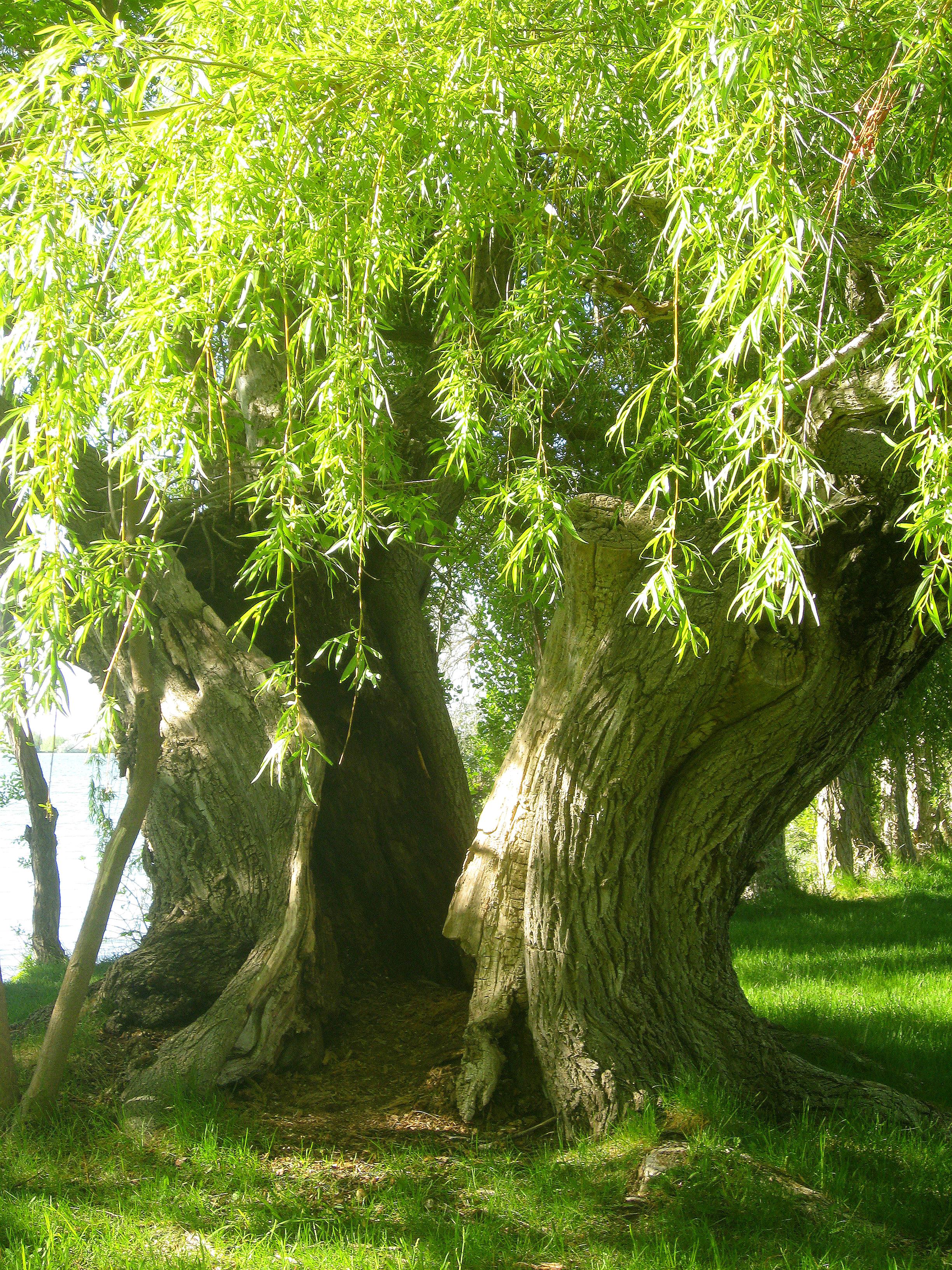
Advice from a Tree: Stand tall and proud. Sink your roots into the earth. Be content with your natural beauty. Go out on a limb. Drink plenty of water. Remember your roots. Enjoy the view. – Ilan Shamir

They’re Huggable

Ralph Marston, author and publisher of The Daily Motivator, asks: “When was the last time you spent a quiet moment just doing nothing – just sitting and looking at the sea, or watching the wind blowing the tree limbs, or waves rippling on a pond, a flickering candle or children playing in the park?”

This live oak tree, thought to be more than a thousand years old, can be found on Goose Island State Park in Texas. It too, is one, whose sight causes me to linger. — Photo by Pat Bean.

My answer is yesterday, when I sat on my third-floor living room balcony, at first watching for the hummingbirds that visit my nectar feeder. When they didn’t come, I then simply stared at the multitude of trees visible from my perch. I know of no better way to calm my body and to fill it with a sense of rightness and peacefulness.

Seven tall Ponderosa pines grow in the courtyard. I often wonder why they are

here in the desert where they don’t belong – but I’m glad they are here. Also growing in the courtyard are the deciduous trees whose names I do not know, plus quite a few black olive trees, whose twisted trunks look as if they have been carved into artistic arrangements.

In the undeveloped desert area around my apartment complex, through which there is a short trail, grow a multitude of Palo Verde trees sporting green trunks and limbs. I’ve observed them through the seasons, sprouting greenish-yellow leaves during monsoon and then dropping them to conserve energy when the desert dries up and the heat sends all living things in search of shade.

Me, hugging a tree in Custer State Park in South Dakota. — Photo by one of the day’s traveling companions.

My former home in Utah, which I sold to go traipsing all across North America, had a huge wild elm tree in the backyard. It was the primary reason I had bought the home. It was so huge that it shaded my entire house, which also benefitted from the shadows cast by a tall Ponderosa pine tree on the opposite side. I needed no other air conditioning.

The trees here at my apartment complex in Tucson, where summer temperatures can reach 120 degrees — air conditioning is definitely needed — provide me the shade I need for the brief walks I take with Pepper, my canine companion, during the hottest part of the summer.

I don’t think I could live in a place without trees. And laugh you might, but I’m not just a tree lover, I’m a tree hugger, too. And I have the photo to prove it.

Bean Pat: The Silence of Nature https://travelsandtrifles.wordpress.com/2018/01/19/thesilence-of-nature/  “See how nature – trees, flowers, grass – grows in silence.”Mother Teresa

Pat Bean is a Lonely Planet Community Pathfinder. Her book, Travels with Maggie, is now up on Amazon at http://tinyurl.com/y8z7553y  Currently, she is writing a book, tentatively titled Bird Droppings, which is about her late-bloomer birding adventures. You can contact her at patbean@msn.com

Read Full Post »

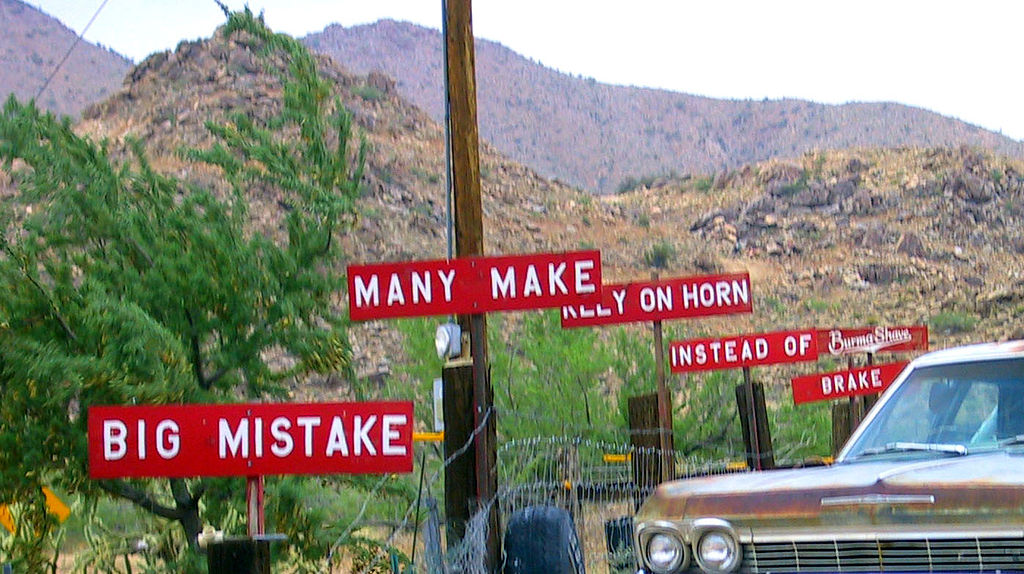
You can still find these signs in Arizona on a section of Old Route 66 that attracts driving tourists. — Wikimedia photo

Why does a chicken

Cross the street?

She sees a guy

She’d like to meet.

He uses

Burma Shave

On Old Route 66

When I was about 12, back in the early 1950s, I went on my first road trip. It was a journey from Texas to California with my aunt and uncle who took me along as the babysitter for my 18-month-old cousin. I already had an addicted case of wanderlust from reading about far-away places. This trip just added jet fuel to a passion that still exists today.

While flying thrilled me the first time I was in an airplane – I was in my 30s by then – I quickly realized I would much rather drive places when possible, because there’s lots more to see.

That first road trip, with my uncle barreling down Route 66 — sometimes hitting 100 mph he bragged – in his brand-new Oldsmobile, found me reading Burma Shave signs. You do remember those, don’t you?

Thankfully, at the speed we were traveling, the bright red and white signs were still spaced far enough apart for me to read. Those signs were a great advertising ploy selling shaving cream. And now they provide good memories for this old, wander-lusted broad.

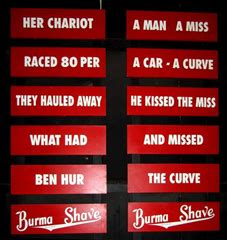
Now here are a few from the past that might bring good memories for some, and maybe even a laugh or two.

Drinking drivers

Enhance their

Chance

To highball home

In an ambulance

Burma Shave

           *

“At ease,” she said.

“Maneuvers begin

When you get

Those whiskers

Off your chin

Burma Shave

          *

I use it too

The bald man said

It keeps my face

Just like

My head

Burma Shave

       *

The Monkey took

One look at Jim

And threw the peanuts

Back at him

He needed

Burma Shave

Bean Pat: Miss Pelican’s Perch https://misspelicansperch.wordpress.com/2018/01/10/undulation-old-stoves-lipstick-and-the-new-moon/  This is a good blog for writers. And I, too, am a fan of Natalie Goldberg.

Pat Bean is a Lonely Planet Community Pathfinder. Her book, Travels with Maggie, is now up on Amazon at http://tinyurl.com/y8z7553y  Currently, she is writing a book. tentatively titled Bird Droppings, which is about her late-bloomer birding adventures. You can contact her at patbean@msn.com

Read Full Post »

The sparrow that is twittering on the edge of my balcony is calling up to me this moment a world of memories that reach over half my lifetime, and a world of hope that stretches farther than any flight of sparrows.” — Donald G. Mitchell

White-crowned sparrow. — Wikimedia photo

Among the Mourning Doves

My daughter T.C’s home in Marana, just 13 miles from my Catalina Foothills apartment in Tucson, is a birder’s paradise. So, when I visit, I usually take my binoculars and try to find a little time to sit on her backyard patio and bird watch.

On my last visit, after seeing a phainopepla sitting on a tall saguaro, I focused on the flock of mourning doves beneath a seed feeder. While looking at the doves, I spotted several white-crowned sparrows. They are distinct birds, especially the adults whose crisp white crowns are set off by two black stripes.

Osprey … Wikimedia photo

I might not have noticed the sparrows if it hadn’t been for the larger doves, which reminded me of the time, 2001 in Utah, when I identified a white crown for the first time. I was taking one of my normal weekend drives along a backroad when I got sight of an osprey high on a utility pole. By then I had been braking for birds for two years, so I pulled over to the side for a better look.

The osprey, however, was skittish and flew off. My disappointment was erased, however, when I saw the white crowns in a bush beneath the pole. The ones I watched on that Sunday morning stayed in sight for about 10 minutes, whistling a sharp tune and flitting among several large bushes before they bounded out of sight.

I got back in my car to drive on, then saw the osprey back up on the pole. I guess it decided I was no threat.

Bean Pat: Things you might not have known. I did know this, because I saw one in Africa.  https://janalinesworldjourney.com/2018/01/05/things-you-probably-never-knew-about-dassies-rock-hyrax/?wref=pil

Pat Bean is a Lonely Planet Community Pathfinder. Her book, Travels with Maggie, is now up on Amazon at http://tinyurl.com/y8z7553y  Currently, she is writing a book, tentatively titled Bird Droppings, which is about her late-bloomer birding adventures. You can contact her at patbean@msn.com

Read Full Post »

“You do not have to be good. You do not have to walk on your knees for a hundred miles through the desert, repenting. You only have to let the soft animal of your body love what it loves. Tell me about despair, yours, and I will tell you mine. Meanwhile the world goes on. Meanwhile the sun and the clear pebbles of the rain are moving across the landscapes, over the prairies and the deep trees, the mountains and the rivers. Meanwhile the wild geese, high in the clean blue air, are heading home again. Whoever you are, no matter how lonely, the world offers itself to your imagination, calls to you like the wild geese, harsh and exciting – over and over announcing your place in the family of things.” – Mary Oliver
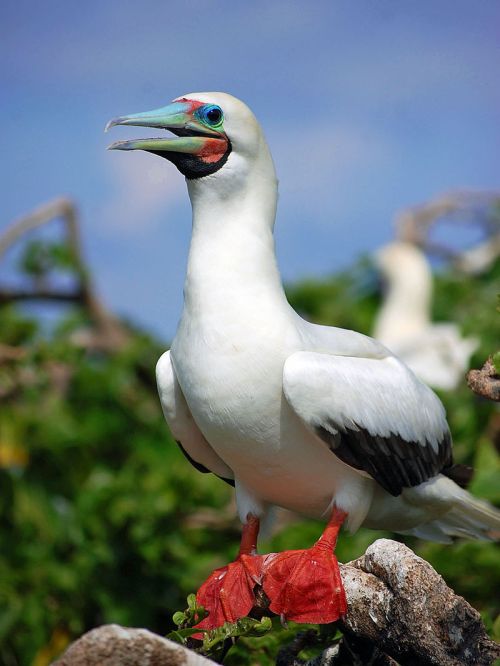
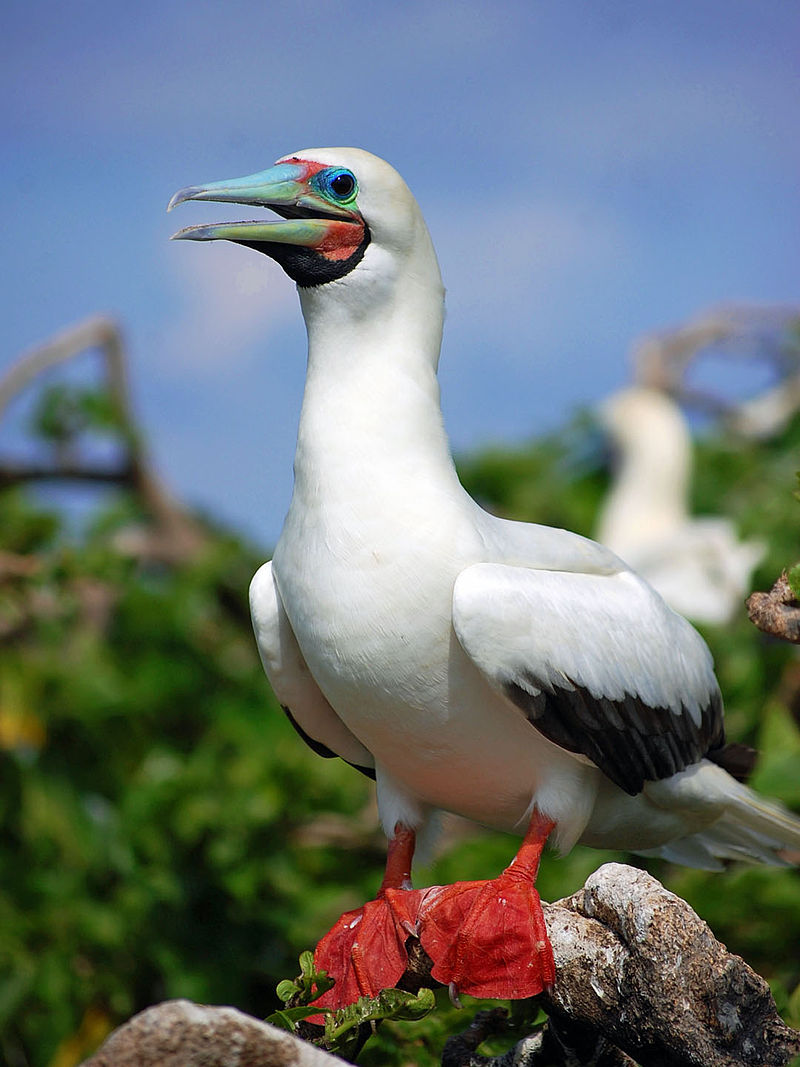
Red-foted booby — Wikimedia photo

And Yellow Feet, Too

            Nothing makes me feel more content than being out in nature. I want to be able to put a name to every wildflower, every tree, every bug, every rock formation and since living in the desert, every cactus that sits along the paths I walk or drive. Did you know there are over 1,500 species of cacti? Finally, I settled on learning to identify and name birds. North America only has about a 1,000 of them. Of course, that’s only about a tenth of the species world-wide.
A dancing blue-footed booby. — Wikimedia photo

I’ve managed, since 1999, which includes nine years of full-time travel across this country, to see a bit over half of them. And a bit of travel to distant lands has added about 200 more to my life list of birds.

The boobies, which are among the latter, are some of my favorite birds. And seeing them for the first time was magical.

The red-footed beauties came first. There were hundreds of them, and I gasped in delight as I watched them, from a walkway above a sheer cliff, circling in flight as they headed out to fish in the Pacific Ocean.

I was at a bird sanctuary on Rota Island, just 35 miles north of Guam, where I was visiting my daughter, Trish. She had treated me to a flight to the island after I had been so disappointed about the lack of birds on Guam. The birds there had been decimated by the brown tree snake, a non-native invader. On Rota, where there were none of these nasty snakes, birds were everywhere.

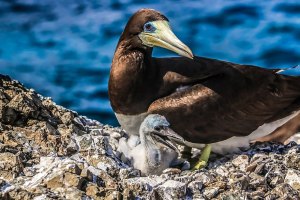
From my high perch, and lower down on the cliff than the red-footed nests, I spied a few brown boobies, whose feet are yellow. It was a grand day to remember.
Just as grand was the day I danced with a blue-footed booby, my favorite of the three boobies.

I saw hundreds of these birds when I cruised the Galapagos Islands in a 16-passenger catamaran. We had along an official guide, which let us visit places where larger groups were not allowed. It was a birder’s paradise, as here the birds had never experienced human predation, and so weren’t afraid of us.

A hooded mockingbird landed on my shoe one day.  And on another I was kissed by a baby seal as I stepped off a small raft and onto the island, The touch made me feel special, unlike the next lady onto the island. That same small seal decided to see if she tasted good.

The rule for us humans was we couldn’t touch the animals, but there was no rule about them touching us.

My dance with the blue-footed booby happened when I came across the large bird blocking my way along a narrow path. He lifted one-foot and then the other to show off his blue feet, which how the male boobies court females. I lifted one foot and then the other in response. We both repeated the motion several times until our guide came around the corner. Stop teasing the booby,” he said.

I skirted around the bird, and when I looked back he lifted one foot , and then the other and our eyes locked. I imagined that he was saying, “Thanks for the Dance.

Bean Pat: A Woman of Worth  https://tinyurl.com/y825f58s   Telling HerStories: The Broad View is sponsored by Story Circle Network, which is an organization that supports female writers. I’m a member and it is the best support I’ve ever had as a writer.

Pat Bean is a Lonely Planet Community Pathfinder. Her book, Travels with Maggie, is now up on Amazon at http://tinyurl.com/y8z7553y  You can contact her at patbean@msn.com

Read Full Post »

« Newer Posts - Older Posts »