Feeds:
Posts
Comments

Archive for the ‘Travel’ Category


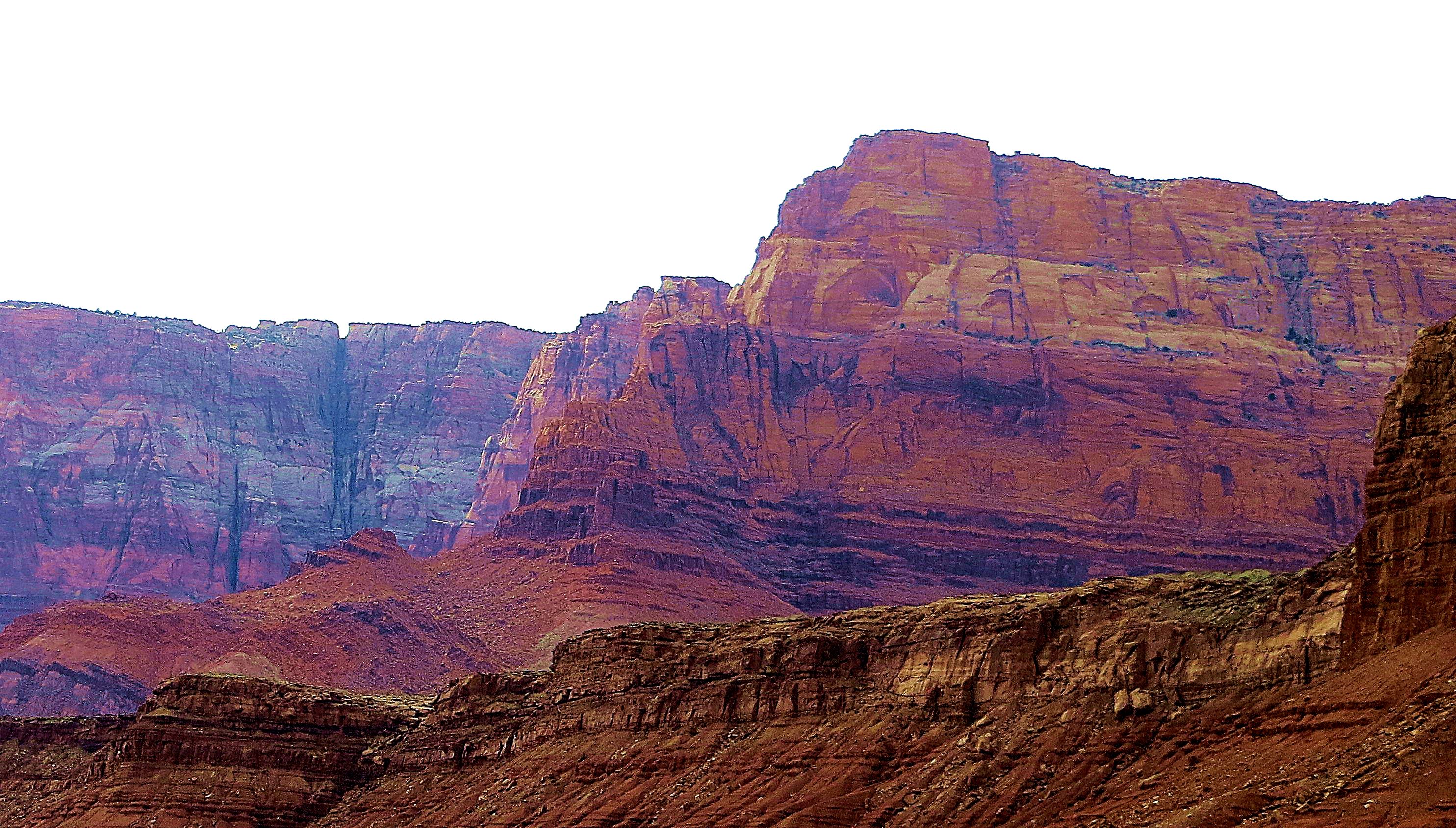
The Vermilion Cliffs -- Photo by Pat Bean

The Vermilion Cliffs — Photo by Pat Bean

“When in doubt, wear red.” Bill Blass

            “Green is the prime color of the world, and that from which its loveliness arises.” – Pedro Calderon de la Barca

Red, Black and Green

If you’re driving north from Flagstaff to Zion National Park’s east entrance, you have a choice of two routes, Highway 89 or Highway 89A. Both are scenic. The first will take you up past Lake Powell and the second past the Vermilion Cliffs and the Kaibab National Forest.
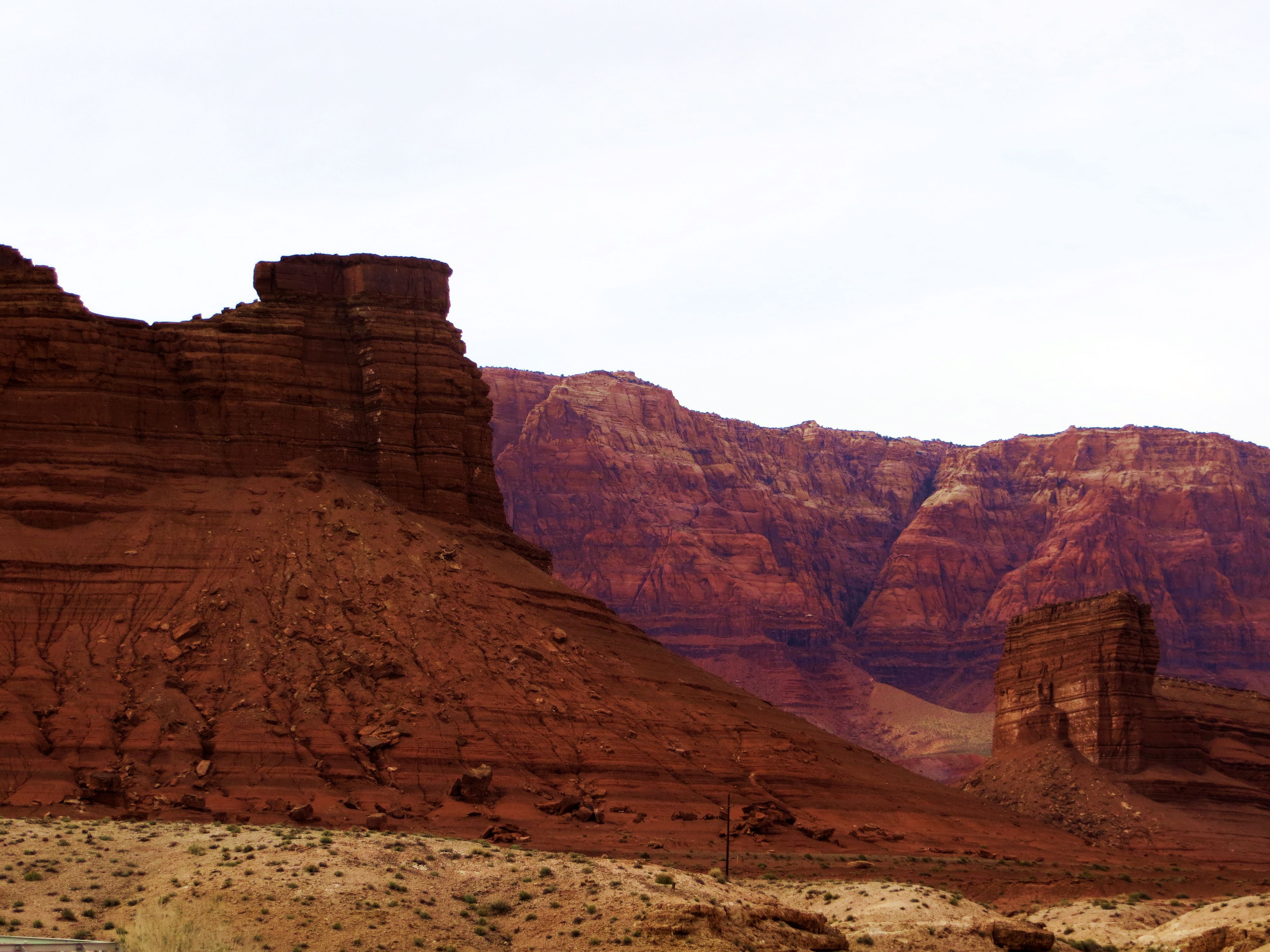
Just red for miles and miles. -- Photo by Pat Bean

Just red for miles and miles. — Photo by Pat Bean

I’ve driven both many times, but since I was going to the North Rim of the Grand Canyon, my only choice was to take 89A, which is where I passed over the Colorado River via Navajo Bridge.

Red is the dominant color of the scenery as you pass by the Vermilion Cliffs, which are the second step-up in the five-step Grand Staircase of the Colorado Plateau. These red-rock escarpments dominate the landscape for miles in Northern Arizona and Southern Utah.

I cannot pass by them without looking up toward the blue sky, however. The Vermilion Cliffs was one of the release sights for returning California condors to the wild, The population of these nearly 10-foot wing-span giants dwindled to a population of only 22 birds in 1987, all of which were in zoos or sanctuaries. By the end of 2014, thanks to efforts to save this endangered species by we humans, California condors numbered over 400, of which half had been released back to the wild.

One of the condors soaring once again in the wild. Note the attached number on its wings.  -- Wikimedia photo

One of the condors soaring once again in the wild. Note the attached number on its wings. — Wikimedia photo

I didn’t see one soaring high in the sky this day, but several years ago, I saw two flying overhead in nearby Zion National Park. Since I had followed the first condor born in captivity in 1983, when I had placed the story and a photo of the hatchling on the front page of the newspaper I was working for at the time, it was a triumphant moment for this birdwatcher, as well as a monument to the efforts of the human race for saving a species from extinction, whose cause of near death had been the pesticide DDT.

I was still reflecting on this momentous achievement, when the red of the landscape turned to green. In the last few miles, the highway had left the red cliffs to zigzag up in elevation until I found myself surrounded on both sides by the green of pines, spruces, oaks and firs that thrive in the Kaibab National Forest .

But I would have to climb higher, still, to find the golden aspens I sought. … To be continued. 

Blog pick of the Day. Check it out.

Blog pick of the Day. Check it out.

Bean Pat: Winter Syntax http://tinyurl.com/q6wb5ct As a writer and nature lover, I found this blog’s poetry appealing.

Read Full Post »


This is an aerial view of the two Navajo Bridges, with the original one on the left. -- Wikimedia Photo

This is an aerial view of the two Navajo Bridges, with the original one on the left. — Wikimedia Photo

          “No man ever steps in the same river twice, for it’s not the same river and he’s not the same man.” — Heraclitus

Beneath Which Flows the Colorado River


Looking down at the Colorado River from the original Navajo Bridge. -- Photo by Pat Bean

Looking down at the Colorado River from the original Navajo Bridge. — Photo by Pat Bean

           The first time I ever crossed the original Navajo Bridge was in the 1960s, and it was night. Built in 1929, and then the highest bridge in the world with the next bridge crossing the Colorado River 600 miles away, were facts which I knew at the time, and facts that sent a shiver of anticipation down my spine , and a bit of dread because of the dark night.

After that first crossing, I drove over the narrow bridge probably over a dozen times more over the next 30 years, and then I walked across it, and stared across it at the new, wider, stronger Navajo Bridge that was built in 1995. The old bridge was kept for foot traffic, with a parking area and a historical museum at one end, and a parking area and Native American open-air market stalls at the other end.

I’ve never crossed the bridge without stopping, and this morning was no different. Pepper and I walked to the middle of the bridge, where I looked down on the river, this time with camera in hand.

My two rafting trips through the Grand Canyon had started just a few miles upstream at Lee’s Ferry, the only easy crossing of the Colorado River within a hundred miles before the first Navajo Bridge was erected. The site is named after John Doyle Lee, who operated a ferry across the Colorado at this spot for many years.

Looking across at the Colorado River as it flows beneath the new Navajo Bridge. -- Photo by Pat Bean

Looking across at the Colorado River as it flows beneath the new Navajo Bridge. — Photo by Pat Bean

Just a short distance downstream Navajo Bridge crosses the Colorado River at Marble Canyon, which marks the start of the 277-mile long Grand Canyon. This spectacular gorge varies from up to 18 miles wide and 6,000 feet deep. But it’s only a little over 800 feet wide at the Navajo Bridge crossing, and a little less than 500 feet deep.

Looking down on the river from the original bridge this day, I envision myself floating beneath it, and a flood of wonderful memories canter through my brain. Sixteen days, each trip, of river baths, sleeping on sandy beaches, sunbaked skin, watching stars pass overhead through a slim ribbon skylight, hikes to waterfalls and fairy-like hidden canyons, no phones, no mirrors and, most memorable, an unexpected swim through Granite Rapid.

My excuse for taking this road trip was to see aspens in their autumn splendor. I suspect, however, that once again crossing Navajo Bridge was never far from my mind. To be continued …

Blog pick of the Day. Check it out.

Blog pick of the Day. Check it out.

Bean Pat: There was a man http://tinyurl.com/peztncx Poetry and Flowers. Who could ask for anything more? A little bread and wine, maybe?

Read Full Post »

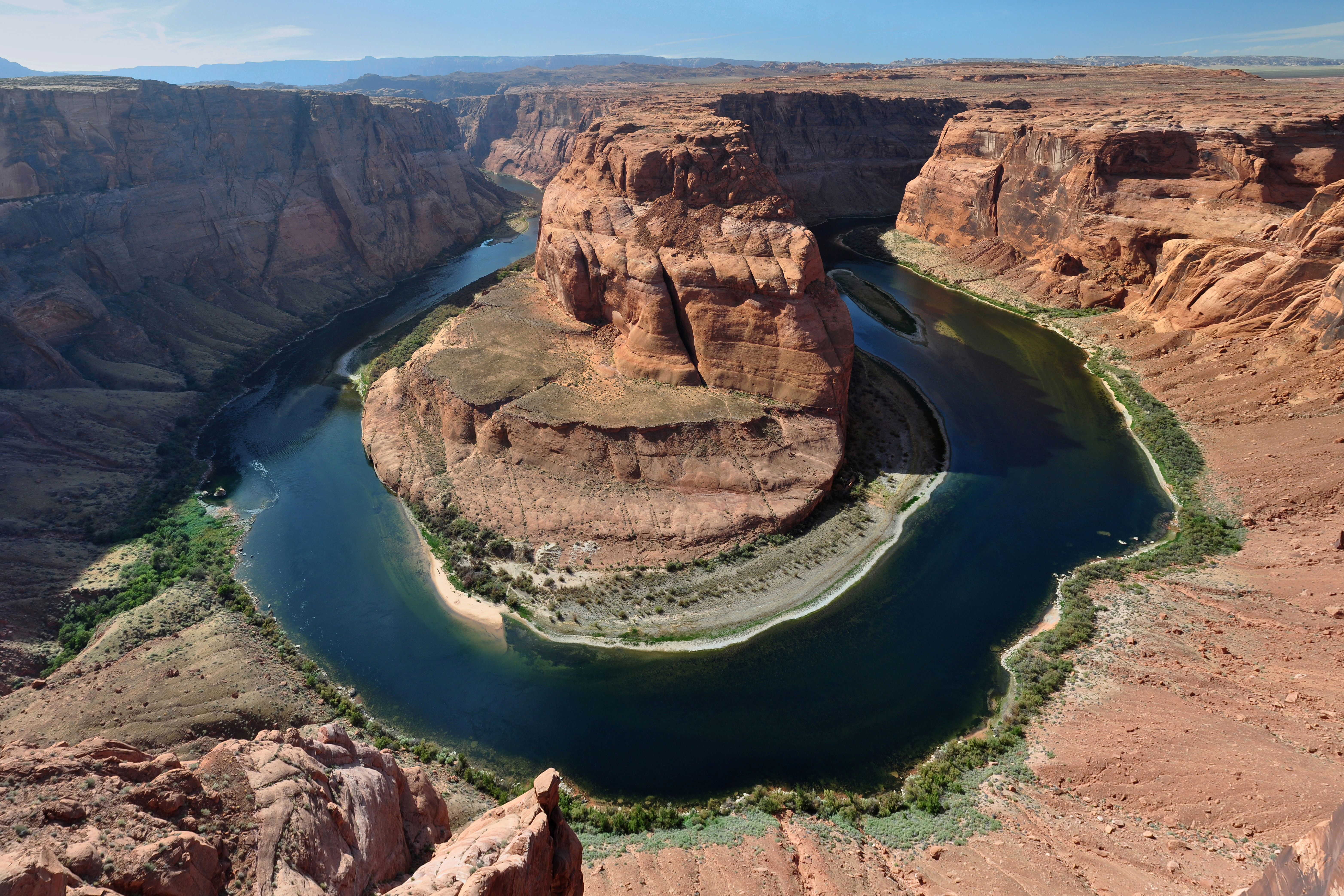
Thank Heavens for Wikimedia and generous photographers for this fabulous stitched panorama of Horseshoe Bend because halfway down to the overlook I remembered I didn't have my camera with me. But even if I had, I couldn't have taken such a magnificent photo. -- Wikimedia photo

Thank Heavens for Wikimedia and generous photographers for this fabulous stitched panorama of Horseshoe Bend because halfway down to the overlook I remembered I didn’t have my camera with me. But even if I had, I couldn’t have taken such a magnificent photo. — Wikimedia photo


“Walking is magic … The movement, the meditation, the health of the blood pumping, and the rhythm of footsteps. This is a primal way to connect with one’s deeper self. – Paula Cole

On Being the Caboose

            Pepper and I set out for the North Rim of the Grand Canyon shortly after dawn, but stopped just south of Page for a quick hike to Horseshoe Bend. It didn’t turn out to be as quick, however, as I remembered it from my younger days.

The hike started with a steep trek up a sandy hill, where you got a good look at the long downhill path ahead of you leading to the edge of a cliff overlooking perhaps the most photographed spot on the Colorado River.

Pepper, the little engine that could to my caboose. -- Photo by Pat Bean

Pepper, the little engine that could to my caboose. — Photo by Pat Bean

Just coming off a serious episode of heavy-duty back pain – from being stupid and lifting way too many pounds for an old broad my age – I questioned my sanity about going on instead of turning back. It wasn’t the next downhill section that worried me, but the trip back up it.

Pepper, however, was still quite frisky and eager for the hike to continue. As for me, I wanted to prove to myself that I still had some go left in me. As I trudged, step at a time in the quickly warming day, I thought back to 1999 when my 60th birthday present to myself was a rafting trip down the Colorado River through the Grand Canyon.

I had made the same trip earlier in time, when I had paddled through the canyon in a six-person paddle raft, enjoying a wondrous up close, personal connection with the rapids. The second trip down the Colorado through the canyon was made in an oar boat with someone else doing all the hard work, which wasn’t too bad because I got to carefully study the passing scenery.

But then, on a side hike up one canyon, over a ridge and them down a second canyon to meet back up with the rafts, I reached a point where I had to have someone help me over a boulder in the path because I couldn’t manage it on my own. I shed a few tears at that. I wasn’t used to having to be helped on a hiking adventure. Usually I led the way – and was never the caboose.

On this day’s adventure to the Horseshoe Bend viewpoint of the Colorado River, I was following my canine companion Pepper. But at least I was going – and of course the viewpoint was worth the effort. In fact, it was magnificent.

On the hike back, I followed Pepper up the hill, and didn’t resist, nor cry, when she trotted far enough ahead to pull me along with her. I’m quite thankful to have such a wonderful hiking companion, and doubly thankful that I still have at least a little bit of go left in me, even if I have to be the caboose on my adventures. .

Back in our vehicle, with its air conditioning blasting away, Pepper and I continued on our day’s journey to the North Rim of the Grand Canyonas Dr. Seuss’s words danced in my head. Oh the places you’ll go and the things you’ll see. To be continued           

Blog pick of the Day. Check it out.

Blog pick of the Day. Check it out.

Bean Pat: Wednesday Vignettes http://tinyurl.com/qape662 Tranquil

Read Full Post »

View across Lake Powell from Wahweap Marina. -- Photo by Pat Bean

View across Lake Powell from Wahweap Marina. — Photo by Pat Bean

“The power of the river is to flow wildly. The power of the lake is to think calmly. Wise man both flows like a river and thinks like a lake.” – Mehmet Merat ildan

Then Lake Powell before Dark

            After joining up with Highway 89 in Flagstaff, where I made a quick stop for gas and snacks — Cheetos and a Coke despite my resolution not to eat such road trip fare — I didn’t stop again until Page, where I checked into the Super 8 Motel.

Lone Rock as seen from the beach where I camped my first night in Gypsy Lee. -- Photo by Pat Bean

Lone Rock as seen from the beach where I camped my first night in Gypsy Lee. — Photo by Pat Bean

While the accommodation was definitely economy with no frills, the cost of my room, $150 a night, definitely wasn’t. I had gotten one of the last free rooms available in town when I had called five days earlier. The only room free at the Super 8 — and it was the cheapest of what was still available — had been a three-bed unit. It was a bit of overkill for me and my canine companion Pepper, for whom I paid an additional $10 pet fee. But I was thankful for it when I arrived because the people in the check-in line, both ahead and behind me, were turned away because they had no reservations and there were no vacancies.

This motel, one couple said, was their last hope. Page sits pretty much in the middle of nowhere on its northern edge with the Utah border.  Kanab, if the unlucky travelers were headed west was 75 miles away, and Flagstaff, if they were headed south, was 135 miles away. Little else was located in between.

Page, with only about 8,000 residents, has about 15 hotels – and sees about 3 million tourists annually. The town sprang up in the late 1950s as a housing community for workers and their families during the construction of the nearby Glen Canyon Dam, which backed up the Colorado River to form Lake Powell. The 17-square mile city of Page, land for which was purchased from the Navajo Nation, is perched atop a 4,300-foot mesa, about 600 feet above Lake Powell..

View from a scenic overlook near Wahweap. -- Photob y Pat Bean

View from a scenic overlook near Wahweap. — Photo by Pat Bean

It was still a couple hours before dark after I was checked in, so I decided to check out Lake Powell from the Utah side of the border. You can see the lake from Page, but the better views, I knew, were on the Utah side.

This would be a nostalgic trip back in time for me. I had camped at Lake Powell’s campgrounds several times when I was living in my RV, Gypsy Lee, and toured its lake aboard a boat before that. As an environmental reporter, I had also written about its controversial construction that flooded Glen Canyon, and its environmental impacts on the Colorado River. As in all things, there were two sides to the story. Actually, there were a hundred sides as I now recall.

But this late afternoon was not for thinking, just for seeing – and remembering. And the very best memory of all came when I looked upon Lone Rock. This unimproved beach was where I spent my first night in Gypsy Lee back in April of 2004.  What a great sundown ending to my first day of this road trip. To be continued …

Blog pick of the Day. Check it out.

Blog pick of the Day. Check it out.

Bean Pat: The Open Suitcase http://tinyurl.com/nfg6823 This is a great blog for those of us who can’t afford to visit Europe, And if you don’t live in New York, you can even have fun trying to find Europe in your own backyard.

Read Full Post »

Picacho Peak looking north. This is a Wikimedia photo because there never seemed to be a safe  spot to pull over and take a photograph from this angle on Interstate 10 -- and it's the view of the peak I like best. -- Wikimedia

Picacho Peak looking north. This is a Wikimedia photo because there never seemed to be a safe spot to pull over and take a photograph from this angle on Interstate 10 — and it’s the view of the peak I like best. — Wikimedia

It’s about finding something interesting in an ordinary place … I’ve found it has little to do with the things you see and everything to do with the way you see them.” – Elliott Erwitt

Road Trip 

            I began the first day of my road trip to the North Rim of the Grand Canyon, so I could see aspens in their shivering-in-the-wind golden fall leaves, by singing and dancing around to Willie Nelson’s “On the Road Again.” The song put me exactly where I wanted to be: excited about my upcoming adventure.

The overcast sky that started my day soon gave way to a sunny day. -- Photo by Pat Bean

The overcast sky that started my day soon gave way to a sunny day. — Photo by Pat Bean

When I had the car all packed and ready to go, it was 7 a.m., a great time to start a trip. Five minutes down the road I realized I had forgotten my binoculars, something no birder – which I am – never travels without. Fifteen minutes later, I was back at the spot I made the U-turn.

Fifteen minutes after that, I realized I hadn’t had my morning cup of coffee, which I had planned on making and pouring in my to-go cup for the trip. I assume it slipped my mind when I packed a cooler with sandwiches and other goodies for the trip, since I didn’t want to spend money for food.

Another 15 minutes later, my pocket book $4 lighter after waiting in a lengthy line at Starbucks for a latte, I again headed out of town. It was after 8 a.m. when my canine companion Pepper and I finally took the ramp to Interstate 10, leaving Tucson in the rearview mirror.

It was a pretty typical start for one of my road trips.

The morning was overcast and dusty, as a stiff breeze rolled across the desert roadsides. But I was upbeat, unhooked from all electronics, including my car radio, and scanning the landscape for surprises on a route I had traveled quite a few times before since moving to Tucson almost three years ago.

Those trips, however, were for taking my daughter to the doctor in Phoenix, or to the Phoenix airport, not just for the pleasure of it, which in my experience is the beginning of a whole new book. The first thing that caught my attention after I turned onto the interstate was Picacho Peak. It intrigues me because of how it stands out in the Sonoran Desert landscape, presenting different and distinct profiles depending on the viewing angle.

What I didn’t know before the trip was that Picacho Peak is the site of a Civil War Battle. The skirmish was fought between an advance party of Confederate soldiers from Texas and a Union Cavalry patrol from California. The site marks the westernmost battle of the war.   The Confederates won the April 1862 battle, but by May of the same year, a stronger force of Union soldiers from California pushed the Confederates back to Texas.

But the history of the 1,500 peak, which served as a landmark for travelers well before my time,  goes back much farther than that, It’s all explained by exhibits at Picacho Peak State Park that now sits at the base of the 1,500-foot peak. It was well worth a stop on my way.  — To be continued


Blog pick of the Day. Check it out.

Blog pick of the Day. Check it out.

   Bean Pat: Write like a weed http://tinyurl.com/nwtm53n  Good writer’s advice.

Read Full Post »

The Hoopoe

“You have to know the past to understand the present.” –Carl Sagan          

A Bird from my Past — and Present

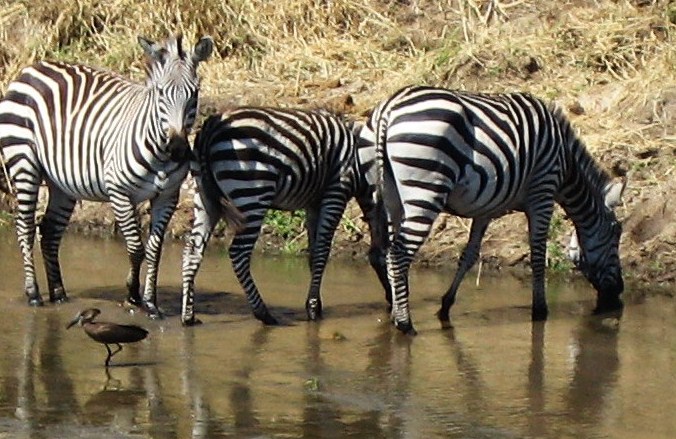
No. That bird at the feet of the zebra isn't a Hoopoe. It's a Hammerkop, and one of the 182 life birds I saw on my African safari. -- Photo by Pat Bean

No. That bird at the feet of the zebra isn’t a Hoopoe. It’s a Hammerkop, and one of the 182 life birds I saw on my African safari. — Photo by Pat Bean

I had never heard of such a thing as a Hoopoe until I read John Michener’s novel, The Source. That was a long time ago. The book was published in 1965, and if I remember correctly I read it right after it came out. I was a Michner fan back then.

This is a Wikimedia photo of a Hoopoe. Sadly I didn't get a good photo of he bird when I saw it, which is actually more normal than not. -- Wikimedia photo

This is a Wikimedia photo of a Hoopoe. Sadly I didn’t get a good photo of he bird when I saw it, which is actually more normal than not. — Wikimedia photo

He wrote 27 fictional novels – and not skinny books either – between 1947 and 2007. The first was Tales of the South Pacific, and the last was Matecumbe, published in its unpolished form a year after his death.

Of all Michener’s books, The Source was my favorite. I think it was because of how Michrner used the bird as a literary device, how described it, and how he named one of his characters Hoopoe, and then claimed he had been named after the bird.

When I read The Source those many years ago, I never expected I would ever get to see a Hoopoe. But I did, while on an African safari in 2007. That trip was one of the top two travel experiences of my life. The other was the 1991 trip when I paddled the Colorado River through the Grand Canyon. I still don’t know which trip should lead off my travel adventure tales. .

It wasn’t until 1999 that I became a passionate birdwatcher. It’s a hobby that caught me by the heart right when my 20 years of passionate white-water rafting heydays, were coming to an end. Wasn’t I lucky?

I’ve found that life always has questions and surprises – like the Hoopoe – to keep my days interesting. And these days, such surprises seem to engage my brain to make connections with my memories. Life is good. Especially since my back is no longer hurting.

Bean Pat http://tinyurl.com/o2jye94 A fascinating tale of the Hoopoe Bird.

Read Full Post »

“Youth is the gift of nature, but age is the work of art.” – Stanislaw Jerzy Lec

Chicago, from the top of the Hancock Building. Jan Morris wrote about the city, as have I.  -- Photo by Pat Bean

Chicago, from the top of the Hancock Building. Jan Morris wrote about the city, as have I. — Photo by Pat Bean

Through the Eyes of Jan Morris

I picked up The World, a travel book by Jan Morris, at the library last week and am fascinated by it.  The book contains a collection of the writer’s work, beginning with the story of the 1953 summiting of Everest for the first time, and ending with an article on Britain’s relinquishment of Hong Kong in 1997.

Jan Morris, who is now 88 to my 76. -- Wikimedia photo

Jan Morris, who is now 88 to my 76. — Wikimedia photo

I was 14 years old in 1953, seeing world happenings through my own eyes – well at least when I was aware of what going on around me – and thus, as I said, fascinated by seeing events and places a second time through both mine and Morris’ eyes and thoughts, veiled in the gauzy haze of half a century.

I had, over the years, read many magazine travel articles by Morris, but none of the writer’s many books, of which the most noted is his history of the British Empire trilogy, Pax Britannica. I knew little, however, about Morris’ personal life. And for some strange reason, or so I thought, I truly didn’t know if the writer was male or female, perhaps because. I knew people of both sexes called Jan.

I laughed when I discovered the answer in The World’s prologue written by Morris. Jan began life as James, completing an eight-year sex transition in 1972. So he wrote over time as both genders.  I guess my instincts were right on target.

Meanwhile, I’m simply enjoying his writing, and traveling back in time to the many eras Jan and this old wondering-wanderer broad have lived through. Morris, in his prologue, could have been speaking for me, when he sums up his feelings about the world over the years.

“I was twenty-four years old at the start of the 1950s, seventy-four at the end of the 1990s, so the passage of the globe described in this book is the passage of a life, too, from the twilight of adolescent to the dawn of senility, all its judgments, unreliable in any case, are colored by the grand change of life from youth to old age … Few of us are consistent in our opinions and values for fifty years, and we are affected not only by experience and maturation, but by moods, fickle tastes, boredom and personal circumstance.”

            Ain’t it the truth!

Bean Pat Morning song http://tinyurl.com/pzn3qla If you love to be woken by bird twitter, you’ll like this house wren’s salute to the day.

Read Full Post »

Another thing that travel writer Catherine Watson share is that we've both visited the Galapagos and were fascinated by the wildlife, like this tortoise I watched on Santa Cruz Island. == Photo by Pat Bean

Another thing that travel writer Catherine Watson and I share is that we’ve both visited the Galapagos and were fascinated by the wildlife, like this tortoise I watched on Santa Cruz Island. == Photo by Pat Bean

            “What is a fear of living? It’s being preeminently afraid of dying. It is not doing what you came here to do, out of timidity and spinelessness. The antidote is to take full responsibility for yourself – for the time you take up and the space you occupy. If you don’t know what you’re here to do, then just do some good.”—Maya Angelou

The Colors of Fear

            I just read the last chapter in Catherine Watson’s travel book, “Home on the Road.”  I understood the title perfectly as the road is where I, too, feel most at home. Catherine and I are both addicted wanderers. The travel bug bit her when she read the Tarzan books. It hit me when I read Osa Johnson’s “I Married Adventure.” Both of us at the time were still a few years away from being teenagers.  Both of us went on to become journalists – and. being of a similar age, both of us were taught as children how to hide beneath our school desks, cover our heads and close our eyes in case of a nuclear bomb attack by our arch-enemy, Russia.

And visited Ecuador, where I (I don't know where she stayed) stayed at this hotel in Guayaquil. -- Photo by Pat Bean

And we have both visited Ecuador, where I (I don’t know where Catherine  stayed) stayed at this hotel in Guayaquil. — Photo by Pat Bean

The last chapter in “Home on the Road” talks about those Cold War days, and how Catherine’s fears of being nuked negatively impacted her life. Looking back on my own life, I now wonder if that’s when I first begin sticking my head in the sand to block out bad stuff happening around me so I could pretend all was right with my world.

I suspect, having overcome our fears, is why Catherine and I can both fearlessly travel alone to unknown places, and why we’re not obsessively fearful of terrorist alerts, that after 9-11 varied in degree by designated  color – with blue being the lowest danger alert and red being the highest danger.

I can no longer stick my head in the sand and say the danger isn’t real, and even more dangerous than our Cold War fears. But I choose not to live my life in fear.

Catherine’s last story in her travel book related the fears she had as a child to what she was seeing when she took a 1979 Trans-Siberian Railroad trip across the then Soviet Union to get a “first-hand look at the country I’d spent my childhood being afraid of, The truth hit me hardest in Irkutsk…. Half the population was living in log cabins without indoor plumbing…. I watched old people wearing heavy clothes against the cold, carrying buckets and trudging slowly along dirt streets to get to the neighborhood water pipe, and suddenly I was flooded with anger.

“For this? ‘I thought,’ For this I gave up my childhood?”

She went on to say that this time around she refused to be afraid. I guess one time was enough for me, too. But I wonder what negative impacts young children today are suffering because our primary colors have become symbols of danger?

Blog pick of the day. Check it out.

Blog pick of the day. Check it out.

Bean Pat:  Bella Remy’s photos  http://tinyurl.com/n4rpcp2  Great photos of a pair of hoodies, also known as hooded mergansers. Looking at them makes up for the fact I was too slow to photograph the gila woodpecker that stood on my balcony rail this morning. Life is good.

Read Full Post »

            “I travel not to go anywhere, but to go. I travel for travel’s sake. The great affair is to move.” – Robert Louis Stevenson

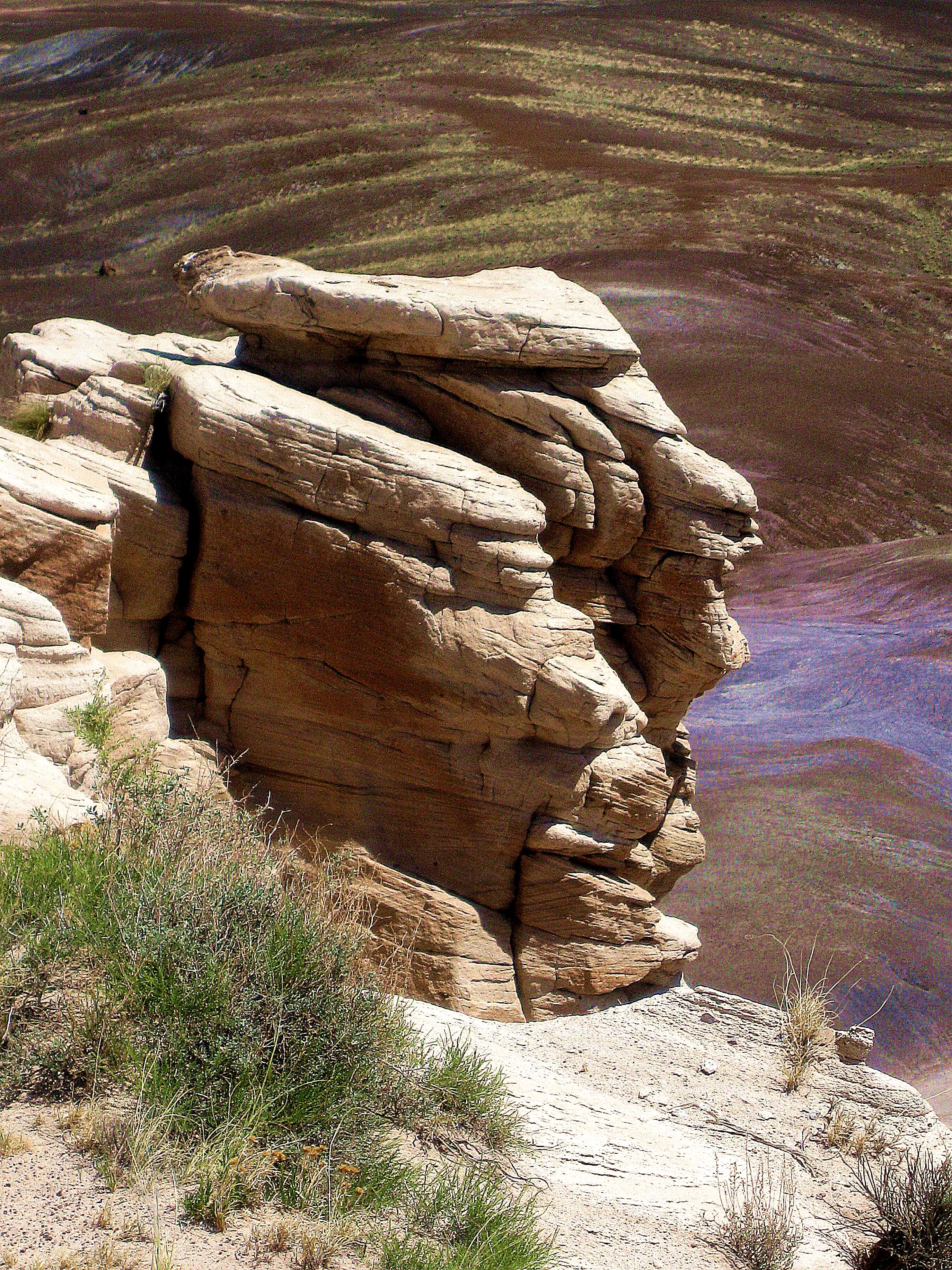
If you traveled Route 66, before it was replaced by Interstate 40, you might have seen these rock faces along side the road. The rocks are in Arizona's Painted Desert, which old Route 66 passed through. Interstate 40 bypasses the scenic landscape.  -- Photo by Pat Bean

If you traveled Route 66, before it was replaced by Interstate 40, you might have seen these rock faces alongside the road. The rocks are in Arizona’s Painted Desert, which old Route 66 passed through. Interstate 40 bypasses the scenic landscape. — Photo by Pat Bean

How Do You Travel

I was 13 when I went on my first road trip, an adventure on Route 66 when it was in its prime. My uncle drove his new 1952 Oldsmobile 100 mph across Texas, New Mexico and Arizona into California, my aunt by his side and me in the back seat with my 18-month-old cousin Barbara. I got invited on the trip, my first time out of Texas, to babysit.

I had lunch in a diner on Route 66, just across from this sign, which stands along of the bits and pieces of the old Mother Road that still exists. -- Photo by Pat Bean

I had lunch in a diner on Route 66, just across from this sign, which stands along of the bits and pieces of the old Mother Road that still exists. — Photo by Pat Bean

It was a long, two-day drive there, and two days back, but I was never bored. Nor did I do anything to entertain myself but to stare out the window. Watching the world go by out the window is still what I do when I’m in a car, either as driver or passenger. The passing sights, be they strange, new and scenic or familiar, decaying and nondescript, continually fascinate me. I’m always expecting to see something wonderful.

That wasn’t the case with my children, who read comic books or slept on long drives; or my grandchildren, who watch videos or play games on their phones constantly when they are in the car.

So now I ask myself, is the world different, or kids different. Or does the wanderlust in my soul make me different? How do you travel?

Blog pick of the day. Check it out.

Blog pick of the day. Check it out.

Bean Pat: Best Super Bowl blog of them all http://tinyurl.com/on6kcmb

Read Full Post »

The tumbleweeds blew across cotton fields... -- Photo by Pat Bean

The tumbleweeds blew across cotton fields… — Photo by Pat Bean

“On day one of the drive, I saw my first dome sky. The world was so flat that I could see the level horizon all around me and the sky looked like a dome. Skies like that will give you perspective when nothing else will. The second day, a tumbleweed blew across the interstate. I’m in a western movie, I said to myself, laughing.” — Kimberly Novosel

Tumbleweeds and Bilbo Baggins

By definition, a tumbleweed is any plant which habitually breaks away from its roots and is driven by the wind. If you’ve ever driven across West Texas, I’m sure you’ve seen them. This day, an army of them pursued me as I began my journey home.

and past oil rigs this Texas day. The lowest price I paid for gas on the trip, just fyi, was $1.84 a gallon. I never thought I would see gas so low ever again. It was up to $4 a gallon when I quit traveling full time. -- Photo by  Pat Bean

and past oil rigs this Texas day. The lowest price I paid for gas on the trip, just fyi, was $1.84 a gallon. I never thought I would see gas so low ever again. It was up to $4 a gallon when I quit traveling full time. — Photo by Pat Bean

When I left Lubbock at 9 a.m., it was a chilly 28 degrees with a wind speed of 30 mph, which made it hellishly cold when you factor in the wind chill. But no sooner had Pepper and I gotten warm and comfy in Cheyenne (my bright red car) when the tumbleweeds started to attack.

They mostly blew across Highway 82, but occasionally they put on a frontal attack. I missed most of them, but not all. One, however, was a monster. It was as if a two-story bush had yanked up its roots and decided it had wanderlust, like me.

Fortunately the wind, which was already blowing briskly, became gusty and yanked the giant tumbleweed off the road just before contact. Whew!

As Bilbo said, “It’s a dangerous business, Frodo, going out your door. You step onto the road, and if you don’t keep your feet, there’s no knowing where you might be swept off to.”

Of course that’s the best thing in my book about being on the road.

“The Road goes ever on and on, Down from the door where it began. Now far ahead the Road has gone, And I must follow, if I can, Pursuing it with eager feet, Until it joins some larger way Where many paths and errands meet. And whither then? I cannot say”         

Blog pick of the day. Check it out.

Blog pick of the day. Check it out.

   Bean Pat: Bobby’s Photo  Blog http://tinyurl.com/k3ffnrv Comet Lovejoy. I’ve long followed Bobby Harrison because of his birding photos, and that he was involved for a while in trying to find and photo an ivory-bill woodpecker, after it was thought not to be extinct. This night sky photo, meanwhile, speaks to my soul


Read Full Post »

« Newer Posts - Older Posts »