Feeds:
Posts
Comments

Archive for the ‘Birds’ Category

When I’m watching birds, like this common yellowthroat, I forget all about one-gallus creatures. — Watercolor by Pat Bean


“If something is true, no amount of wishful thinking will change it.” Richard Dawkins

Wishful Thinking

I recently came across the word one-gallus while rereading Aldo Leopold’s Sand County Almanac. I had no idea what it meant, so I looked up the meaning. When I found it, I laughed out loud.  Leopold had called people who didn’t respect wildlife “low-class, ignorant and backward.”

I used to read with a dictionary beside me, but these days it’s my Kindle because it gives me quick access to the internet. I love this modern highway of information, although like almost every change in life, it comes with a dark side – those one-gallus creatures who use it maliciously.

Does the good in life always have to be countered with a dark side? This is a question I ask myself often. I would like the answer to be no, but the longer I live on this planet the more saddened I become that my wished-for answer is never going to come to pass.

And this brings me to one of my favorite quotes: “Insanity is doing the same thing over and over again and expecting a different result.” Or in my case, asking the same thing over and over and expecting a different answer.

I did get a different answer, however, when I went online to double-check the name of the author of the quote. It’s usually attributed to Albert Einstein, but now someone is saying it might have been Benjamin Franklin, or Mark Twain, or none of the above.

If made me think that perhaps nothing is set in concrete, and that perhaps there is still a chance, slight though it will be, that we can eliminate the word one-gallus from the dictionary.

But I suspect this is simply wishful thinking.

            Bean Pat: Bluebirds to cheer your day https://pinolaphoto.com/2018/11/16/a-bluebird-day-at-the-celery-bog/  A photo blog that makes me happy

Pat Bean is a Lonely Planet Community Pathfinder. Her book, Travels with Maggie, is now up on Amazon at http://tinyurl.com/y8z7553y  Currently, she is writing a book, she is calling Bird Droppings, which is about her late-bloomer birding adventures. You can contact her at patbean@msn.com

Read Full Post »

What Life Has Taught Me

Completing a painting, whether it’s good or not, makes me feel happy. — Crow by Pat Bean

“If your happiness depends on what somebody else does, I guess you do have a problem.” — Richard Bach

20 Things that Make Me Happy

I’m not one to give advice. The choices I’ve made in my own life have not always been perfect, and often disastrous. But I was recently thinking about things that have made my life better, which I did feel good about sharing. I came up with the following.

Having a dog and walking her daily:

Not taking anything personal unless it makes me feel better.

Realizing people are more concerned about how they look than how I look.

Writing and bird watching.

Watching birds, like this snowy egret, makes me happy, too. — Photo by Pat Bean.

Believing in myself.

Accepting that I’m not perfect – and even prefer it that way.

Learning something new every day.

Getting enough sleep, but not occasionally missing out on a special opportunity to keep going until I drop.

Smiling

Hugging someone

Laughing often and loud, especially at myself

Beating a pillow with a tennis racket when I’m frustrated, or simple screaming the anger out.

Eating chocolate

Taking a hike in the mountains, or forest, or beside a stream, or on an ocean beach.

Completing a project.

Saying no when I don’t want to do something.

Not breaking promises to myself.

Giving myself credit for reaching goals, like finally publishing my travel book or simply finishing a painting.

Doing something I’ve never done before.

Watching sunrises and sunsets.

So, what’s on your list?

Bean Pat: Live to Write https://nhwn.wordpress.com/2018/09/18/write-now/#like-18435 Good advice for us writers.

Now available on Amazon

Pat Bean is a Lonely Planet Community Pathfinder. Her book, Travels with Maggie, is now up on Amazon at http://tinyurl.com/y8z7553y  Currently, she is writing a book, tentatively titled Bird Droppings, which is about her late-bloomer birding adventures. You can contact her at patbean@msn.com


Read Full Post »

             “The Early bird gets the worm. The early worm … gets eaten.” – Norman Ralph Augustine

It was peaceful and quiet at the Matagorda County Bird Nature Center, where rare time spent with a son was even more important than the lovely scenery and the birds. — Photo by Pat Bean


A Day for the Birds

The greatest number of bird species ever reported in one U.S. county in a single day is 250.  The day was December 19, 2005, and the place was Matagorda County, Texas, according to Wikipedia.

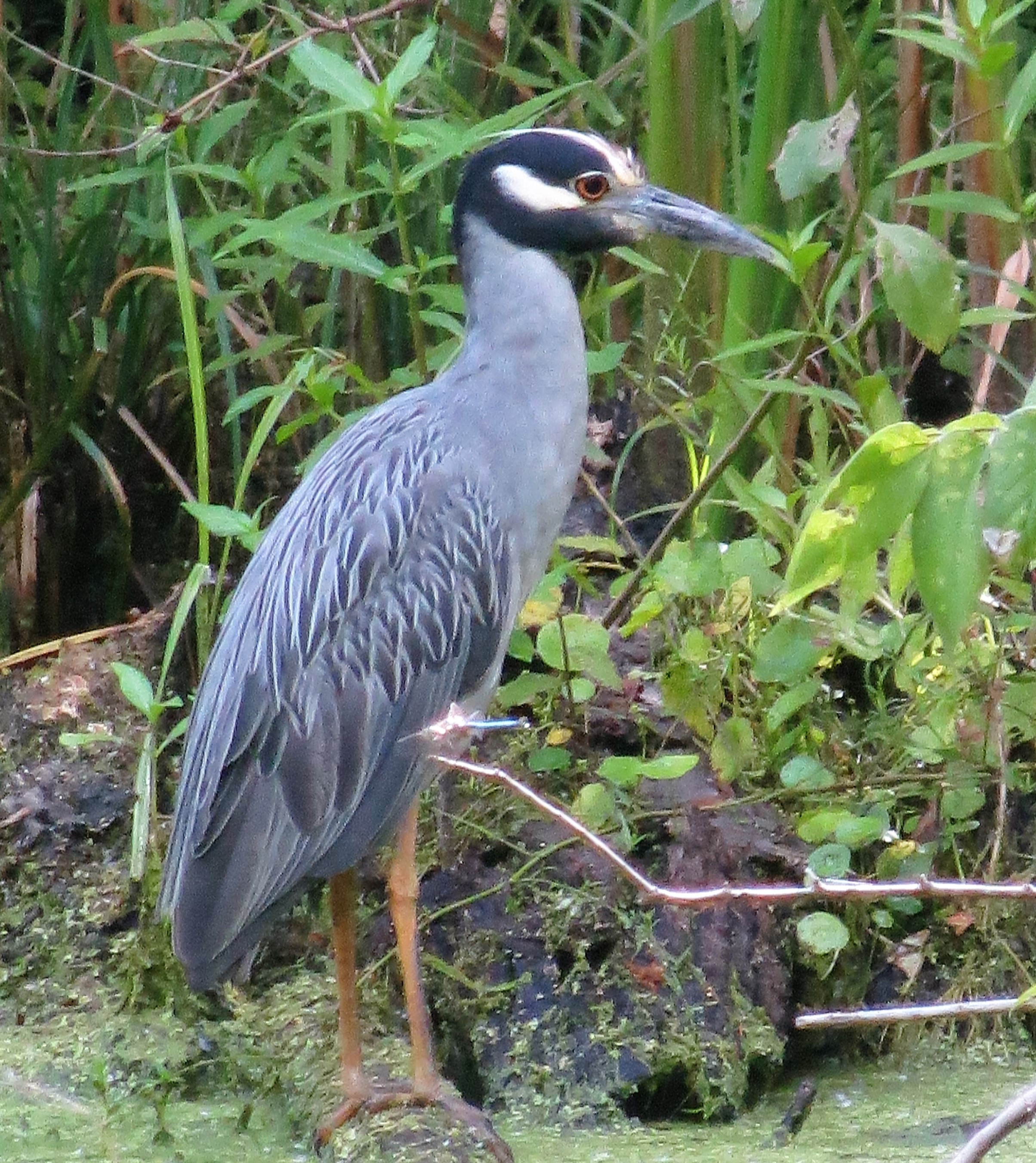
This yellow-crowned night heron patiently posed for his portrait. — Photo by Pat Bean,

Knowing this bit of trivia, it was an easy decision when my son asked me where I wanted to go birding, which is how he and I bond when we have a rare day to be together. I chose the Matagorda County Birding Nature Center located in Bay City for more reasons than that, however. It wasn’t December. It was going to be a hot 100-degree plus July day, and I knew this bird sanctuary had a golf cart that birders could use to get around its 37 acres. And while summer birding in Texas isn’t exactly great, I suspected the center would still have some birds in residence.

Lewis picked me up early, and we birded until 10:30 when the heat got to me and I had to yell uncle.  We then did a drive through nearby San Bernard National Wildlife Refuge, which is in both San Bernard and Brazoria counties.

Lewis posed for a photo to be texted to his wife, Karen, who wasn’t with us this day. She was in Niagara Falls, where Lewis plans to join her soon. — Photo by Pat Bean.

The day’s final bird total was well below the 100 birds Lewis and I got on an April birding day on the Texas Gulf Coast a few years back, which began on the beach in Quintana, and included a visit to the San Bernard refuges. But we still had a few extraordinary sightings,

There were a couple of green herons, always one my favorite birds; a close overhead flyover of a Cooper’s hawk; a brilliant summer tanager, which was one of the birds Lewis and I saw on our first bird outing together at Brazoria National Wildlife Refuge in 2002 when Lewis caught my birding addiction; and a great photo-op of a yellow-crowned night heron.

We ended our adventure by having lunch at Dido’s, where a couple of hummingbirds entertained us as they vied for nectar feeders that sat in front of the large windows that overlooked the San Bernard River.

It was a great day. But as much as I loved the birding, the best part of the it was simply getting to spend time with my son Lewis.

Bean Pat: Writing Soul Mates https://smpauthors.wordpress.com/2018/08/05/waiting-to-be-prospected/  Some good ideas for those times when we struggle with writer’s block.

Pat Bean is a Lonely Planet Community Pathfinder. Her book, Travels with Maggie, is now up on Amazon at http://tinyurl.com/y8z7553y  Currently, she is writing a book, tentatively titled Bird Droppings, which is about her late-bloomer birding adventures. You can contact her at patbean@msn.com

Read Full Post »

In a region of Texas some call the last great habitat, thorn forest intermingles with freshwater wetlands, coastal prairies, mudflats and beaches. Dense patches of thorny brush rise among unique wind-blown clay dunes called lomas.”  — US Fish and Wildlife Service

Laguna Atascosa National Wildlife Refuge — US Fish and Wildlife photo

Birds Galore

            It was a warm November day in 2005 when I visited South Texas’ Laguna Atascosta National Wildlife Refuge, whose name loosely translates to boggy lake. My own description of the refuge, recorded in my journal, coincides somewhat with the official version. I wrote: “Laguna Atascosta is one big briar patch – a haven of thorns. It seemed as if every plant was armed.  Scattered purple and orange wildflowers sat among sage, yucca, and palm trees with shaggy trunks.”

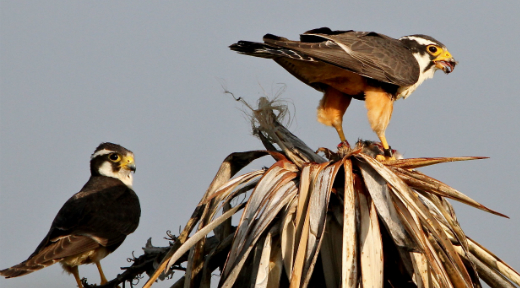
A pair of aplomado falcons. — US Fish and Wildlife photo

Along with my descriptions of the landscape was a list of the birds I was seeing: osprey, white-fronted goose, great egret, great blue heron, white-tailed kite, long-billed curlew, loggerhead shrike, kestrel, sandhill crane, white-tailed hawk, Cooper’s hawk, white pelican, Harris hawk, red-shouldered hawk – just to name a few. Half of the birds found in North America rest, feed, migrate through or nest on this landscape, the leader of our small birding group told us as we watched lesser and greater yellowlegs feeding in some shallow water.

It was easy to tell which was which of the two, not an easy task when looking at only one of the species, I thought, as I added dunlin, marbled godwit, black-bellied plover, northern harrier, gull-billed tern, black-necked stilt and willet to my bird list, which kept getting longer – and kept looking for the No. 1 bird on my priority list.

But as the day wore on, I became more and more doubtful I would see an aplomado falcon, a globally abundant species but rare in North America. Once widespread throughout the American Southwest, only two remaining pairs of aplomado falcons were known to exist in the states in the 1940s and ‘50s, most likely because of over harvesting of eggs, according to US Fish and Wildlife.

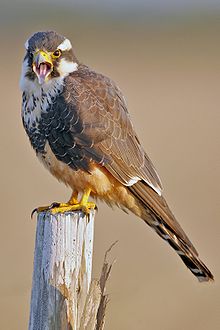
Aplomado falcon. — Wikimedia photo

Today, the aplomado falcon has made a comeback in South Texas due to an aggressive recovery program involving captive breeding and re-introduction efforts. As of 2004, more than 900 falcons had been released in the Rio Grande Valley, with 25 nesting pairs documented in 2006.

Finally, thankfully, I got to see one of those pairs. Our group finally identified one sitting regally on a yucca. The aplomado falcon was a good distance away, but my long-lens telescope brought it up close for a detailed view. As I watched the falcon, which was a new life bird for me, I noted a second one sitting a bit lower on the plant. What a delightful day for us birders.

But it wasn’t over. Before we headed back to our Harlingen Hotel, which was the base for those attending the Rio Grande Valley Birding Festival, I added lesser scaup, crested caracara, belted kingfisher and a dozen or so more birds to my day’s list.

Laguna Atascosa may mostly be a briar patch, but I feel like Br’er Rabbit, who despite his words, would have been quite happy to be tossed back into that thorny thicket.

Bean Pat: Bay of Fundy https://portraitsofwildflowers.wordpress.com/2018/07/02/the-bay-of-fundy/#like-38633 One of my favorite blogs because I usually learn something new, especially how to identify wildflowers.

Pat Bean is a Lonely Planet Community Pathfinder. Her book, Travels with Maggie, is now up on Amazon at http://tinyurl.com/y8z7553y  Currently, she is writing a book, tentatively titled Bird Droppings, which is about her late-bloomer birding adventures. You can contact her patbean@msn.com

Read Full Post »

Hermit thrush — Wikimedia photo

            “That’s the wise thrush; he sings each song twice over, lest you should think he never could recapture the first fine careless rapture!” – Robert Browning

Fodder for Writers

Walt Whitman, like Browning, memorialized the thrush in verse. He used the song of the hermit thrush to describe his lament over the death of Abraham Lincoln.

Whitman had asked nature writer John Burroughs what bird’s voice had a heartbreaking purity that could be used as a motif for his poem, and Burroughs had suggested the hermit thrush. In his own writings, Burroughs wrote that the song of the hermit thrush brought him “that serene exaltation of sentiment of which music, literature and religion are but the faint types of symbols.”

And Anthony Trollope wrote: “I do not know whether there be, as a rule, more vocal expression of the sentiment of love between a man and a woman, than there is between two thrushes. They whistle and call to each other, guided by instinct rather than by reason.”

I didn’t get a photo of the owls this morning, but I did get one of a gila woodpecker in a wild piece of desert landscape near my Tucson apartment. — Photo by Pat Bean

The great American birder, Roger Tory Peterson wrote about hearing the hermit thrush’s haunting melody near Monterey, California, during his trek across American with the great English birder James Fisher in the 1950s, in their book, Wild America.

I saw my first hermit thrush on a cold winter day in 2004, at a small city park near Brigham City in Northern Utah. I had been scrunching through crispy, crackling snow that was laced with ring-necked pheasant tracks when I heard someone say: “Hermit thrush.” I quickly veered in their direction, but by the time I got there, the small brown bird had disappeared into some thick bushes.

Before I could moan in despair, however, the thrush hopped out of the bushes and back into plain sight – and stayed long enough for me to note that its tail and rump looked like it had been dusted with rust, and to observe its slender white eye ring and sprinkling of freckles on its breast.   Life was good – still is. I’ve seen our resident great horned owl pair every day this week.

Bean Pat: Hide and Seek with Butterflies https://forestgardenblog.wordpress.com/2018/06/29/fabulous-friday-hide-and-seek-with-the-butterflies/  A delightful armchair walk in nature.

Pat Bean is a Lonely Planet Community Pathfinder. Her book, Travels with Maggie, is now up on Amazon at http://tinyurl.com/y8z7553y  Currently, she is writing a book, tentatively titled Bird Droppings, which is about her late-bloomer birding adventures. You can contact her patbean@msn.com

Read Full Post »

“I said, ‘Ooh, Dad, I want the yellow ones.’ He said, ‘Where?’ I said, ‘Right there, Dad. I want the yellow ones.’ Everybody goes, ‘Those are green’. That’s how I knew I was colorblind.” — Michael Rosenbaum

An evening view from my apartment balcony that I took last fall. — Photo by Pat Bean

A Yellow Variant

It was a birdy morning today, one that had me almost constantly reaching for my binoculars as I drank my coffee

A yellow variant house finch.

while sitting on my third-floor balcony. There were the usual suspects of Anna’s, black-chinned and broad-tailed hummingbirds spatting at my nectar feeder, mourning and white-winged doves cooing in the background, a raven cawing from the roof opposite my balcony, and small verdins and goldfinches flitting about in the trees.

Our resident Cooper’s hawk flew to the top of a tall tree and stared down at be for a bit – and I stared right back at him. A bright red northern cardinal flew past before disappearing in the foliage of trees across the courtyard. Then two other visitors, a brown thrasher and a tropical kingbird, uncommon visitors to my balcony view, flew in for a brief visit.

House finch sitting on my balcony railing. — Photo by Pat Bean

Elated at these last two, I described their visit in my journal. But then another bird flew in. It was a house finch, a common species I’ve seen hundreds of times. But this one was different. Instead of being all decked out in red feathers on head and breast, this one had yellow feathers. While not exactly rare, although not common, this was the first one in almost 20 years of serious bird watching I had ever seen.

I was seriously thrilled. Life is good.

            Bean Pat: A laugh for writers https://brevity.wordpress.com/2018/06/13/classic-jokes-for-writers/#like-12824   You might not get these if you’re not a writer. And if you’re a writer, you will probably like this blog.

Pat Bean is a Lonely Planet Community Pathfinder. Her book, Travels with Maggie, is now up on Amazon at http://tinyurl.com/y8z7553y  Currently, she is writing a book, tentatively titled Bird Droppings, which is about her late-bloomer birding adventures. You can contact her patbean@msn.com

Read Full Post »

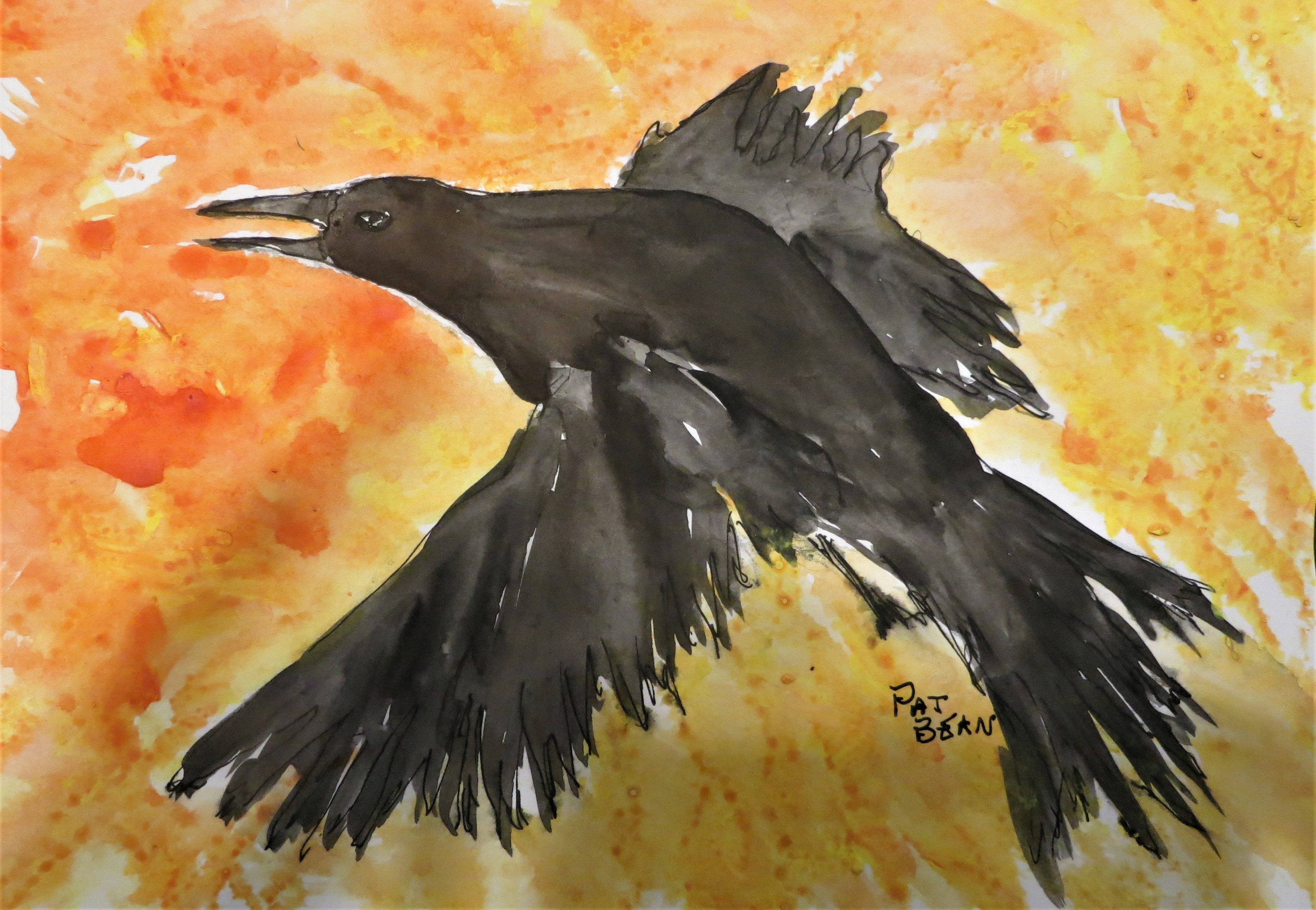
The Raven — By Pat Bean

“To dream is to remain always open.” – Rod McKuen

A Page from My 1983 Journal

The early 1980s were a tumultuous time in my life. I was coming off a bad 22-year marriage, and was both having the time of my life and lonely tearful nights.  It was a time when I let the words of others explain my new-found feelings, thus my journals back then are full of quotes that were meaningful to me.

And Rod McKuen spoke for me.

“Without some think time, we relinquish our quest for knowledge to others, and are forced to accept their opinions as our own.” Yup, I certainly had been doing that.

“Nobody’s perfect and that’s one of the best things that can be said about man.” One of the landmark days of my life was when I not only accepted but rejoiced in this truth.

“Welcome is the thunder to the man who’s lived to long in silence.”

To the above, I wrote on that April 6 day: I love this quote. I guess I really went out to search for the thunder in my own life – and found it, and welcomed it. Life is a joy – and occasionally a pain in the arse.

Bean Pat: Contrast https://andrewsviewoftheweek.com/2018/05/27/contrast/

Blog pick of the day.

I love this post because it feels real, both about life and how a writer’s mind works. And I sometimes tell my canine companion Pepper how lucky she is to have adopted me.

Pat Bean is a Lonely Planet Community Pathfinder. Her book, Travels with Maggie, is now up on Amazon at http://tinyurl.com/y8z7553y  Currently, she is writing a book, tentatively titled Bird Droppings, which is about her late-bloomer birding adventures. You can contact her at patbean@msn.com
Read Full Post »

Birds: Ibises

“The soul becomes dyed with the color of its thoughts.” – Marcus Aurelius

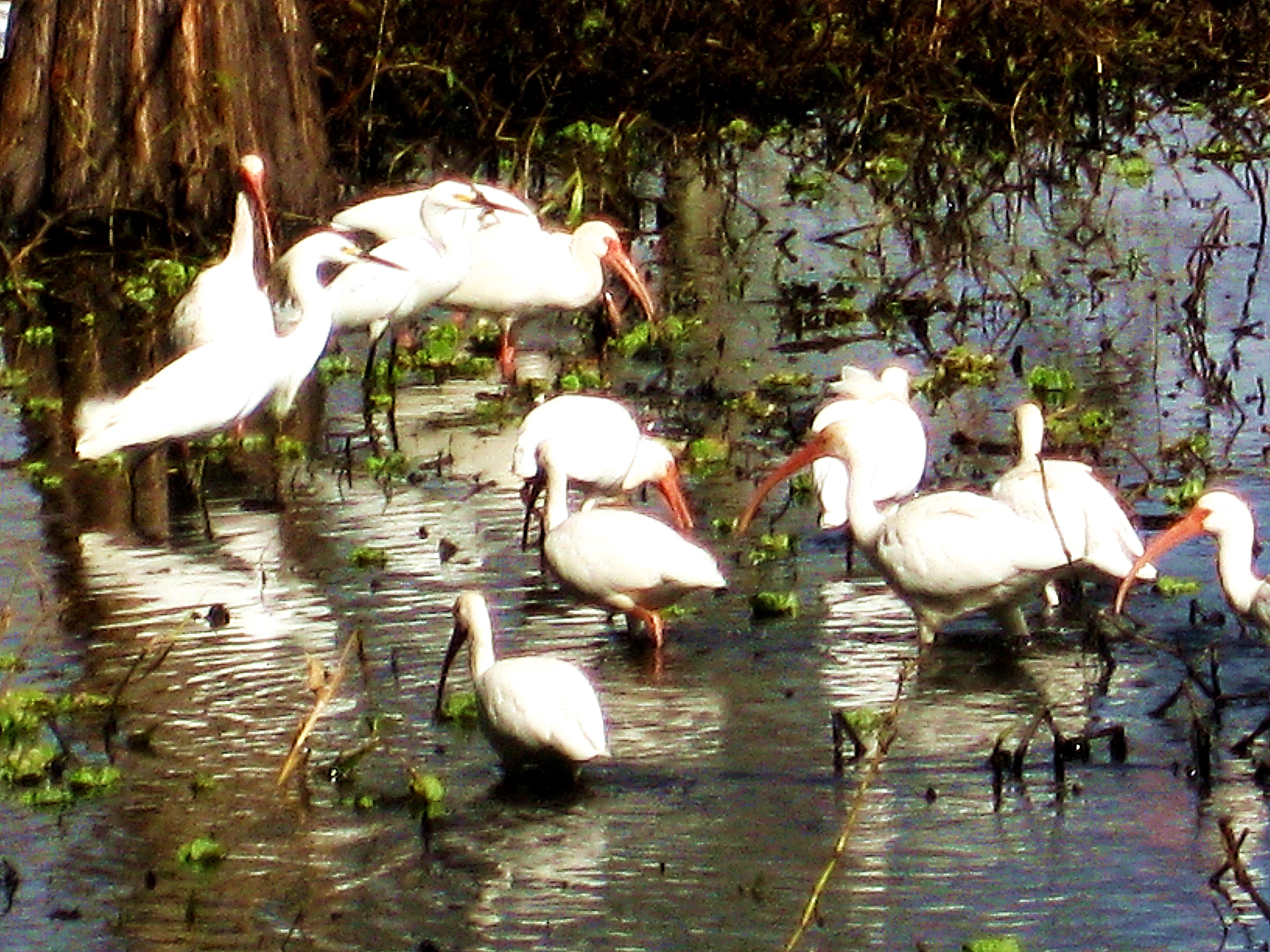
One is not like the other. Among this flock of white ibis at Brazos Bend State Park in Texas, is a lone snowy egret. — Photo by Pat Bean


One is Not Like the Other

I lived in Northern Utah – where you might see 463 different bird species – when I first started birding in 1999. The

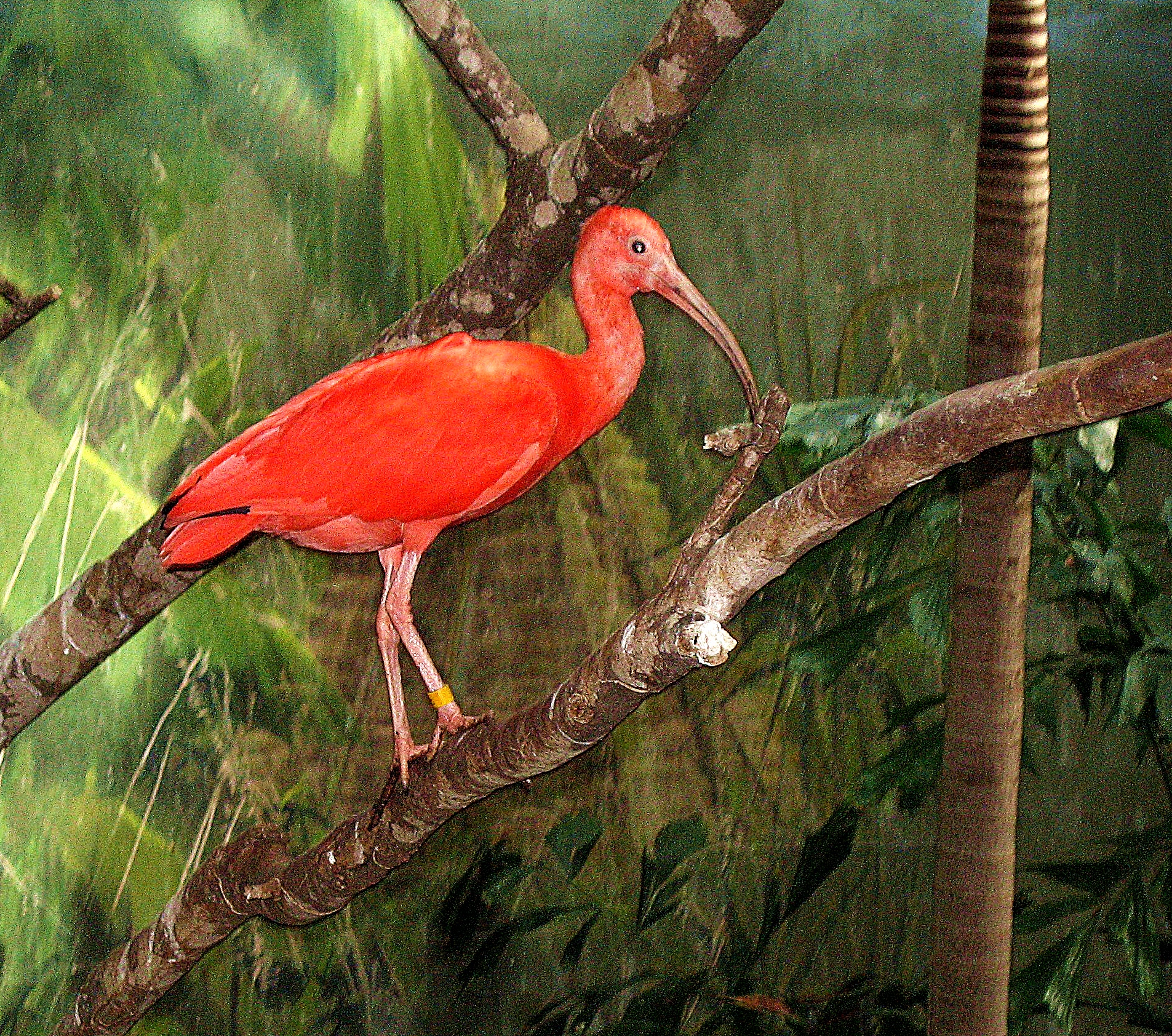
Scarlet Ibis at zoo in Dallas, Texas. — Photo by Pat Bean

white-faced ibis was one of the first ones to make my Life List. Like so many other strange things I was learning about birds, I couldn’t understand why this ibis one was so named. The amount of white on this long-legged, curved-bill bird was so tiny that I usually couldn’t see it with the naked eye, and not always with binoculars.

But this maroonish-brown shore bird, with flashes of green in its feathers, is fun to watch. I often saw flocks around the shallow waters of Great Salt Lake. Its distinctive profile, and the fact that it looks like a flying stick when in the air, makes it an easy bird to identify.

I saw my first white ibis, even easier to identify, and the second of

White-faced ibis ner the shoreline of Great Salt Lake.

America’s four species of ibis to make my list, in 2001, and my third, a glossy ibis, in 2005, both on Texas’ Gulf Coast. I have only seen the fourth, the scarlet ibis, in zoos and aviaries. This brilliant colored ibis only rarely visits North America from its habitats in the Caribbean and South America.

Two other ibises are also on my life list: the hadada and the sacred. The hadada ibis was the first bird I saw after landing in the middle of the night in Nairobi, Kenya. It was up a tree in the courtyard of the Norfolk Hotel. A few days later, I saw the sacred ibis in the Ngorongoro Crater in Tanzania.

Of the now estimated 10,000 birds in the world, 28 of these are ibises. Sadly, including the five ibis, (the scarlet ibis doesn’t count because I haven’t yet seen a wild one), I only have 710 birds on my Life List.  I guess this old broad still has a lot of birding to do.

Bean Pat: Gulls of the World http://www.10000birds.com/gulls-of-the-world-a-photographic-guide-a-gull-book-review.htm?utm_source=feedburner&utm_medium=feed&utm_campaign=Feed%3A+10000Birds+%2810%2C000+Birds%29  Just in case you’ve ever wondered what gull you are looking at.

Pat Bean is a Lonely Planet Community Pathfinder. Her book, Travels with Maggie, is now up on Amazon at http://tinyurl.com/y8z7553y  Currently, she is writing a book, tentatively titled Bird Droppings, which is about her late-bloomer birding adventures. You can contact her at patbean@msn.com
Read Full Post »

“There is nothing to writing. All you do is sit down at a typewriter and bleed.” – Ernest Hemingway.

The Good Old Days

So many writing quotes, like the one above by Hemingway, have become outdated. While I do know a few writers who still write their first drafts by hand, I know none who still use a typewriter. The computer has made that once miracle machine obsolete.

I vividly remember my first encounter with a computer. The year was 1978, and I was working as a reporter for the Fort Worth Star-Telegram. One day I was typing my stories on a typewriter, and the next day I was told that I had to use a computer.

My first thought was I can’t write on a computer. So, I continued writing my stories on a typewriter — and then retyping them into that dang computer. This lasted for about two weeks before I finally caught on to the fact I was doubling my work load.

A couple of years later, I accepted a job as features editor at the Standard-Examiner newspaper in Ogden, Utah, where I was introduced to a Mercenthaler computer system, which was always breaking down and eating my words. I blame it for teaching me how to cuss at the late-blooming age of 40.

During these years, I continued using my old Remington typewriter at home for my personal writing. By 1985, however, the difference in the feel of the two keyboards forced me to give in and buy my first home computer, one that didn’t have a hard drive, but ran on floppy disks. Every couple of years after that I upgraded to a newer computer.

I bought my first laptop, paying $2,300 for a top-of-the-line machine in 2004, the week I retired from journalism so I could continue to freelance while I traveled the country in my small RV with my canine companion Maggie. For two years, I used my phone as a modem to connect to the world, but then I got my own hot spot. Comcast is the provider of my current Wi-Fi system, and costs me $70 a month.

My current laptop, a Toshiba I bought in 2011 for $800, and which is the longest lasting computer I have ever had, is just about ready for replacement.

Today, I don’t just use a computer as a writing tool, but also to do research, stream movies and tv, play games, stay in contact with family and friends, read the news, and to export my freelance articles directly to magazines and publishers, which is what I did when I finished my book, Travels with Maggie.

I went from wondering what in the heck I was going to do with a computer, to wondering how I can live without one. Ditto for air conditioning — I lived on the Texas Gulf Coast in the 1950’s without it.

I also grew up knowing how to change a tire on my car because tires were not as reliable as they are today, and we didn’t have mobile phones.

Yup. My world has changed a lot. Perhaps the good old days are here and now — or waiting for us in the future.

Bean Pat: Pileated woodpecker https://belindagroverphotography.com/2018/06/03/young-pileated-woodpecker-three-photographs/

Now available on Amazon

One of my favorite photography blogs. And an amazing bird that catches my breath every time I see one.

Pat Bean is a Lonely Planet Community Pathfinder. Her book, Travels with Maggie, is now up on Amazon at http://tinyurl.com/y8z7553y  Currently, she is writing a book, tentatively titled Bird Droppings, which is about her late-bloomer birding adventures. You can contact her at patbean@msn.com

Read Full Post »

“Stop waiting for the perfect day, or the perfect moment … Take this day, this moment and lead it to perfection. – Steve Maraboli

Red-headed woodpecker. — Wikimedia photo

A Page From my May 2005 Journal 

            I was sitting on a bluff above the Oauchita River in Camden, Arkansas, listening to bird song. Low clouds still carried the pink glow of the rising sun, and I watched as the airy cotton-like puffs transformed, first to golden and then to the blue tinge of the morning sky. It was cool and a gentle breeze ruffled tree leaves. All around me were clumps of wisteria, a vigorous tree-climbing vine with drooping lilac-hued blossoms that scented the morning air. Here and there, small dogwood trees with their dainty white flowers added to the enchantment of the landscape. .

Morning sky beside the Oauchita River in Arkansas. — Photo by Pat Bean

I was sitting where once stood a Confederate fort, aptly named Lookout because it provided the perfect spot to keep an eye on the river below.  It was also this very same bluff that had been visited in 1541 by the Spanish explorer, Hernando De Soto. I thought about all this as I surveyed the landscape from my blanketed, cocooned perch in a lawn chair. All troubles, politics and wars of the world were put on hold….

Then I heard a tap-tap-tap coming from a grove of trees. I had seen northern flickers and downy woodpeckers in the area and assumed it was one of them. Instead, I got a nice surprise. I found myself looking at a red-headed woodpecker. Because there is no gender field mark in this species, as there are in many birds, it could have been either a male or female.

The bird was in a typical woodpecker stance, with its strong opposing talons gripping the tree trunk while it leaned back on its stiff tail. It’s head and throat were a brilliant shade of red, in stark contrast to the bluish-black and white feathers that covered the rest of its body.

I watched until the woodpecker flew off across the river, after turning an ordinary morning into an extraordinary one, a perfect start for the day. From their hiding places, a host of other birds chattered, whistled, twittered and sang in agreement.

Bean Pat: The planning fallacy https://tierneycreates.com/2018/05/15/the-planning-fallacy/?wref=pil This made me laugh because it’s so true of my own planning in whatever endeavor.

Blog pick of the day.

Pat Bean: is a Lonely Planet Community Pathfinder. Her book, Travels with Maggie, is now up on Amazon at http://tinyurl.com/y8z7553y  Currently, she is writing a book, tentatively titled Bird Droppings, which is about her late-bloomer birding adventures. You can contact her at patbean@msn.com


Read Full Post »

« Newer Posts - Older Posts »