“It gives one a sudden start in going down a barren, stony street, to see upon a narrow strip of grass, just within the iron fence, the radiant dandelion, shining in the grass, like a spark dropped from the sun.” Henry Ward Beecher

Why is a rose thought to be more beautiful than a dandelion? -- Photo by Pat Bean
Travels With Maggie
I’ve taken my daily walks with my dog, Maggie, while visiting my daughter here in the Dallas suburbs in Rowlett’s Springfield Park. There’s a nice pond, which on my visits has been full of wigeons, coots, cormorants and shovelers, and a paved path that goes all the way around it.
For variety, one can wander over to a slow-moving creek that borders the park and watch, if you’re lucky, a turtle or two, and perhaps spot a ruby-crowned warbler flitting among the tree branches.

Creek turtle -- Photo by Pat Bean
Despite being winter, the park still has green grass, although much of it lies beneath crackling brown tree leaves. On my most recent walk, I came across a sight that always delights me, the unloved dandelion.
Perhaps seeing dandelions springing up unwanted in someone’s lawn or in a landscaped park thrills me because I’ve always been for the underdog. Or perhaps it’s because their bright yellow color brings joy to my soul. Or perhaps it is because I love the wild freedom of a flower that can’t be tamed?
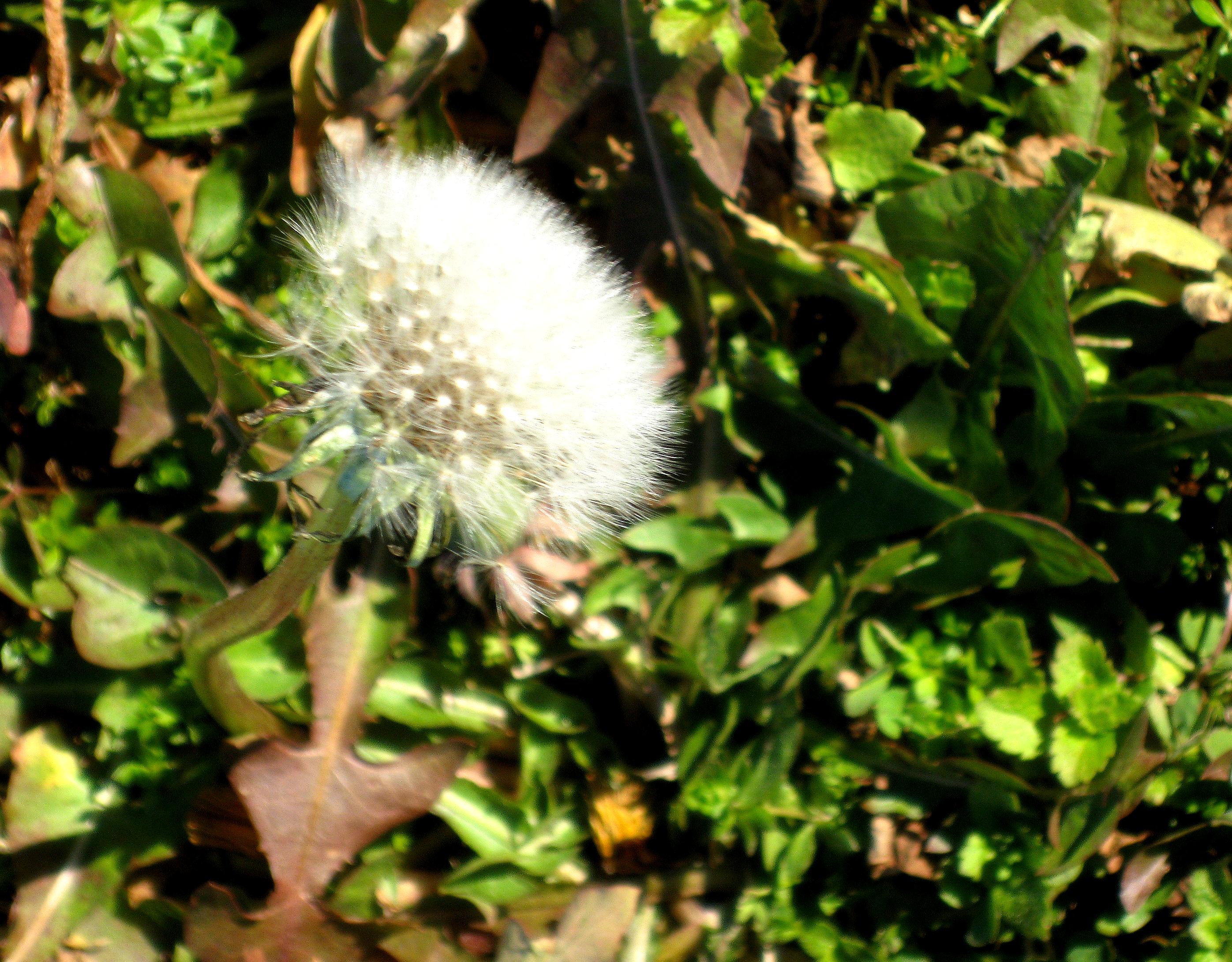
Future generations of dandelions waiting for the wind. -- Photo by Pat Bean
The dandelions were blooming, I suspected, because of Texas’ recent warm weather spell – which last night disintegrated to cold and rainy.
Along with spotting the few dandelions this past Friday, I also saw evidence that some of the golden youngsters had already passed their prime. The elderly among the dandelions had dropped their petals and were white-headed, and in various stages of dispersing their life forces to the wind. They do it with a promise that many more dandelions will invade many more lawns come spring.
How is it, I wondered, that we humans can ooh and aah over a field of bluebonnets but be turned off by a lawn full of dandelions? Who decided what is beautiful and proper and what is not?
Is there something wrong with my DNA because I can love a dandelion as much as a lily?
Aha, my wondering brain concluded as I pondered these questions, perhaps it is those who can’t appreciate the yellow glow of happiness that a dandelion symbolizes who inherited the defective DNA gene?


 Pat Bean's blog
A fellow student in a plant taxonomy class asked where I got a certain flowering plant I’d brought in for my collection. I told him I found it in my yard. “Some yard!” he said. That’s when I realized not everyone appreciates the floral invasions that are part of life in a country town. Manicured lawns are nice, but I like a touch of chaos.
I agree Kathy. Glad your DNA is not defective.
I’ve had thoughts similar to yours, Pat. I grew up in the suburbs of New York, where some people were horrified to have dandelions and clover in their monotone lawns. Like any kid, I used to blow on dandelion puffballs and watch the seeds take off on their little parachutes.
The main thing I have against dandelions now is that they’re from Europe and have become invasive over here. As part of my explorations of plants that evolved in Texas I learned about Pyrrhopappus pauciflorus, which some field guides call “false dandelion,” when in fact it’s the real one (i.e. native one) in this part of the world.
Unfortunately (from my perspective), many people here consider even a lot of the native plants to be weeds. For example, plenty of Texans have called a pretty little flower like Mexican hat a weed:
Oh well….
Interesting. I’m aware of how many non-native plants and animals, like Russian olive trees and European starlings, have affected this country, but wasn’t aware the dandelion was among them. In today’s global world, I’m sure the problem is not going to go away. It really does give new meaning to who and what survives in the long run.
Keep writing … Pat Bean https://patbean.wordpress.com
My mother loved having dandelions in the yard because she went out in the spring and dug them up to eat. Have to get them early before they bloom, though.
I always wondered what part of the dandelion one ate. Thanks for the info.
Diaspora
There is a weed, hunted and hounded but rarely defeated. Its bright yellow flowers and familiar puffball were produced as long as the weather was warm enough. It had many names but we know it as a Dandelion, the ‘Dent de Lion’. Picture it in a field of green grass, yellow and white, flowers and seeds. It is early spring and we lie looking up at the sky, a few clouds drift across, the breeze lifts the seeds from the plants and casts them into the air, who knows where they will end their days. It is a moment of blind hope for the plant, for the future. We lie there silently watching, one moment in a lifetime and no knowledge of the future can intervene, we are here, together.
The opening paragraph of a short story I wrote a while back. Pissenlit in French, Wet the bed is its old English name, for its diuretic properties. You can eat the leaves as a salad. The French force grow them in a long tube to extend them and keep them white and sweet, but I like the young shoots, and they can be harvested all through the spring summer and autumn.
It is a true survivor, and tasty too.
Jim
Great opening paragraph Jim. I loved reading it. if just for a moment in time, the distance and differences between our two worlds flowed together.
I have to agree with your last thought because I think a field (or lawn) filled with the yellow heads of dandelions is a beautiful sight to behold. 🙂
Which is one of the reasons I enjoy your blog so much. Thanks Robin.