Feeds:
Posts
Comments

Posts Tagged ‘postaday2011’

Above Photo: Masai Mara sunset, Wikipedia

How hard to realize that every camp of men or beast has this glorious starry firmament for a roof! In such places … it is easy to realize that whatever special nests we make – leaves and moss like the marmots and birds, or tents or piled stone – we all dwell in a house of one room – the world with the firmament for its roof.” – John Muir
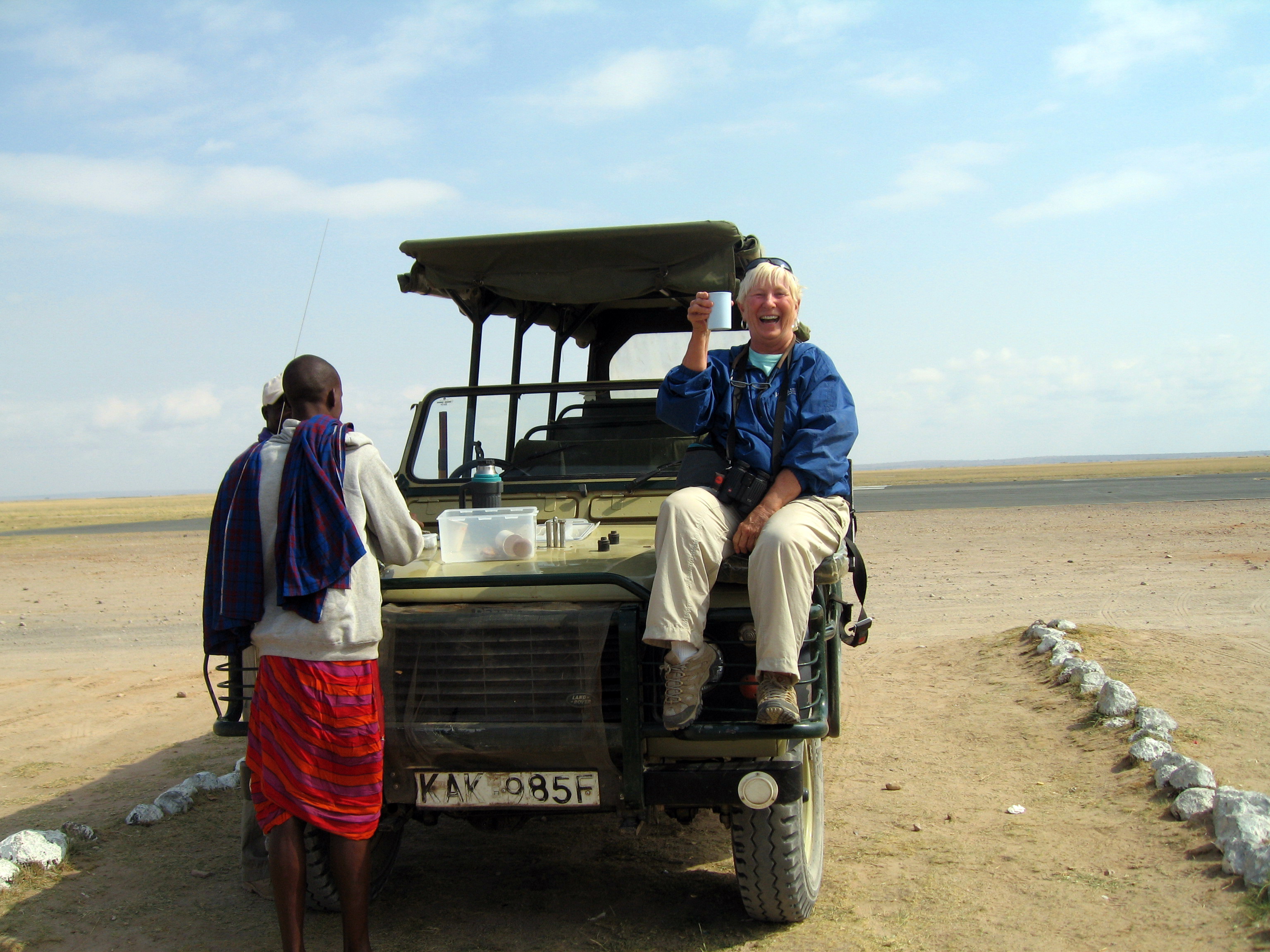
Me playing John Wayne in "Hatari" at the Ambolseli Air Strip. Also pictures is Jackson, a member of the Maasai tribe who was nearing the end of his five-year apprenticeship to be a guide. -- Photo by Kim Perrin

African Safari: Little Governor’s Lodge

After breakfast, Emanuel drove us the Amboseli Airport, a dirt landing strip with only a sign announcing its purpose, where we were to catch an 8:30 a.m. flight back to Nairobi’s small Wilson Airport.

In reminiscence of John Wayne in “Hatari,” I sat on the fender seat of the Land Rover and drank my coffee while we waited for the small plane to arrive. It was late.

The flight was a replay of the informal flight we had taken to Tanzania on our first full day in Africa, and was repeated again on the connecting flight we took from Nairobi on to the Masai Mara National Reserve, which is the northern end of Serengeti National Park.
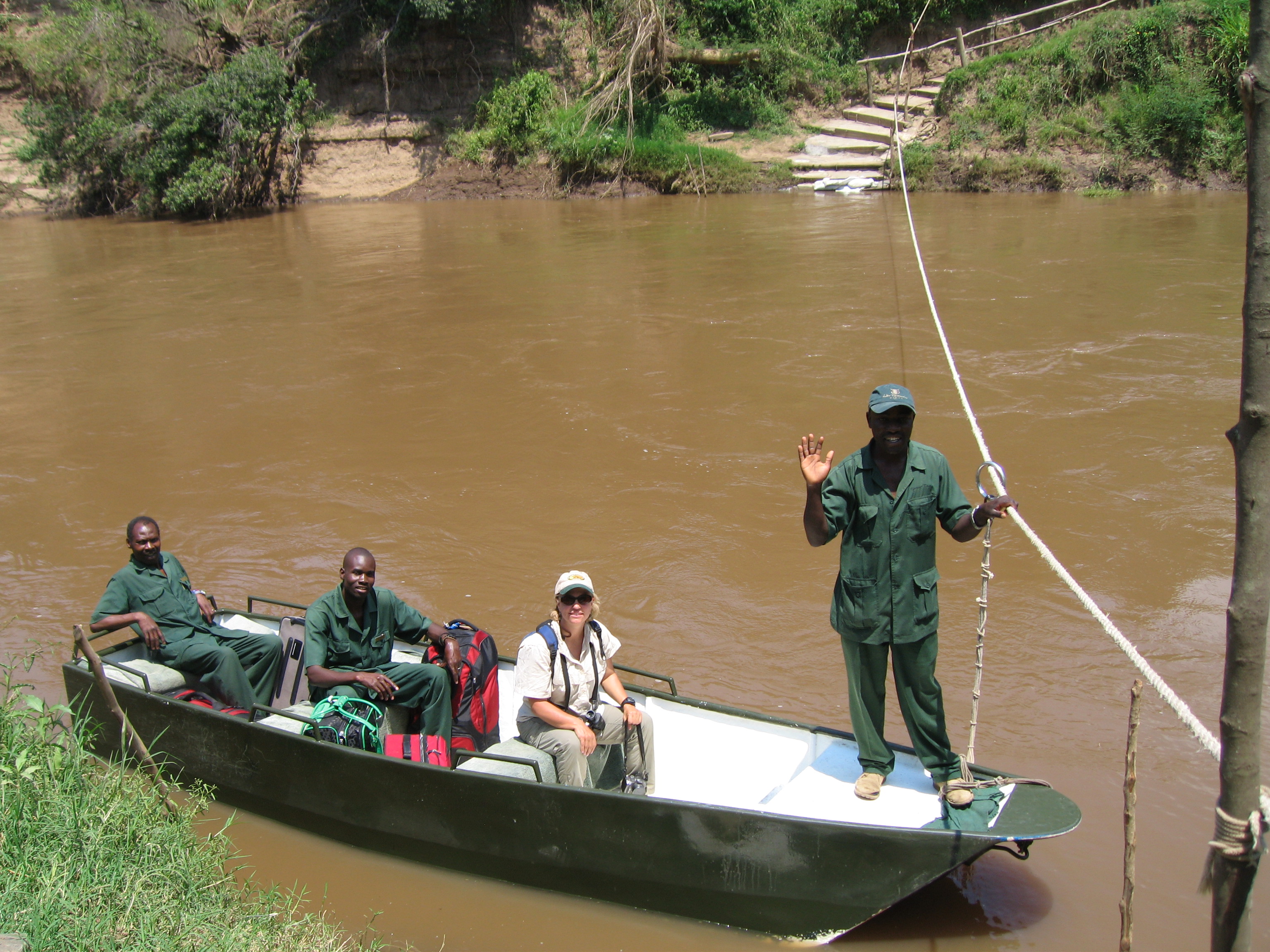
Kim on board for the boat ride across the Mara River to get to Little Governor's Lodge. -- Photo by Pat Bean

Our small plane landed on a dirt strip within sight of zebra and giraffes. The smallest airport I had landed in up to this point had been a dirt strip in Smiley, Idaho, but then there had been a small town across the road.

A wart hog visits our tent at Little Governor's. -- Photo by Pat Bean

Here, at the Amboseli airport, there was nothing but wilderness and wildlife. I loved it.

From the airport it was a just a short distance to Little Governor’s Lodge, another tent camp and one where we would sleep for the next four nights. 

To get to the lodge complex, which was on an island surrounded by the Mara River and a swamp, we,took a boat powered by two staff members and a rope, to get across the river. Once across, we were met by a big-stick armed guard who escorted us the quarter-mile to camp.

Other stick-armed guards took us from the main, open air lodge buildings, to our tent, which in any sense of the word was much more than that. It included a large, tiled open shower and a front porch on which we could sit and watch animals across the swamp.

At closer range were wart hogs that roamed the tent complex. Our favorite of these was a mom with a tiny young one. The pair came right up to our porch. What fun, especially after we were told they were harmless.

Wart hogs were funny animals. We often saw them running full speed through the grass with their tails stuck straight up in the air. Then suddenly they would stop, as if they forgot where they were going.

Such behavior assured that they were often the entrée on a lion’s menu.

Read Full Post »


Sunflowers are just beginning to bloom at Lake Walcott -- Photo by Pat Bean

“Properly trained, a man can be dog’s best friend.” Corey Ford

Travels With Maggie

Thought I’d interrupt my past African Safari today to visit the present, which finds me at Lake Walcott State Park in southern Idaho.

I wanted to tell you that the Canada goose kids have all grown up now, sunflowers are finally blooming, and that I had a marvelous day on the lake with a couple of starving artists (so they said, but their fancy boat said otherwise), who were staying at the park between art shows, and finally to complain about my faithful companion.

Nuff said about everything but Maggie, a black cocker spaniel who thinks I’m her servant. I rescued her from a life of abuse when she was a year old and we’ve now been together for 12 years. She went from being afraid of her shadow to becoming Queen of my world.


And butterflies accompany Maggie and me on our walks. -- Photo by Pat Bean

For example: This past Wednesday, I went into town to do laundry, something that has to be done every two weeks if I want to wear clean underwear. Since I’m a volunteer at the park, I’m allowed to use a small park truck for the trip. And since I don’t get into town often, I treated myself to a Swiss cheese burger with grilled onions and a chocolate mile shake.

I drank the shake and ate half the burger on the drive back to the park, saving the other half of the big sandwich for dinner. Back at my RV I transported the leftover sandwich and a few other things into my RV, then went back out to bring in my clean laundry.

By the time I got back, Maggie had climbed up on my table, took the sandwich out of a paper sack, and then out of its cardboard container and was licking her chops. Not a crumb of the sanding was left.

I yelled, but she didn’t even blink. In fact the look that she gave me said: “Do you have any more.”


And Maggie is not the least bit repentant for eating my sandwich. -- Photo by Pat Bean

I gave her dirty looks for the rest of the day. She, simply, hopped up on to my bed, and gave me unrepentant stares. I mean take a look at that face. Does it look apologetic to you?

I think she’s more cat than dog.

Read Full Post »

“You can become blind by seeing each day as a similar one. Each day is a different one, each day brings a miracle of its own. It’s just a matter of paying attention to this miracle.” – Paulo Coelho

The dining area and lobby at Porini Tent Camp -- Photo by Pat Bean

African Safari: A Full Day

Continuing our full day in Amboseli National Park, we ate a box lunch that had been packed for us in view of a high overlook of the Enkongu Narok Swamp, one of the larger ones in the park fed by Mount Kilimanjaro’s snow melt.

Normally we should have been able to see the mountain, which Hemingway’s book, “The Snows of Kilimanjaro,” put in literary history. But this day, as it was all the other days we were in viewing distance, it was hidden by clouds.

Water buffalo resting in the tall grass with cattle egrets for company. -- Photo by Kim Perrin

The landscape and wildlife in its shadow, however, was gloriously visible after we had climbed to the top of the overlook. Elephants, hippos, water buffalo, all in significant numbers, all took advantage of the wetland landscape.

Then on our way back to Porini, we watched as a fish eagle, which looks an awful lot like our bald eagle, swooped down and caught a fish. Even the non-birders among us were awed.

Photo by Kim Perrin

Back at camp, we just barely had time for a hot shower before we took off to visit a local Maasai village. This was a less of a showplace than the one we visited in Tanzania, and I suspected it was more of the real thing. Both Kim and I were horrified at all the flies on the young children.

I was the kind of mother who went around with a wash cloth swiping at my kids’ faces, a tradition that continues to this day with my grandkids — to their consternation. I longed this day to have just such a wash cloth in my hand.

Women of the Maasai Village near the Porini Camp. I loved the bright colors they wore. -- Photo by Pat Bean

It might not have been the proper respect to show a different culture, but that’s how I felt. Both Kim and I kept our feelings to ourselves, however, as the children lined up to allow us to pat them on the head as their way of showing respect to their elders.

We were both quite thankful someone in our group had hand sanitizer to share after we had left the village.

It was a quiet group that sat and watched the sun go down later that evening, but the wildlife drive back to camp cheered us all up. Among our sightings was a caracal, which was a rare fine. Our spotter was Jackson, who sat on a seat strapped to the fender of our Land Rover with a spotlight in hand.

Sundowner sunset -- Photo by Pat Bean

Back at camp, however, things seemed not to be quite normal. Grim faces peered at us almost everywhere we looked. We were told that an expected supply truck had broken down on the rough drive to camp and had not yet arrived.

Our Maasai guard, on escorting us back to our tent, asked Kim if she had a flashlight. She thought he wanted it to help guide us to the tent, which he did, but then he disappeared into the night with it, never seen by us again.

Things didn’t really cheer up around the camp until the next morning when the truck finally arrived – and then there seemed to be smiles once again all around. And our breakfast,which had already been served, suddenly became more abundant with fresh fruit.

Our Porini stay was interesting, and we loved our sundowners and wildlife drives with Emanuel and Jackson, but we both agreed it was our least favorite of all the lodges – and not just because it wasn’t luxurious.

We would stay in another tent camp before we left Africa, and that one would be our favorite of all the places we stayed, including our one exotic night spent in a tree-house.

Read Full Post »

 “We all have our time machines. Some take us back. They’re called memories. Some take us forward. They’re called dreams.” – Jeremy Irons

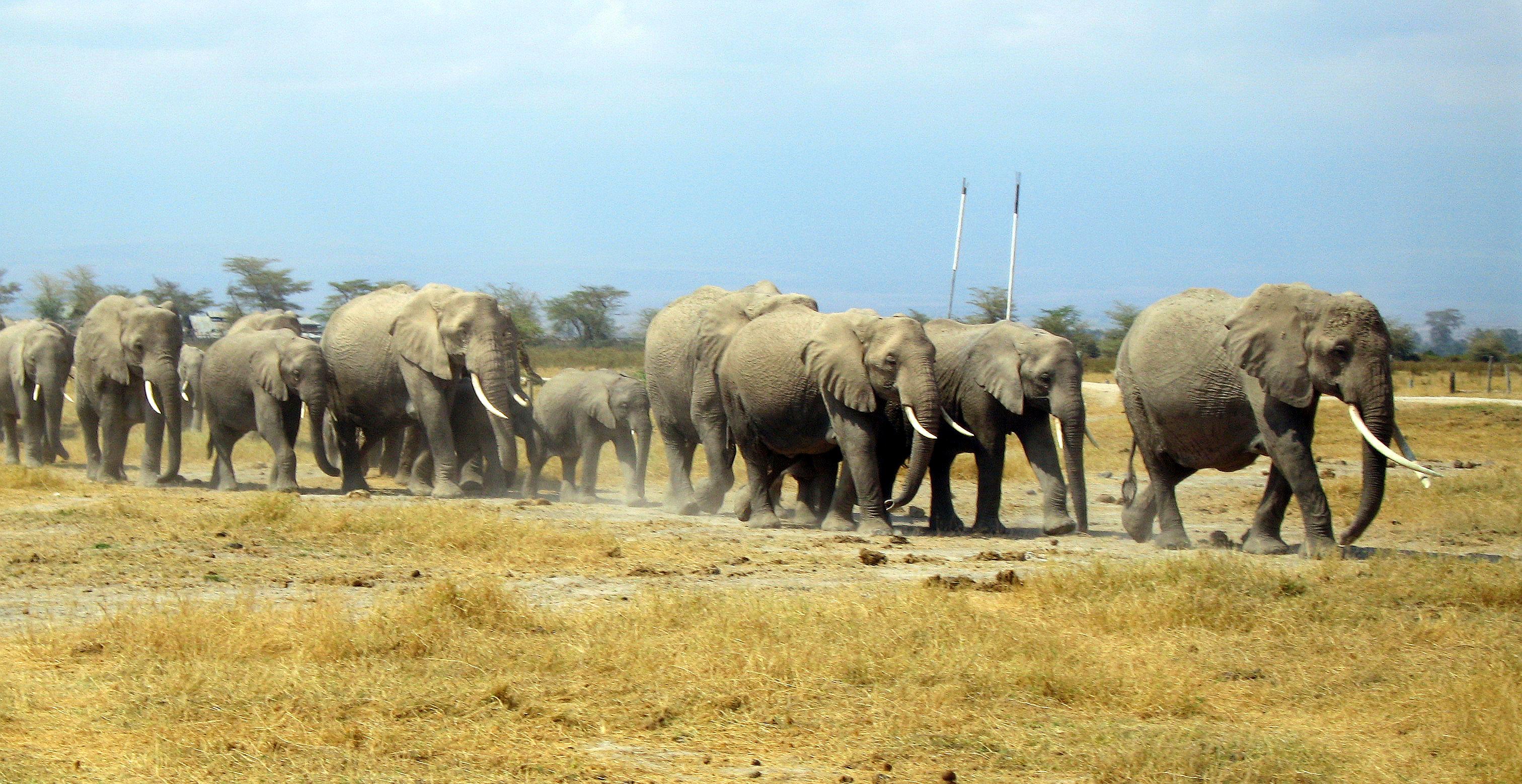
Elephants on the move in Amboseli -- Photo by Pat Bean

African Safari: Amboselli

The next morning we were up early for breakfast, served family style in open air tent, and eagerly ready for a day in Amboseli National Park, which was about an hour away from our Porini camp. Our driver was Emanuel, whom I was delighted to discover was more interested in birds than Bilal. I never once had to ask him to stop when one was in sight.

Emanuel, our driver/guide for Amboseli. He was a real birder. Yea! -- Photo by Pat Bean

In fact, even before we left the camp he had pointed out a blue-naped mousebird that I had missed seeing. I knew then it was going to be a great day, like every other day I’d so far spent in Africa.

We were accompanied in the Land Rover by a husband and wife couple, whom I barely remember except that they were pleasant. Kim remembered, when I asked, that he had a lot of expensive cameras and was heavily into photography.

The other person who also accompanied us was Jackson, who was nearing the end of a five-year internship to become a guide. Jackson was a Maasai, and would be one of the very first of his tribe to become a guide.

From a distance hippos looked like big gray rocks, especially since sometimes only their backs were visible in the sunken swamps that dotted the Amboseli landscape. -- Photo by Kim Perrin

While it was an hour’s drive to the park from our Porini camp site, there was plenty to see along the way, including two, then three, cheetahs stalking a gerenuk, which escaped all of them once the pursuit race began.

Our first sighting in the park was a large herd of female elephants migrating across the landscape with a lot of young ones in tow. Following behind was one huge male with a huge desire to sire yet another one.

Amboseli is a Maasai word for salty dust, and refers to the volcanic ash from past Mount Kilmanjaro eruptions. Snow melt flowing down into the landscape here from the mountain makes it an excellent habitat for wildlife, and rarely were we out of sight of the four-legged and winged creatures that call Amboseli home.

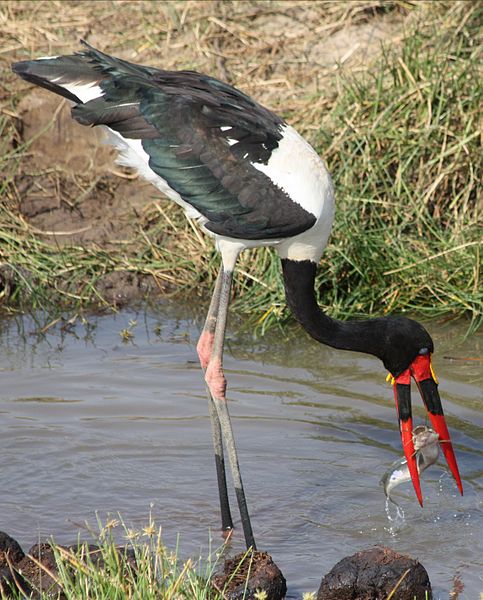
Saddle-billed stork catching a fish -- Wikipedia photo

Looking across the savannah, we often saw what at first glance were big gray rocks. In reality they were hippos lazing in the swamp areas of the park. 

Among our more fun bird-watching experiences was watching a saddle-backed stork fight with a snake. The stork won.

We also saw an African jacana walking on lily pads, a jewel colored malachite kingfisher and a squacco heron, which looked an awfully lot like our American bittern.

 Lots of memories were made this day.

Bird Log of new lifers: Lizard buzzard, red-billed hornbill, August 28, 2007,  during the drive to Porini; crested francolin, blue-naped mousebird, crested bustard, black-faced sandgrouse, Fischer’s starling, plain-backed pipit, Fischer’s sparrow -lark, grassland pipit, saddle-billed stork, long-toed plover, common greenshank, malachite kingfisher, African jacana, squacco heron, eastern pale chanting goshawk, pied kingfisher. August 29, 2011, Amboseli National Park. We also saw a sandwich tern, which is a common bird along the Texas Gulf Coast.

Read Full Post »

“Once you have traveled, the voyage never ends, but is played out over and over again in the quietest chamber. The mind can never break off from the journey.” – Pat Conroy.

Dik-Dik -- Photo by Kim Perrin

African Safari: A Kenya Welcome

We joined another couple and their driver for the half-four ride from Arusha to the border town of Namanga, where after a check through customs we met up with Johnson, another Ranger Safaris’ driver. He warned us that we were in for a long bumpy ride to the Porini Camp Lodge, where we were to spend the next two nights.

We were used to a bumpy ride and there was plenty to see along the way, and Johnson was quite knowledgeable about the sights we were seeing. So it all seemed perfectly normal.

Kim emerging from our tent suite, one of only six for safari guests at the Porini Camp. -- Photo by Pat Bean

I even got two more life birds, a lizard buzzard and a red-billed hornbill. The longer we were in Africa, the slower grew my list of new birds. But I was happy because I was beginning to recognize many of the earlier ones now without having to use the field guide every time.

We also saw quite a few giraffe along the way, as well as elephants, zebras, gazelle and a couple of dik-diks, tiny antelopes named for the warning sound they issue when predators are nearby.

The hot water tank for showers in our tent. -- Photo by Pat Bean

When we finally drove up to the Porini Lodge, we were met, as usual, with a wet wash rag to clean the African dust from our face and hands. I noticed my washrag had turned from white to brown by the time I handed it back to a staff worker.

Our lodge, however, was a far cry from the five-star camp complexes we stayed at in Tanzania. Tonight we would be sleeping in tents, albeit one with floors and showers. Hot water for the latter, however, was hauled up in a canvas bag.

A shower would have to wait, however. We had barely gotten into camp in time for the nightly sundowner. This even was a late wildlife viewing drive to a place where we could watch yet another spectacular African sunset.

Two very tired ladies at the end of a long day enjoying their first taste of a Tuskers.

Bone-tired from the long day, Kim and I watched it go down with a Tuskers in hand. While I’m not a big beer fan, this one tasted really good. And the photo someone took of us two with the beers in hand turned out to be another favorite of the trip

Read Full Post »

“Work like you don’t need the money, love like your heart has never been broken, and dance like no one is watching.” — Aurora Greenway.

Broken Water

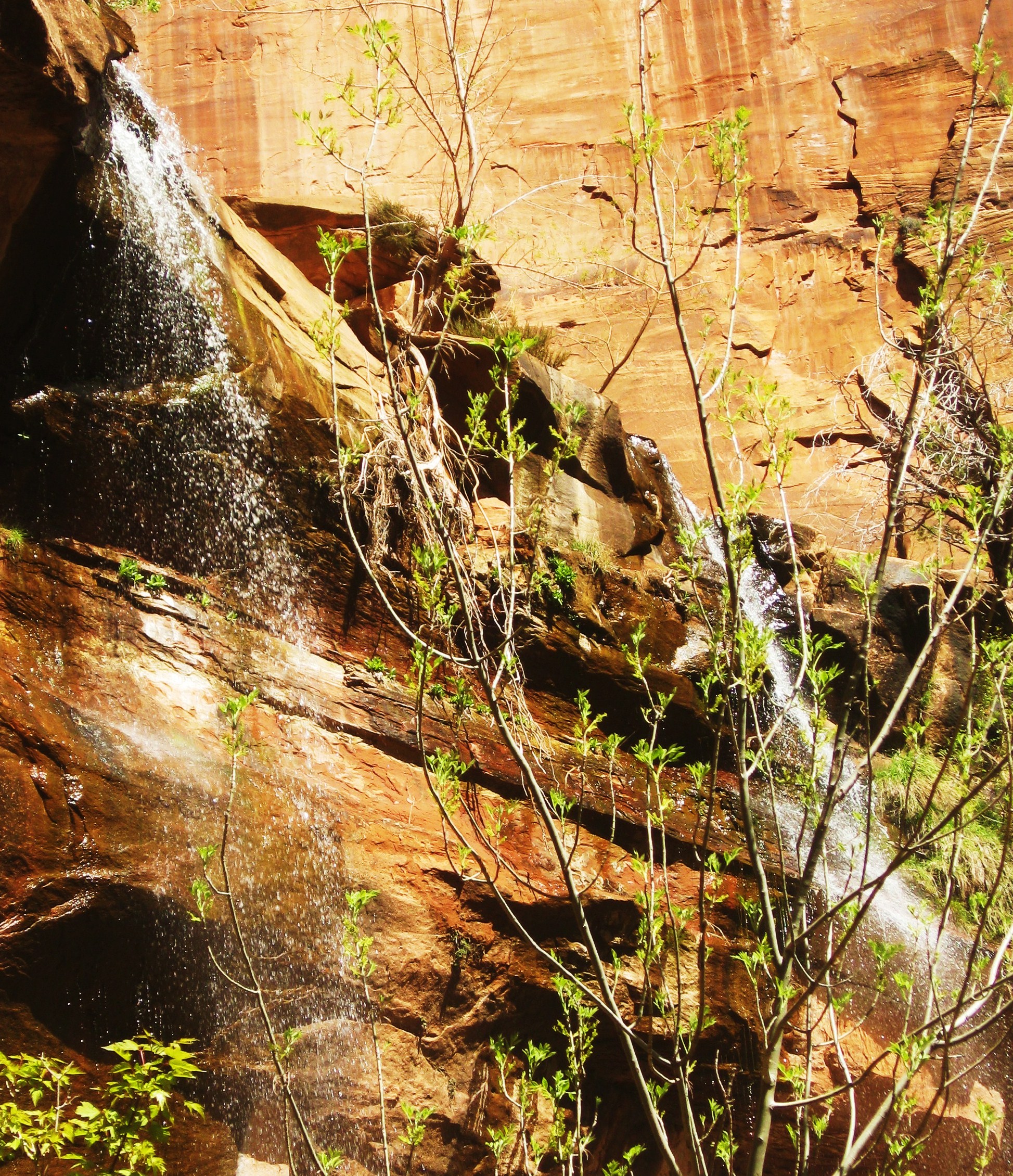
Zion National Park, Emerald Pools hike, lower falls. -- Photo by Pat Bean

 I couldn’t  find anything in my photo files that fit the theme “broken.” Then I came across this photo of water falling over the edge of a cliff and it reminded me of broken glass.

Is my entry into the contest quite lame or brilliant. I can’t decide, but would love to know your opinion.

Read Full Post »

 “Be grateful for luck. Pay the thunder no mind – listen to the birds. And don’t hate nobody.” – Eubie Blake

Verreaux eagle owl -- Photo by Kim Perrin

African Safari: “Stop, Stop!”

As we drove out of Arusha, leaving Bilal and Tanzania behind for Kenya, I touted up my number of new life birds. Adding the ones I had seen in Tarangire National Park yesterday afternoon and this morning’s wildlife drive, the total was 135.

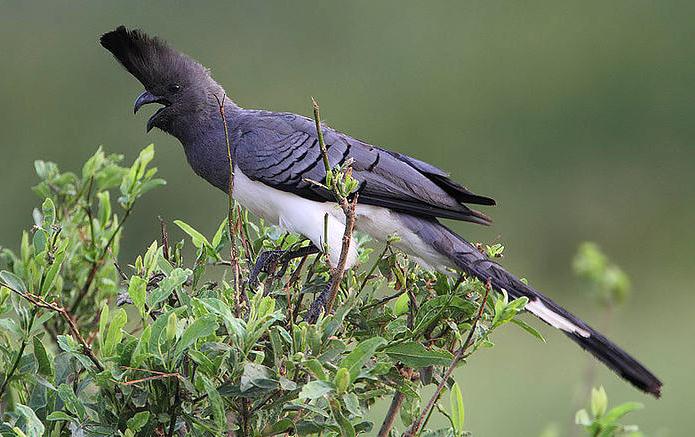
Some like the more exotic hoopoe, grey-crowned herons and noisy go-away-birds had been easy to identify, and Bilal had stopped the Land Rover for closer looks automatically. But most of the time, and especially for the smaller, less flamboyant birds along the way, it was me who was always hollering “Stop, stop!”

Lilac-breasted roller -- Photo by Pat Bean

I could see I was annoying Bilal, and Kim said stopping the big Land Rover with all its gears took time. I tried, honestly I did, to curb my actions, but my enthusiasm for a potentially new lifer simply couldn’t be contained.

I truly did get as big a high from spotting a lilac-breasted roller or even a plain black sooty chat as I did from seeing an elephant or a lion, which I’m sure only another addicted birder will understand. And while Bilal never missed stopping for any big cat in our vicinity, he often seemed blind when it came to many of the birds.

White-bellied go-away-bird. They're quite noisy and everybody usually ends up telling them to go away. -- Wikipedia photo

So it was with great delight that on one of our wildlife drives it was Kim hollering to Bilal to stop – and if anything she did it more commandingly and every bit as loud as my frequent calls for halts.

Almost jumping up and down, she ordered Bilal to back up to a spot beneath a tree we had just passed. The bird she had seen, and which I had totally missed, was a magnificent Verreaux eagle owl.

Silvery-cheeked hornbill -- Wikipedia photo

Unlike most of my calls for halts, Bilal didn’t roll his eyes this time. He was as impressed as we both were.

Like so many of the owls I’ve seen sleeping high in American trees, it stayed put and simply blinked its sleepy eyes at us a few times. Slightly bigger than a great-horned owl, this African species had a ruffled white feather collar and pink eyelids.

Since it was the only one we would see during our Safari, I owed Kim big time.

Bird Log of New Lifers: White-bellied go-away-bird, ashy starling, lesser grey shrike, green-winged pytilia, hammerkop, cardinal quelea, yellow-bellied greenbul,. Tarangire National Park, August 27.

Read Full Post »

” Travel is fatal to prejudice, bigotry, and narrow-mindedness, and many of our people need it sorely on these accounts.  Broad, wholesome, charitable views of men and things cannot be acquired by vegetating in one little corner of the earth all one’s lifetime.”  ~Mark Twain<!–, The Innocents Abroad, or, The New Pilgrims Progress, "Conclusion," 1869; CTO–>

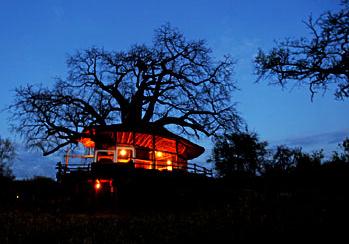
A tree grew through it. A parting look at the Tarangire Treetops Lodge's main building.

African Safari: Photo Op

It was with regret that Kim and I left the Treetops Lodge the next morning. We both would have loved to have spent more time in this place where childhood fantasies were a reality. All too soon, it seemed, a guard was outside below waiting for us to descend from our trap-door entrance so he could walk us to the main lodge for breakfast.

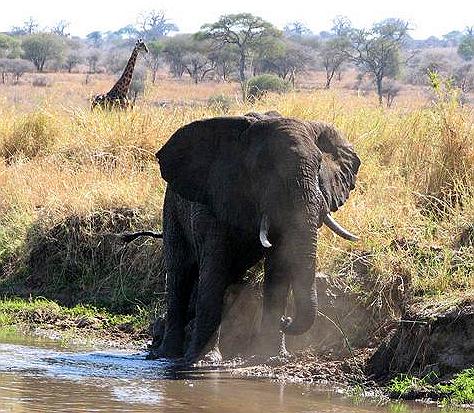
Elephants and giraffe's shadowed us for our final wildlife drive with Bilal. -- Photo by Kim Perrin

Later, looking at the lodge’s website, I realized we couldn’t have afforded it. One night’s stay at the lodge, which has only 20 tree-house suites, cost over $600. It had been one of the luxuries that we had included in our African Adventure Company package. I’m glad we hadn’t known the cost it added to our trip or Kim and I might have forgone staying here.

As it was, our tree-house night will forever be part of our Africa memories. And so would Bilal.

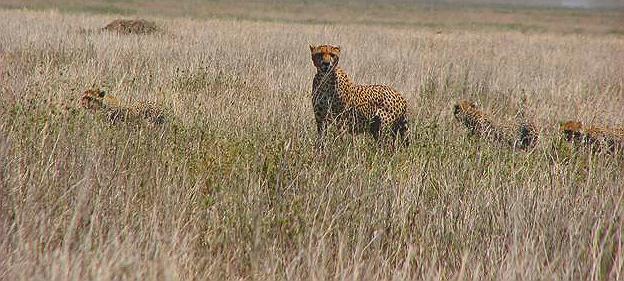
Cheetahs, like this mom with three youngsters, were frequently seen on our wildlife drives with Bilal. -- Photo by Kim Perrin

The macho, dark-skinned man had looked out for us for a whole week. He treated us with respect and professionalism in all his actions, and we came to respect and care for him.

Today, we would have one last wildlife drive with him, before he deposited us in Arusha, where we would have lunch at the Flame Tree Restaurant, a dropping-off place for various safari companies, and where we would be met and driven across the border into Kenya.

Giraffe, elephants, zebras and other wildlife shadowed us for the usual bouncy journey. While they, like the superb starlings and cattle egret, had become familiar sights to us this past week, their antics were still awesome to watch.

Kim and I say our good-byes to Bilal in Arusha, where he handed us off to a Ranger Safaris' driver who would take us to the Kenya border, where we would continue our safari. Just for the record, we tipped him well.

We arrived in Arusha early, and Bilal drove us around the busy downtown area, where I kept seeing images of Elsa Martinelli being chased by baby elephants in the 1962 John Wayne film “Hatari.” The town was quite a bit bigger these days, with lots of hustle and bustle and color. But my imagination had grown bigger over the years, too. And so I could still see the town as it might have once been.

Both views were exotic and strange and wonderful, and expanded the mind.

Arusha Market -- Wikitravel photo

Then all too soon it was time to say good-bye to Bilal. Kim and I both hoped he had enjoyed his time with us as much as we had with him. He posed with us while another guide took our picture.

It’s one of my favorite photos of the entire safari.

Read Full Post »

“If people sat outside and looked at the stars each night, I’ll bet they’d live a bit differently.” – Bill Watterson

Kim in a Maasai robe ready for our nighttime safari -- Photo by Pat bean

African Safari: Beneath the Stars

For our night-time drive, one of our Maasai guides sat on the front fender of the car with a spotlight to provide us an opportunity to see a few animals that are rarely seen during daylight hours.

It was a completely different experience from our earlier wildlife viewing. For one thing, there were 10 of us squeezed into the Land Rover and Kim and I couldn’t hop around from side to side as we were used to doing in our drives with Bilal.

So if an animal wasn’t on your side of the vehicle, given the darkness, you might not see it. Some animals froze when they were spotlighted but others quickly disappeared into the bush. We spotted many more glowing eyes than glimpses of entire animals.

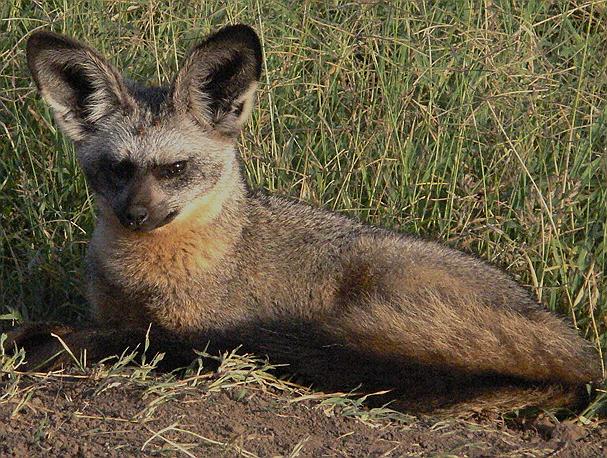
Bat-eared fox -- Wikipedia photo

Even so, I was amazed at what we saw. My list included bat-eared fox, genet, large winged bat, steenbok, dik-dik, white-tailed mongoose, spring hare, bushbaby, kangaroo rat and a few zebra and impala wandering around in the dark.

I might have seen a few more things but the birder guy along for the ride and myself talked birds for much of the trip. We both admitted being frustrated with not being able to identify a lot of what we had seen.

 After awhile, however, I decided enough of that and began watching the sides of the roads intently for what I could see right now and possibly identify.

The warm lights of the Treetops Lodge was a welcome sight.

I truly don’t believe in what ifs, and here I was wallowing in it.

It was cool, with a clear sky painted with brilliant white sparks of light. I decided just being outdoors in an African landscape in the dark, with its sweet, earthy smells and background music of rustling animals and insect chirps, was as rewarding as any animals we happened to see.

After our hour-long drive in the dark, preceded by a very long day of exciting wildlife viewing in a bouncing vehicle, I must admit, however, that the warm lights of our lodge was a welcome sight.

I was eager to go to sleep among our suite’s tree branches.

Read Full Post »

“What is that feeling when you’re driving away from people and they recede on the plain till you see their specks dispersing? — it’s the too-huge world vaulting us, and it’s good-by. But we lean forward to the next crazy venture beneath the skies.”- Jack Kerouac, On the Road.

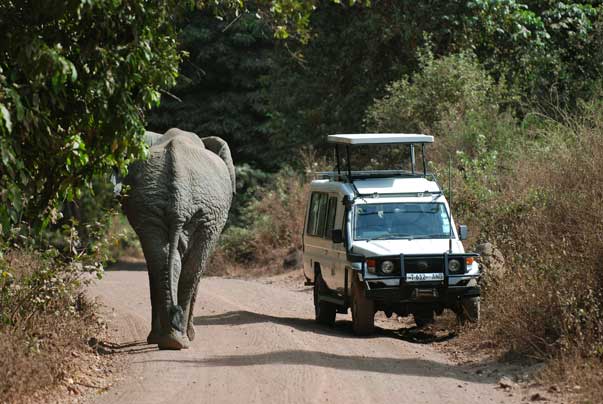
Sharing the road -- Photo by Kim Perrin

Maggie and I are on the road today, traveling from Ogden, Utah, back to Lake Walcott State Park. I’ll try to write a post later today about our first night-time safari drive. 

In the meantime I thought you might enjoy these photos of  a couple of our drives with Bilal in Tanzania. Then if I don’t get back to blogging again as promised, I won’t feel so guilty.

I must say I liked sharing the road with these travelers much better than 18-wheelers.

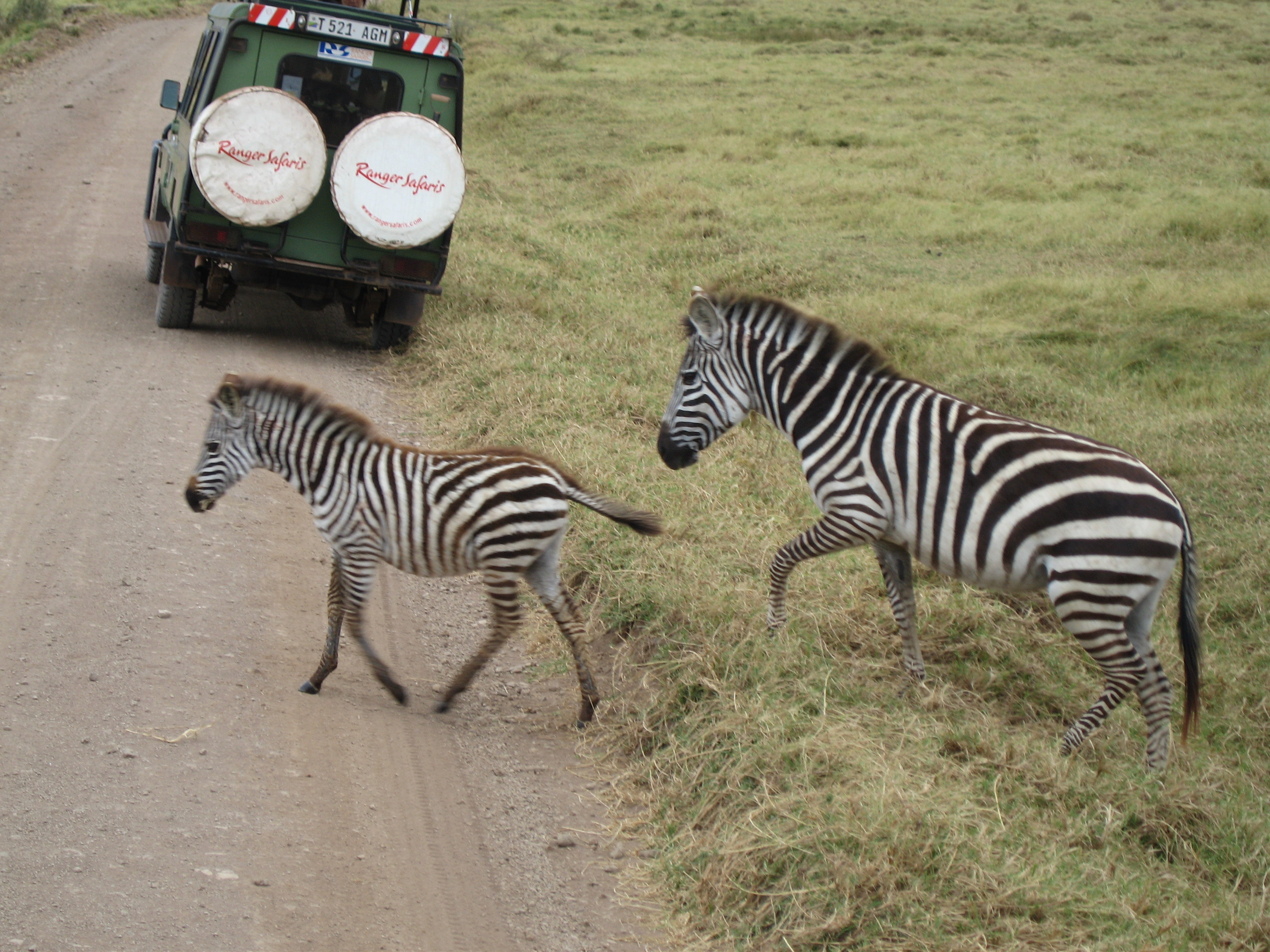
Zebra crossing -- Photo by Pat Bean

.

Read Full Post »

« Newer Posts - Older Posts »