Feeds:
Posts
Comments

Posts Tagged ‘postaday2011’

 “It is necessary to write, if the days are not to slip emptily by. How else, indeed, to clap the net over the butterfly of the moment? For the moment passes, it is forgotten; the mood is gone; life itself is gone. That is where the writer scores over his fellows: he catches the changes of his mind on the hop.” — Vita Sackville-West

Authors and Books

Victoria Mary Sackville-West at 17. Painting by Phillip de Laszlo

I collect quotes that speak to me. The one above by Sackville-West shouts at me. I am a writer who must write or not be. And I know that what I write today will not be the same words I will write tomorrow.

Life, be it a butterfly that alights on a flower in front of me and expands my mind about beauty or an earthquake that shakes the ground beneath my feet and forces me to consider death, continually colors my thoughts. That last analogy, as you probably already know, was prompted by yesterday’s headlines.

The quotes that go in my journal are collected everywhere. From my reading of diverse books, from the women in my Story Circle Network, from a bumper sticker, a billboard, and from my musings of quote blogs when I want one on a particular subject for my own blog.

I’m not sure where the Sackville-West quote came from. I found it on perusing my own journals for something to write about today. The blog I thought I would write this morning, the one that bloomed so clearly in my brain yesterday, I decided to chuck. See what I mean about not being able to write one day what you could have the day before.

Vita in her 20s. Painting by William Stang

One of the side benefits of collecting quotes is learning about the person who said or wrote them. Not always, but when I have time, I check out the author if I haven’t heard of them.

Sackville-West was a person I had never heard of when I originally copied her quote into my journal. I didn’t look her up back then, but was moved to find out who she was when I came across her name again this morning. It used to be I would have to go to a library for such research, but now I simply Bing or Google it. Gawd I love the Internet. Anyway, here’s what I found out about Vita:

She’s really a Victoria, which immediately jarred my brain because I thought Vita was a male name. She was born in 1892 as Victoria Mary Sackville West, the only child of the 3rd Baron Sackville. Because she was female (English former gender laws), she could not inherit her Kent family home, Knole House,  after her father died. It went to an uncle.  She is said to have considered this a betrayal for the rest of her life.

Historical plaque on Ebury Street in London -- Wikipedia photo

Perhaps that is why she became a female rebel. While she was supposedly happily married to Arthur Nicholson, 1st Baron Carnock, she also had same-sex affairs, the most prominent being with Virginia Wolfe. Vita’s son said Wolfe’s “Orlando” was a love letter to his mother, only with a sex change for Vita.

Sackville-West wrote no less than 17 novels of her own, winning the renown British Hawthornden Prize for literature twice.

I found all this trivia fascinating, although it boggles my mind that I knew who Virginia Wolfe was, but if I had ever heard of Vita Sackville-West, the name had never imprinted on my brain

.I am definitely going to have to check out Vita’s books and see if any are still in print. Her quote, which rescued today’s blog, demands it.
Read Full Post »

It may be hard for an egg to turn into a bird. It would be a jolly sight harder for it to learn to fly while remaining an egg. We are like eggs … We must be hatched or go bad.” C.S. Lewis

Travels With Maggie

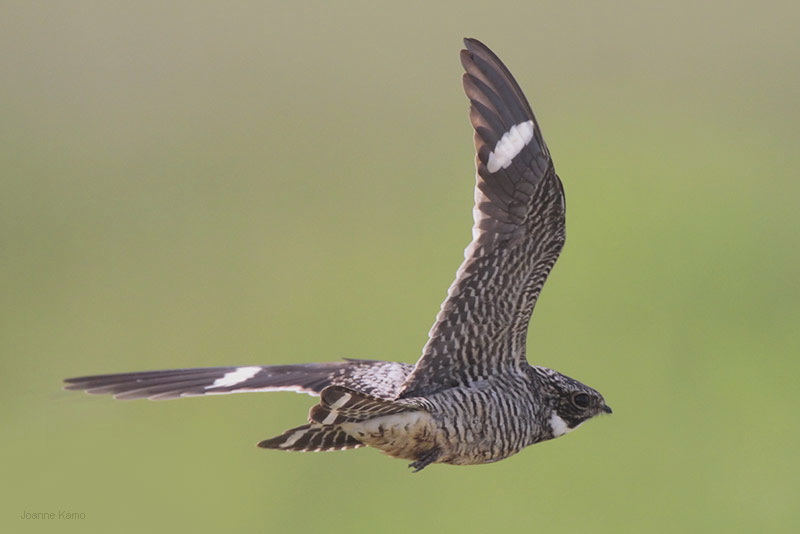
Common nighthawk -- Photo by Joanne Kamo, whose many other wonderful bird photographs can be seen at http://www.pbase.com/jitams

I try to time my last walk with Maggie so that it ends just as the sun goes down so as to catch the sunset. The days, in my opinion, are best when they begin with a sunrise and end with a sunset.

But late evening is also the time of day here at Lake Walcott State Park in Southern Idaho when the nighthawks come out to feed. For a kettle of common nighthawks that regularly takes place over the campground where my RV, Gypsy Lee, is parked.

They dine in the air on the many insects that also call this small park home. It’s always a treat to see them. Not only are they awesome to watch, my brain knows that every bug they eat is one that won’t bite me.

A fellow lone-female traveler, not a birder, who stopped by recently to visit me, asked what the birds flying overhead were as we shared our evening walk.

Common nighthawks, I told her. Then pointed out how to easily recognize them when in flight.


Common nighthawk -- Photo by Joanne Kamo

About the size of a robin, these birds have long, forked and pointed wings with a distinctive broad white bar about a third of the way up from the tip of the wing. The white bars are very prominent.

“Do they always fly that low,” she asked, as a couple of the birds zoomed in front of us at about head level.

“Nope. Usually they fly much higher,” I replied. “I guess the bugs are flying low tonight.”

The first time I saw these birds, whose large heads seem to lack a neck, they were flying even lower, however. I was fairly new to birding at the time, having only become addicted to the passion in 1999. The life sighting occurred while I was walking a trail at the Arizona-Sonora Desert Museum, where they were flying low over a small pond.

After watching them for a while, I realized they were skimming bugs off the water. Looking in my field guide to identify them, I discovered they were a member of the goatsucker family, whose name tickled my funny bone. According to folklore, these birds were thought to suck a goat’s milk at night.

The image this false legend flashed through my brain gave me an even more robust chuckle.

There are so many reasons why I’m passionate about birds, and such oddities as this, which I swear each species seems to enjoy, is just one.

Lake Walcott, meanwhile, has treated me to more common nighthawks in one night than all the others I’ve seen elsewhere. If you visit, I hope you take advantage of the nightly summer show.

Read Full Post »

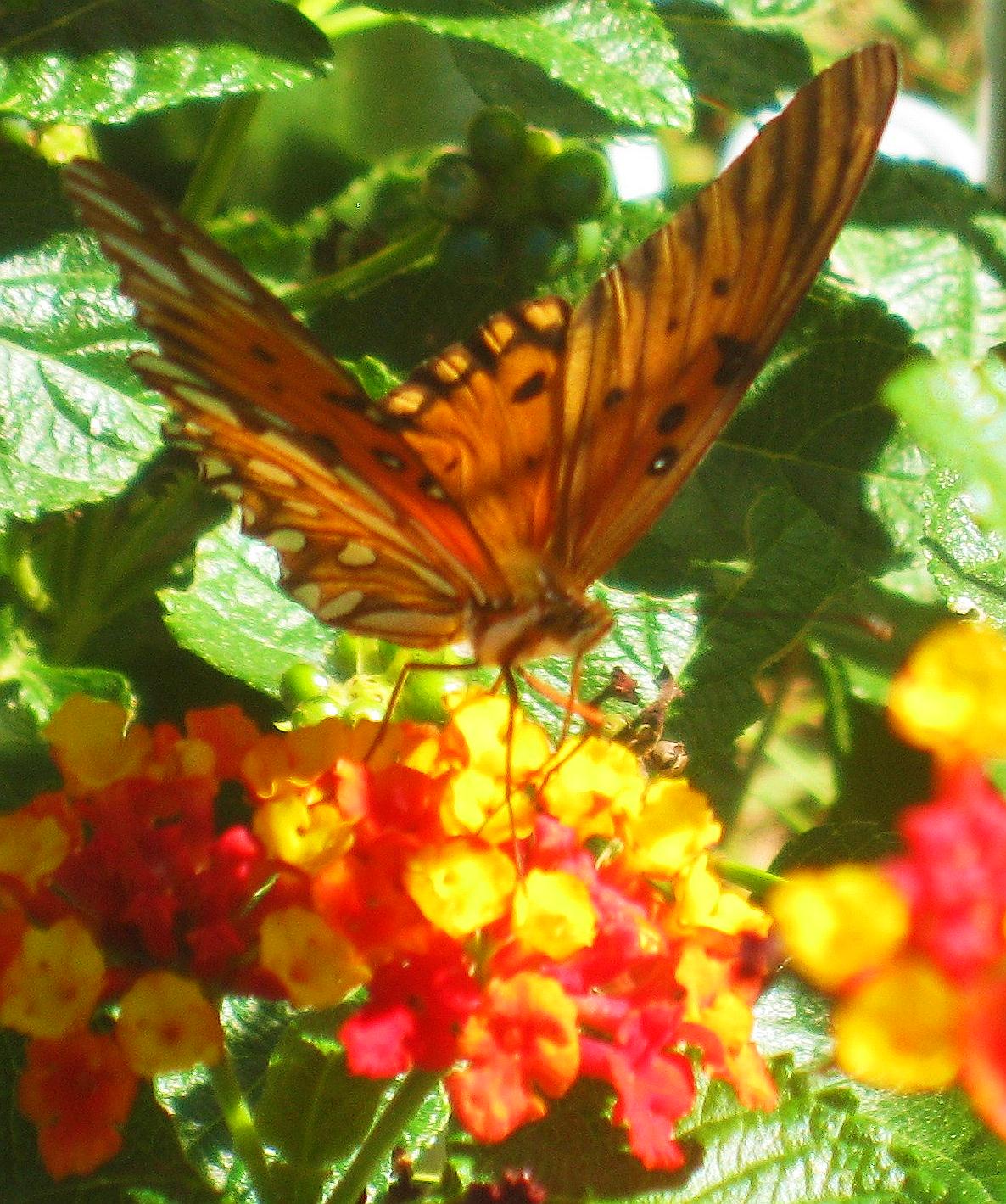
“Just living is not enough,” said the butterfly, “one must have sunshine, freedom and a little flower.”  ~Hans Christian Anderson

What's a flower without a butterfly? -- Photo by Pat Bean

Read Full Post »

 What makes a river so restful to people is that it doesn’t have any doubt – it is sure to get where it is going, and it doesn’t want to go anywhere else.” – Hal Boyle

Lake Walcott puts on light and music shows daily. I love to sit on a bench nearby and let my mind drift into calmness. -- Photo by Pat Bean

Travels With Maggie

Water soothes me. There’s something about the sound it makes as it laps against the shore that vanishes the rest of the world for a little bit.

Having lived for many years right on the Texas Gulf Coast, I’ve set for many an hour mesmerized by the way light played through the gulf’s waves as they relentless rolled forward onto the sand. These days my water fix comes in smaller packages.

Here at Lake Walcott, where I walk daily by the 11,000-acre reservoir, I never cease to be fascinated by the water’s mood.

This day the lake was restless. -- Photo by Pat Bean

On the May 15 day I arrived to begin my summer campground hosting duties, it was in the throes of a wind storm. The lake water was dashing against the shore, sending its spray onto Maggie and I when we got too close. .

I was just giving Maggie a quick walk after our windy drive, and didn’t have my camera with me. Back at the RV, I decided to rest a bit before going back out to record the fury. Bad decision. An hour later, the wind had ceased and the lake was once again calm. I’ve never seen it quite that angry again.

Most days, the lake transforms itself frequently between a gentle rustling to mirror calm. Other days, it can send fishermen in their small boats dashing for shore; and because the winds here can blow up suddenly, anyone leaving their boat unattended on the water over night risks losing it.

Gypsy Lee is parked about 150 yards away from the lake. Unless it is overly restless, I can’t hear the water’s drum beat against the shore when I’m inside my motor-home. I can, however, almost constantly hear the symphony performed by the Snake River, which feeds and flows out of the lake.

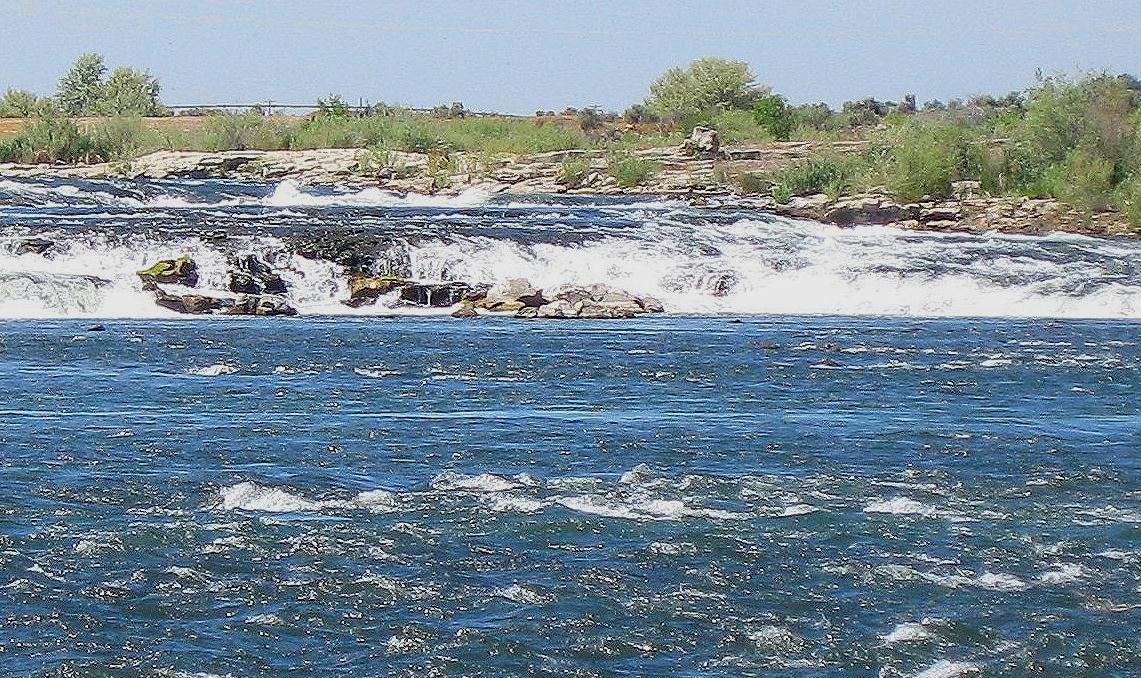
The Snake River below the Minedoka Dam that created Lake Walcott. -- Photo by Pat Bean

A siren signals the release of water from the dam, and I know on hearing it that the river’s rise turns up the volume of the music. When I first got here, because of rain and snow melt, that siren was going off every few hours.

A white water stretch in the Snake just below the dam particularly roars with intensity when the river rises. Depending, I think, on the direction of the wind, the river music can either sound like a revved-up dragster or simple be an unrecognized part of the background, like the silent running of a refrigerator.

The lake and river music drown out the chaos of the real world, which is probably why I find water soothes my soul.

What soothes yours?

Read Full Post »

Black-eyed susans at Lake Walcott State Park -- Photo by Pat Bean

“Let us dance in the sun, wearing wild flowers in our hair.”  ~Susan Polis Shutz

Read Full Post »

“A dog is not almost human and I know of no greater insult to the canine race than to describe it as such.” – John Holmes

Travels With Maggie

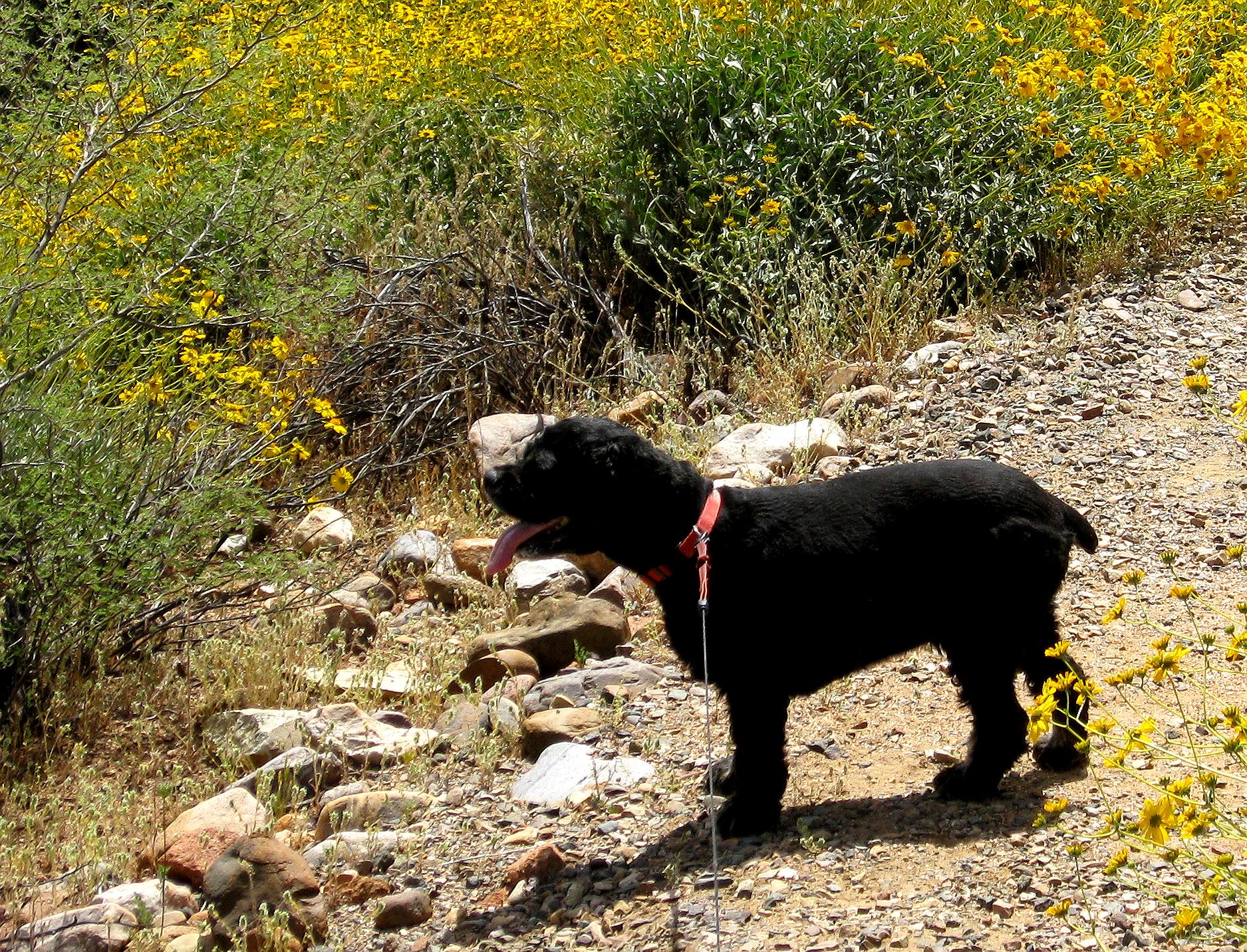
While Maggie grudgingly lets me share her over-the-cab bed at night, she considers it her personal domain during the day. -- Photo by Pat Bean

Someone let their big dog run loose in the campground here at Lake Walcott State Park this past week. That’s a big No-No.

While dogs, like my spoiled owner, Maggie, are welcome in the park, the rule is that they are to be kept on a leash at all times, and that the human be considerate and pick up their poop.

Most of the times these rules are followed, but there’s always the guy or gal who thinks rules don’t mean them.

At least once or twice a week I get to remind people of the leash regulation, and most of them nicely comply – at least when I’m in sight.

Maggie’s usually the one who ferrets the non-complying dogs out. While a loose pet might calmly remain sitting by their owner’s side when a person walks by, they can’t resist running out to sniff another dog’s butt to say hello.

Maggie will ignore any dog smaller than her, wag her tail and get happy if the dog’s her size, but growl ferociously if the dog’s bigger than her. I tell her she hasn’t got a lick of sense, but then she figures she has me to hide behind if her bluff doesn’t work.

Anyway, our park ranger was the one to catch the most recent unleashed dog, quite a big one, he told me when I relieved him at the entrance kiosk yesterday morning.

Maggie's always on a leash. She wants her pet to stay close enough to protect her from the world. -- Photo by Pat Bean

He – I’m sure quite gruffly because he’s that kind of ranger – warned the owner to put his dog on a leash, While it can’t be proved, we suspect the owner didn’t comply once the ranger was out of sight. The clues to back up our suspicions include:

I walked outside Friday morning and spotted a big pile of poop near my RV.

Something spooked the two skunks that have been hanging around the park, and they sprayed near the ranger’s house. He’s not a happy camper.

The dog owner was taking his pet to the vet yesterday morning because it came across a porcupine and lost the battle.

Too bad it wasn’t the dog owner who got punctured is all I have to say.

Read Full Post »

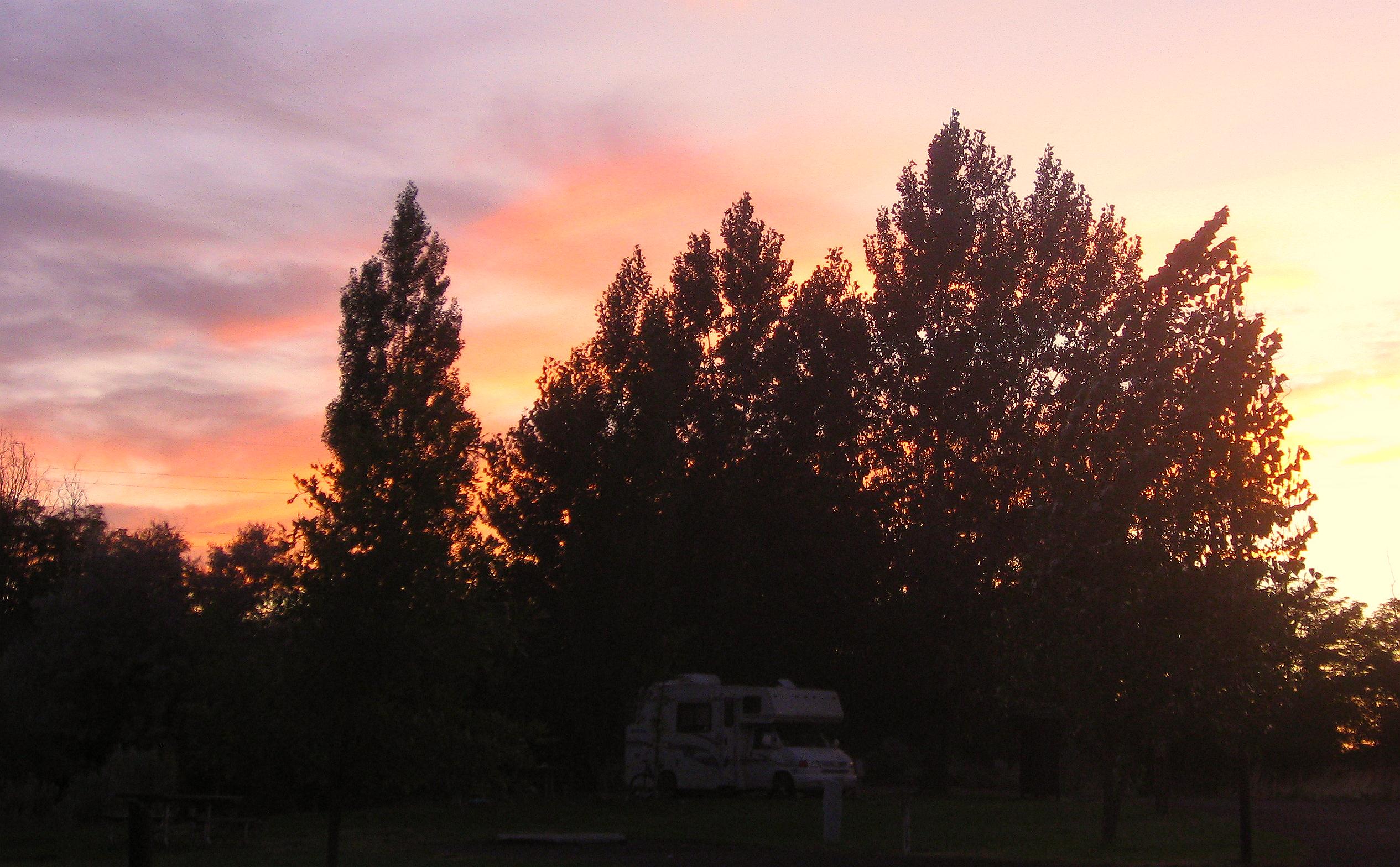
 “Clouds come floating into my life, no longer to carry rain or usher storm, but to add color to my sunset sky.” Rabindranath Tagore


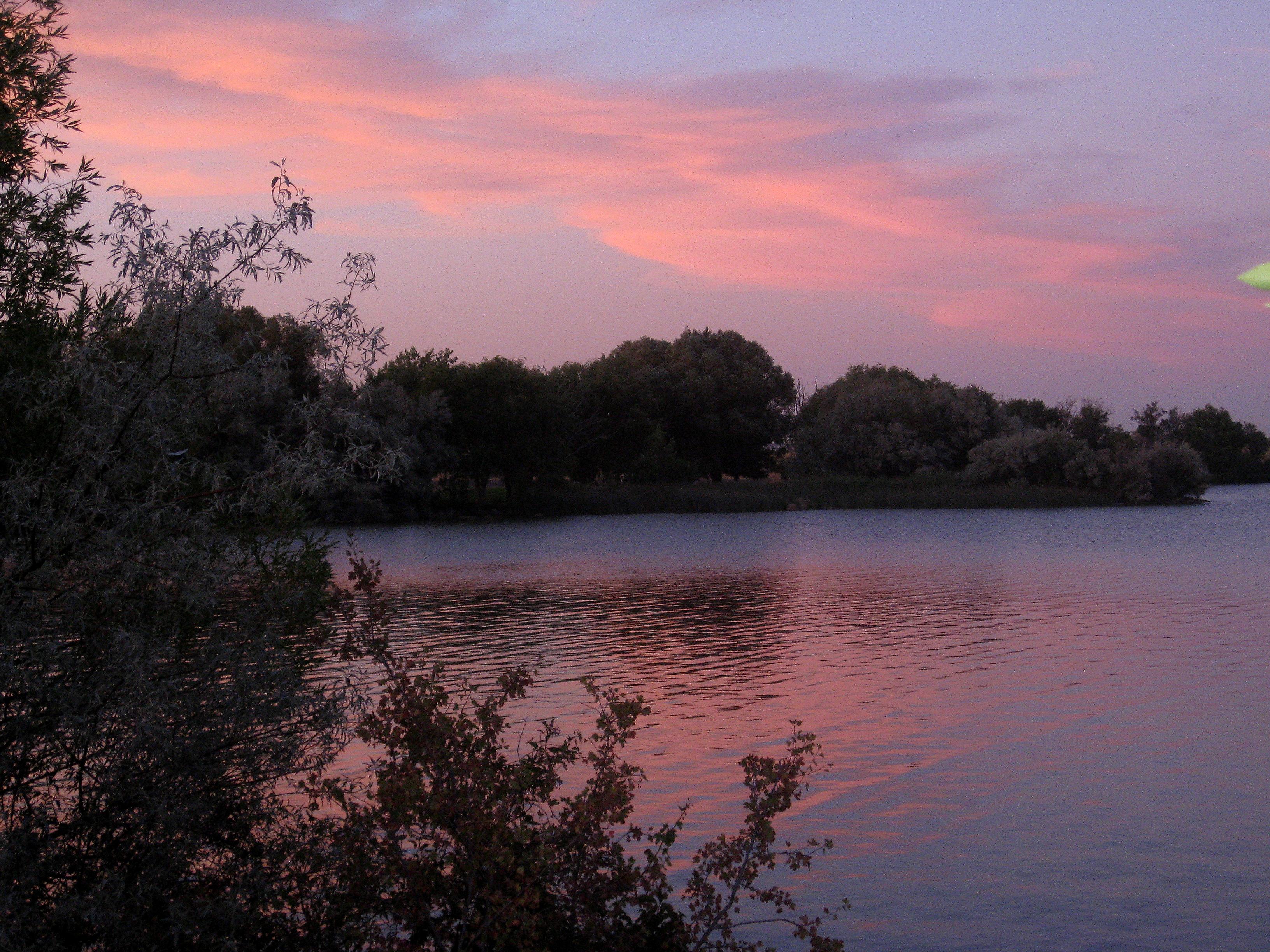
Looking eastward at the sunset over Lake Walcott, Aug. 17, 2011. -- Photo by Pat Bean

Travels With Maggie

There’s a scene in the first released episode of “Star Wars” in which Luke Skywalker is standing outside at the end of the day, staring at the sky.

You immediately know he’s not on Planet Earth because the sky is lit by two moons. That scene has long stayed with me. It had a haunting quality about it that imprinted on my catch-all brain.

The scene flashed in my mind again the first time I visited Lake Walcott in Southern Idaho a few years ago. As always, Maggie and I were taking our walk at the end of the day.

We were standing on a point overlooking the lake, her sniffing at a bush, and me staring up at a princess pink sunset with a half-moon framed between glowing clouds. It was an awesome, but not unfamiliar sight – until I realized I was looking east.

Quickly turning around, I saw a second sunset, a Halloween orange one peeking from behind cottonwood and Russian olive trees. This was the real sunset. The eastern one was a trick of the lake.


The same sunset view looking west, Aug. 17, 2011. If you look carefully you can see Gypsy Lee beneath the trees, -- Photo by Pat Bean

The calm water, acting like a mirror, had captured the sunset and then reflected the hues, now muted, up into the clouds.

Depending on the weather, the clouds and what’s hanging around in the air, the sunsets here at Lake Walcott range from a”Brahms Lullaby” to the clash of cymbals in Beethoven’s “1812 Overture.” While the eastern display is barely visible on quieter nights, it can outshine its western source on the louder nights.

I’ve seen both versions many times now since this is my second year as a summer volunteer campground host here at Lake Walcott. But they can still can take my breath away.

And they did that just two nights ago. I was standing at my favorite spot overlooking the lake when the show began. It lasted for a good 10 minutes, going from pastel to vibrant hues than fading into darkness.

I wish you had been here to see it with me.

Read Full Post »

“Flowers are those little colorful beacons of the sun from which we get sunshine when dark somber skies blanket our thoughts.” – Dodinsky

Travels With Maggie

Echinacea, or purple cone flowers. -- Photo by Pat Bean

Echinacea is more than a pretty flower. It’s also a popular herbal health supplements. My fictional friend, China Bayles, or her creator Susan Wittig Albert, could tell you a lot more about it. In fact they probably do in one of Albert’s cozy mysteries, which I’ve been reading the past year.

China gave up her depressing life as a former criminal defense lawyer to run a quaint herbal boutique in the fictional town of Pecan Springs. The rural city is located in the Edwards Plateau landscape not too far from Austin, where for one reason or another, China’s always getting involved with dead bodies.

I read Albert’s books because I’ve come to know and care about her characters, because I love her descriptions of the hill-country landscape, and because she’s more into the who-done-it genre of Agatha Christie than the detailed blood and gore of so many of today’s murder mysteries.

I want to be able to figure out who the murderer is in a mystery book before I’m told, and to do so without upchucking my lunch.


This bee was enjoying the echinacea as much as me. -- Photo by Pat Bean

I also read Albert’s books – the current one being No. 13, “Dead Man’s Bones” – because plants fascinate me, and I want to learn all about them and their names.

But this day, one in which I was working in the entrance kiosk at Lake Walcott State Park, where I’m a volunteer campground host, I was simply into the purple cone flower’s beauty.

Echinacea plants were blooming all around me. They were at their peak, deep pink in color with petals all still attached – and I wasn’t the only one attracted to them.

Bees were busy exploring their tastiness while I drank in their beauty. The bees were particularly interested in the flower’s large cone, so much so that they ignored my presence when I got close to them with my camera.

I think I got some pretty good shots? What do you think?

Read Full Post »

 Souvenirs and Memories Go Home With Me


One final serengeti sunset -- Photo by Pat Bean

“Any traveler who doesn’t return from a trip a changed person has taken only half the journey. Step by step, I went the entire distance.” – Pat Bean

African Safari:

So sad, I thought, as the last day in Africa drew to a close. Just as the wildebeest had started their migration, so must we migrate back to our homes in America, for which I truly had new appreciation.

I'll miss Africa's bright colors, and the beautiful faces of the Maasai women. -- Photo by Pat Bean

Or I could write an entire blog about our flight being delayed three hours, leaving us with nothing to do but browse the airport’s souvenir shops because there was no place to sit.

Kim and I both thought this was a well thought-out ploy to make sure tourists didn’t take any money out of Africa, although we willing obliged the shop owners because we both had family and friends back home who expected presents from our adventure.

These things were minor in comparison to the memories we were taking home with us. I’ve been fortunate that during my life I’ve had many fantastic adventures. I’ve paddled down the Colorado through the Grand Canyon, visited the Galapagos Islands, which prompted Charles Darwin to write “Origin of Species,” and spent a couple of days on Miyajima, what many consider Japan’s most beautiful island.

Hadada ibis in flight. This was both the first and last bird I saw in Africa. -- Wikipedia photo

This African safari, however, topped them all. As I finally got to lean my head back and relax once we boarded the plane I thought of all the things I would miss. The list included our wonderful guides, educated men who watched over us and showed us the best parts of their country.

I would miss the sunrises and sunsets, and knew that I would understand the next time I read or heard someone talking about Africa’s amazing light. It really does have a special glow to it.

One of the black rhinos in the Ngorongoro Crater that we did not see. -- Wikipedia photo

And oh how I would miss Africa’s colorful birds. I had added 182 lifers on this trip, the final one being a bronze mannikin flitting around the garden at the Karen Blitz Cottages. I wondered also if there was some hidden meaning in the fact that both the first and last bird I saw in Africa was the hadada ibis. I haven’t figured that one out yet, but for some reason it seems important.

I would miss Africa’s wildlife, much of which is disappearing. Kim and I were told we were fortunate to see it while it was still there. I hate to imagine an Africa without big cats, zebras, elephants, wildebeest, jackals, hyenas and all the rest.

And I'll miss the funny antics of baby baboons that tease and then run back to their big dads for protection. -- Photo by Kim Perrin

Just the fact that we saw no black rhinos does not bode well for the future. Where in the 1960s, there were about 70,000 of them, today there are less than 3,000, and they are considered endangered. Their decimation has come about because of their horns. The Chinese want them for their perceived medicinal properties, and the Arabs want them for their elaborate daggers. One the black market, a rhino horn is worth thousands of dollars, too big an incentive for subsistence farmers to resist. 

And I would also miss the cacophony of color that I saw everywhere, from Africa’s red earth to the clashing colors of the robes and clothes worn by the Maasai. I’ve always thought bright colors are joyful, and wondered why so many Americans – definitely  not me – mostly choose to wear drab colors. It’s as if we want to blend into the background and not make a statement about who we are.

Africa awakened new insights in me that will color the rest of my days. Travel, I have learned, is as much about discovering oneself as it is about seeing new sights. Anyone who doesn’t return a changed person has taken only half the journey.

Step by step, I traveled the entire distance. And I want to go back.

Read Full Post »

 “Between the great things we cannot do and the small things we will not do, the danger is that we shall do nothing.” Adolph Monod

Final Breakfast at Little Governor's Camp. -- Photo by Kim Perrin

African Safari: Karen Blitzen Museum

Joseph got us back to Little Governor’s Lodge in time for breakfast, where Kim and I ate the last of those great little sausages that had become a breakfast standard since first we had them back at the Norfolk Hotel.

As usual, breakfast here was served beneath the open sky with a grand look at the swamp in front of us. It was full this morning with sacred ibises, rufus bellied herons and white-faced whistling ducks, which were in fact whistling.

At the landing strip with Joseph and the "Kids" from London, Frankie and John.

All too soon, however, it was time to gather our belongings and make out last crossing of the Mara River, where we would be met by Joseph for the ride back to the tiny airstrip where we would catch our fight back to Nairobi.

In Nairobi, since our flight back home, didn’t leave until midnight, we would check into the Karen Blixen cottages to spend the rest of the day. Like most of the tourist hotels in Nairobi, this one was located behind guarded gates.

After lunch, I wanted to go curl up on the bed in our cottage suite, and take a nice long, and I thought well-deserved nap. Kim wanted to walk a half mile down the road to the Karen Blixen Museum. I suggested that there were guarded gates around our complex for a reason but Kim would not be deterred.

Our ride back to Nairobi touches down. -- Photo by Pat Bean

I certainly wasn’t going to let her go wandering off by herself, so off we went, two white women in a sea of black, sometimes scowling faces, walking on the edge of a narrow road. This was the real world, not the sheltered tourist wonderland where we had roamed for two weeks.

I was nervous at first, but then relaxed and went with the flow. I’m so glad I did.

Blitzen as Isek Dinesen, wrote “Out of Africa,” which was made into a movie starring Meryl Streep and Robert Redford.

“”I had a farm in Africa,” her book began. The museum was that farm, and we were told it is little changed today from what it looked like then. Blitzen turned the farm into a coffee plantation, and because it provided jobs was much-loved by the locals.

Minutia from the Streep and Redford movie was mingled in with the museum’s displays. But it was the one huge photo of Blitzen, slender and sophisticated and smoking a cigarette in her later years, that captured my attention. It made me think of Auntie Mame, Patrick Dennis’ fictional aunt whom I’ve always admired. .

Kim in front of Karen Blitzen's home, which was the setting for her book, "Out of Africa." -- Photo by Pat Bean

There’s a mental game I’ve often played that calls for you to name six people you would like to invite for dinner. Margaret Mead, Carl Sagan, Shirley MacLaine, John Muir, Maya Angelou, Ralph Waldo Emerson, Eleanor Roosevelt, Barbara Jordan, Molly Ivins, Sean Connery, Gloria Steinem, Gandhi, Golda Meir, Agatha Christie and Charles Darwin, among others, have all at various times received mixed and matched invitations.

I added Karen Blitzen to my address book today.

Still digesting the things we had observed during our visit to the museum, the walk back to our day cottage actually seemed pleasant.

Later in the year, Kenya would erupt with protests about electoral manipulations after President Mwai Kibaki was re-elected. Nairobi would see some of the worst violence, and over 800 people were killed during the protests.

Kim and I, in a long-distance phone conversation, both expressed thankfulness that the riots hadn’t occurred while we were there. Suddenly our State Department’s travel warning didn’t seem as trivial. While we had both enjoyed flirting with danger while on safari, the violence humans can inflict on one another was not the kind of adventure we would ever want to impinge on our memories.

Read Full Post »

« Newer Posts - Older Posts »