Aging My Way
Since my heart attack, and the installation of three stents in this old broad’s body, I’ve pretty much nested. It felt like a major triumph when two months out I could drive again, even if just to the doctor’s, pharmacy, grocery store and library.
Then on my first real outing, a party accompanied by “the girls” – my granddaughter and her wife – I took a fall. It was a little one, with me going down on my knee, rolling forward on my left side and just barely hitting my head. In my younger life, I would have just gotten up and been embarrassed if someone had seen me.
But I’m on blood thinners and my head and knee swelled up to gigantic proportions, so “the girls” rushed me to the emergency room for a CT scan. I was fine and the swelling soon went down. However, I was black and blue on my left side from my knees to my head for several weeks.
After that, I was reluctant to leave my comfortable abode except for necessities. It kind of felt like I had agoraphobia. I decided I didn’t like it – and in response recently set a goal of doing one outside activity a week. Last week, it was a pool party at the same friend’s house, but because I was accompanied by “the girls,” it kind of felt like I was cheating.
This morning, however, I got up early and went on an accessible bird watching outing all by myself. The event took place at Sweetwater Wetlands, one of Tucson’s birding gems. Before my heart attack, I had hiked the trail around the small lake often but hadn’t been back in recent months.
While most of the lake had been drained in anticipation of the upcoming annual burn to control invasive plant species and mosquitos, there were still birds around. These are the ones I saw as I walked along the accessible path with my rollator – or simply sat in it and watched: Say’s Phoebee, Gila Woodpecker, Green Heron, Least Flycatcher, Western Kingbird, Cooper’s Hawk, Vermillion Flycatcher, Gambel’s Quail, Kestrel, Black-Crowned Night Heron, Mourning Dove, Abert’s Towhee, and lots of Mallards of varying ages.
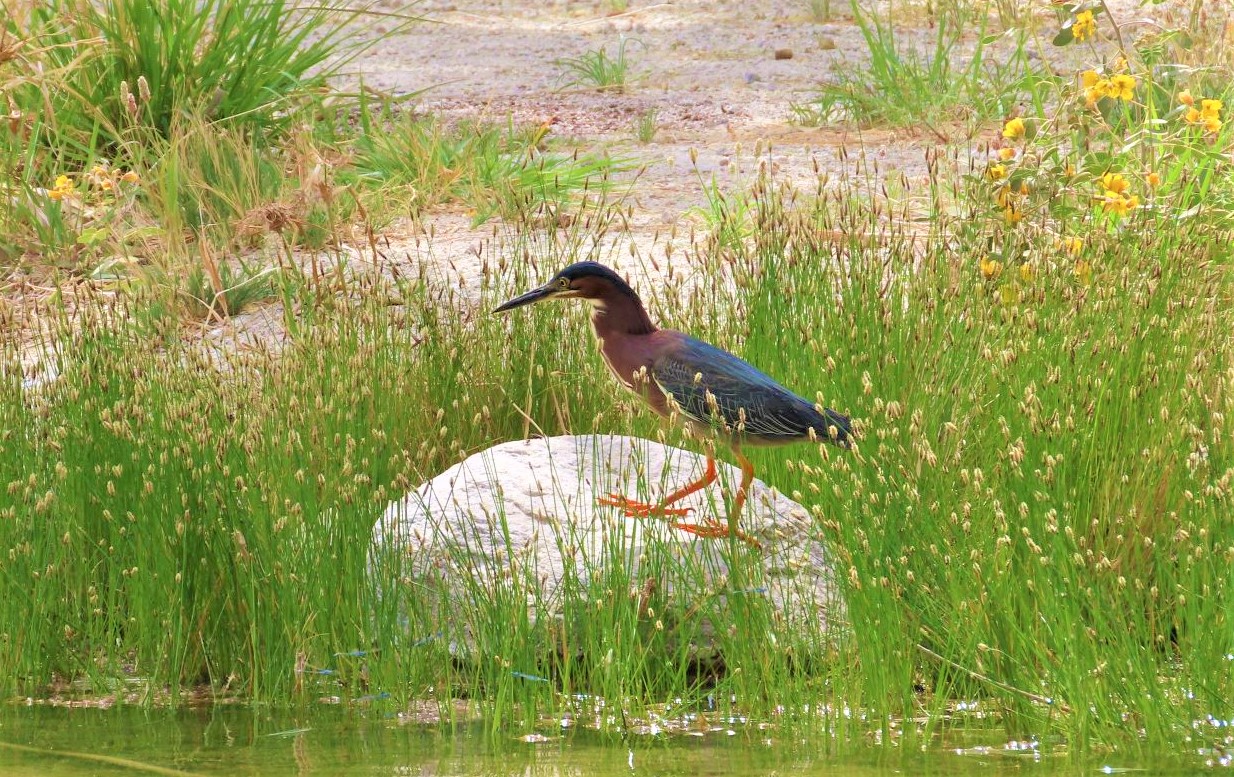
The Cooper’s gave us a nice fly-about view, but the Green Heron, which flew in and settled among the Mallards was my favorite sight of the morning. These birds have been a favorite since I saw one sitting on a branch barely above the water watching the scene below intently. Its watch paid off as a small fish swam beneath the branch and quickly became lunch for the heron.
Watching birds is still about the only thing I have patience for. Now, as I sit here in front of my computer in my cozy air-conditioned apartment, I’m thinking about what I will do for an outing next week. Stay tuned.
Pat Bean is a retired award-winning journalist who lives in Tucson with her canine companion, Scamp. She is an avid reader, an enthusiastic birder, staff writer for the Story Circle Network Journal, the author of Travels with Maggie available on Amazon (Free on Kindle Unlimited), is always searching for life’s silver lining, and these days aging her way – and that’s usually not gracefully.



 Pat Bean's blog