Feeds:
Posts
Comments

Posts Tagged ‘Birds’

I heard a loud squawking outside my RV and went out, binoculars in hand, to investigate.
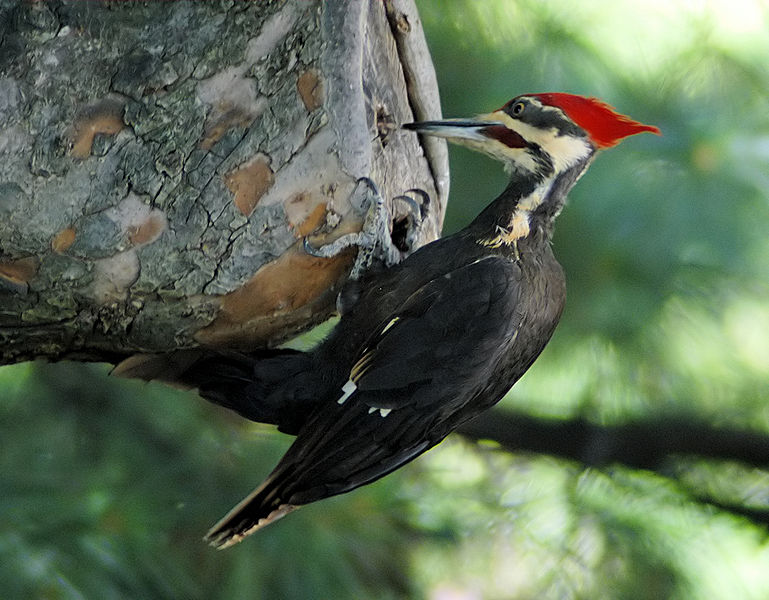
Pileated Woodpecker ... Photo courtesy Wikimedia

 It didn’t take me long to find the source, a pileated woodpecker. It was clinging well above my head to the side of a tall, winter-barren tree. This smaller look-alike version of the sought-after ivory-billed woodpecker was a frequent sight near my son’s home in Lake Jackson, Texas, but getting such a close look at one still stirred this birder’s heart.

As I watched, the woodpecker’s squawk went from a loud kuk-kuk-kuk to a KUTCH-KUTCH-KUTCH-KUTCH-KUTCH screech that harassed the eardrums. Through my binoculars, I noted what could only be described as a glare on its red-topped, long-billed face.

Following the direction of the bird’s gaze with my binoculars, I spotted the source of the agitation. It was a handsome red-tailed hawk occupying the same tree. After a minute or so more, the hawk conceded defeat, spreading its broad wings to the air and flashing a rusty red tail as it escaped the woodpecker’s cacophony.

The pileated hesitated only a few seconds before taking off in the same direction.

 While I may never know the thrill of sighting an ivory-billed, a bird that was once thought extinct and which some birders now believe they’ve seen (and I believe them), I felt honored to have shared a few minutes with its cousin in such a lively tableau.

Life is good.
Read Full Post »

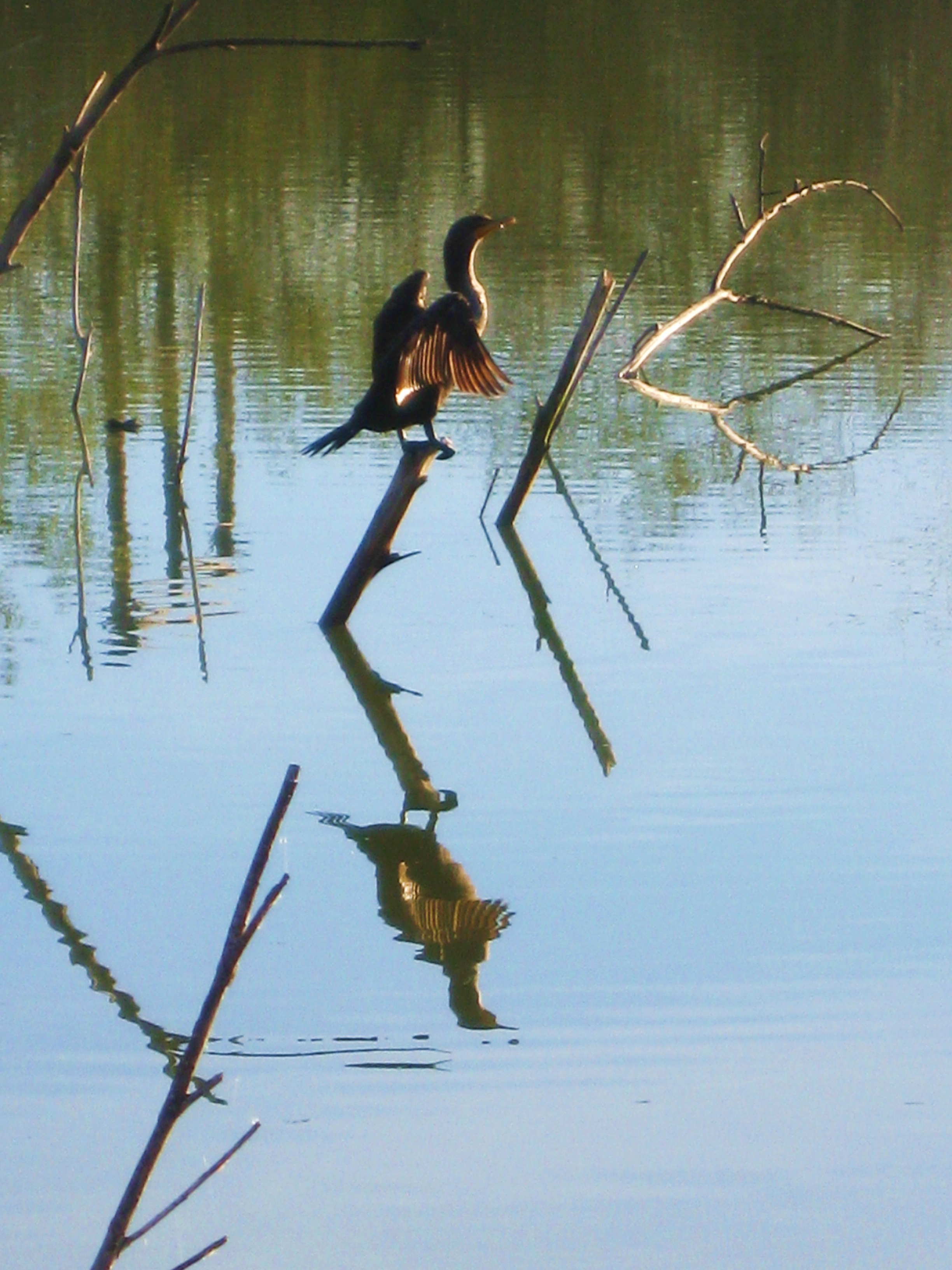
A neotropic cormorant and its reflection in Alligator Lake at Estero Llano Grande State Park in Weslaco, Texas ... Photo by Pat Bean

While I didn’t get the green kingfisher I was hoping for during my walk to Alligator Lake at Estereo Llano Grande State Park in Weslaco, Texas, I saw 136 birds this past weekend. Seven of these were lifers, birds I was seeing for the very first time.

One of these new birds was the rose-throated becard, which is rare in the valley. The Texas Ornithological Society group I birded with the first day of the organized field trips looked in vain for this becard. I found it the next day when I birded alone with my son and grandson.

On the third day of the field trips, I met up with a woman who had birded with me the first day, so of course I told her about seeing the becard. She said that was OK, because not seeing it meant she had an excuse to return again to the Rio Grande Valley.

Her attitude is a familiar one with the birders I know. One doesn’t even have to see a bird to have a good time. Just walking with Mother Nature is its own reward. One of these days I’m going to finally see the green kingfisher, which is not rare at all here in the valley.

Thankfully there will still be over 400 North American birds not yet on my life list, and thousands of others around the world still waiting to be seen.

Read Full Post »

Blue-footed booby ... Photo courtesy Wikimedia

The large white and brown bird with the blue feet didn’t recognize my right to the hiking path. Its home here in The Galapagos Islands, where man has not yet imposed his predatory nature, let it assume it was my equal.

I stopped about a foot away and was quickly mesmerized as the two of us, human and bird, stared eye-to-eye. My birding knowledge finally kicked in, however, and I identified the bird in front of me as a male blue-footed booby. The sex-distinguishing clue was that the pupil in its pale yellow eye was smaller than the pupil of the bird sitting on two eggs in a nest beside the path. I assumed the two birds were mates.

 As these birder thoughts filtered through my brain, the booby blocking my way lifted his right foot and gazed quizzically at me. I didn’t move. He put the right foot down and lifted his left foot and bobbed his head a few times. I smiled at him, and he repeated the maneuvers, the same ones I assumed he had used to woo his breeding female.

 When he lifted his left foot for the third time, I lifted my right foot in reply. For the next couple of minutes he and I continued this Hokey Pokey. It might have gone on longer except the rest of the tour group caught up.

 “Don’t tease the bird,” our guide said when he saw me.

“I’m not,” I replied. “He wanted to dance with me.”

 But since I could feel a thread of impatience coming from the people behind me, I moved off the path and started around the booby. We had been warned not to touch any of the Galapagos animals.

 The booby had no such compulsive restraint. He reached out and gave my leg a quick, non-threatening peck as I passed by him. It felt both like a good-bye handshake, and an invitation to “come back and dance with me.”

Read Full Post »

« Newer Posts