Feeds:
Posts
Comments

The Seasons

  “Winter is an etching spring a watercolor, summer an oil painting, and autumn a mosaic of them all.” – Stanley Horowitz

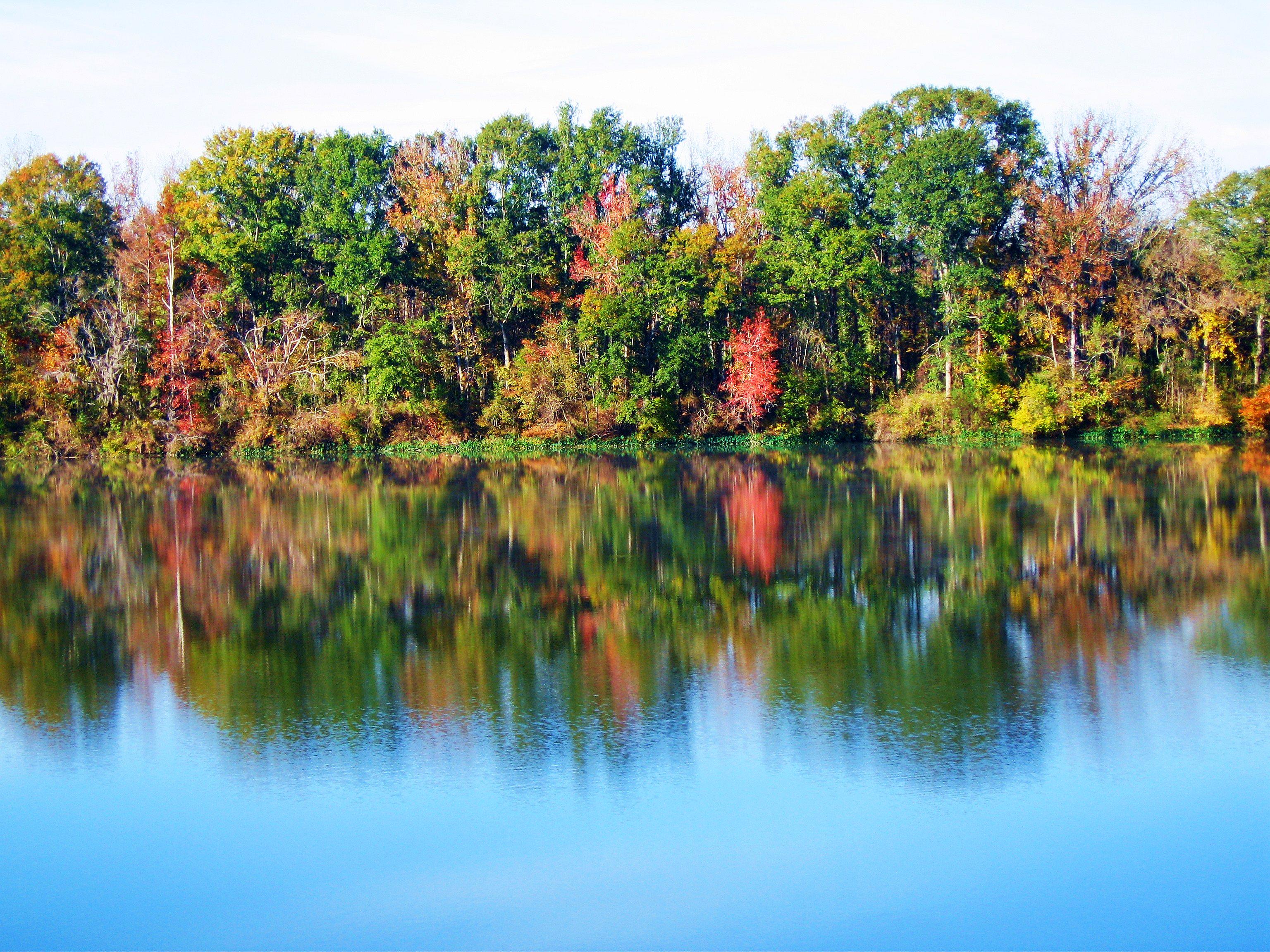
The view of autumn painting a mosaic landscape on the far side of Lake Claiborne was a vivid image from the rear window of my RV at Isaac Creek Campground in Alabama. -- Photo by Pat Beean

This double-image view of an autumn landscape on the far side of Lake Claiborne was a vivid image from the rear window of my RV at Isaac Creek Campground in Alabama. — Photo by Pat Bean

Two Autumns

My yearly routine, when I was living in an RV and traveling across America’s landscapes of purple mountains, blue lakes, tall corn fields, golden waves of grain, saguaro deserts, sandy beaches and green forests beneath an ever-changing sky, found me heading toward Texas at the first sign of winter.

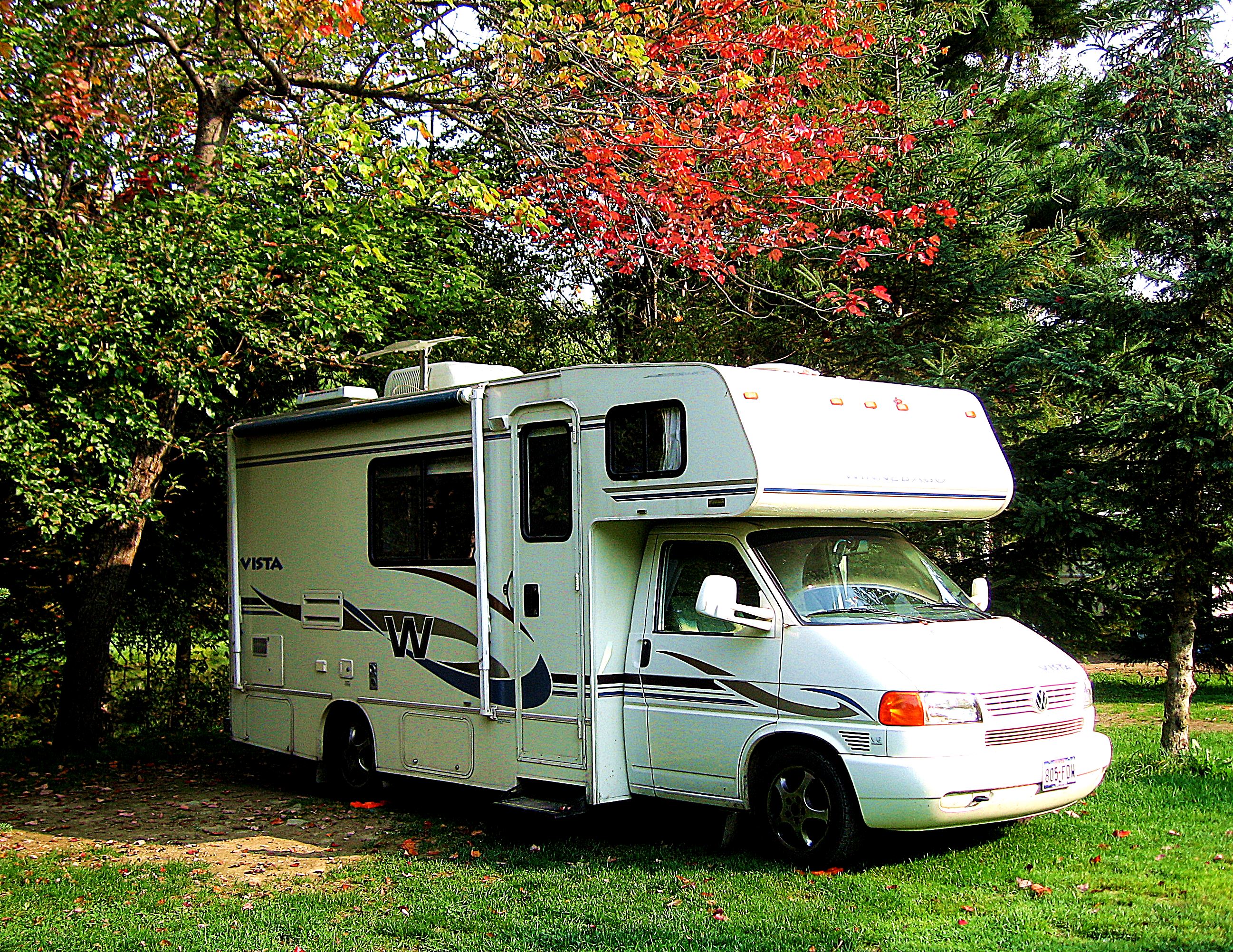
The red leaves of this tree at the Paul Bunyan Campground in Bangor Maine, that hung over Gypsy Lee were redder every morning during the week I stayed there. -- Photo by Pat Bean

The red leaves of this tree at the Paul Bunyan Campground in Bangor Maine, that hung over Gypsy Lee were redder every morning during the week I stayed there. — Photo by Pat Bean

Once there, I would spend the cold months bouncing between my children’s homes, all of which had hookup connections for my RV and me to sit until the danger of traveling icy roads had passed.

The year I traveled to Maine, autumn arrived early. And so did winter. I found cold winds and storms barking at my heels in early September, while at the same time, according to my children’s emails, summer still had a firm grip on Texas.

Maine’s fast approaching winter, and closed-down RV parks, had me joining the migration of birds and quickly heading south. But when I reached Delaware, I found that autumn hadn’t even begun to paint the first leaves. My travels turned leisurely again, and when I reached Alabama, in mid-November, I was treated to my second autumn. I watched it blossom into that mosaic Stanley Horowitz described as I sat beside Lake Claiborne at Isaac Creek Campground.

Since autumn is my favorite season, I considered myself a lucky old broad to have gotten two in one year.

Blog pick of the Day. Check it out.

Blog pick of the Day. Check it out.

Bean Pat: Screen Crud http://tinyurl.com/hh2hqdv This blog made me laugh because non-existent periods on my computer page happen to me a lot.

Late Blooming Lesson

  “A woman’s mind is cleaner than a man’s. She changes it more often.” – Oliver Herford

            “You have power over your mind – not outside events. Realize this, and you will find strength.” – Marcus Aurelius

The story of how the magpie became my animal totem would make a good first chapter  for my bird book. -- Photo by Pat Bean

The story of how the magpie became my animal totem would make a good first chapter for my bird book. — Photo by Pat Bean

It’s OK to Change One’s Mind

I’m not sure where I got it in my head that once I made a decision I had to follow through on it, but it got me in trouble in my earlier years. Young minds don’t always make the right choices.

Old minds don’t either.

But more often than not, the choices and decisions we make in life, especially those we make on a daily basis, have nothing to do with right or wrong. They are simply choices, like the one I made recently to do NANO in November, which is to write a 50,000 word novel in 30 days.

m

And I can write about my experience of seeing California condors flying free  over Zion National Park, and all the times I wrote about them when I was a reporter. -- Wikimedia phoot by Phil Armitage.

And I can write about my experience of seeing California condors flying free over Zion National Park, and all the times I wrote about them when I was a reporter. — Wikimedia photo by Phil Armitage.

Along with making that choice, I also made a decision to make my proposed book a mystery, and dedicated yesterday to working on an outline for it. Instead, I kept putting the task off and spent most of the day reading. The truth was I couldn’t come up with a good plot.

Then this morning I got to thinking. I have three completed (not sure how many uncompleted) first drafts of mysteries in my writing files, which I have no inclination to take to polished completion. I don’t think I need another.

Meanwhile, for the past year I have been outlining a book about my bird-watching experiences. I have numerous anecdotes about this late-blooming passion of mine. Why not, I thought, write my bird book for my NANO project?

The decision felt right. And suddenly I was more enthusiastic about my November writing marathon. Of course, I could change my mind again.

Learning to be comfortable with not having one’s decisions written in cement, even for life-changing choices, has made life a lot easier and more pleasant for me. Perhaps that’s because I make a lot of hummingbird-wing-quick decisions without thinking everything out fully first.

Patience simply isn’t a virtue in my mind. And while I believe, unlike Oliver Herford whose quote began this blog, that men change their minds as often as woman, I do believe I have a very clean mind.

Bean Pat: Hanging out: in Puerto Iguazu http://tinyurl.com/h6rg4vm A nice and easy day of armchair travel

A Novel Idea

“There are times when a feeling of expectancy comes to me, as if something is there, beneath the surface of my understanding, waiting for me to grasp it.” – Sylvia Plath

Laughing gulls on Mustang Island on the Texas Gulf Coast, not too far from where Ridley sea turtles have nested. -- Photo by Pat Bean

Laughing gulls on Mustang Island on the Texas Gulf Coast, not too far from where Ridley sea turtles have nested. — Photo by Pat Bean

A November Challenge

This makes the seventh year I’ve signed up to do NANO, which is short for National Novel Writing Month that takes place November. The goal is to write a 50,000-word novel in 30 days.

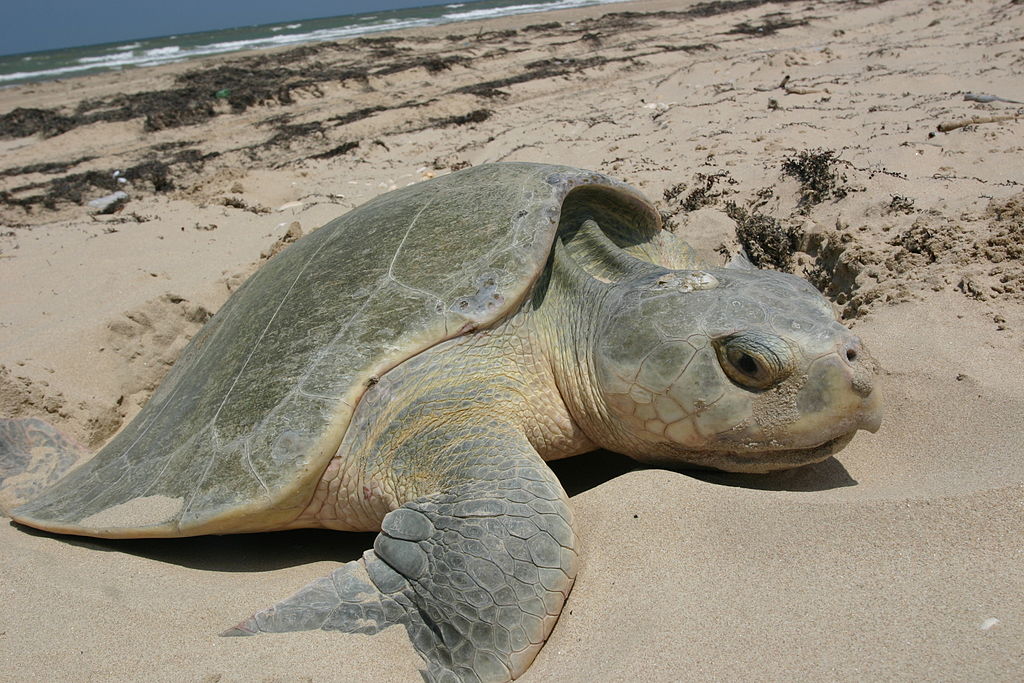
A Ridley sea turtle laying her eyes on a Texas Gulf Coast beach. -- National Park Service photo.

A Ridley sea turtle laying her eyes on a Texas Gulf Coast beach. — National Park Service photo.

I actually completed the goal, and got my certificate, once. It was a great writing exercise but I ended up with a wobbly first draft whose protagonist I had fallen out of love with, and so that’s as far as I took the project. I’m hoping to do a little better this time around, which is why I’m now working on an outline of the mystery novel I’m planning on writing in November.

The last time I flew by the seat of my pants only. I wrote a mystery the first time around as well, and am repeating the genre because I love reading mysteries – the ones that focus on who-dun-it instead of blood and gore.

A just hatched sea turtle ready to battle its way to the ocean. -- U.S. Fish and Wildlife photo

A just hatched sea turtle ready to battle its way to the ocean. — U.S. Fish and Wildlife photo

I’m going to use the things I liked from my first NANO completion, mainly the setting along the Texas Gulf Coast and the story of the endangered Ridley sea turtles, but with new characters and a new plot.

Anyone interested in joining the challenge with me can sign up at: http://nanowrimo.org/   It’s free, and not a contest. The only person you have to please is yourself.

My goal for doing the challenge, besides completing a first draft of a novel, is to get myself back into the habit of writing more consistently on a daily basis.

Blog pick of the Day. Check it out.

Blog pick of the Day. Check it out.

Wish me luck!

Bean Pat: Glassine Visions http://tinyurl.com/h7gfdxn For Dale Chihuly fans.

P.S. Re NANO: Since 2006, hundreds of novels first drafted during NANO have been published. You can check out the list at: http://nanowrimo.org/published-wrimos

U vs. You

Oh and yet another reason I like watching Survivor is its settings, like Africa. And the scenes often show birds, like this hammerkop at the foot of the zebras. -- Photo by Pat Bean

Oh and yet another reason I like watching Survivor is its settings, like Africa. And the scenes often show birds, like this hammerkop at the foot of the zebras. — Photo by Pat Bean

“Language… has created the word ‘loneliness’ to express the pain of being alone. And it has created the word ‘solitude’ to express the glory of being alone.” — Paul Tillich

Gen Xers vs. Millennials

I’m not sure I’ve shared one of my secret vices. I’m an avid Survivor fan who hasn’t missed a single one of its 33 seasons. This year it’s Generation Xers (those born between the mid-1960’s and the early 1980’s ) versus the Millennials, those young whippersnappers now between the ages of 18 and 33

And Survivor provides this wandering-wonderer with some nice armchair travels. -- Photo by Kim Perrin

And Survivor provides this wandering-wonderer with some nice armchair travels. — Photo by Kim Perrin

Being very competitive myself, the competitions are my favorite parts of the show. After that, it’s seeing how people react and relate to one another in stressful situations. Although I didn’t quite understand it during the first few seasons, because I was still of the mentality that the strongest should win, I now appreciate that it takes a combination of skills – strength, intelligence, sociability, staying power and will power to get to the end.

In this year’s competition, Survivor host Jeff Probst asked a question that showed the difference between the two competing age groups , and I found the answers intriguing.

How do you spell the word you when you text? Jeff asked.

“Y.O.U” answered the Gen Xers. “Just U” said the Millennials, and said the other way was “behind the times and old-style.” “But there’s a grace to the language,” said the Xers.

As someone who led the Baby Boomers in to this world, I cheered that rebuttal. I always spell out the word you – and all other words besides. I find it difficult when tweeting to even use the & sign when forced because of the limited number of letters.

Not that there is anything wrong with “U,” but simply because I enjoy the proper use of language that I was taught as a youngster. Change doesn’t come easy.

So how do you spell the word you when texting?

Blog pick of the Day. Check it out.

Blog pick of the Day. Check it out.

Wandering Cows http://tinyurl.com/hewo3na Take an armchair trip on a Jacobite Steam Train in Scotland.


Journal Keeping

The starting point of discovering who you are, your gifts, your talents, your dreams is being comfortable with yourself. Spend time alone. Write a journal. Take long walks in the woods.” – Robin Sharma

The Mark Twain Lighthouse in Hannibal Missouri, which I wrote about climbing up to see in 2006, when I was traveling the country full time with my canine companion Maggie in a small RV. -- Photo by Pat Bean

The Mark Twain Lighthouse in Hannibal Missouri, which I wrote about climbing up to see in 2006, when I was traveling the country full-time with my canine companion Maggie in a small RV. — Photo by Pat Bean

A Half Century of Memories

            I began keeping journals when I was 25, when, like a bolt of lightning on a clear day, I discovered I wanted to be a writer. For the next 15 years, my journals were cheap spiral notebooks that never got completed. I might write for a week, and then the next entry wouldn’t happen for three months, and sometimes the journal got lost in the between times.

I say lost because I never threw one away, and I think I eventually found most of them. A few years ago, I recopied the scant early journaling pages into one volume.

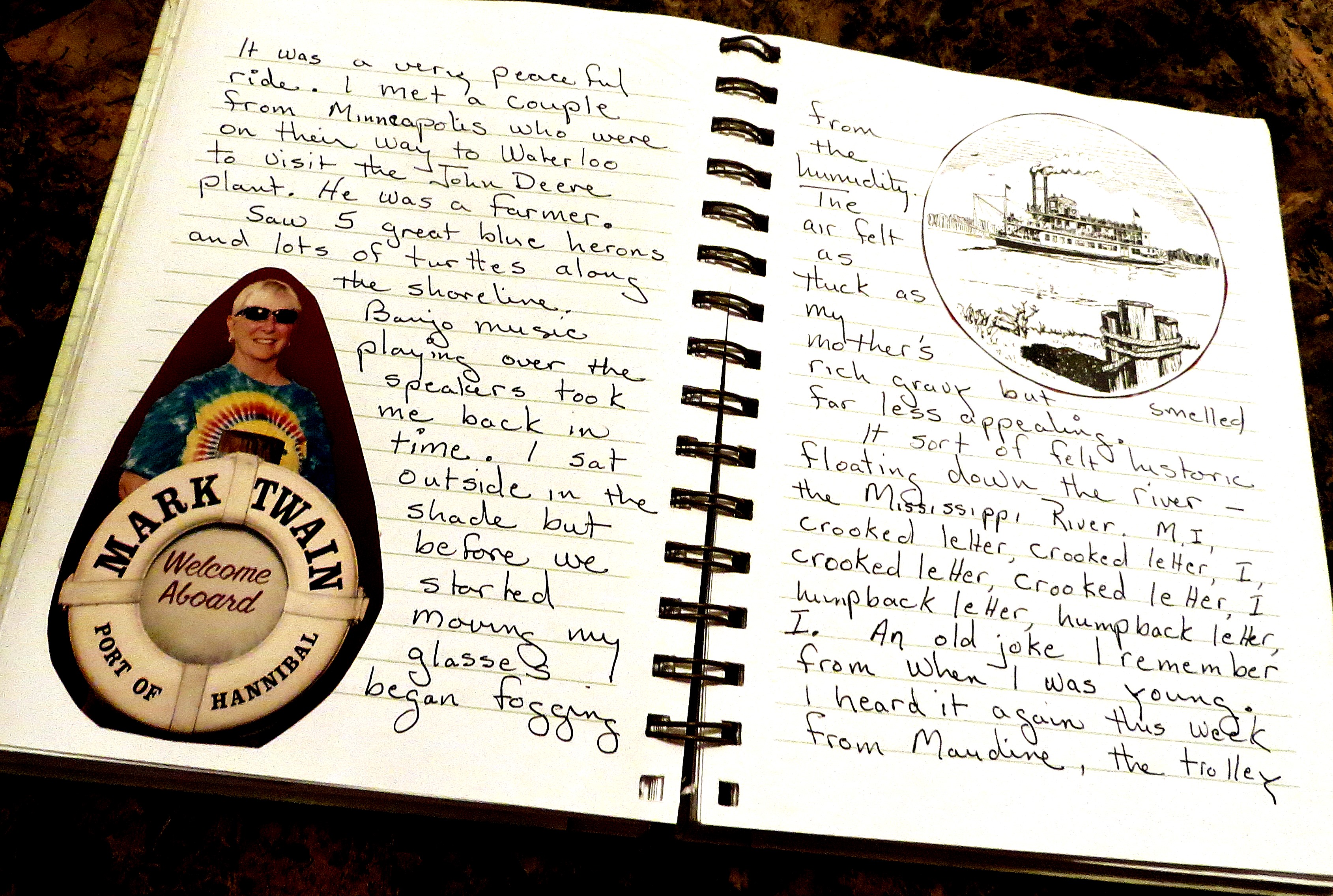
Pages from my journal  written when I was in Hannibal, Missouri, and took a paddleboat cruise on the Mississippi River.

Pages from my journal, written when I was in Hannibal, Missouri, in 2006, and took a paddle boat cruise on the Mississippi River.

My first journals were written when I was a working mother of five with no help, and the journal contents were too often filled with my beating up on myself because I never completed a day’s to-do list. What amazed me in the rereading, however, were all the things I did accomplish, and never gave myself credit for doing. Today, I honestly don’t know how I did all I did back then.

Around the age of 40, I decided to buy decent journals – one of my favorite being a Gibson that has thick enough paper to write on both sides and a spiral binding for ease in writing. I also began journaling more regularly. As time passed, the journals filled more quickly, until the present when I complete about two a year with a record of my days and thoughts. My journals, even the early ones, are also packed with quotes that have meaning to me.

Until recently, I had never read most of my journals, a task that now finds its way on my daily to-do lists. Unlike many of my journal writing friends, who told me they wrote more when times were bad, I’ve discovered that most of my entries are about the good times. While that means there are big gaps, especially in my earlier journals, and makes for an incomplete recording of my life, I’m discovering a treasure trove of memories that are delightful to relive.

And the thoughts I did record are enough for me to see how I’ve changed over the years – from a goodie-two-shoes who beat up on herself to an imperfect human who makes mistakes and is not usually sorry for them – and into someone who actually likes herself.

And that’s enough for me.

Blog pick of the Day. Check it out.

Blog pick of the Day. Check it out.

Bean Pat: 10 Forgotten Books http://tinyurl.com/hs5qh7n This dang blog cost me money. As an avid reader of travel books, I had to have The Illustrated Journeys of Celia Fiennes, 1685-c.1712, which was on the list. But thankfully I found one for 97 cents (plus $3.99 shipping) instead of having to buy a new one for the listed price of $59.

The Color Blue

A blue bench for birdwatching at Lake Walcott State Park in Southern Idaho. -- Photo by Pat Bean

A blue bench for birdwatching at Lake Walcott State Park in Southern Idaho. — Photo by Pat Bean

       “I think I have something tonight that’s not quite correct for evening wear. Blue suede shoes.” — Elvis Presley

A Many-Hued Thing

If you want a definition of the color blue, scientifically it is the color between violet and green on the optical spectrum of visible light.

Looking down on Bear Lake after exiting Logan Canyon in Utah. -- Wikimedia photo

Looking down on Bear Lake after exiting Logan Canyon in Utah. — Wikimedia photo

Blue comes in many hues. Just to name a few watercolor choices, there is Cobalt, Phthalocyanine, Antwerp, Peacock, Ultramarine, Prussian, Winsor, Cerulean, Manganese and, Turquoise.

As a writer, I’ve used such terms as robin’s egg blue, periwinkle blue and Steller jay blue, a bird whose brilliant coloring can send shivers down my spine when I see one in bright sunlight against a background of fluttering green leaves. It’s a sight that, thankfully, is a long-lived image that lingers in the soul.

Another blue that stands out in my mind is the color of Bear Lake in Utah as you crest the final summit in Logan Canyon and look down at the scene before you. No matter what the cold and deep lake’s color of the day was – and it was never quite the same each time I saw it – the intensity of the hue always made me gasp in awe.

Steller Jay --  Wikimedia photo

Steller Jay — Wikimedia photo

Graphic designer David Carson said: “Good things are associated with blue, like clear days, more than singing the blues. Just the word ‘blue’ in the singular is full of optimism and positive connotation to most people.”

Artist Wassily Kandinsky said: “The deeper the blue becomes, the more strongly it calls man towards the infinite, awakening in him a desire for the pure and … the brighter it becomes, the more it loses its sound, until it turns into silent stillness and becomes white.”

And Ralph Waldo Emerson, less picky about colors, said: “Nature always wears the colors of the spirit.” His quote makes me think of green, which was the color of my mom’s eyes.

Red’s not bad either. That’s the color of my couch. So what’s your favorite color?

Blog pick of the Day. Check it out.

Blog pick of the Day. Check it out.

            Bean Pat: Brevity http://tinyurl.com/h6m5khk Getting past the rejection slip. This is one of my favorite writing blogs.

The Soul of Wilderness

            “Wilderness is not a luxury but a necessity of the human spirit, and as vital to our lives as water and good bread. A civilization which destroys what little remains of the wild, the spare, the original, is cutting itself off from its origins and betraying the principle of civilization itself.”  Edward Abbey

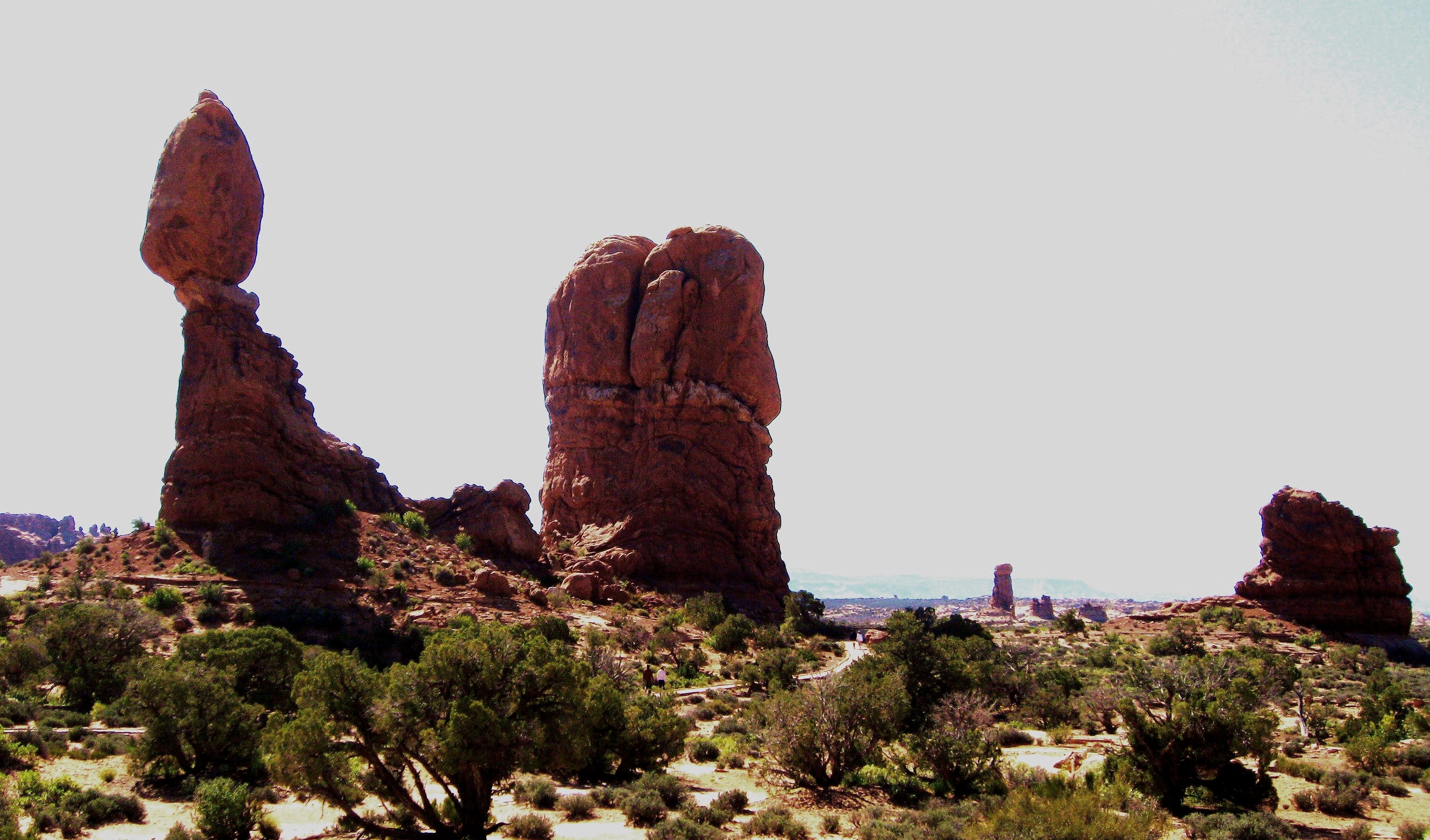
Balanced Rock, one of he more recognizable features at Arches National Park. -- Photo by Pat Bean

Balanced Rock, one of the more recognizable features at Arches National Park. — Photo by Pat Bean

Edward Abbey

            I’m slowly rereading Desert Solitaire by Edward Abbey, just a few pages a day as my morning read with coffee. I have more leisure time than the first time I read it, when I was a working mother of five whose every moment was double or triple-booked. If memory serves me well, I read it while soaking in a hot bath, about the only solitary luxury in my life back then.

Paved roads have brought crows to Arches. I'm thankful more people have the opportunity of seeing Mother Nature's red-rock creations, but miss the solitude I found there even back in the 1970s. -- Photo by Pat Bean

Paved roads have brought crowds to Arches. I’m thankful more people have the opportunity of seeing Mother Nature’s red-rock creations, but miss the solitude I found there even back in the 1970s. — Photo by Pat Bean

While I originally enjoyed the book for its content, this time around I’m also enjoying it with a writer’s eye, immersing myself in Abbey’s ability to put life into the landscapes with words that paint vivid images in my mind.

Desert Solitaire is about the author’s seasonal ranger job at Arches National Park back in the 1950s, when it was still just a monument and the few roads into it were unpaved. Arches is a place I’ve visited many times, having lived for many years only five hours away, but it wasn’t until the 1970s when I saw it for the first time. It was more civilized by then, but I can still recognize the landscape features as Abbey describes them with accuracy and poetry.

  “Lavender clouds sail like a fleet of ships across the pale green dawn,” he wrote, about his first morning at the park. Such imagery inspires me to get up in time to watch yet another sunrise.

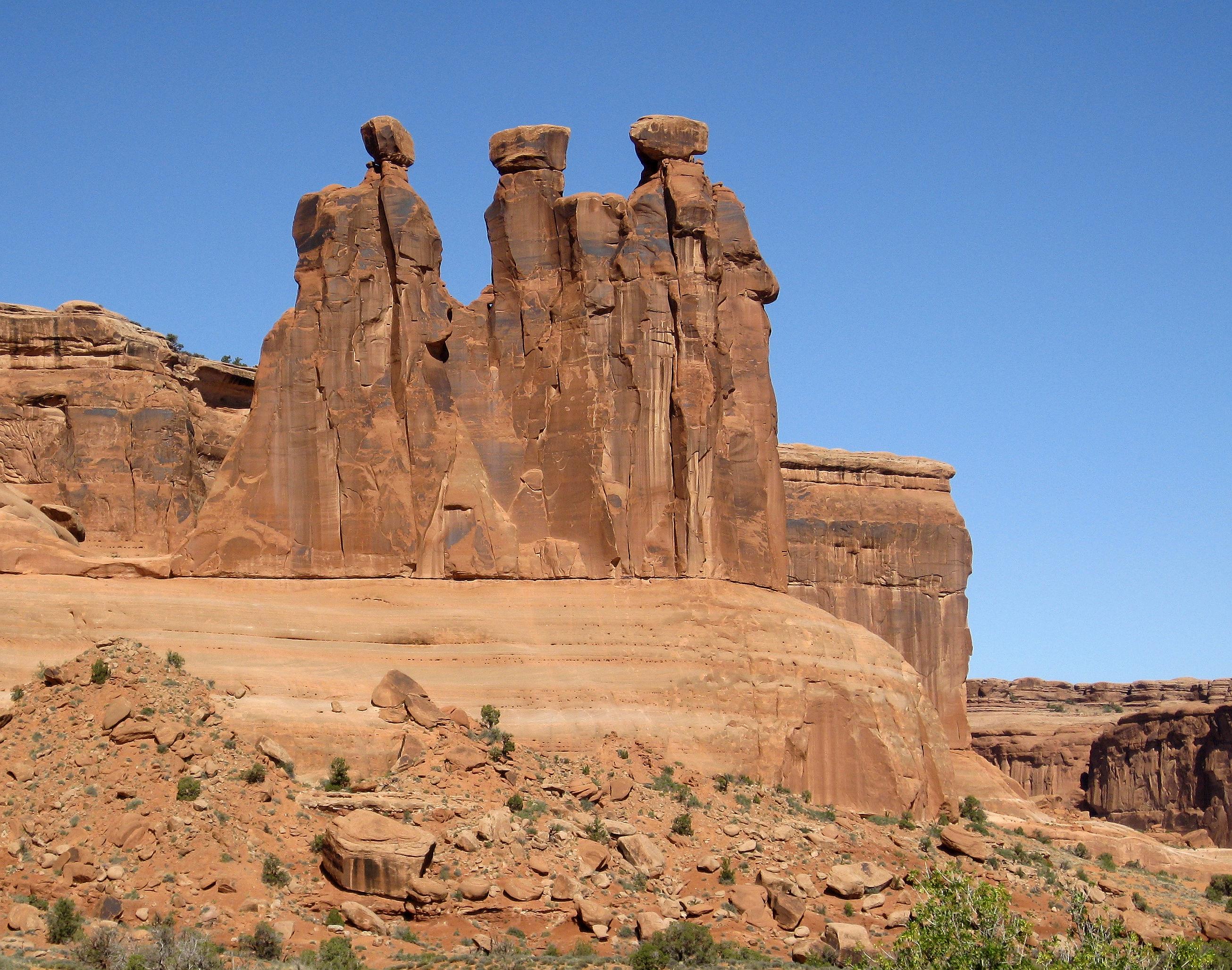
The three gossips, one of my favorite landmarks at Arches. -- Photo by Pat Bean

The three gossips, one of my favorite landmarks at Arches. — Photo by Pat Bean

And then, moved back in time and place by words, I sit with Abbey on the step of his trailer as he waits for the sun to come up on a cold April morning.

  “Suddenly it comes, the flaming globe, blazing on the pinnacles and minarets and balanced rocks, on the canyon walls and through the windows in the sandstone fins. We greet each other, sun and I, across the black void of ninety-three million miles. The snow glitters between us, acres of diamonds almost painful to look at. Within an hour all the snow exposed to the sunlight will be gone and the rock will be damp and steaming. Within minutes, even as I watch, melting snow begins to drip from the branches of a juniper nearby…”

Abbey’s words brought a memory to life. They took me back through time and place to a moment when I looked down and saw a melting tennis shoe that I had placed too close to a campfire as I watched for a morning sun to creep down from a red-rock cliff and into the valley where it would warm my body.

Thank you Edward Abbey.

You may have left this world, but your words still bring joy to my soul. And my hope for you — wherever you are — are the words you wrote that I took to heart when I was on the road: “May your trails be crooked, winding, lonesome, dangerous, leading to the most amazing view. May your mountains rise into and above the clouds.”

Bean Pat: A photo to make you smile and some words to make you think.  http://tinyurl.com/jostvnh


The Morning Birds

“Lavender clouds sail like a fleet of ships across the pale green dawn.” – Edward Abbey. The Opposite of Bird Watching

White-winged doves to the left, mourning doves to the right. -- Photo by Pat Bean

White-winged doves on the ends, mourning doves in the middle. — Photo by Pat Bean

It is a dawn like what Abbey describes that makes me often wake before the sun rises. After watching the gray turn the landscape into a fleeting moment of golden glow, I began looking around for birds, knowing that when I return to my apartment I will note in my journal the first species of the day. More often than not it will be a dove, either a white-winged or a mourning dove.

White-winged dove on top of a blooming saguaro.  -- Photo by Pat Bean

White-winged dove on top of a blooming saguaro. — Photo by Pat Bean

Both these species are as common here in the Sonoran Desert as are the saguaro, which normally can only be found in Southern Arizona or just across the border into Mexico.

You can see a mourning dove anyway in the mainland 48 states, but white-winged doves can only be found in the more southern states. Here where I live, I often see them sitting atop a saguaro, especially when it is in bloom (like the photo on the left). Mourning doves more commonly tend to flock on the ground in bunches of two to six.

If I listen, as my canine companion Pepper and I make our morning circuit, I can hear the doves murmuring to one another. It’s an interesting chatter. The mourning doves have a mellow, cooing song, which sounds like a lament, but which also is close to the sound of our resident great horned owls. White-winged doves, named for just that, also coo, but there is more variation and cheeriness to their songs. It sounds to me like they’re happy to be up and moving, while the mourning doves are bemoaning having to get up.

Recently I added a bird feeder to the nectar feeder that hangs on my third-floor apartment balcony. Both the mourning and white-winged doves have been feeding from it. They empty it way too quickly, which is why I only partially fill it each morning. There is only so much bird seed my budget can afford.

The doves, having become familiar with my custom of putting out seeds after my morning walk, often gather on the tile roof across from my apartment in anxious anticipation. I think you can call that people watching.

Blog pick of the Day. Check it out.

Blog pick of the Day. Check it out.

Bean Pat: With Less Weight in my Back Pack http://tinyurl.com/z5kco7l Sedona area landscape — and the way I feel these days.

“We write for the same reason that we walk, talk, climb mountains or swim the oceans – because we can. We have some impulse within us that makes us want to explain ourselves to other human beings. That’s why we paint, that’s why we dare to love someone – because we have the impulse to explain who we are.” — Maya Angelou

They call it Canaval Mountain, but it's really only a hill. -- Wikimedia photo

They call it Canaval Mountain, but it’s really only a hill. — Wikimedia photo

Or Turning a Hill Into a Mountain

            My grandmother used to tell me not to turn a molehill into a mountain whenever I got upset about something she considered insignificant. It was just one of her many sayings, like you’re going to hell in a handbasket when I did something wrong, or if it was raining but the sun was still shining, she would exclaim, “Well, the devil must be beating his wife.”

But there's no mistaking the Grand Teton as a hill. -- Photo by Pat Bean

But there’s no mistaking the Grand Teton as a hill. — Photo by Pat Bean

She was the only grandparent I ever knew, and she died when I was 11, which makes me wonder why, over a half century later. I can still hear her words in my head. It doesn’t take much to trigger the memories, which is what happened this morning when I was editing a chapter in my book, Travels with Maggie.

I had written about Poteau, Oklahoma, which claims to be home of the world’s tallest hill, despite the fact it’s commonly called Cavanal Mountain. That it’s a hill is based on the geological understanding that a landscape feature is a mountain if it’s 2,000 feet tall, and a hill if it is less than that. Cavanal is 1,999 feet tall.

And before I could move on to reading the next paragraph, my grandmother’s old time sayings were in my head. And then I found myself wanting to know where the phrase “don’t turn a mountain into a molehill” originated, which led me to the Internet.

According to the online encyclopedia, Wikipedia, the phrase dates back to 1548, when Nicholas Udall used it in a translation of the New Testament. He wrote: “The Sophistes of Greece coulde through their copiousness make and an elephant of a flye, and a mountaine of a molehill.” Allegedly (you can’t always believe what you read), the comparison of the elephant with a fly is an old Latin proverb, but the mountain and molehill example was likely coined by Udall himself – and it’s been used ever since.

And the sound of my grandmother telling me, “Don’t turn a mountain into a molehill,” still rings in my head. I wonder where my grandmother first heard the phrase. My wondering mind just never seems to stop.           

Blog pick of the Day. Check it out.

Blog pick of the Day. Check it out.

  Bean Pat: Sometimes Once is Enough http://tinyurl.com/jybtbzz A spoonbill, an egret and a great post.

Reflections

Weekly Photo Challenge

“There’s an unseen force which lets birds know when you’ve just washed your car.” — Denis Norden

Roseate spoonbill at Brazos Bend National Park

Roseate spoonbill at Brazos Bend National Park — Photo by Pat Bean

And for good measure, since I do so enjoy watching these pink-winged birds with the funny bill, here is another photo I snapped of roseate spoonbills.

Roseate spoonbills in the World Fair's Aviary at the St. Louis Zoo.  -- Photo by Pat Bean

Roseate spoonbills nesting in the World Fair’s Aviary at the St. Louis Zoo. — Photo by Pat Bean