Feeds:
Posts
Comments

The Trees Around Us

Advice from a Tree: Stand tall and proud. Sink your roots into the earth. Be content with your natural beauty. Go out on a limb. Drink plenty of water. Remember your roots. Enjoy the view. – Ilan Shamir

They’re Huggable

Ralph Marston, author and publisher of The Daily Motivator, asks: “When was the last time you spent a quiet moment just doing nothing – just sitting and looking at the sea, or watching the wind blowing the tree limbs, or waves rippling on a pond, a flickering candle or children playing in the park?”

This live oak tree, thought to be more than a thousand years old, can be found on Goose Island State Park in Texas. It too, is one, whose sight causes me to linger. — Photo by Pat Bean.

My answer is yesterday, when I sat on my third-floor living room balcony, at first watching for the hummingbirds that visit my nectar feeder. When they didn’t come, I then simply stared at the multitude of trees visible from my perch. I know of no better way to calm my body and to fill it with a sense of rightness and peacefulness.

Seven tall Ponderosa pines grow in the courtyard. I often wonder why they are

here in the desert where they don’t belong – but I’m glad they are here. Also growing in the courtyard are the deciduous trees whose names I do not know, plus quite a few black olive trees, whose twisted trunks look as if they have been carved into artistic arrangements.

In the undeveloped desert area around my apartment complex, through which there is a short trail, grow a multitude of Palo Verde trees sporting green trunks and limbs. I’ve observed them through the seasons, sprouting greenish-yellow leaves during monsoon and then dropping them to conserve energy when the desert dries up and the heat sends all living things in search of shade.

Me, hugging a tree in Custer State Park in South Dakota. — Photo by one of the day’s traveling companions.

My former home in Utah, which I sold to go traipsing all across North America, had a huge wild elm tree in the backyard. It was the primary reason I had bought the home. It was so huge that it shaded my entire house, which also benefitted from the shadows cast by a tall Ponderosa pine tree on the opposite side. I needed no other air conditioning.

The trees here at my apartment complex in Tucson, where summer temperatures can reach 120 degrees — air conditioning is definitely needed — provide me the shade I need for the brief walks I take with Pepper, my canine companion, during the hottest part of the summer.

I don’t think I could live in a place without trees. And laugh you might, but I’m not just a tree lover, I’m a tree hugger, too. And I have the photo to prove it.

Bean Pat: The Silence of Nature https://travelsandtrifles.wordpress.com/2018/01/19/thesilence-of-nature/  “See how nature – trees, flowers, grass – grows in silence.”Mother Teresa

Pat Bean is a Lonely Planet Community Pathfinder. Her book, Travels with Maggie, is now up on Amazon at http://tinyurl.com/y8z7553y  Currently, she is writing a book, tentatively titled Bird Droppings, which is about her late-bloomer birding adventures. You can contact her at patbean@msn.com
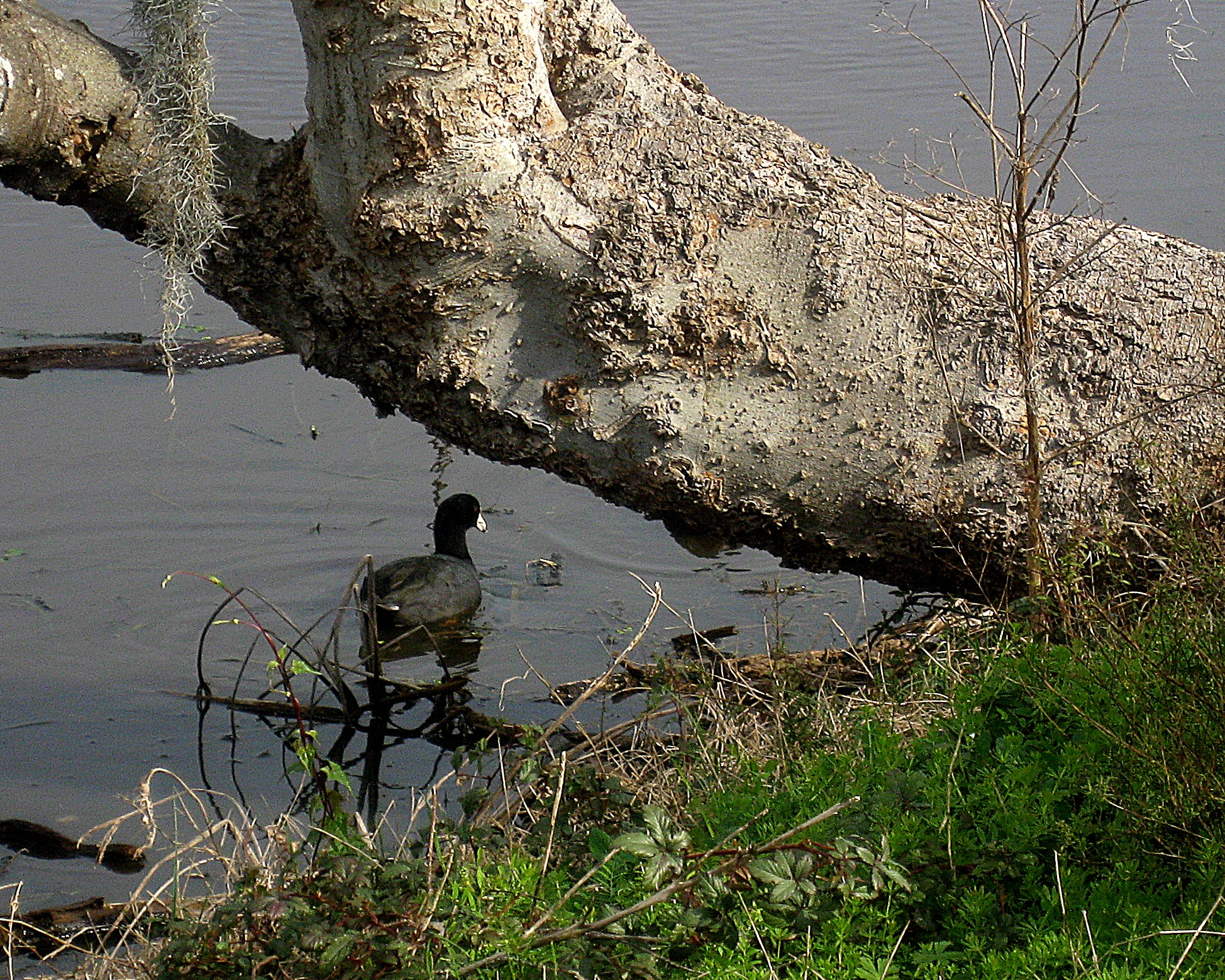
American Coots

“I won’t lock my doors or bar them either. If any of the old coots in the pictures out in the hall want to come out of their frames for a friendly chat.” — Bess Truman

Not Ducky at All

While that’s an interesting description Bess Truman has about coots, whom I’m assuming include our founding fathers, I’m referring to the one that flies, The American coot.

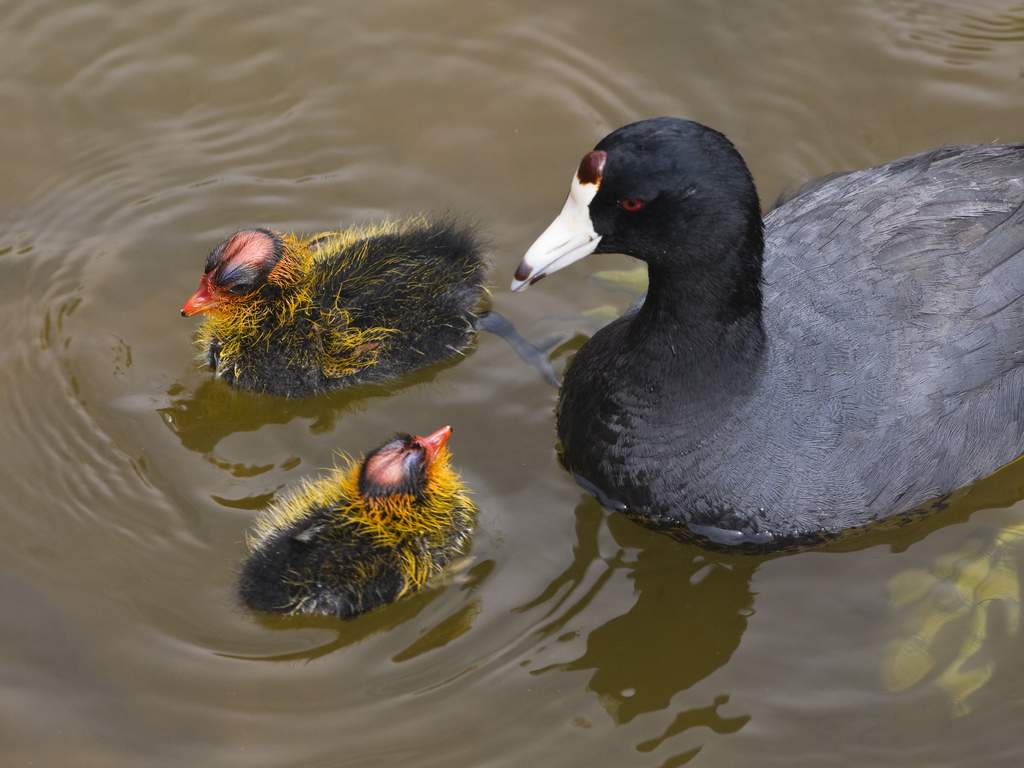
Coot with its unlikely looking offspring.

I frequently see coots when I’m out birding wetland and lake areas.  They’re so easily recognizable that I don’t spend as much time observing them as I might. They’re clunky looking birds whose feathers range from slate-gray to black. While they look kind of like ducks, coots belong to the rail family.

One of the times, when I did take the time to study them more closely, was when I saw a pair of the coots share some food with three small floating companions. The fluffy chicks, looking nothing like their parents, had bald scarlet heads and wore wiry looking orange necklaces.

According to David Attenborough, in his book The Life of Birds, the American coot tends to feed the chick first that has the most brilliant red head, which may be why a third of the coots that hatch die from starvation.

Since I only saw three chicks, and a coot mom can lay nine or more eggs, I suspected this natural selection had already taken place.

Meanwhile, during my observations of the coots, I came a little too close to the one nearest the shore. It took off like a World War II fighter plane after it had taken a few hits in the engine, giving me a view of its over-sized lobed feet, which were a neon lemon-lime in color.

There really is a lot to enjoy about these birds, I decided. You just have to give a coot.

Bean Pat: A Writer’s Path https://tinyurl.com/yd5hzned  I used to have a sign over my desk at work that read: “Just because I’m not writing doesn’t mean I’m not writing.,” which may be why I dig this blog.

Pat Bean is a Lonely Planet Community Pathfinder. Her book, Travels with Maggie, is now up on Amazon at http://tinyurl.com/y8z7553y  Currently, she is writing a book. tentatively titled Bird Droppings, which is about her late-bloomer birding adventures. You can contact her at patbean@msn.com
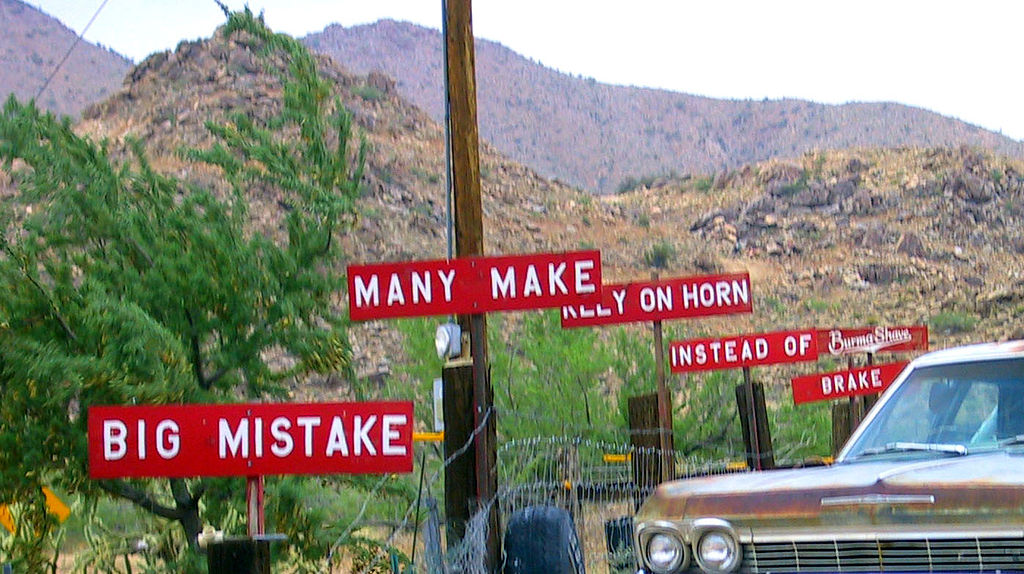
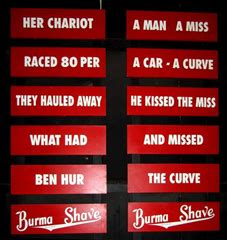
You can still find these signs in Arizona on a section of Old Route 66 that attracts driving tourists. — Wikimedia photo

Why does a chicken

Cross the street?

She sees a guy

She’d like to meet.

He uses

Burma Shave

On Old Route 66

When I was about 12, back in the early 1950s, I went on my first road trip. It was a journey from Texas to California with my aunt and uncle who took me along as the babysitter for my 18-month-old cousin. I already had an addicted case of wanderlust from reading about far-away places. This trip just added jet fuel to a passion that still exists today.

While flying thrilled me the first time I was in an airplane – I was in my 30s by then – I quickly realized I would much rather drive places when possible, because there’s lots more to see.

That first road trip, with my uncle barreling down Route 66 — sometimes hitting 100 mph he bragged – in his brand-new Oldsmobile, found me reading Burma Shave signs. You do remember those, don’t you?

Thankfully, at the speed we were traveling, the bright red and white signs were still spaced far enough apart for me to read. Those signs were a great advertising ploy selling shaving cream. And now they provide good memories for this old, wander-lusted broad.

Now here are a few from the past that might bring good memories for some, and maybe even a laugh or two.

Drinking drivers

Enhance their

Chance

To highball home

In an ambulance

Burma Shave

           *

“At ease,” she said.

“Maneuvers begin

When you get

Those whiskers

Off your chin

Burma Shave

          *

I use it too

The bald man said

It keeps my face

Just like

My head

Burma Shave

       *

The Monkey took

One look at Jim

And threw the peanuts

Back at him

He needed

Burma Shave

Bean Pat: Miss Pelican’s Perch https://misspelicansperch.wordpress.com/2018/01/10/undulation-old-stoves-lipstick-and-the-new-moon/  This is a good blog for writers. And I, too, am a fan of Natalie Goldberg.

Pat Bean is a Lonely Planet Community Pathfinder. Her book, Travels with Maggie, is now up on Amazon at http://tinyurl.com/y8z7553y  Currently, she is writing a book. tentatively titled Bird Droppings, which is about her late-bloomer birding adventures. You can contact her at patbean@msn.com
White-Crowned Sparrows

The sparrow that is twittering on the edge of my balcony is calling up to me this moment a world of memories that reach over half my lifetime, and a world of hope that stretches farther than any flight of sparrows.” — Donald G. Mitchell

White-crowned sparrow. — Wikimedia photo

Among the Mourning Doves

My daughter T.C’s home in Marana, just 13 miles from my Catalina Foothills apartment in Tucson, is a birder’s paradise. So, when I visit, I usually take my binoculars and try to find a little time to sit on her backyard patio and bird watch.

On my last visit, after seeing a phainopepla sitting on a tall saguaro, I focused on the flock of mourning doves beneath a seed feeder. While looking at the doves, I spotted several white-crowned sparrows. They are distinct birds, especially the adults whose crisp white crowns are set off by two black stripes.

Osprey … Wikimedia photo

I might not have noticed the sparrows if it hadn’t been for the larger doves, which reminded me of the time, 2001 in Utah, when I identified a white crown for the first time. I was taking one of my normal weekend drives along a backroad when I got sight of an osprey high on a utility pole. By then I had been braking for birds for two years, so I pulled over to the side for a better look.

The osprey, however, was skittish and flew off. My disappointment was erased, however, when I saw the white crowns in a bush beneath the pole. The ones I watched on that Sunday morning stayed in sight for about 10 minutes, whistling a sharp tune and flitting among several large bushes before they bounded out of sight.

I got back in my car to drive on, then saw the osprey back up on the pole. I guess it decided I was no threat.

Bean Pat: Things you might not have known. I did know this, because I saw one in Africa.  https://janalinesworldjourney.com/2018/01/05/things-you-probably-never-knew-about-dassies-rock-hyrax/?wref=pil

Pat Bean is a Lonely Planet Community Pathfinder. Her book, Travels with Maggie, is now up on Amazon at http://tinyurl.com/y8z7553y  Currently, she is writing a book, tentatively titled Bird Droppings, which is about her late-bloomer birding adventures. You can contact her at patbean@msn.com
First Bird of 2018

“Be grateful for luck. Pay the thunder no mind – listen to the birds. And don’t hate nobody.” – Eubie Blake.

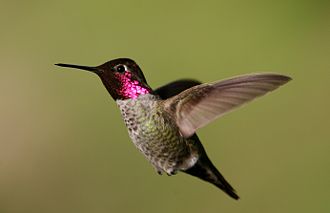
Male Anna’s Hummingbird. — Wikimedia photo

Portent of the Birding Year Ahead  

For the first four years (2000-2003) after I became a passionate birdwatcher, the first bird of the year was always a house sparrow. That’s probably because I had a generational family of them living and raising chicks in the thick cedar bush right outside my bedroom window.

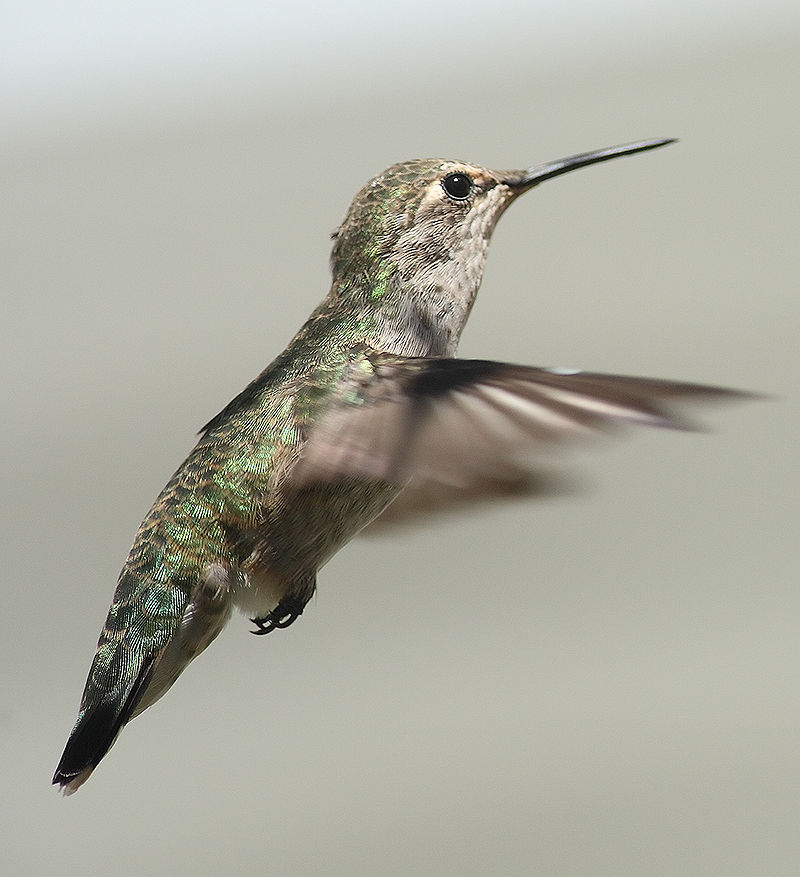
Female Anna’s Hummingbird. — Wikimedia photo

The first bird of the year, at least for a birder, is considered a portent of the year to come, which is why Noah Strycker, author of Birding without Borders, which is about his search to see 5000 birds in one year, found himself sitting in a hot tub on the deck of a ship in the Antarctic at midnight waiting for Jan. 1, 2015 to arrive. He was hoping it would be his year of the penguin.

It should have happened, but it didn’t. Nary a bird was in sight as he scanned the horizon in the midnight sun. The water soon got cold, and Noah went in, dressed, and took up his watch at the back of the ship. At 3 a.m., he finally spotted the first bird of his journey. It was a cape petrel.

While it wasn’t a penguin, “it was perfect,” Noah wrote. “Petrels, in their infinite grace, are thought to be named for Saint Peter and his habit of walking on water. With a blessing like that, the Year of the Petrel was off to an auspicious start,” he said.

In my fifth year of birding, I was on Guam, and was pretty sure this year my first bird wasn’t going to be a sparrow. And I right. But it wasn’t until about 3 p.m. in the afternoon, that I finally got my first bird of the year. Guam, I had discovered, was almost bereft of birds because of the, non-native, nasty, ugly brown tree snake that raided the island’s bird nests.

My first bird of 2004 turned out to be a yellow bittern.

            This year, my first bird of the year was an Anna’s Hummingbird, which came to the nectar feeder on my living room balcony, where I watched for it’s arrival while drinking my cream-laced coffee.

As an animal totem, the hummingbird symbolizes joy, playfulness and adaptability. I’m looking forward now to my Hummingbird Year.

Bean Pat: See Mike’s first bird of the year. https://naturehasnoboss.com/2018/01/01/everyday-blessings/

Pat Bean is a Lonely Planet Community Pathfinder. Her book, Travels with Maggie, is now up on Amazon at http://tinyurl.com/y8z7553y  Currently, she is writing a book tentatively titled Bird Droppings, which is about her late-bloomer birding adventures. You can contact her at patbean@msn.com

Lake Pend Oreille

Some folks say big ol’ Lake Pend Oreille is Idaho’s most magnificent lake. But let’s just stick to the facts: It’s the state’s largest (43 miles long, 111 miles of shoreline). It’s the deepest (at 1,158 feet deep, there are only four deeper lakes in the nation). It’s got terrific scenery, splendid clean water, big fish, a fascinating history …” – sandpointonline.com

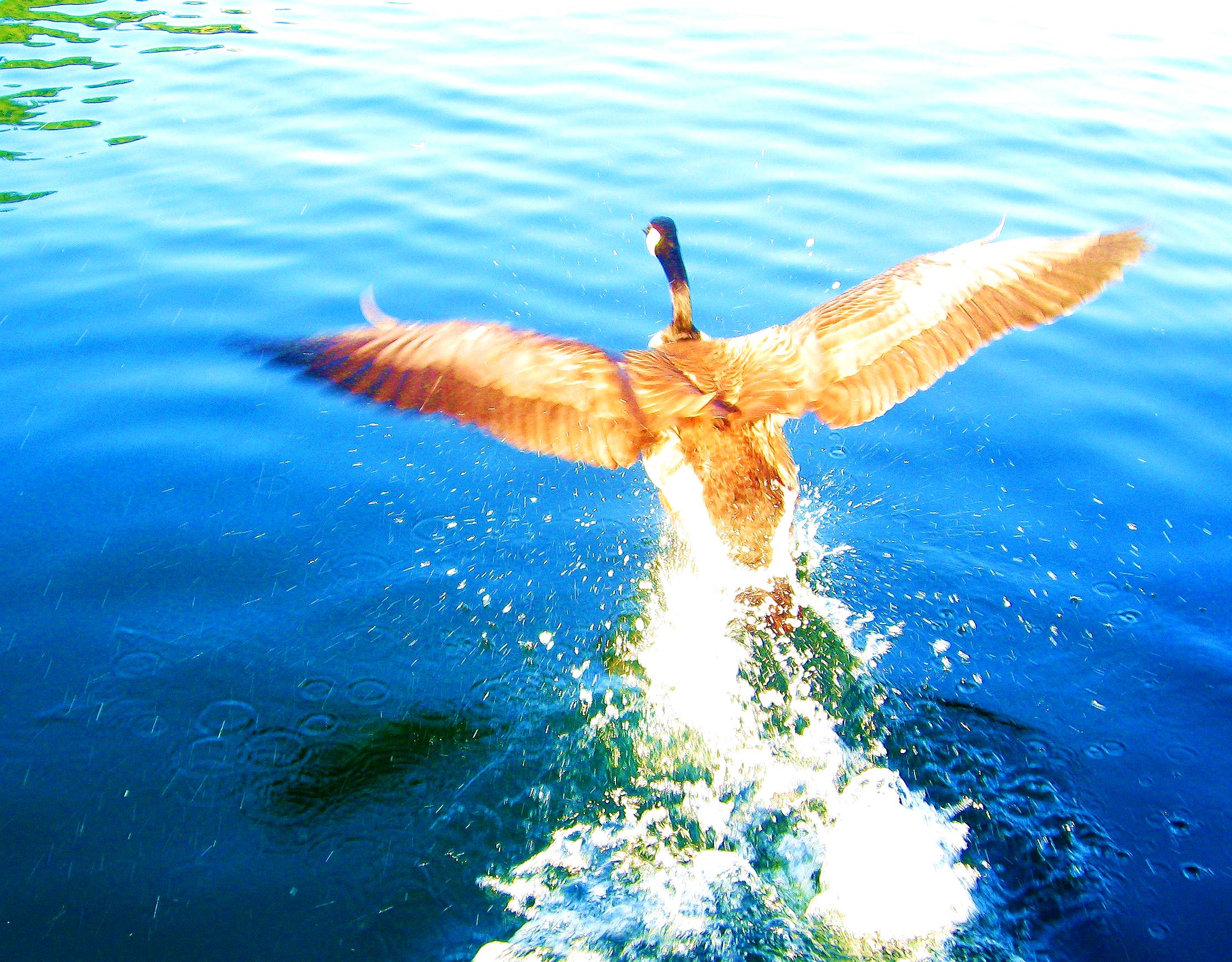
A Canada goose taking of from Lake Pend Orielle.  I took the photo during a Ladies Night Out boating cruise for Farragut State Park’s volunteers. — Photo by Pat Bean

It’s pronounced Pon-de-ray

I was listening to Clive Cussler’s Poseidon’s Arrow in my car while driving from Tucson  to my daughter’s home in Marana. It’s just 13 miles away, but traffic and construction detours turn it into a 40-minute drive, making the familiar route an excellent time for book listening.

An aerial view of Lake Pend Orielle. — Wikipedia Photo

I think of Cussler’s Dirk Pitt books as fantasy swashbuckler reading, not to be taken seriously, simply a time to enjoy the good guys wearing white hats and the villains all wearing black hats, which isn’t ever the case in the real world.

Anyway, after a boat/vehicle chase that led through a crowded Mexican town, the book has its protagonists landing at the Coeur d’Alene Airport in Idaho, then driving through Farragut State Park to Bayview, a small town that sits beside Lake Pend Oreille, which is pronounced Ponderay. The lake is home to a Naval submarine base, and the book’s characters talk of the place as being interesting trivia for back home in Washington D.C.

Now if you’re thinking that the idea of an inland submarine base in Idaho is all in Cussler’s imagination, you would be wrong. I was a campground volunteer at Farragut State Park one summer, have been boating on Lake Pend Oreille, and learned all about the Farragut Naval Training Station that was in operation during World War II, a part of which is still active for underwater submarine research.

One of the beauties of being a widely traveled old broad is reading books that include descriptions about places I have visited. It seems to happen regularly these days. I find such déjà vu moments, which refresh the brain, a bonus for having lived so long.

    Bean Pat: Have you ever seen an Inca tern? https://cindyknoke.com/2017/12/20/inca-tern/ Then take a look at them here. They are awesome, and so are this blogger’s photographs of them.

Pat Bean is a Lonely Planet Community Pathfinder. Her book, Travels with Maggie, is now up on Amazon at http://tinyurl.com/y8z7553y  You can contact her at patbean@msn.com

Turning the Tables

Antelope Island

Antelope Island from the causeway on an overcast day. — Photo by Pat Bean

“Women, like men, should try to do the impossible. And when they fail, their failure should be a challenge to others.” – Amelia Earhart

Wilson’s Phalaropes 

My newest writing work in progress, since Travels with Maggie is now published, is a book I’m calling Bird Droppings. It’s about my adventures, and that they have been, of being a late-blooming birder.

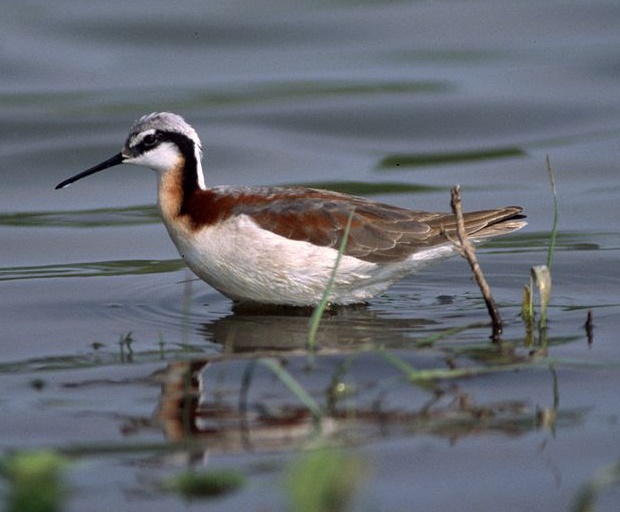
Female Wilson’s phalarope in breeding plumage. — Wikimedia photo

It’s a passion that addicted me at the age of 60, just when my body was beginning to revolt against my more strenuous outdoor activities of back-packing, white-water rafting, biking and skiing.

Recognizing the new hobby as a major blessing that kept me moving forward in my zest for life, I reveled in the new experiences. And the more I actually learned about birds, the more enamored I became with bird watching.

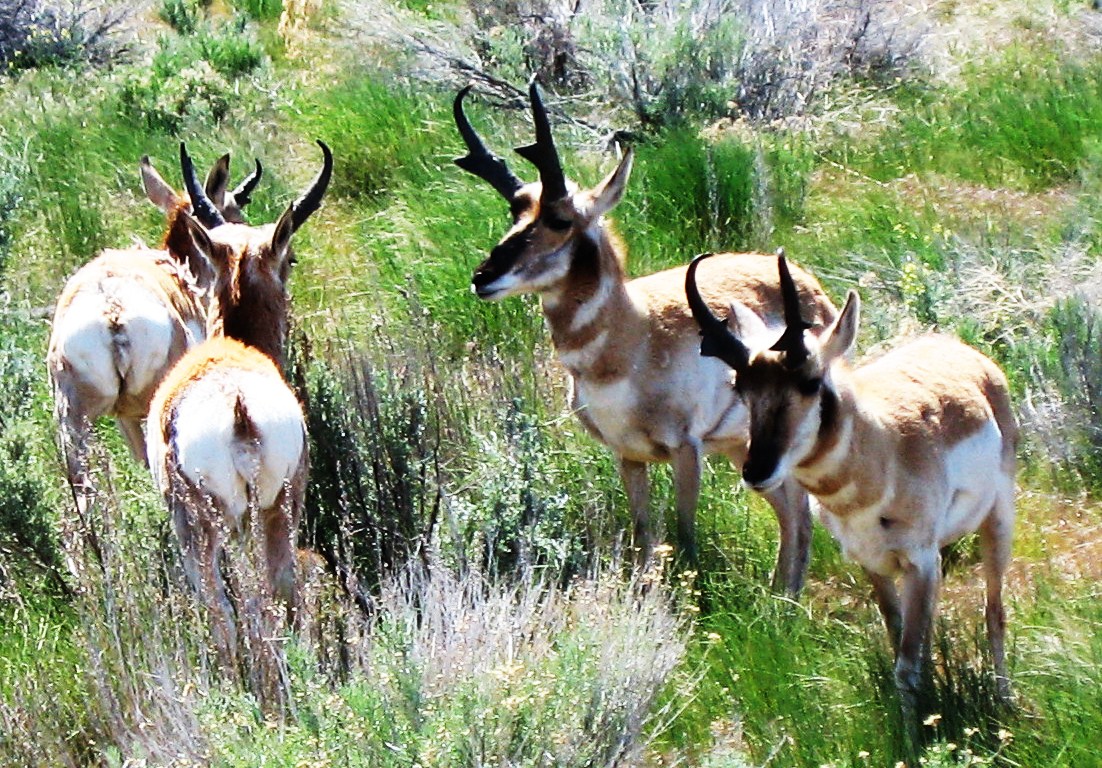
As I watched for birds on the island, I always saw other wildlife, and pronghorn antelope were frequently among them. — Photo by Pat Bean

At first, I relied on others to make identifications of birds in the field, but there came a point when I wanted to be able to be the first one to say that’s a yellow-rumped warbler or a ruddy duck. Those two, by the way are usually easy to identify. The first, also known as a butter butt, often moons you so you clearly see its golden backside, and the second has a blue bill and a stuck-up tail,

To satisfy my need to be able to identify a bird on my own, I began solo weekly visits, with field guides in hand, to Antelope Island in Great Salt Lake. I called the place my Birding 101 Lab and visited it almost weekly, throughout the seasons, for two years. I never had an outing to the island, which was reached by a six-mile causeway, in which I didn’t learn something new and fascinating.

One of the more interesting birds to me, since I’m a woman who raised five children almost entirely on her own, were the Wilson’s phalaropes. These nine-inch or so shorebirds are members of the sandpiper family. They flock by the hundreds of thousands to Great Salt Lake during the summer. I often watched them swimming around and around in circles, creating a vacuum that would bring up tiny bits of food to eat.

But the thing I enjoyed most about these birds, which I learned from my many bird books and field guides, was that they switched roles. The female had the brightest colored feathers, courted the males, and then left the egg sitting and rearing the young to the gentlemen as well.

As a mom who changed cloth diapers for five children without any help, I couldn’t help but admire the female phalaropes.

            Bean Pat: Refuge https://www.birdnote.org/show/terry-tempest-williams-reads-refuge One of my favorite authors reads a short piece in her soothing voice. This is a real treat, and less than 2 minutes long.

Pat Bean is a Lonely Planet Community Pathfinder. Her book, Travels with Maggie, is now up on Amazon at http://tinyurl.com/y8z7553y  You can contact her at patbean@msn.com
Hem and Haw

“I saw myself sitting in the crotch of this fig tree, starving to death, just because I couldn’t make up my mind which of the figs I would choose. I wanted each and every one of them, but choosing one meant losing all the rest, and, as I sat there, unable to decide, the figs began to wrinkle and go black, and, one by one, they plopped to the ground at my feet.”  —  Sylvia Plath, The Bell Jar

I hemmed and hawed about continuing on the trail when I saw this baby guarding it. Wisely I reversed my direction. — Photo by Pat Bean

Huh and Um

I have this idea list of blog topics. Every time something pops into my mind that intrigues me, I add it to the list, which by now is several pages long.

This morning, sitting in front of a blank page on my computer screen with a mind that seemed to have nothing to say, I got out the list. As I skimmed through it, I came to the words hem and haw. I had no idea where this idea came from. It must have been on my list a long time.

Not sure where it would lead me, but I decided to give it a shot.

According to the Oxford English Dictionary, hem is an interjectional utterance like a slight half cough, used to attract attention, the same sound depicted by the interjection “ahem. The verb “to hem” dates to the 15th century. “Haw,” which dates back to the 1600s, is another case of a word imitating a sound, in this case “as an expression of hesitation.

The dictionary went on to note that today we are more likely to say “uh,” “huh,” or “um” when faced with a sudden decision, but the feeling is the same.

Briefly, that’s it, and now you know as much as I do about hemming and hawing, which evidently is what I was doing trying to come up with a blog topic.

Or perhaps you know more. If so, this writer who loves words and is always curious as a cat, would like to know, too.

Blog pick of the Day. Check it out.

Bean Pat: Santa Clause and Bruce Springsteen This should put you in the mood for Christmas. It did me.  https://theimmortaljukebox.com/2017/12/13/christmas-alphabet-s-for/

Pat Bean is a Lonely Planet Community Pathfinder. Her book, Travels with Maggie, is now up on Amazon at http://tinyurl.com/y8z7553y  You can contact her at patbean@msn.com
 

A Morning Hoo

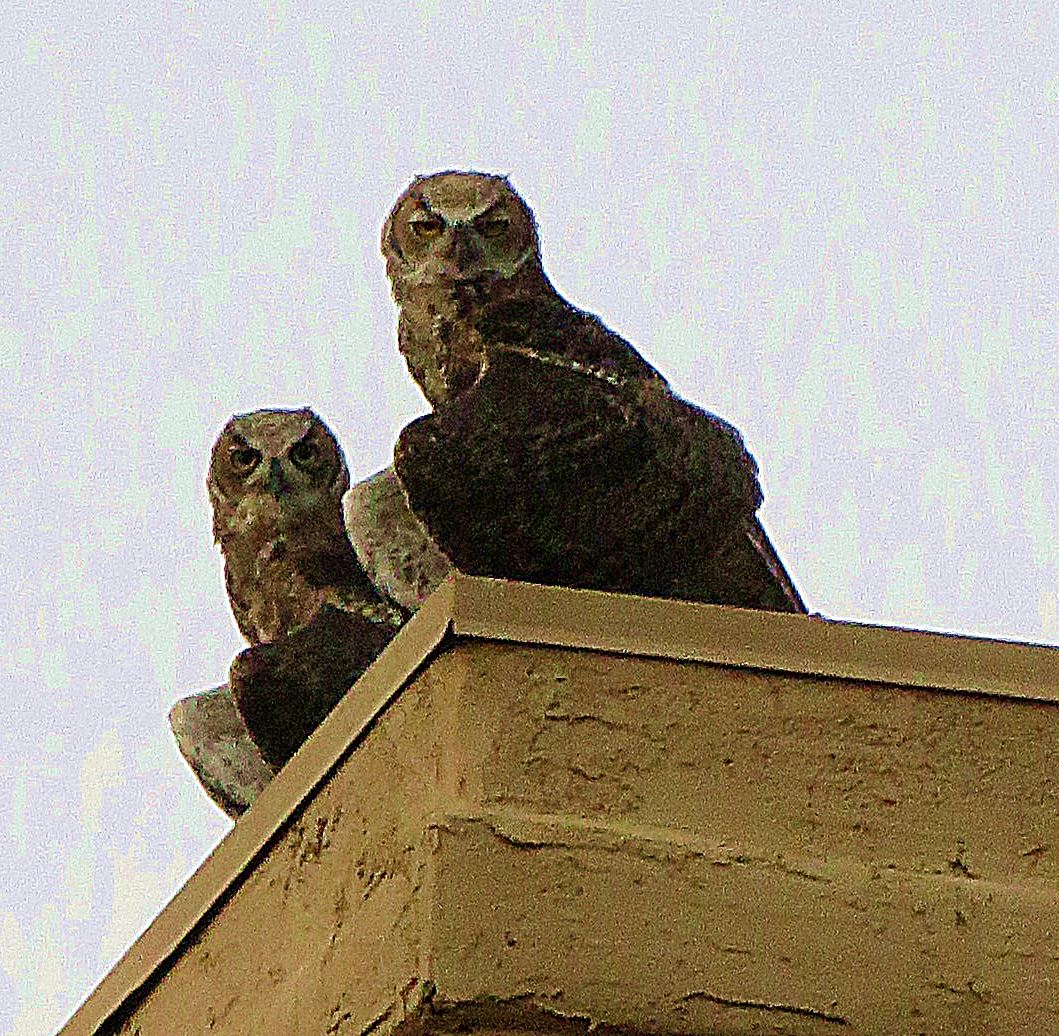
A pair of juvenile great horned owls from two years ago sitting n top of one of my apartment complex’s roof. — Photo by Pat Bean

Old friends pass away, new friends appear. It is just like the days. An old day passes, a new day arrives. The important thing is to make it meaningful: a meaningful friend – or a meaningful day.” — Dalai Lama

Great Horned Owls

It’s still dark when I walk Pepper at 6 a.m. this time of year. Sometimes I try to sleep in, but my beautiful canine companion will have none of that, and so it’s 6:15 when we take our walk – but it’s still dark then, too.

Great owned owl in all its glory. — Wikimedia photo

It’s quiet, too, Mostly. There’s the one guy who walks his cat on a leash the same time I walk Pepper, a couple of people leaving for work, and a clanging gate when one of them forgets to close the gate quietly when they exit.

But it’s silent and peaceful enough that I can enjoy the hoo-ing calls of our resident great horned owls. It’s an eerie sound coming from above, soft and full of nature’s wild things.  Here in the middle of Tucson, I often go to sleep with the yipping of coyotes, and then, more mornings than not, my first greeting of the day is that soft hoo, hoo, hoo from my owl friends.

On a morning like this, which is exactly how I welcomed this day, I can forget for a few minutes that all is not right with the world. And that’s a good thing, don’t you think?

            Bean Pat: A snowy owl https://tinyurl.com/y7pssdek Just another owl tidbit.

Pat Bean is a Lonely Planet Community Pathfinder. Her book, Travels with Maggie, is now up on Amazon at http://tinyurl.com/y8z7553y  You can contact her at patbean@msn.com
Blue Feet – Red Feet

“You do not have to be good. You do not have to walk on your knees for a hundred miles through the desert, repenting. You only have to let the soft animal of your body love what it loves. Tell me about despair, yours, and I will tell you mine. Meanwhile the world goes on. Meanwhile the sun and the clear pebbles of the rain are moving across the landscapes, over the prairies and the deep trees, the mountains and the rivers. Meanwhile the wild geese, high in the clean blue air, are heading home again. Whoever you are, no matter how lonely, the world offers itself to your imagination, calls to you like the wild geese, harsh and exciting – over and over announcing your place in the family of things.” – Mary Oliver

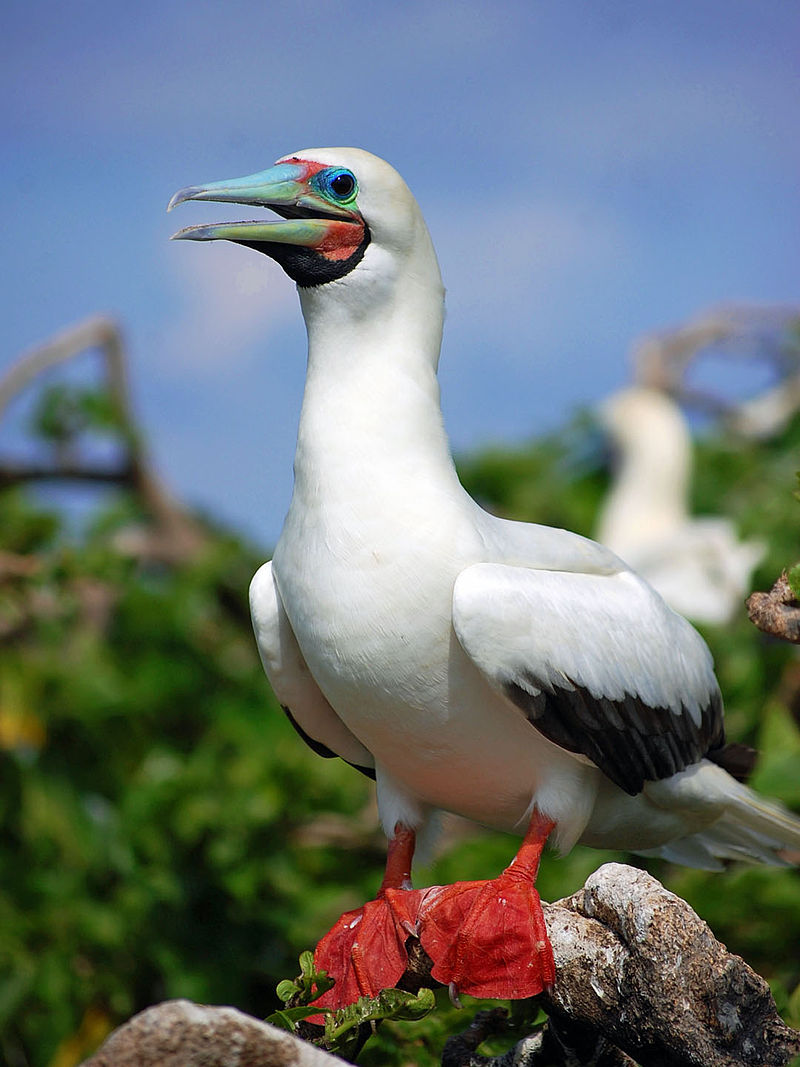
Red-foted booby — Wikimedia photo

And Yellow Feet, Too

            Nothing makes me feel more content than being out in nature. I want to be able to put a name to every wildflower, every tree, every bug, every rock formation and since living in the desert, every cactus that sits along the paths I walk or drive. Did you know there are over 1,500 species of cacti? Finally, I settled on learning to identify and name birds. North America only has about a 1,000 of them. Of course, that’s only about a tenth of the species world-wide.

A dancing blue-footed booby. — Wikimedia photo

I’ve managed, since 1999, which includes nine years of full-time travel across this country, to see a bit over half of them. And a bit of travel to distant lands has added about 200 more to my life list of birds.

The boobies, which are among the latter, are some of my favorite birds. And seeing them for the first time was magical.

The red-footed beauties came first. There were hundreds of them, and I gasped in delight as I watched them, from a walkway above a sheer cliff, circling in flight as they headed out to fish in the Pacific Ocean.

I was at a bird sanctuary on Rota Island, just 35 miles north of Guam, where I was visiting my daughter, Trish. She had treated me to a flight to the island after I had been so disappointed about the lack of birds on Guam. The birds there had been decimated by the brown tree snake, a non-native invader. On Rota, where there were none of these nasty snakes, birds were everywhere.

From my high perch, and lower down on the cliff than the red-footed nests, I spied a few brown boobies, whose feet are yellow. It was a grand day to remember.

Just as grand was the day I danced with a blue-footed booby, my favorite of the three boobies.

I saw hundreds of these birds when I cruised the Galapagos Islands in a 16-passenger catamaran. We had along an official guide, which let us visit places where larger groups were not allowed. It was a birder’s paradise, as here the birds had never experienced human predation, and so weren’t afraid of us.

A hooded mockingbird landed on my shoe one day.  And on another I was kissed by a baby seal as I stepped off a small raft and onto the island, The touch made me feel special, unlike the next lady onto the island. That same small seal decided to see if she tasted good.

The rule for us humans was we couldn’t touch the animals, but there was no rule about them touching us.

My dance with the blue-footed booby happened when I came across the large bird blocking my way along a narrow path. He lifted one-foot and then the other to show off his blue feet, which how the male boobies court females. I lifted one foot and then the other in response. We both repeated the motion several times until our guide came around the corner. Stop teasing the booby,” he said.

I skirted around the bird, and when I looked back he lifted one foot , and then the other and our eyes locked. I imagined that he was saying, “Thanks for the Dance.

Bean Pat: A Woman of Worth  https://tinyurl.com/y825f58s   Telling HerStories: The Broad View is sponsored by Story Circle Network, which is an organization that supports female writers. I’m a member and it is the best support I’ve ever had as a writer.

Pat Bean is a Lonely Planet Community Pathfinder. Her book, Travels with Maggie, is now up on Amazon at http://tinyurl.com/y8z7553y  You can contact her at patbean@msn.com