Feeds:
Posts
Comments


Leon Dormido, also know as Kicker Rock. — Wikimedia photo

The Galapagos Islands provide a window on time. In a geologic sense, they are young, yet they appear ancient.” – Frans Lanting

Pages From My Travel Journal

Shortly after boarding the Archipell II, a 16- passenger catamaran in which I would spend the next eight days sailing around the Galapagos Islands, we motored around Kicker Rock, which is actually two volcanic rocks split apart.

Pages from my journal.

The English name refers to the rocks’ resemblance to a boot when viewed from one angle. Our guide, Luiz, called it Lion Rock, or Leon Dormido in Spanish, however, because viewed from another angle, the 400-feet tall rock towers look like a sleeping lion.

We had set sail for our adventure from the harbor at Puerto Baquerizo Moreno on San Cristobal Island, where sea lions seemed to be everywhere. One group of sea lions had even commandeered a small boat tied to a larger boat, and one, a young juvenile lying near where our group boarded a panga for the ride out to the Archipell, sniffed my leg when I passed it.

Sea Lion in Puerto Baquerizo Moreno. — Wikimedia photo

It was a bit chilling, but I was thrilled to have such an experience. My friend, Shirley Lee, who was behind me, was less thrilled. The sea lion nipped her instead of just sniffing. While we had dutifully been instructed not to touch the animals, someone forgot to pass the message on to the islands’ wildlife, which had absolutely no fear of humans.

By the time we got to Kicker Rock, I had seen dozens of birds, many that would go onto my life list, such as great frigatebirds, a striated heron, blue-footed boobies, Nazca boobies, and several of what are known as the Darwin finches, a group of about 15 birds studied by Darwin because of diversity in beak form and function.

And this was only day one. What fun it is to relive this great adventure. I’ll write more about it next week.

Bean Pat: Spring Equinox https://marinakanavaki.com/2018/03/20/spring-equinox-2018/?wref=pil An artist’s rendition.

Pat Bean: is a Lonely Planet Community Pathfinder. Her book, Travels with Maggie, is now up on Amazon at http://tinyurl.com/y8z7553y  Currently, she is writing a book, tentatively titled Bird Droppings, which is about her late-bloomer birding adventures. You can contact her at patbean@msn.com

Art by Pat Bean

“Writing means sharing. It’s part of the human condition to want to share things – thoughts, ideas, opinions.” – Paulo Coelho

About My Foibles

            I have a tendency, when given advice, to immediately utter: “Nope, not for me.” It’s a phrase that usually annoys my friend Jean, who often sits with me on my balcony in the evening for a Happy Hour – and is always free with her advice and suggestions.

Jean, who calls me a stubborn old broad, is a year or so younger than my youngest daughter, and last night she said I was the teacher she needed to get through the daily chaos of being a teacher.

“The unteachable teacher mentoring a teacher,” I said, and laughed, a bit embarrassed a bit by her kind words. Then we both laughed.

“It’s good to be able to laugh at our foibles,” she said.

And it was.

The next morning, I wrote about the incident and the comradely laughter in my journal, which got me thinking about how long it took me to accept that I was not ever going to be perfect, and longer still to accept that not being perfect was not only acceptable, but preferable.

Daily writing in my journal helped me come to that conclusion. Writing, which I originally took up as a way to express myself, has also helped me discover myself, a treasure that is as golden as having a good friend who laughs at my foibles.

Bean Pat: Trent’s World https://trentsworldblog.wordpress.com/2018/03/17/if-we-were-having-coffee-on-the-17th-of-march-2018/?wref=pil Just an ordinary morning, like most of us have, written by a blogger I just started following.

Pat Bean: is a Lonely Planet Community Pathfinder. Her book, Travels with Maggie, is now up on Amazon at http://tinyurl.com/y8z7553y  Currently, she is writing a book, tentatively titled Bird Droppings, which is about her late-bloomer birding adventures. You can contact her at patbean@msn.com


Birds: Spotted Towhees

Female spotted towhee — Wikimedia photo

“The accent of one’s birthplace remains in the mind and in the heart as in one’s speech.” — Francois de La Rochefoucauld

A Southern Accent, Perhaps

            Towhee … towhee!

The sound was coming from a bird hidden in a tree about halfway up Negro Bill Canyon near Moab, Utah.

Male spotted towhee

Drink ur tea … drink your tea, a reply echoed from farther up the canyon.

The sounds stopped me in my tracks. I had no intention of hiking on until I had spotted the two birds with my binoculars. I was sure I would see two different species, based on the different bird sounds they were making.

Although tucked among some small branches, I easily spotted the first bird, a male spotted towhee that gets its name from its voice. With a black head and back, rusty sides, and black wings speckled with white spots, it was an easy identification, even without the binoculars. But this basic bird-watching tool let me get a closeup look at the towhee’s bird’s brilliant red eye. Such details always delight me.

After the second bird sang out drink ur tea … drink ur tea a second time, I found it sitting in another tree. Except that its head appeared to be more of a rich brown than black, the two birds were identical. According to my field guide, this was a female spotted towhee.

Towhees, I had read, learn their songs when young, and pick up different inflections, even copy the songs of other species if they hear them frequently.

Perhaps one of these birds had a southern accent, like this native Texan. It was a fanciful thought, but it might even have been true.

Bean Pat: Brevity: Stripper Girl  https://brevity.wordpress.com/2018/03/15/stripper-girl/  Always one of my favorite blogs, and this one is an example of how the world’s language  changes.

Pat Bean: is a Lonely Planet Community Pathfinder. Her book, Travels with Maggie, is now up on Amazon at http://tinyurl.com/y8z7553y  Currently, she is writing a book, tentatively titled Bird Droppings, which is about her late-bloomer birding adventures. You can contact her at patbean@msn.com

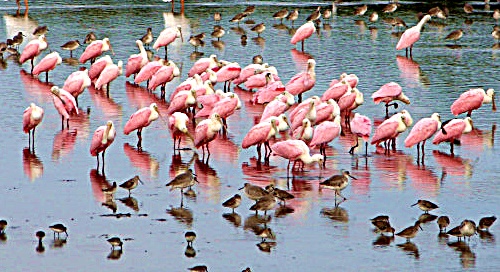
A flock of roseate spoonbills won the color award of the day when I visited Ding Darling National Wildlife Refuge. — Wikimedia photo

“I want my children and my grandchildren to live in a world with clean air, pure drinking water, and an abundance of wildlife, so I’ve chosen to dedicate my life to wildlife conservation so I can make the world just a little bit better.” – Bindi Irwin

Cormorants and turtles were also plentiful on the island sanctuary. — Photo by Pat Bean

Favorite Places: Ding Dong, I Thought

The name Ding Darling for a national wildlife refuge fascinated my wandering-wondering brain. So. of course I had to research its origin while visiting Florida’s Sanibel Island sanctuary in 2008.

D’ing Darling in 1918. — Wikimedia photo

The refuge, which is home to a mangrove forest, submerged sea-grass beds and a multitude of birds and other wildlife, was simply named after the island on which it is located when it was created in 1945. It wasn’t until 1987 that the refuge was renamed after Pulitzer Prize winning cartoonist Jay Norwood Darling, who used a contraction of his last name — D’ing — to sign his work. The name stuck.

D’ing, as everyone called him, got involved with the refuge when he worked to help keep developers from taking over some environmentally valuable land on Sanibel Island. He also penned conservation cartoons, initiated the Federal Duck Stamp, which supports wildlife habitation, and designed its first stamp. In addition, he was instrumental in founding the National Wildlife Federation in 1936. Lake Darling, a 9,600-acre lake in the Upper Souris National Wildlife Refuge in Iowa is also named in his in honor.

All of which makes me a bit embarrassed that my first thought of the refuge was that it must be a “ding dong” place to visit.

The first Duck Stamp, designed by D’ing Darling.

One had to take a ferry to get to the refuge before a causeway was built to the island in 1963. But that old bridge was replaced in 2007, just a year before I visited, with a flyover span tall enough for sailboats to pass beneath. The scenic view from the top was awesome.

I remember the refuge as a place where I got two birds for my life list, a prairie warbler, and a Bahama mockingbird, which at first, I thought, was simply a familiar northern mockingbird. I could have seen the warbler is many other places in the southeastern United States, but the Bahama mockingbird is a rare vagrant that only occasionally can be seen is southern Florida.

But it was the roseate spoonbill flock that impressed me most. I’m a fan of color.

Bean Pat: Daily Echo https://scvincent.com/2018/03/13/wishes-flashfiction/?wref=pil Flash fiction in 99 words.

Pat Bean: is a Lonely Planet Community Pathfinder. Her book, Travels with Maggie, is now up on Amazon at http://tinyurl.com/y8z7553y  Currently, she is writing a book, tentatively titled Bird Droppings, which is about her late-bloomer birding adventures. You can contact her at patbean@msn.com

“In my later years, I have looked in the mirror each day and found a happy person staring back. Occasionally I wonder why I can be so happy. The answer is that every day of my life I’ve worked only for myself and for the joy that comes from writing and creating. The image in my mirror is not optimistic, but the result of optimal behavior.” — Ray Bradbury

The Yellow Flower — Art by Pat Bean

A Little Yellow Flower

I was 25, with five children that ranged in age from a few months to nine years old. Yes, the math is correct. It was just a few days before I turned 17 when my first child was born. It was all legitimate, as I had dropped out of high school and gotten married when I was barely 16. This wasn’t a rare occurrence back in the 1950s.

My life up to this point was one of changing diapers, cleaning house, cooking meals, catering to a demanding husband and going to church. I wasn’t exactly unhappy — that wasn’t in my nature and still isn’t – but I did do a lot of crying and a lot of escaping from daily life in my mind.

That all changed on a day that was a mother’s nightmare. My oldest son had taught his younger brothers how to climb the backyard fence. One of his younger brothers had gotten into the sugar bowl and traipsed the sweet granules all over the house … and that was just the beginning of the children’s shenanigans.

I was close to despair when my middle son, Lewis, presented me with an almost stemless yellow flower, which he had picked from the neighbor’s flowerbed, and which I was sure to hear about. But the sweet smile on his face, and the love that shone in his eyes for me, his mother, made everything I had gone through that day pale in comparison.

I had wanted each of my children, and I loved each of them, even if sometimes they were almost too much for me to handle.  At that day’s end, when all five of the rascally darlings were finally down for the night, I fell into my bed and was asleep almost before my head hit the pillow.

But at 2 a.m., I was wide awake and couldn’t go back to sleep. I was impelled to get up, find some paper and a pen. I needed to capture that moment in which I had been presented that yellow flower. I wrote a crude poem about the incident before I was able to go back to bed and fall asleep.

That poem was the first thing I had ever written, except for a school assignment or letters. It changed my entire life. I suddenly knew my future was to be a writer. And I made it happen, beginning with a 37-year newspaper journalism career in which I wrote almost every day.  I’ve been writing, in one form or another, now for over half a century. I suspect the day I stop writing will be the day I die, because not writing is like not breathing to my soul.

Bean Pat: Barbets https://adityasbirdingblog.com/2018/03/01/the-colorful-world-of-barbets-4-blue-throated-barbet-great-barbet/?wref=pil This one’s for the bird lovers.

Pat Bean: is a Lonely Planet Community Pathfinder. Her book, Travels with Maggie, is now up on Amazon at http://tinyurl.com/y8z7553y  Currently, she is writing a book, tentatively titled Bird Droppings, which is about her late-bloomer birding adventures. You can contact her at patbean@msn.com

Brown Creeper

“Searching is half the fun: life is much more manageable when thought of as a scavenger hunt as opposed to a surprise party.” — Jimmy Buffett

The Nemesis Bird

Brown creeper — Wikimedia photo

Two blocks from my oldest daughter’s home, in a crowded residential neighborhood near Dallas, I finally saw a brown creeper, a bird that can be seen in all 49 North American states and Canada. But it had eluded me for five years of seriously looking for it in all the right habitats.

There were even several times during those five years when I was with other birders who would call out: “Brown creeper, here!” But the darn little creeper was always gone before I got a look.  It had become my nemesis bird.

The one I finally saw on a winter day in 2005, however, made up for all my efforts to see it. Here’s how I described the event in my journal.

Dainty and delicately patterned to match the bark of the tree, the creeper was spiraling upward around the trunk of an old oak … Two more times, this little tree climber circled the trunk, always in an upward motion. … it then flew to the bottom of a second tree about four feet away, and began spiraling upward once again, its actions perfectly matching a description of its behavior in my field guide.

The creeper was using its thin, down-curved bill to dig out tiny insects in the trunk’s crevices. So well camouflaged was the bird that my eyes were sometimes fooled into thinking I was simply looking at tree bark. But when I did see the creeper, I was amazed at the crisp look of the bird’s brown and white feathers, which seemed to sparkle when the sun briefly flashed on them.”

I’m glad I took time to write down my observations, because the brown creeper I saw that day is still the only one I have ever seen.

I guess you could still call it my nemesis bird.

Bean Pat: Blogging at the Holler’s for the birds. https://cindyknoke.com/2018/03/07/blogging-at-the-hollers-for-the-birds/?wref=pil

Pat Bean is a Lonely Planet Community Pathfinder. Her book, Travels with Maggie, is now up on Amazon at http://tinyurl.com/y8z7553y  Currently, she is writing a book, tentatively titled Bird Droppings, which is about her late-bloomer birding adventures. You can contact her at patbean@msn.com


The Corkscrew Boardwalk … Wikimedia photo

Lie on the bridge and watch the water flowing past. Or run, or wade through the swamp in your red boots. Or roll yourself up and listen to the rain falling on the roof. It’s very easy to enjoy yourself.” — Tove Jansson

Home of Wood Storks, Air Flowers and Cypress Trees

In 2008, I spent a month on Pine Island just across the water from Cape Coral, Florida. The location allowed me to explore the west side of the Everglades at my leisure. One place I visited twice was Corkscrew Swamp Sanctuary, home to the largest old growth bald cypress forest in North America and a favorite habitat of endangered wood storks. .

The Ghost Orchid

Both times I took over five hours to hike the 2.25-mile loop boardwalk that meandered through the sanctuary’s awesome and varied landscape. It seemed as if Mother Nature had a different spectacle for me to watch and observe every 100 feet or so.

While my goal for visiting was to bird watch, that often took a back seat to my gawking at the cypress trees that stood tall and wide. with moss-draped limbs and sometimes unrelated flowers that grew among the branches. I even got a glimpse – thanks to my birding binoculars – of the swamp’s famous ghost orchid, discovered just a year before I visited.

I was told where to look for it at the visitor center or I would have just thought it was one of the bromeliads that had attached their roots to tall branches in

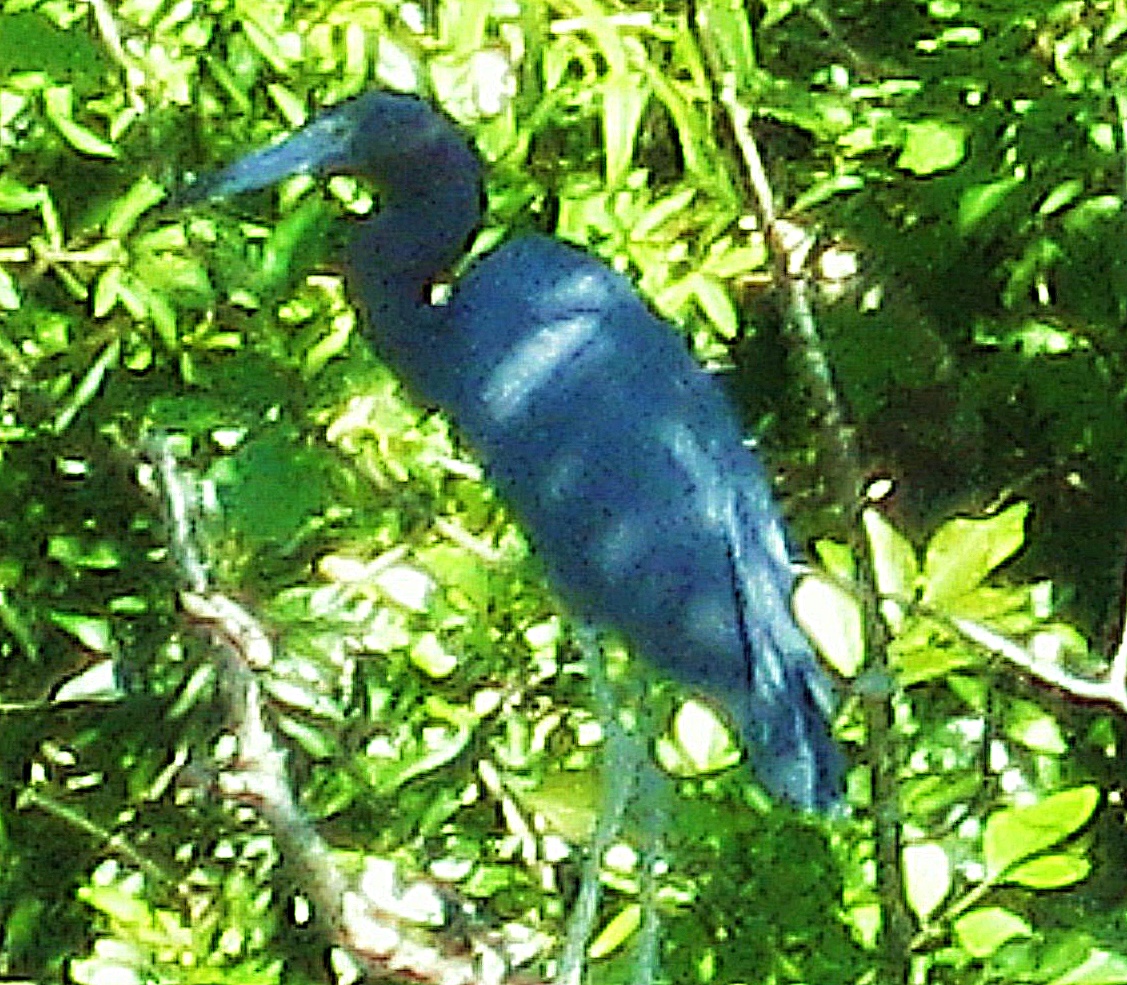
Little blue heron up a tree. — Photo by Pat Bean

the trees. These plants, which seemed to grow on nothing but air, fascinated me. But then so did the swamp’s birds, marsh prairies, otters (I saw two) and all the other wonders of a place that miraculously was saved when Florida’s cypress forests were being leveled for timber in the mid-1900s.

The National Audubon Society, recognizing the swamp’s value, worked to save the land and its inhabitants for future generations to enjoy.  Today, Corkscrew Sanctuary, is both a designated Wetland of International Importance and an Important Bird Area. I hope it will still be there when my grandchildren’s children, and their children, want to visit, like my six-year-old great-grandson Kaiden, whose mother and my granddaughter Keri spent a week touring the Everglades with me in 2008.

Bean Pat:  In the Forest https://forestgardenblog.wordpress.com/2018/03/06/blossom-xxxv-in-the-forest/ A perfect blog to accompany mine. They’re both about the beauty of a place.

Pat Bean is a Lonely Planet Community Pathfinder. Her book, Travels with Maggie, is now up on Amazon at http://tinyurl.com/y8z7553y  Currently, she is writing a book, tentatively titled Bird Droppings, which is about her late-bloomer birding adventures. You can contact her at patbean@msn.com

Birds at Lake Patagonia

The sun’s rays made this coot’s black back look almost white, and its red eyes gleam, while the lake’s ripples take on the ambiance of a fine art painting. — Photo by Pat Bean

“Even the woodpecker owes his success to the fact that it uses its head and keeps pecking away until it finishes the job it starts.” – Coleman Cox

A Chilly, Windy February Day

It was cold and a bit on the breezy side last week at Lake Patagonia State Park, but the birds didn’t seem to mind. While my friend Jean walked our dogs, I watched birds at the feeders and on the lake.

A northern cardinal playing peek-a-boo among the tree branches. — Photo by Pat Bean

The first bird I saw, well after all the great-tail grackles flying around, was a gila woodpecker. It attracted my attention because it was hanging upside down from a nectar feeder. The acrobatic maneuver was the only way it could feed. I’ve watched other gila woodpeckers do exactly the same thing on my balcony hummingbird feeder.

The one I saw this day was a male, its gender easily identified by the red feathers it wore on its crown. The female is identical to the male except for that patch of red. The gila is a common bird in Southern Arizona, less common in California, New Mexico and Texas, and rare anywhere else above our border with Mexico.

A gila woodpecker at my balcony feeder. — Photo by Pat Bean

Other birds I watched this day included coots paddling around on the lake, (you can see them everywhere), and a violet-green swallow joyfully darting back and forth across the lake. Near the feeders, I spied a couple of northern cardinals in the still, winter-leafless branches, a small flock of American goldfinch at the feeders, dozens of white-crowned sparrows feeding on the ground beneath the feeders, along with a few male and female red-winged blackbirds. I also spotted two yellow-rumped warblers, both of which flashed their butter butts at me, and one black phoebe and one house finch.

I’m eager to visit again next month when spring has made its greening appearance, and the birds should be more plentiful.

            Bean Pat: Daily Stuff https://onewomansday.wordpress.com/2018/02/27/february-27-daily-stuff/?wref=pil From Story Circle’s One Woman’s Day

Pat Bean is a Lonely Planet Community Pathfinder. Her book, Travels with Maggie, is now up on Amazon at http://tinyurl.com/y8z7553y  Currently, she is writing a book, tentatively titled Bird Droppings, which is about her late-bloomer birding adventures. You can contact her at patbean@msn.com

The river is constantly turning and bending and you never know where it’s going to go and where you’ll wind up. Following the bend in the river and staying on your own path means that you are on the right track. Don’t let anyone deter you from that.” — Eartha Kitt

The entrance to South Llano River State Park. — Photo by Pat Bean


Turkeys, Wildflowers and Dark Skies

A pair of Rio Grande wild turkeys.

It was one of those days when my canine companion Maggie and I took off down the road in our small RV with no destination in mind. We were simply exploring Texas’ Hill Country. I was confident that I would come across the perfect place for us to camp before night overtook us.

As I recall, it was well before noon when I came upon South Llano River State Park, and on seeing the abundance of lavender wildflowers dominating the lawn in front of the small building near the entrance, I figured we had found the place. I brake for wildflowers the same as I do for birds.

The South Llano River, a spring-fed tributary of the 105-mile Llano River that flows through Texas’ Hill Country.

And on checking into the park, I learned that here there were both. The park’s 500 plus acres of Hill Country river bottomlands, are home to the Rio Grande turkey, as well as habitat for wood ducks, white-tailed deer, squirrels, jackrabbits, javelinas, foxes, beavers, bobcats, cottontails and armadillos. It would be nice to see an armadillo walking around, I thought, recalling the roadkill one I had passed earlier in the day.

The park also had 18 miles of hiking trails, a few miles of which I explored, and modern campsites with electricity and water to feed my RV. I stayed for several nights, one of which I stayed up late watching a sky full of twinkling stars, a bonus of the park being a designated Dark Sky site.

Wildflowers, birds and stars – life doesn’t get much better for this fan of Mother Nature.

Bean Pat: You Gotta Live:  https://theenchantedoutlook.com/2018/02/20/you-gotta-live/ T0 this great post, I add my own mantra. Live so that when you die, you’ll know the difference.

Pat Bean is a Lonely Planet Community Pathfinder. Her book, Travels with Maggie, is now up on Amazon at http://tinyurl.com/y8z7553y  Currently, she is writing a book that she is tentatively calling Bird Droppings. It is about her late-bloomer birding adventures. You can contact her at patbean@msn.com
Birds: California Condor

“I think we consider too much of the early bird, and not enough of the bad luck of the early worm.” – Franklin D. Roosevelt.

I hope you already have had breakfast when you view this photo of the first California condor born in captivity. — From my 1983 scrapbook memories.

A Historic First

I was regional editor at the Time-News in Twin Falls, Idaho, in 1983, when the first California condor was hatched in captivity from an egg taken from the wild. It was a Saturday night, and the Associated Press sent out a news release of the birth, along with color separations for a photo that could be used with the story. This was before digital capabilities and when color in a newspaper, except for the comics, was not an everyday occurrence.

A bit less bloody photo of a young California condor and a parent. — Wikimedia photo

I was in charge of putting out the Sunday front page, and since it was a slow news night, I decided to use the condor wire piece as the lead story above the fold. It wasn’t hard to convince myself of the story’s significance, as it included the information that there were then less than 30 of the birds known to exist in the world.

California condors are North America’s largest bird, having a wing span of almost five feet, and weighing up to 25 pounds. The near extinction of these birds in the 20th century was caused by hunting, lead poisoning, loss of habitat, and the prolific use of DDT before it was banned.  The pesticide caused the condor’s eggs to have soft shells, which then didn’t survive to hatching.

And this is what they grow up to look like. — Wikimedia photo

Anyway, I assigned the story to the front page, wrote a headline, and informed the press room that I wanted the condor chick photo to be in color, a task they weren’t too happy to fulfill. I knew getting the color separations coordinated exactly right was tricky, but I had fallen in love with that tiny ball of ugly fluff that was the newborn condor. He was so ugly he was beautiful – at least in my mind.

I should have listened to the pressmen.

The image that greeted Sunday morning Times-News readers was anything but pretty. The color plates had dumped out an image that looked like it had been soaked in witch’s blood. Even I was appalled. And readers sent a barrage of letters to the paper complaining that the photo had spoiled their Sunday morning breakfasts.

I had barely stepped inside the newsroom on Monday morning when I was told to report to the managing editor’s office, where I found a displeased boss. I defended my choice of story as being historic – and my use of the color photo as a bad mistake.

Thankfully I kept my job. But it was too late to stop the damage to my soul – I had fallen in love with the carrion scavenging condors, and their good-news, survival story, which I have been following ever since. We humans, who almost destroyed the condors, helped made it up to these birds.

As of 2012, there were 405 known condors; in 1987, there were only 27.  Today, more than 200 of these condors are once again flying free, mostly over Arizona, Utah, California and Mexico.

I was privileged to see two of them flying wild and free near the east entrance to Zion National Park in the 1990s.

Bean Pat: The way forward https://thewhyaboutthis.com/2018/02/18/the-way-forward/#like-26548 Yes, yes and yes!

Pat Bean is a Lonely Planet Community Pathfinder. Her book, Travels with Maggie, is now up on Amazon at http://tinyurl.com/y8z7553y  Currently, she is writing a book, tentatively titled Bird Droppings, which is about her late-bloomer birding adventures. You can contact her at patbean@msn.com