Feeds:
Posts
Comments

“Family means putting your arms around each other and being there.” — Barbara Bush

Nana, posing for a picture with Savannah and Charlotte. Life was good.

Making Connections

After too brief a visit with family in San Antonio, and a promise to stop again on my way out of Texas, I hit the road for Texas’s Gulf Coast south of Houston. It was an easy, and familiar, 210-mile drive: Interstate 10 to Highway 36 to West Columbia, the home of my son D.C., his wife Cindi, who acts as my guardian angel when I am on the road, and their autistic daughter, Susan, who holds a special place in my heart.

One of my favorite things when I visit the Texas Gulf Coast are the moss-laden trees. I lived down there during Hurricane Carla in the 1960s, and one of the sad results that all the moss was blown away. — Photo by Pat Bean

Nearby lives his son, David, and the second of my three sons, Lewis, and their children (my grandchildren and great-grandchildren). Making and keeping connections with all these family members is important to me, especially since I usually only get to see them once a year.

The connections come easier with the adults, especially since I’ve found things to share with them – from watching Survivor with D.C (we’re both addicted to this TV reality show) to playing Settlers of Cataan with Cindi, to birding with Lewis.

But I hadn’t yet truly bonded with my two great-granddaughters, four-year-old Savannah and two-year-old Charlotte. Charlotte wasn’t even a year old when I had seen her last, and Savannah was shy with strangers, a good thing in my mind, and I let her maintain her comfortable distance.

This visit, however, Charlotte broke the ice. She climbed up on the couch beside me and we played “This Little Piggy …” She laughed and giggled and was free with her hugs, and since Savannah didn’t want to be left out, I got hugs from her too.

Life is good.

Bean Pat: A relaxing drive through the country  https://travelsandtrifles.wordpress.com/2018/07/22/lens-artists-photo-challenge-time-to-relax/ A peaceful kind of road trip.

Pat Bean is a Lonely Planet Community Pathfinder. Her book, Travels with Maggie, is now up on Amazon at http://tinyurl.com/y8z7553y  Currently, she is writing a book, tentatively titled Bird Droppings, which is about her late-bloomer birding adventures. You can contact her at patbean@msn.com

“The reward for having children is grandchildren.” – Pat Bean

Me and Junior, taken nine years ago. — Photo by Barry Marsh


Grands and Greats

After the blowout day, the next day’s 430-mile drive into San Antonio was a breeze. I was passing through familiar territory, and so out came my audible book, Fallout by Sara Paretsky. But I didn’t listen much as I was still too excited about the road trip and the scenery to concentrate for long periods.

A recent picture of three-year-old Marshall with his dad. — Photo by Heidi Pease

I have two granddaughters in San Antonio: Heidi, who is the mother of my three-year-old great-grandson Marshall, and who was nine months pregnant with my great-granddaughter Cora; and her younger sister, Lindsey, who is mother of nine-year-old Junior, my oldest great-grandchild.

I arrived on July 6, and Junior’s birthday was July 5. He had chosen to wait to share his birthday dinner with me, which of course made me feel good. It turned out to be a delightful event with both sisters’ family in attendance, as well as one of Junior’s closest friends.

My daughter in Tucson had sent a bike and other presents with me for Junior, but I simply gave him books, which is what I almost always give my children, grandchildren, and great-grandchildren.

Marshall, who had recently turned three, got a book, too. And for a special treat the next day, I got to go to Marshall’s swimming lesson.

And of Marshall waiting to become a big brother. Heidi was due any moment but didn’t pop while I was there.

While I enjoyed every minute of the two days, I had with this portion of my large scattered family, I came away with a favorite memory.

Nine-year-old Junior wanted to play Nerf guns with me, and I didn’t want to play. And after I had told him that for the fourth time, he walked over to a chair, and plonked down with a big sigh.

“I guess I’m not your favorite Nana anymore,” I said.

Junior, who had given me my name of Nana Bean almost as soon as he could talk, got quite indignant. Looking squarely at me, he said, “You will always be my favorite Nana Bean.”

I just about cried. He got a big hug for that. But I still didn’t play Nerf guns with him.

            Bean Pat:  Procrastination https://ryanlanz.com/2018/07/29/12-ways-to-manage-your-procrastination-problem-because-yes-you-definitely-have-one/    A good reminder to this procrastinator.

Pat Bean is a Lonely Planet Community Pathfinder. Her book, Travels with Maggie, is now up on Amazon at http://tinyurl.com/y8z7553y  Currently, she is writing a book, tentatively titled Bird Droppings, which is about her late-bloomer birding adventures. You can contact her at patbean@msn.com

“The greatest reward and luxury of travel is to be able to experience everyday things as if for the first time, to be in a position in which almost nothing is so familiar it is taken for granted.” — Bill Bryson

leaving at dawn

Nothing is better than setting out on a road trip at dawn. — Photo by Pat Bean

The Blow Out
When I posted my last blog, I said stay tuned for the details of my upcoming road trip to Texas. I had planned to post along the journey. But you know what they say about the best laid plans of mice and men.
I was distracted, too busy having too many wonderful moments, and too undisciplined to follow through. But I’m back now with lots to tell you over the next few posts. We’ll start with my first day on the road.

IMG_4129

Rocks became the dominant landscape as I pass through Texas Canyon about 65 miles east of Tucson. — Photo by Pat Bean

While I love back roads, the only way to Texas from Tucson, without adding too many extra miles and time is Interstate 10. But since it had been a while since I had been alone on a road trip, I enjoyed even the passing scenery of cacti and mesquite trees.
I didn’t listen to music or even an audible book this first day, simply happy to think of Willie Nelson singing “Back on the Road Again,” and hearing Dr. Seuss say “Oh the things you will see…”, and stopping every 75 miles, to walk around a bit to untangle the kinks of sitting. The pattern worked as I stayed comfortable, well almost, the entire drive.
My destination was Van Horn, Texas, which was 438 miles from Tucson and the halfway point of my first stop in San Antonio. Since I had left early in the morning, I expected to arrive at my two-star –that’s all there is in Van Horn — hotel around 4 p.m., or 2 p.m. Tucson time, which would give me plenty of time to rest up and have a leisurely dinner.
All was going well until I was 10 miles east of Las Cruces and my left, rear tire blew out. I was going 70 mph but was easily able to get to the side of the busy highway, where I sat for a moment or two thinking “What in the hell do I do now?” Then my brain kicked in, and I called my insurance company, which gave me the number for roadside assistance, for which I generously pay them.
I got a quick response, but even quicker were a New Mexico Highway Patrol woman, a county sheriff’s deputy, and a Border Patrol guy, who all pulled up in separate cars around me. I told them I had roadside assistance, but they said they wanted to get me quickly back on the road.
Since the semis roaring past shook my car every time they went by, their kindness was greatly appreciated. They pulled off my shredded tire, put on the spare donut, then gave me directions to the nearest Discount Tire back in Las Cruces.
I called to cancel the roadside assistance, but 10 minutes later, as I was renearing Las Cruces, I got a call from the roadside assistance guy saying he couldn’t find my car. I apologized, and said I had left the scene of the incident.
It took a bit of time to get a new tire put on, but finally, my pockets $155 lighter, I was back on the road. I made it to Van Horn by 8 p.m. and had a fast food burger for dinner. Even so, it had been a wonderful day.
Bean Pat: In Diane’s Kitchen https://indianeskitchen.com/2018/07/27/old-fashion-blueberry-grunt/#like-26686 I’m getting ready to go to the store and I am going to buy blueberries.
Pat Bean is a Lonely Planet Community Pathfinder. Her book, Travels with Maggie, is now up on Amazon at http://tinyurl.com/y8z7553y Currently, she is writing a book, tentatively titled Bird Droppings, which is about her late-bloomer birding adventures. You can contact her at patbean@msn.com

Life is Good

Mountains are always calling to me. — Art by Pat Bean

The greatest reward and luxury of travel is to be able to experience everyday things as if for the first time, to be in a position in which almost nothing is so familiar it is taken for granted.” — Bill Bryson

Road Trip Ahead

One of the best parts of my days is sitting on my third-floor balcony with my morning cream-laced coffee and my thoughts. Often, they turn to gratefulness for the good life I have. Thus, it was this morning.

While I have to count the pennies carefully these days, at the still young (or so I would like to believe) age of 79, I have a nice place to live, children and grandchildren who love me, plenty of books to read, good friends, a dependable car, great horned owls in the giant ponderosa tree in view of my balcony, I’m not yet addle-brained (at least I think I’m not), a loving canine companion – and I’m beginning a road trip Thursday.

May I never take any of these fine things for granted.

Meanwhile, my plan is to tell you all about my road trip to visit family and attend a writer’s conference in Texas as it happens. Stay tuned.

Bean Pat: Frog Diva Thoughts https://frogdivathoughts.com/2018/07/04/scaffolding/#like-8189  Most, if not all of us, have survived some hard times in our life. This heartfelt blog reminded me of that, and made me even more grateful for the life I live now.

           Pat Bean is a Lonely Planet Community Pathfinder. Her book, Travels with Maggie, is now up on Amazon at http://tinyurl.com/y8z7553y  Currently, she is writing a book, tentatively titled Bird Droppings, which is about her late-bloomer birding adventures. You can contact her patbean@msn.com

In a region of Texas some call the last great habitat, thorn forest intermingles with freshwater wetlands, coastal prairies, mudflats and beaches. Dense patches of thorny brush rise among unique wind-blown clay dunes called lomas.”  — US Fish and Wildlife Service

Laguna Atascosa National Wildlife Refuge — US Fish and Wildlife photo

Birds Galore

            It was a warm November day in 2005 when I visited South Texas’ Laguna Atascosta National Wildlife Refuge, whose name loosely translates to boggy lake. My own description of the refuge, recorded in my journal, coincides somewhat with the official version. I wrote: “Laguna Atascosta is one big briar patch – a haven of thorns. It seemed as if every plant was armed.  Scattered purple and orange wildflowers sat among sage, yucca, and palm trees with shaggy trunks.”

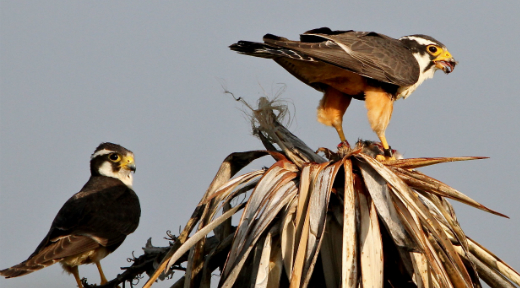
A pair of aplomado falcons. — US Fish and Wildlife photo

Along with my descriptions of the landscape was a list of the birds I was seeing: osprey, white-fronted goose, great egret, great blue heron, white-tailed kite, long-billed curlew, loggerhead shrike, kestrel, sandhill crane, white-tailed hawk, Cooper’s hawk, white pelican, Harris hawk, red-shouldered hawk – just to name a few. Half of the birds found in North America rest, feed, migrate through or nest on this landscape, the leader of our small birding group told us as we watched lesser and greater yellowlegs feeding in some shallow water.

It was easy to tell which was which of the two, not an easy task when looking at only one of the species, I thought, as I added dunlin, marbled godwit, black-bellied plover, northern harrier, gull-billed tern, black-necked stilt and willet to my bird list, which kept getting longer – and kept looking for the No. 1 bird on my priority list.

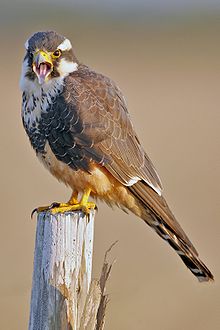
But as the day wore on, I became more and more doubtful I would see an aplomado falcon, a globally abundant species but rare in North America. Once widespread throughout the American Southwest, only two remaining pairs of aplomado falcons were known to exist in the states in the 1940s and ‘50s, most likely because of over harvesting of eggs, according to US Fish and Wildlife.

Aplomado falcon. — Wikimedia photo

Today, the aplomado falcon has made a comeback in South Texas due to an aggressive recovery program involving captive breeding and re-introduction efforts. As of 2004, more than 900 falcons had been released in the Rio Grande Valley, with 25 nesting pairs documented in 2006.

Finally, thankfully, I got to see one of those pairs. Our group finally identified one sitting regally on a yucca. The aplomado falcon was a good distance away, but my long-lens telescope brought it up close for a detailed view. As I watched the falcon, which was a new life bird for me, I noted a second one sitting a bit lower on the plant. What a delightful day for us birders.

But it wasn’t over. Before we headed back to our Harlingen Hotel, which was the base for those attending the Rio Grande Valley Birding Festival, I added lesser scaup, crested caracara, belted kingfisher and a dozen or so more birds to my day’s list.

Laguna Atascosa may mostly be a briar patch, but I feel like Br’er Rabbit, who despite his words, would have been quite happy to be tossed back into that thorny thicket.

Bean Pat: Bay of Fundy https://portraitsofwildflowers.wordpress.com/2018/07/02/the-bay-of-fundy/#like-38633 One of my favorite blogs because I usually learn something new, especially how to identify wildflowers.

Pat Bean is a Lonely Planet Community Pathfinder. Her book, Travels with Maggie, is now up on Amazon at http://tinyurl.com/y8z7553y  Currently, she is writing a book, tentatively titled Bird Droppings, which is about her late-bloomer birding adventures. You can contact her patbean@msn.com

Birds: Hermit Thrush

Hermit thrush — Wikimedia photo

            “That’s the wise thrush; he sings each song twice over, lest you should think he never could recapture the first fine careless rapture!” – Robert Browning

Fodder for Writers

Walt Whitman, like Browning, memorialized the thrush in verse. He used the song of the hermit thrush to describe his lament over the death of Abraham Lincoln.

Whitman had asked nature writer John Burroughs what bird’s voice had a heartbreaking purity that could be used as a motif for his poem, and Burroughs had suggested the hermit thrush. In his own writings, Burroughs wrote that the song of the hermit thrush brought him “that serene exaltation of sentiment of which music, literature and religion are but the faint types of symbols.”

And Anthony Trollope wrote: “I do not know whether there be, as a rule, more vocal expression of the sentiment of love between a man and a woman, than there is between two thrushes. They whistle and call to each other, guided by instinct rather than by reason.”

I didn’t get a photo of the owls this morning, but I did get one of a gila woodpecker in a wild piece of desert landscape near my Tucson apartment. — Photo by Pat Bean

The great American birder, Roger Tory Peterson wrote about hearing the hermit thrush’s haunting melody near Monterey, California, during his trek across American with the great English birder James Fisher in the 1950s, in their book, Wild America.

I saw my first hermit thrush on a cold winter day in 2004, at a small city park near Brigham City in Northern Utah. I had been scrunching through crispy, crackling snow that was laced with ring-necked pheasant tracks when I heard someone say: “Hermit thrush.” I quickly veered in their direction, but by the time I got there, the small brown bird had disappeared into some thick bushes.

Before I could moan in despair, however, the thrush hopped out of the bushes and back into plain sight – and stayed long enough for me to note that its tail and rump looked like it had been dusted with rust, and to observe its slender white eye ring and sprinkling of freckles on its breast.   Life was good – still is. I’ve seen our resident great horned owl pair every day this week.

Bean Pat: Hide and Seek with Butterflies https://forestgardenblog.wordpress.com/2018/06/29/fabulous-friday-hide-and-seek-with-the-butterflies/  A delightful armchair walk in nature.

Pat Bean is a Lonely Planet Community Pathfinder. Her book, Travels with Maggie, is now up on Amazon at http://tinyurl.com/y8z7553y  Currently, she is writing a book, tentatively titled Bird Droppings, which is about her late-bloomer birding adventures. You can contact her patbean@msn.com

From the time the sun came up in the morning until it set in the evening,, my thoughts were never far from thinking about potential newspaper stories. I often dreamed about being a reporter at night. — still do. — Photo by Pat Bean

“The best and most beautiful things in the world cannot be seen or even touched – they must be felt with the heart.” — Helen Keller

Memories of a Journalist

In 2001, when I was city editor at the Standard-Examiner, then a 65,000-circulation daily newspaper, I began a weekly column called Heart Beat. This morning I came across a copy of the first piece I wrote for it.

Because I am proud of my journalism career, a field whose reputation is being seriously pummeled – both justified and unjustified – these days, reading it brought tears to my eyes. I thought it was worth sharing.

********

            Editor shares heart beat with Top of Utah Community

I was city editor when the Standard-Examiner moved into its new home in Ogden, Utah. The newspaper crew occupied the entire building. Today the staff  barely occupies one large room. Since I retired in 2004, I’ve watched reporters and others go out the door one by one as the paper began dying, as are newspapers all over the country. Two of the newspapers I once worked for no longer exist. — Photo by Pat Bean.

“In 34 years as a working journalist, I have interviewed three presidents and covered a huge Texas chemical explosion in which I came across scattered body parts.

I have waded through floods, chased fire trucks, and even tried to catch up to a raging tornado.

I have petted pythons, ridden a horse down Ogden Canyon and held on tightly as one wild horse called Rainy carried me on the last cattle drive through Hagerman, Idaho – all for the sake of a story.

Rainy was supposed to be this very gentle horse ridden by very young children. Only later did I learn that this big and beautiful black stallion had thrown almost every cowboy who sat him. The joke was on the reporter.

“Once I was almost chomped by an alligator that had wandered into a residential backyard. I had been photographing the wayward reptile, using a long-range lens, when I suddenly couldn’t get the camera in focus. I looked up in time to see the alligator, a hungry grin on its face, dashing toward me.

But I’d face that alligator again rather than listen once more as a heartbroken mom reads me the last letter from her son, who had just been killed in Vietnam.

Or to once again type notes through tears as a daughter begs me to write something good about her mother, who had been killed in a car accident on her way to teach Vacation Bible School.

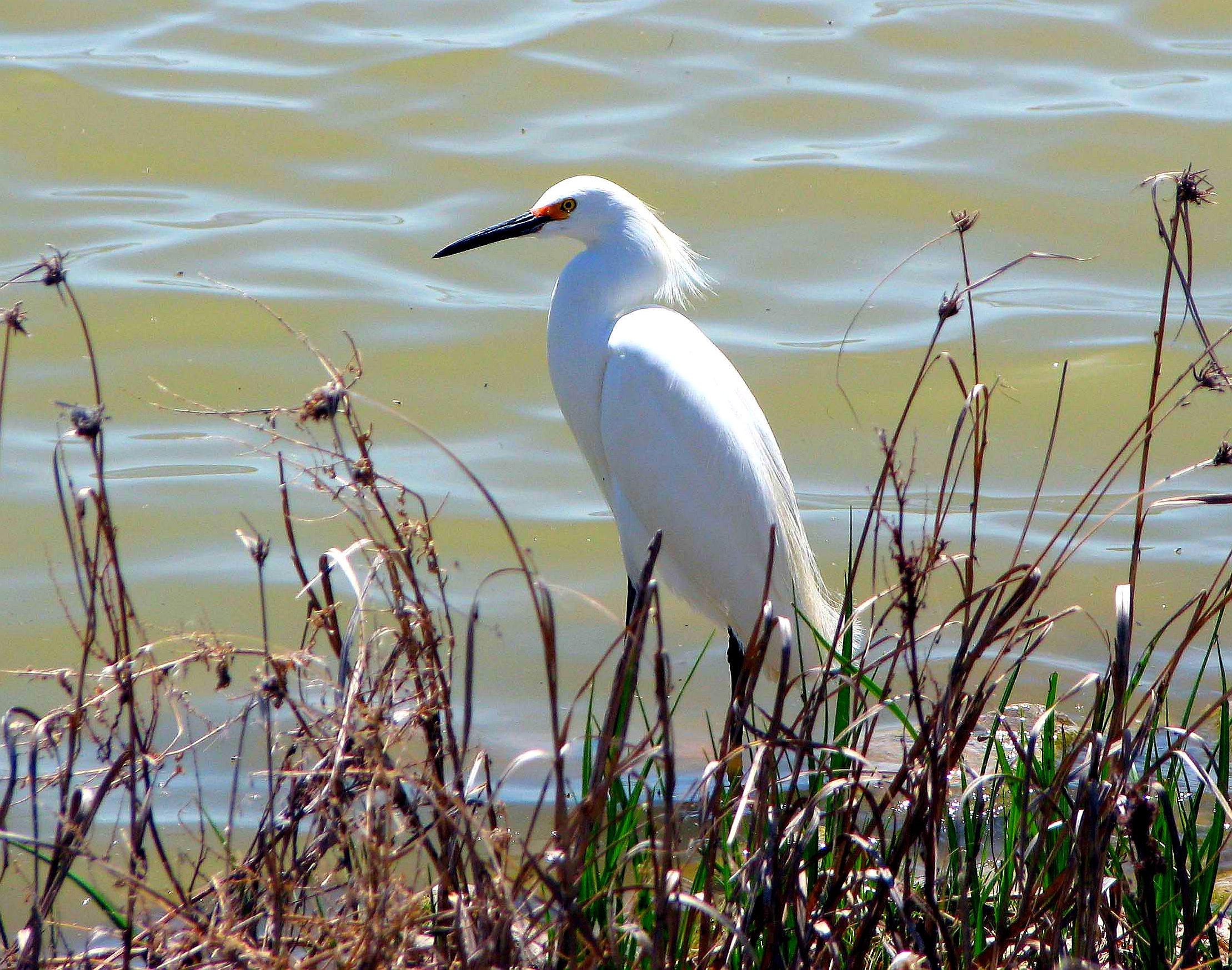
A snowy egret at the Bear River Migratory Refuge, whose restoration from Great Salt Lake flooding I covered for 20 years. — Photo by Pat Bean

That story, as did one I wrote on a fatal airplane crash up Ogden Canyon, won spot news awards. It’s the ironic nature of this crazy business.

In pursuit of stories, I have flown in a Blackhawk helicopter over the Great Salt Lake to the West Desert, watched in awe through a glass bay in a huge tanker as it fueled an F-16 high over the Grand Canyon, and walked the halls of the Pentagon during base closure negotiations.

I have been brow-beaten by politicians, and have pinched myself to stay awake through numerous governmental meetings – and an editor’s meeting or two.

I have been accused of being too liberal, too conservative, too uncaring and too prejudiced.

But then I’ve also seen the better and higher side of human nature shine through in times of adversity.

Matt “The Cat” Maw, the Weber State University mascot who injured his spine immediately comes to mind. The reporter who wrote his story shared Maw’s upbeat attitude that cheers others in adverse situations.

I’ve also watched time and again as people pulled together in disasters, such as the overwhelming community support I saw recently from my editor’s seat during the aftermath of a flooded Riverdale neighborhood. Or the outpouring of neighborly aid I saw during a Texas Gulf Coast hurricane back in my still-wet-behind-the-ears reporting days.

In thousands of ways, I’ve seen and heard the heart beat of daily news events for over a third of a century. The experiences have affected me, changed me – and both speeded up and slowed down my heart.

Now in this column, my hope is to share the heart beat with readers. It’s the heart beat of this Top of Utah community – and the heart beat of this writer.”

**********

This writer’s heart still beats – and the blood that flows through it still belongs to a journalist. And I’m proud of it.

Now available on Amazon

Bean Pat: Galveston Beach https://sfkfsfcfef.wordpress.com/2018/06/26/on-the-beach-in-galveston/  I couldn’t help myself in choosing this blog. In another couple of weeks, I will be walking on a Texas Gulf Coast beach about 25 miles south of this one. Simple things like this make my heart beat with pleasure.

            Pat Bean is a Lonely Planet Community Pathfinder. Her book, Travels with Maggie, is now up on Amazon at http://tinyurl.com/y8z7553y  Currently, she is writing a book, tentatively titled Bird Droppings, which is about her late-bloomer birding adventures. You can contact her patbean@msn.com

It is not so much for its beauty that the forest makes a claim upon men’s hearts, as for that subtle something, that quality of air that emanation from old trees, that so wonderfully changes and renews a weary spirit.” — Robert Louis Stevenson

An old bristlecone pine at Great Basin National Park, where stars light up the sky at night. — National Forest Service Photo

A Walk Among the Trees

I was sitting on my third-floor balcony drinking my cream-laced coffee this morning, with my binoculars aimed at our resident great horned owl. We have a pair here, and since this was the largest of the two I assumed it was the female.

All that’s left of what was once the world’s oldest living tree. — Wikimedia photo

The owl was restless and flew off after a couple of minutes, but I continued to stare, this time at the magnificent Ponderosa pine in which the owl perched, and which graces my balcony view. I saw the tree as a living thing, and knowing that it is a tiny cog in the ecosystem that is necessary to my daily breath, I was awed and thankful,

And that thought took me back to the trip I made to Great Basin National Park, where I stood near the summit of 13,063-foot Wheeler Peak, and learned of the murder of what was thought to be the world’s oldest living tree.

I was with a small group of hikers led by a ranger at this time, and one of the men in the group asked: “Did they kill the murderer.”  The ranger responded: “They should have.”

Stella Lake at Great Basin National Park. — Wikimedia photo

But the truth is that the murderer was given a permit to cut the bristlecone pine tree down for research purposes. It was found to be 5,200 years old, and the oldest known living tree.

The silver lining from this tragedy – and the Pollyanna side of me always looks for this ray of sunshine – is that the hue and cry from this 1964 murder eventually led to the creation of Great Basin National Park.

“If anything good can come from the cutting of the world’s oldest tree, then it was that,” the ranger said, as we walked among other bristlecones, some of which were thought to be as old as 3,000 years.

That recorded memory, recalled from my journals and a newspaper story I wrote when the park was celebrating its 10th birthday, dates back to 1996. I made the trip to the Nevada park after then Rep. Jim Hansen, protesting the creation of the Grand Staircase-Escalante National Monument, which, I note, has recently been reduced in size, suggested that parks like the Great Basin didn’t deserve national protection.

I disagree one thousand percent.

Bean Pat: Old Plaid Camper https://oldplaidcamper.com/2018/06/22/hazy-lazy-low-tide-mornings/#like-10237  Life’s a marathon not a sprint.

Pat Bean is a Lonely Planet Community Pathfinder. Her book, Travels with Maggie, is now up on Amazon at http://tinyurl.com/y8z7553y  Currently, she is writing a book, tentatively titled Bird Droppings, which is about her late-bloomer birding adventures. You can contact her patbean@msn.com

Birds: House Finches

“I said, ‘Ooh, Dad, I want the yellow ones.’ He said, ‘Where?’ I said, ‘Right there, Dad. I want the yellow ones.’ Everybody goes, ‘Those are green’. That’s how I knew I was colorblind.” — Michael Rosenbaum

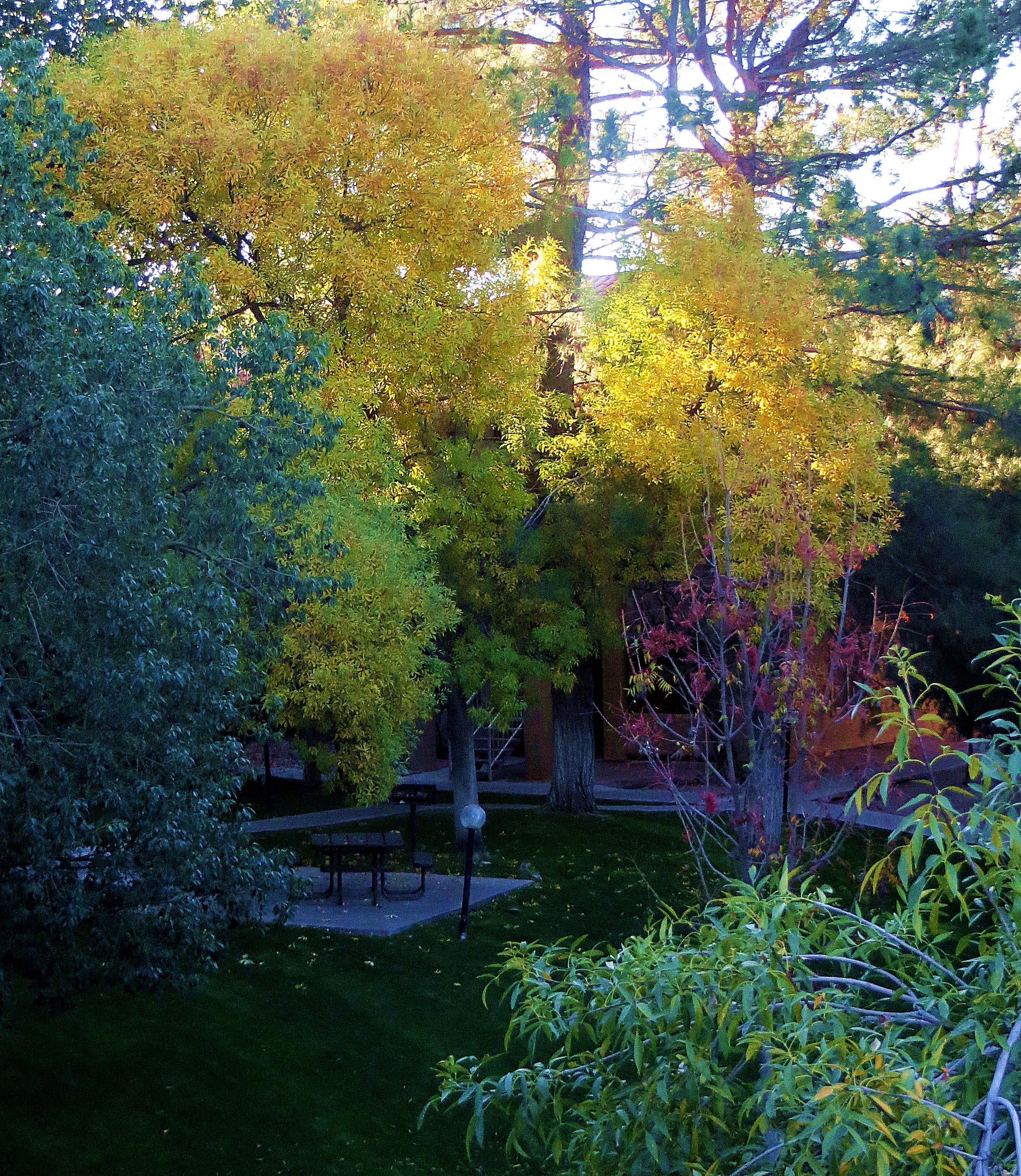
An evening view from my apartment balcony that I took last fall. — Photo by Pat Bean

A Yellow Variant

It was a birdy morning today, one that had me almost constantly reaching for my binoculars as I drank my coffee

A yellow variant house finch.

while sitting on my third-floor balcony. There were the usual suspects of Anna’s, black-chinned and broad-tailed hummingbirds spatting at my nectar feeder, mourning and white-winged doves cooing in the background, a raven cawing from the roof opposite my balcony, and small verdins and goldfinches flitting about in the trees.

Our resident Cooper’s hawk flew to the top of a tall tree and stared down at be for a bit – and I stared right back at him. A bright red northern cardinal flew past before disappearing in the foliage of trees across the courtyard. Then two other visitors, a brown thrasher and a tropical kingbird, uncommon visitors to my balcony view, flew in for a brief visit.

House finch sitting on my balcony railing. — Photo by Pat Bean

Elated at these last two, I described their visit in my journal. But then another bird flew in. It was a house finch, a common species I’ve seen hundreds of times. But this one was different. Instead of being all decked out in red feathers on head and breast, this one had yellow feathers. While not exactly rare, although not common, this was the first one in almost 20 years of serious bird watching I had ever seen.

I was seriously thrilled. Life is good.

            Bean Pat: A laugh for writers https://brevity.wordpress.com/2018/06/13/classic-jokes-for-writers/#like-12824   You might not get these if you’re not a writer. And if you’re a writer, you will probably like this blog.

Pat Bean is a Lonely Planet Community Pathfinder. Her book, Travels with Maggie, is now up on Amazon at http://tinyurl.com/y8z7553y  Currently, she is writing a book, tentatively titled Bird Droppings, which is about her late-bloomer birding adventures. You can contact her patbean@msn.com

The Raven — By Pat Bean

“To dream is to remain always open.” – Rod McKuen

A Page from My 1983 Journal

The early 1980s were a tumultuous time in my life. I was coming off a bad 22-year marriage, and was both having the time of my life and lonely tearful nights.  It was a time when I let the words of others explain my new-found feelings, thus my journals back then are full of quotes that were meaningful to me.

And Rod McKuen spoke for me.

“Without some think time, we relinquish our quest for knowledge to others, and are forced to accept their opinions as our own.” Yup, I certainly had been doing that.

“Nobody’s perfect and that’s one of the best things that can be said about man.” One of the landmark days of my life was when I not only accepted but rejoiced in this truth.

“Welcome is the thunder to the man who’s lived to long in silence.”

To the above, I wrote on that April 6 day: I love this quote. I guess I really went out to search for the thunder in my own life – and found it, and welcomed it. Life is a joy – and occasionally a pain in the arse.

Bean Pat: Contrast https://andrewsviewoftheweek.com/2018/05/27/contrast/

Blog pick of the day.

I love this post because it feels real, both about life and how a writer’s mind works. And I sometimes tell my canine companion Pepper how lucky she is to have adopted me.

Pat Bean is a Lonely Planet Community Pathfinder. Her book, Travels with Maggie, is now up on Amazon at http://tinyurl.com/y8z7553y  Currently, she is writing a book, tentatively titled Bird Droppings, which is about her late-bloomer birding adventures. You can contact her at patbean@msn.com