Feeds:
Posts
Comments

Hummingbird Visitors

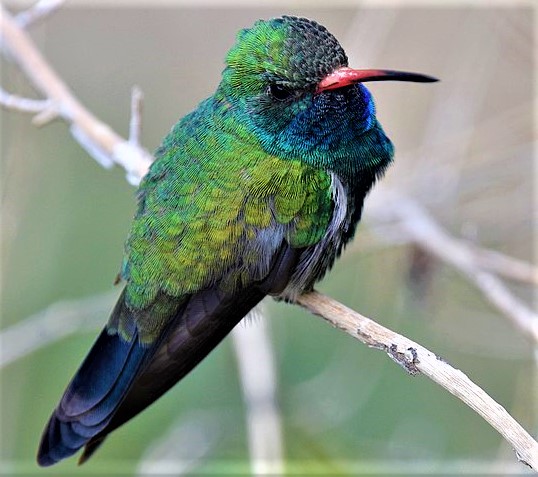
Broad-Billed Hummingbird — Wikimedia Photo

I have seen eight different hummingbird species from my third-floor Catalina Foothills apartment balconies since moving to Tucson in 2013. One of these was a Lucifer’s hummingbird that sat in a nearby tree but didn’t visit my nectar feeder. It was a lifer, a first-time sighting that hasn’t happened again.

My field guide says this hummer only comes as far north as the tips of southern Arizona and Texas and is only rarely seen. I did a double take when I saw it, and triple-checked my bird guide before I accepted what I was looking at. The bird, a male, had a distinctive purple patch on its neck and a long, decurved bill. So, I finally decided it couldn’t be anything but a Lucifer.

I was thrilled, as it’s rare for me to see a new species now that my lifer list has grown to over 700 species.

In contrast, I almost daily see Anna’s hummingbirds, the male of which has a head that shimmers a brilliant magenta. I have one Anna’s that sits on a branch in the tree next to my front balcony — and attacks any other hummers that come in range. It’s quite a show to watch when he’s in residence.

But since he can’t be on guard broad every minute, I also see quite a few broadtail hummingbirds with their rose-red throats and wings that produce a trilling whir when they are flapping. The Anna’s makes a sharp clicking sound instead, which makes the two species easy to tell apart when they’re zipping around. This is especially true if the birds are the less distinctive females.

The broadbills, meanwhile, don’t seem to be as intimidated by the Anna’s as some of the other species that hover around my nectar feeder, which is probably why they are the second most common hummingbird to visit.

The next two most common visitors are the black-chinned, a smaller bird with a dark head and a sometimes-visible purple throat, and a broad-billed, a darker colored bird and the only visitor with an orange bill.

It’s taken hours of study for me to now identify my hummingbird visitors, and I still keep my bird guide close by. But being able to identify the birds I see is a major part of the enjoyment I get from birdwatching. It’s kind of like the thrill I get from reading a mystery book and correctly guessing who the killer is before the author reveals it.

I considered the time well-spent.

Pat Bean is a retired award-winning journalist who lives in Tucson with her canine companion, Scamp. She is a wondering-wanderer, avid reader, enthusiastic birder, Lonely Planet Community Pathfinder, Story Circle Network board member, author of Travels with Maggie available on Amazon (Free on Kindle Unlimited) and is always searching for life’s silver lining.

The Magic of a Dance

Even the moon acted like Friday night was Magic. — Photo by Shanna Lee

 Shanna and Dawn, my granddaughter and her wife, threw an 83rd birthday bash for me Friday night. I had a blast.

I laughed a lot, drank just a bit too much, played pool and near the end even had one dance. It was magic.

 When I was young, I had loved to dance. But one night, the man I was dancing with told me I was a horrible dancer and had proved it by (I now suspect) maneuvering me so I stepped on his feet.

I stopped dancing for the next twenty years,

It was not until 1983 — when I found myself footloose and single in a small Idaho town, and friends with three women who liked to party on Wednesday nights after work, that I began dancing again.

At first, I would turn down invitations to dance. But one night, perhaps after a drink too many, I accepted.  My partner told me that I was a good dancer. I thought he was lying, but I didn’t turn down offers to dance after that. Amazingly his compliment was repeated a few times again by other partners.

For the next two years while I lived in Twin Falls, and for quite a few years after that, I danced at every opportunity that came my way. My favorite was the country western swing with a six-foot-two guy who was just a friend. Our favorite move was something we called the Octopus.

 But until Friday night I hadn’t danced in at least 20 years. The body reacted as if I had just danced the day before, and brought with it a flood of dazzling memories. It also felt good to have a man’s arms around me once again. I guess this old broad still has a bit of life in her yet.

Pat Bean is a retired award-winning journalist who lives in Tucson with her canine companion, Scamp. She is a wondering-wanderer, avid reader, enthusiastic birder, Lonely Planet Community Pathfinder, Story Circle Network board member, author of Travels with Maggie available on Amazon (Free on Kindle Unlimited), and is always searching for life’s silver lining.

On Being a Writer

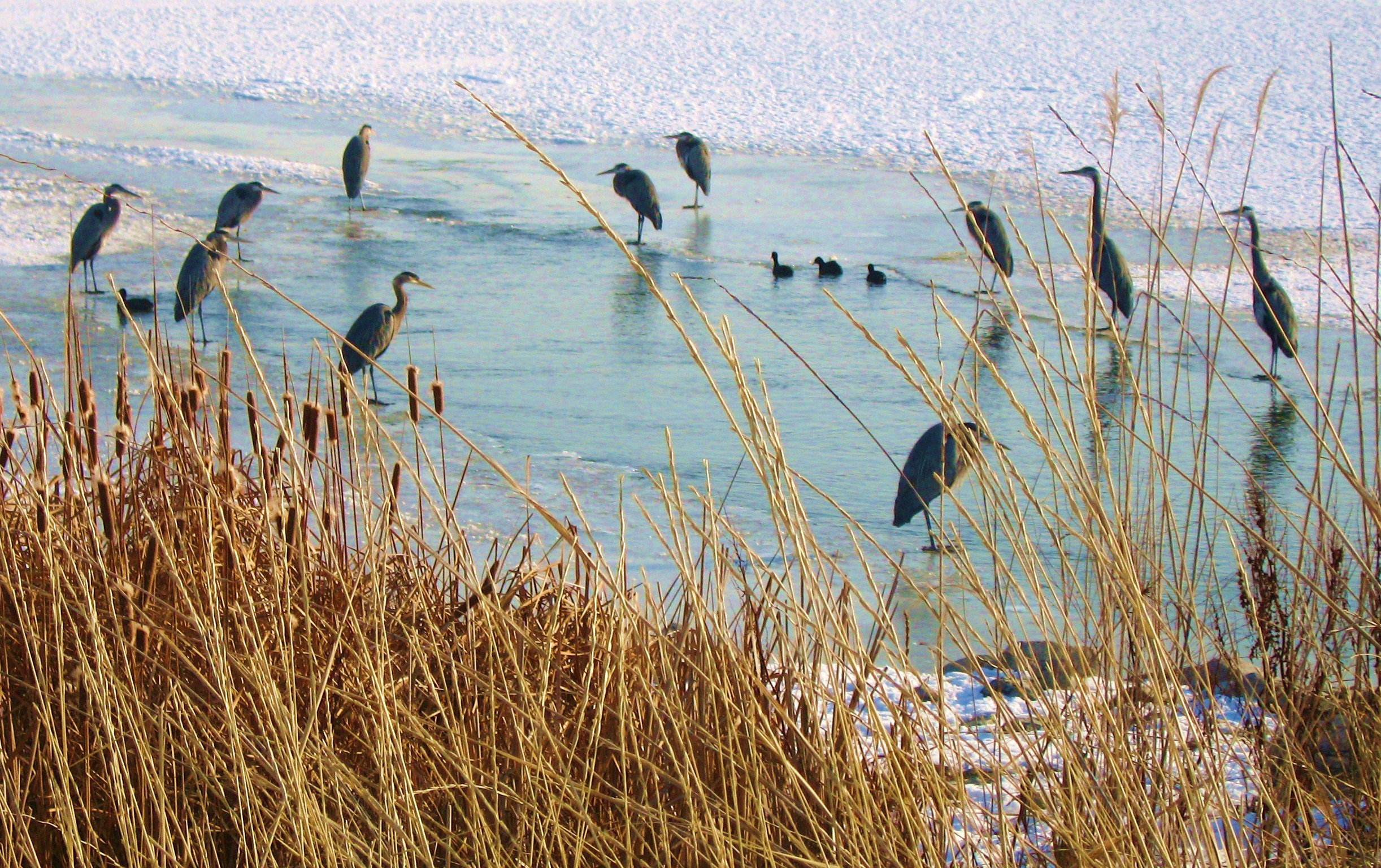
Great blue herons on frozen Farmington Bay in Utah: One of the best things about being a writer is that it makes you more observant because you will want to put what you see with your eyes into words. This is just one way being a writer has enriched my life.

I Think of Writing as a Gift

  For 37 years, as a newspaper journalist, I wrote almost every day. It meant I often saw my name in print, and the thrill of this never dimmed. It’s probably why I write a blog, as I’ve eschewed having ads on it.

Author Anne Lamott, whose book Bird by Bird is one I’m currently rereading for the third time, says some writers need to see their name in print to know they exist. I think I am one of them.

Now retired and having lived over eight decades on Planet Earth, I still get a joyful satisfaction in seeing my byline, whether it is on the book I have written, on magazine articles that occasionally get published, or this blog.

 And I was overjoyed yesterday, when I learned that my blog earned third place in Story Circle Network’s blog contest for my post Then Being Then.  https://patbean.net/2021/11/03/then-being-then/ The well-deserved first place, in case you are interested, went to Stephanie Rafflelock for We Matter at Every Age https://www.byline-stephanie.com/post/we-matter-at-every-age

As an old broad, writing has come to be just about my only outlet to still try and make a difference in the world, however tiny it might be.

 To date, I’ve posted 1,499 blogs. I’ve often encouraged readers to be kind, to be more open-minded, to not believe everything they hear or read, and to get their news from multiple sources – and I’ve written thousands of words about birds and nature, two things that keep me sane when chaos reigns.

These days, I write a lot about past experiences, a validation for my own life, but hopefully the posts let others who have had similar experiences know they are not alone. And I also try to make readers laugh or be awed by some trivial fact – as I laugh or am awed.

I’m a writer. That’s what I do. I can’t imagine being anything else.   

Pat Bean is a retired award-winning journalist who lives in Tucson with her canine companion, Scamp. She is a wondering-wanderer, avid reader, enthusiastic birder, Lonely Planet Community Pathfinder, Story Circle Network board member, author of Travels with Maggie available on Amazon (Free on Kindle Unlimited), and is always searching for life’s silver lining.

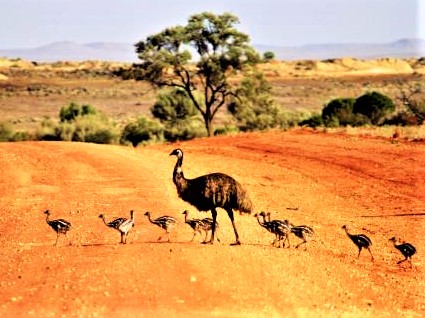
An emu dad is a candidate for father of the year. He takes care of chicks, even if they are not his own, for up to 18 months.

  In 1999, at a time in my life when I was slowing down, I took up birdwatching. It’s still been about the only thing I’ve ever done that absolutely requires patience, something I always thought couch-potatoes used as an excuse to Be lazy.

 In the beginning, I spent hours and hours on the Antelope Island Causeway in Great Salt Lake learning to identify ducks. The island was also the first place I saw a bird through a telescope. It was a western meadowlark, and the golden color of the bird’s throat took my breath away.

 As I learned more and more about these winged creatures, I became partial to the ones that seemed to be feminists, outshining or out-sexing the normally more colorful males.

First there was the belted kingfisher. I was delighted to learn that the female was the more colorful of the two genders. It sports a reddish belly band on its blue and white feathers which the male lacks.

 Then came the Galapagos hawk, which I saw in the Galapagos. The female, after she lays her eggs, leaves all the nest sitting and chick-tending to her male partner, while she goes off and finds another male to mate with.

 This somewhat made up for most birds, like sage grouse males whose only contribution to their female partners is to impregnate them, which takes no more time than two blinks of an eye.

The males gather in what is called a lek, and drum by expanding their chests to attract the females, who to my feminist delight were very picky and often walked away. I got to watch this action, after hiking before dawn to a blind on Desert Ranch in Utah.

Another avian feminist is the African jacana, a bird I saw during a 2007 safari to Kenya and Tanzania.  It’s a wading bird species in which the female also leaves all the chick rearing to the male while she finds another partner.

 Then there’s the giant emu. After producing an egg, the brooding, and then the care and feeding of the hatchlings is all the male’s responsibility, even if all the eggs aren’t his own. He has even learned how to carry a chick beneath his wings.

 You go girls?

 Pat Bean is a retired award-winning journalist who lives in Tucson with her canine companion, Scamp. She is a wondering-wanderer, avid reader, enthusiastic birder, Lonely Planet Community Pathfinder, Story Circle Network board member, author of Travels with Maggie available on Amazon (Free on Kindle Unlimited), and is always searching for life’s silver lining.

C is for Cowabunga!

Howdy Doody and Buffalo Bob

The Meaning of Words

I came across the word cowabunga recently, and it brought Howdy Doody memories floating through my head. For those of you a bit younger than me, Howdy Doody was a puppet with his own television show, which my children loved to watch.

 Howdy was created by Bob Smith – known as Buffalo Bob on the show –when Smith was a radio announcer, and later given a puppet’s body for the television screen.

The children’s show was pure corn – and I sometimes silently groaned when my children turned it on – and sometimes laughed along with the craziness.

But it wasn’t Howdy Doody who first uttered cowabunga. It was a character on the show in 1953, one called Chief Thunderthud, who used the then non-existent word.

Cowabunga, like the frabjous words made up by writer Lewis Carrol, took root, and today’s dictionaries define it as an exclamation used to express delight or satisfaction.

 Surfers adopted the word as slang for a great ride, and the word was also adopted by the Cookie Monster and the Mutant Ninja Turtles. These are all fun memories.

  The word, however, holds yet another memory for me, one closer to my heart. It was the favorite saying of my oldest grandson David, who is now in his mid-40s. As an adorable young boy, he used to stomp around shouting the word when he was excited about something — or wanted attention.

Years have taught me that the meaning of words has more to do with the people speaking them, or listening to them, than a formal definition. Because of David, my mind translates cowabunga as meaning joyful.

I also like the feel of how the word cowabunga rolls off my tongue. What’s one of your favorite words?

 Pat Bean is a retired award-winning journalist who lives in Tucson with her canine companion, Scamp. She is a wondering-wanderer, avid reader, enthusiastic birder, Lonely Planet Community Pathfinder, Story Circle Network board member, author of Travels with Maggie available on Amazon (Free on Kindle Unlimited), and is always searching for life’s silver lining.
Some of the best trails end at waterfalls, like this one in Idaho. – Photo by Pat Bean

“Yesterday’s the past, tomorrow’s the future, but today’s a gift. That’s why it’s called the present.” These words from Bil Keane, a cartoonist best known for his The Family Circus strip, had special meaning for me this morning when I reread words from a decade-old journal.

  At this time, I was still exploring this country, mostly on backroads, in the small RV in which I lived and traveled for nine years.

On November 10, 2010, I listed 100 things I was thankful for. On seeing this list again, I saw that some of those things, when I was 71, were not applicable to the 83-year-old I will be in just a few days.

 On the upside, I’m still thankful for belly laughs, good cream-laced coffee, being a writer, my zest for life and hot baths – and thankful for my family, which has grown by four great-grandchildren the past 12 years.

 But I still miss my canine companion Maggie, a mischievous cocker spaniel who spent eight years on the road with me, and my nature hikes, which have been curtailed by a bad back.

   While Maggie has been replaced by a spoiled Siberian husky/shih tzu-mix canine companion, whose name of Scamp perfectly fits him, my trail days have been replaced with short walks around my apartment complex with the Scamp. Some days I can comfortably walk an eighth of a mile, and on other days much less.

  While there are many blessings that have come with my years, including the gift of time to ponder as well as write, actually liking myself, and learning to slow down and really see Mother Nature’s wonders, I mourn my lost hiking ability.

 Thankfully, I seldom let an opportunity to go on a hike pass me by when I was younger. And thankfully I can still drive back roads and park in scenic spots where I can bird watch at a trailhead. In my younger days, one of my older birding colleagues did just that – and often saw more birds than those of us who took the trail.  

But take it from this old broad. If there is something you love to do, make sure you do it while you can. It makes it easier to continue being thankful for what you still have, and more able to see what you gain from the passing years.

Pat Bean is a retired award-winning journalist who lives in Tucson with her canine companion, Scamp. She is a wondering-wanderer, avid reader, enthusiastic birder, Lonely Planet Community Pathfinder, Story Circle Network board member, author of Travels with Maggie available on Amazon (Free on Kindle Unlimited), and is always searching for life’s silver lining.

The Meadowlark and the Chukar: I wrote a bird column for three years back in the early 2000s, and a chukar I saw on Antelope Island in Utah’s Great Salt Lake was the first bird I wrote about. — Art by Pat Bean

 My mornings start with my to-do list, which is a carry over from the day before, and the day before that, and the days before those. Eventually a dreaded chore finally gets done because I’m tired of looking at it.

The daily list actually is two lists in one. The tasks I need to do, or simply want to do (like watch a bird cam located in Panama), and the list of the books I’m reading, or want to read.

As an old broad, my body appreciates many breaks during the day, and the reading list gives me something to fall back on besides computer games – which according to my self-imposed rule must not be played before 4 p.m. This rule, because I love playing games is often broken. So as a reminder I have a note taped to my refrigerator that says “You could be reading.”

 Besides the daily list, I keep lists of books I’ve read, places I’ve been, the proverbial bucket list, menu lists and an idea list, from which I always can find a topic to write about.

But one of my favorite lists is the one I begin on April 1, 1999 – the day I joined the world of avid (translate crazy) bird watchers.

 I keep a list of every bird I’ve seen, noting the place and the date. But thankfully, I’m not like the birder who once passed me on a favorite birding trail. I was dawdling along, watching red-winged blackbirds flash their scarlet marked wings while listening to a couple of breeding male meadowlarks trying to out sing each other.

Barely slowing his pace, a middle-aged hiker came upon me and asked if I had seen a chukar. I replied that I often saw this partridge-like bird in the rocks near a bend up ahead. About 10 minutes later, the man ran past me going the other way. 

  “Got it … that’s 713 birds for me now.” His voice was like the rumble of a passing freight train.

How sad, I thought, that he didn’t take a minute to admire the flashy scarlet markings on the blackbirds or to enjoy the melodic voices of the two meadowlarks.

 Numbers and names on a list are only that. It’s being present in the moment – seeing the golden yellow on a meadowlark’s throat as it tilts its head toward the sky in song, or the magic of a sunrise slowly coloring the sides of a canyon – that make my heart beat faster. And I’m thankful I enjoy such wonders whether I’m seeing them for the first or the hundredth time.

 Seeing birds is always delightful – but then so is getting my oven cleaned after seeing the chore on my to-do list for three weeks running.

  I’m glad I’m a list-maker.

Pat Bean is a retired award-winning journalist who lives in Tucson with her canine companion, Scamp. She is a wondering-wanderer, avid reader, enthusiastic birder, Lonely Planet Community Pathfinder, Story Circle Network board member, author of Travels with Maggie available on Amazon (Free on Kindle Unlimited), and is always searching for life’s silver lining. 
Star-Filled Nights

Night sky over the Grand Canyon

Mother Nature’s Silver Lining

 here are places in this world where, when looking up at the night sky, you can clearly see portions of the Milky Way, the galaxy we live in. It’s a magnificent sight. But those places get fewer and fewer every year because we humans are fond of lighting up the dark, creating a light pollution that dulls our view of the stars.

 Some cities, including Tucson where I live, have ordinances that limit artificial-light pollution. Supposedly, Tucson’s location in the heart of the Sonora Desert, has the darkest sky of any city its size in the country. And because of this, astronomers come from all over the world to visit nearby Kitt Peak National Observatory, home to some of the best sky observation telescopes in the world.

 I’ve visited the observatory, but only during the daylight hours. The best sky watching I’ve ever experienced came when I was rafting down the Colorado River through the Grand Canyon, especially in places where the canyon was tall and at its narrowest. As I lay in a sleeping bag on a sandy beach, I could actually see the stars move across the thin strip of visible sky.

 It was magical, a moment in nature that connected me with the whole of the universe. Thinking about those Grand Canyon nights still leaves me awed.

 Sky watching here in Tucson doesn’t compare. But I’ve never seen more spectacular sunsets than the ones that I see most nights from my third-floor balcony here in the city. They, too, are magical, a silver-lining for surviving the daily news.  

Pat Bean is a retired award-winning journalist who lives in Tucson with her canine companion, Scamp. She is a wondering-wanderer, avid reader, enthusiastic birder, Lonely Planet Community Pathfinder, Story Circle Network board member, author of Travels with Maggie available on Amazon (Free on Kindle Unlimited), and is always searching for life’s silver lining.
Possum Tribute

The Possum Monument in Wausau, Florida, the Possum Capital of the world.

Quite Tasty

These days I often scratch the itch of my wanderlust soul from the comfort of my living room recliner, but it’s large enough so that my canine companion Scamp — who thinks 45 pounds is the perfect size to be a lap dog — can curl up with me.

 From this seat, books and the internet take me all over the world. This morning it was to Wausau, Florida, a small town of only 400 where possums supposedly outnumber humans, and which is home to the Possum Monument.

Erected in 1982, the monument’s inscription reads: “…in grateful recognition of the role the North American possum — to be technical correct possums only live in Australia, America has the opossum — played in furnishing both food and fur for early settlers and their successors.

 Possums were also a great source of protein for residents during the Great Depression, the article said.

On reading that, I remembered the time in the early 1940s when my dad went hunting and brought home a possum for dinner. My grandmother cooked it with sweet potatoes, and as I recall the meal was pretty tasty.

If you want to taste for yourself, you should visit Wausau on the first Saturday in August, which is the day the Florida Legislature designated as Florida Possum Day when possum and sweet potatoes will be on the menu.

Pat Bean is a retired award-winning journalist who lives in Tucson with her canine companion, Scamp. She is a wondering-wanderer, avid reader, enthusiastic birder, Lonely Planet Community Pathfinder, Story Circle Network board member, author of Travels with Maggie available on Amazon (Free on Kindle Unlimited), and is always searching for life’s silver lining.

Politically Speaking

Sketching and watching birds, like this Gila Woodpecker, is one way I get my mind off the chaos of daily news headlines.

Agreement is Rare

Political speaking, when it comes to certain things, especially politics, my family pretty much has America covered – and for peace’s sake we usually keep our views to ourselves.

 With a great margin for error, this is how I see things among my five children.

I have one child to the left of me, one child to the right of me, one child that knows without a doubt that their side, whatever it is, is always the right side, one child who gets quite passionate about their particular side, and one child who appears not to follow the political arena at all.

That last may be the lucky one. I tried not reading a newspaper for the first four months after I retired from being a newspaper journalist. It was a relaxing, but not a satisfying time, in my life. I came to the conclusion that sticking my head in the sand and ignoring what’s going on in the world is not for me.

These days, reading the NY Times, and then the varied and even conflicting news on my computer’s home page while I drink cream-laced coffee in the morning, gives me plenty to think about — and fume about — for the rest of the day.

 My children grew up in the 1950s, 60s, and 70s’, and we often talked about world events. We seldom agreed back then on anything either.

I actually take pride in that. It means I raised independent children who mostly took an interest in the world they lived in and learned to think for themselves.

 With my own family as a role model, I know it’s possible to get along without chaos, ugliness or war — even if there’s no way in hell, we’re ever likely to agree with one another.

I suspect it works because we all care about and love each other – and have the sense, at least most of the time, to keep our political opinions to ourselves. 

Pat Bean is a retired award-winning journalist who lives in Tucson with her canine companion, Scamp. She is a wondering-wanderer, avid reader, enthusiastic birder, Lonely Planet Community Pathfinder, Story Circle Network board member, author of Travels with Maggie available on Amazon (Free on Kindle Unlimited) and is always searching for life’s silver lining.