Feeds:
Posts
Comments

 “I have a theory about the human mind. A brain is a lot like a computer. It will only take so many facts, then it will go on overload and blow up.” — Erma Bombeck
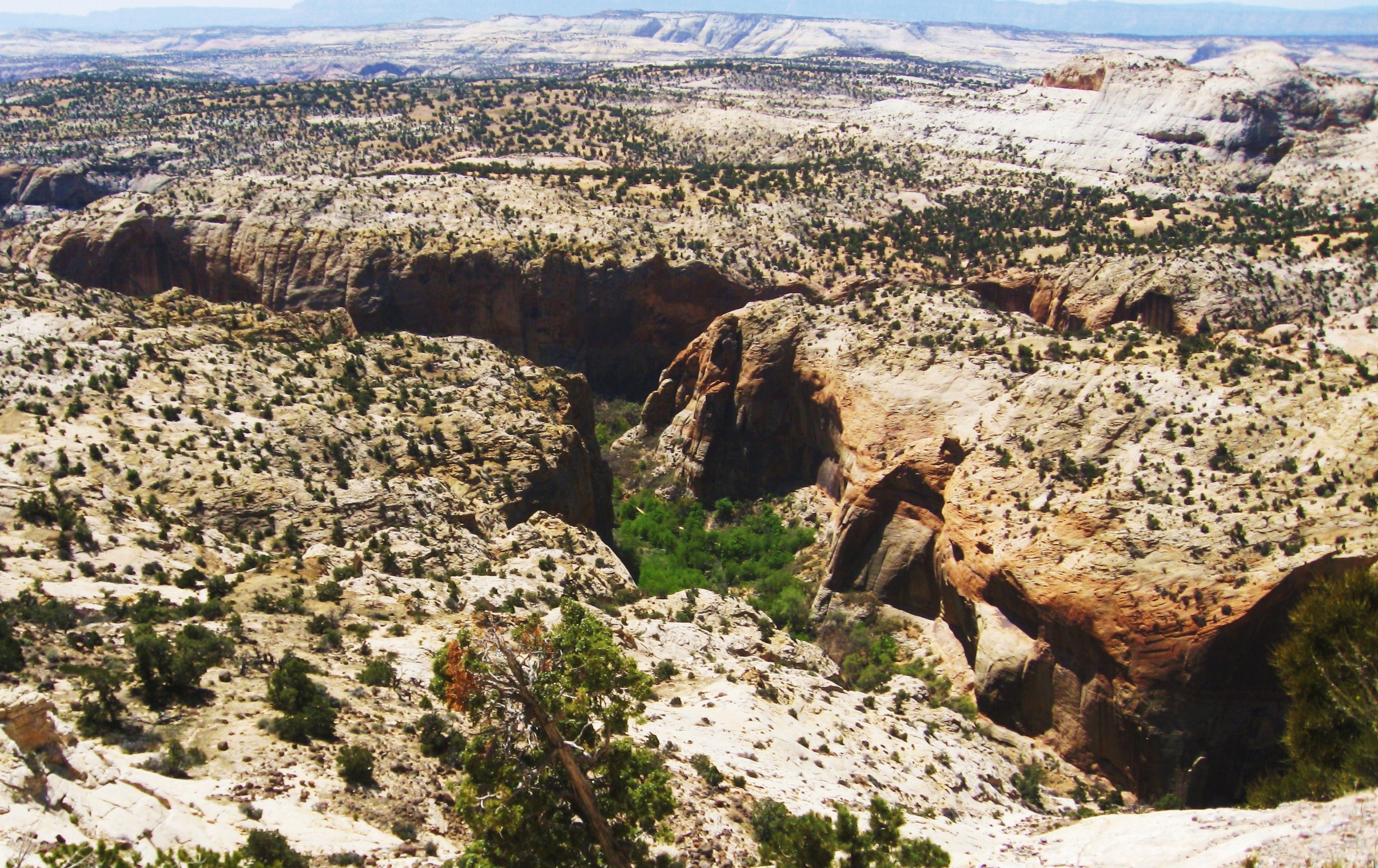
Looking down from the Hogsback, the Escalante River snakes a path of greeness through the rocky landscape. -- Photo by Pat Bean

Travels With Maggie

Heading southwest out of Boulder from Highway 12’s junction with the Burr Trail, you’ll pass the entrance to Utah’s Anasazi State Park and Museum.

It’s a protective home for an Indian village occupied between approximately AD 1050 and AD 1200. It’s a fascinating place to visit for archeological and history buffs and shouldn’t be passed by. While that’s exactly what I did this day, I had spent time in the museum and in the Coombs Site Indian ruins here on previous visits to the area. Check it out at: http://tinyurl.com/3wzmn6z

Just a little ways farther down the road and I was on the section of Highway 12 known as the Hogsback, although some people refer to it as Knife’s Edge, which seems quite appropriate.
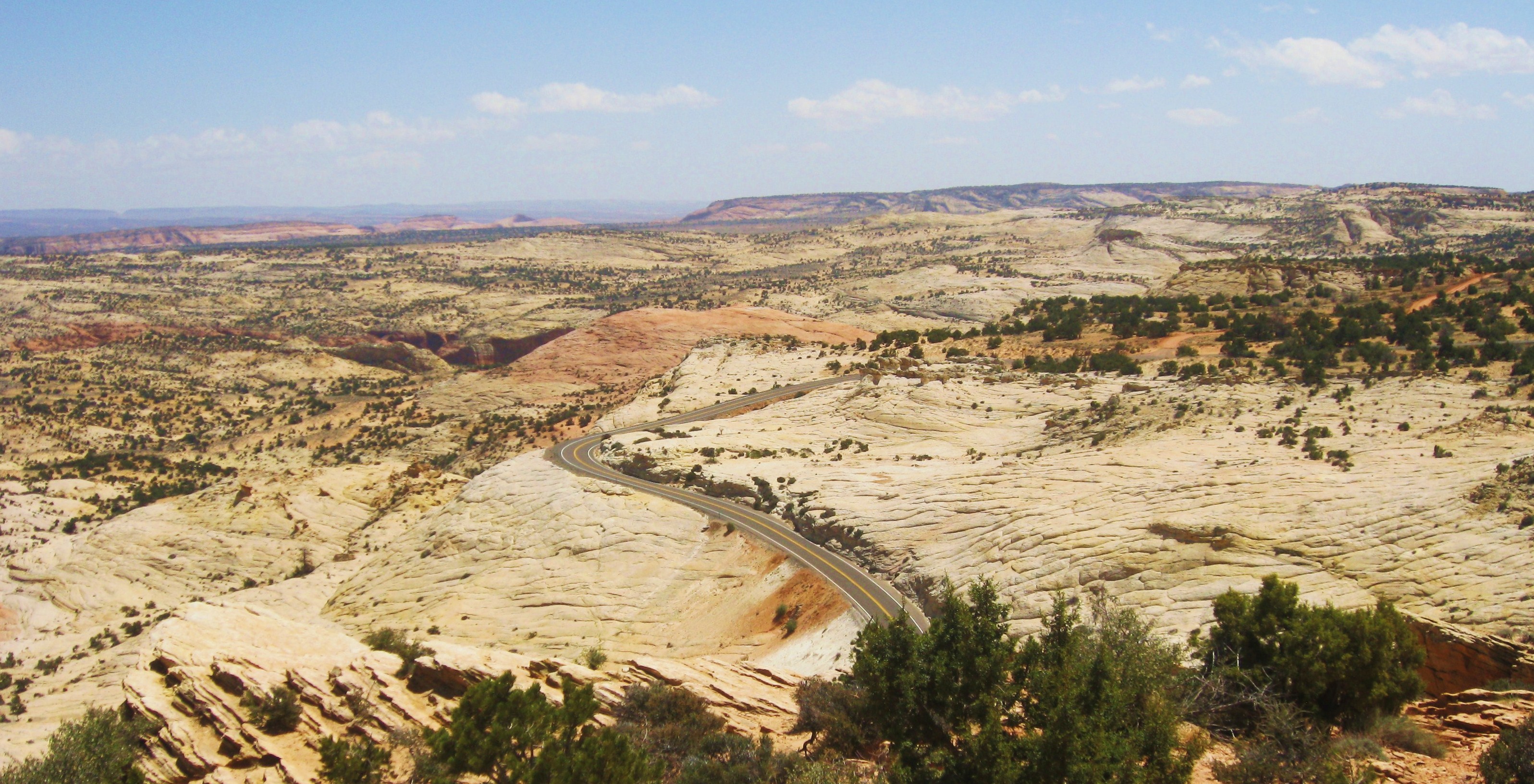
Looking back as Highway 12 leads onto the Hogsback. -- Photo by Pat Bean

This section of Highway 12, which 70 years ago opened up Boulder to the more civilized world, travels along a high narrow ridge with steep cliffs on both sides. There is not a single spot along the highway that doesn’t offer magnificent views.

But since it’s narrow enough in some places to see down both sides of its 2,000-foot high cliffs at the same time while driving, for safety’s sake I did most of my gawking at pullouts.

The first time I crossed this amazing landscape was when I was visiting Escalante in the late 1970s and a local was showing me the sights. I was quite impressed – and the amazed emotions haven’t dimmed with the years.

Since leaving Boulder, I had been traveling through the Grand Staircase-Escalante National Monument, which is spread across nearly 2 million acres of Southern Utah.

Its creation in 1996 by Democratic President Bill Clinton, who announced the gigantic news in Arizona with the widowed wife, Norma Mattheson, of Utah’s former Democratic governor, Scott Mattheson, did not sit well with the state’s then Republican administration, nor the state’s large anti-environmentalist segment.

The controversy was a boon, however, for this  environmental reporter who was thrown into the thick of the battles.

In the end, at least in my opinion, the protection of these awesome lands has benefited the state greatly with increased tourism in an area where jobs were scarce, and with transfer/trades of lands elsewhere to the state that have been more profitable in providing income for Utah’s school system.
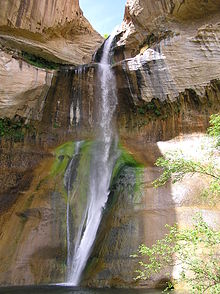
Calf Creek Falls, worth the 6-mile round-trip hike. -- Photo by Scott Catron

 Escalante had certainly grown since my last visit about eight years ago, I noticed as I entered this town named after a Franciscan missionary who was the first to explore the area. And why not? It’s situated in some of the best scenery and hiking trails you’ll find anywhere in North America.

One of my favorites is the six-mile round-trip hike to Calf Falls,whose trailhead I had passed before entering Escalante. It has been a long time since I had seen the falls, but I could still recall the thrill at the end of three miles, mostly on a sandy path, of coming upon the 125-foot waterfall beneath which lay an inviting pool and shade trees.

Egads! Here I’ve covered only 27 miles of driving in today’s blog, and already I’m in past-and-present landscape brain overload.

Highway 12 will do that to you. And there’s more to come – tomorrow.

*Continuing Day 11 of the journey, April 29, 2011

 “You cannot be wimpy out there on the dream-seeking trail. Dare to break through barriers, to find your own path.” Les Brown

The Henry Mountains as seen from Highway 12's beginning in Torrey, Utah -- photo by Pat Bean

*Travels With Maggie

Utah Highway 12, a 125-mile Scenic Byway that runs from Torrey just outside of Capitol Reef to Highway 89, has been called America’s most beautiful drive.

Yippee! Driving it was my agenda for the day.

The journey for my dog, Maggie, and I began in the Dixie National Forest. The narrow road through the woodlands, with rarely another vehicle in sight, climbed steeply upwards, offering spectacular views of snowy peaks in the Henry Mountains.

The nearer landscape was a mixture of red earth and rocks heavily dotted with cedar and sagebrush that gave away to tall pines and firs and still leafless aspen at higher altitudes.

I stopped at all the overlooks to gasp in wonder. I also gasped with delight when, just as I topped a 9,600-foot summit, a soaring red-tailed hawk glided past.

I didn’t mind at all that the winding and steepness of the road often meant traveling at speeds of 25 mph or even less at times.

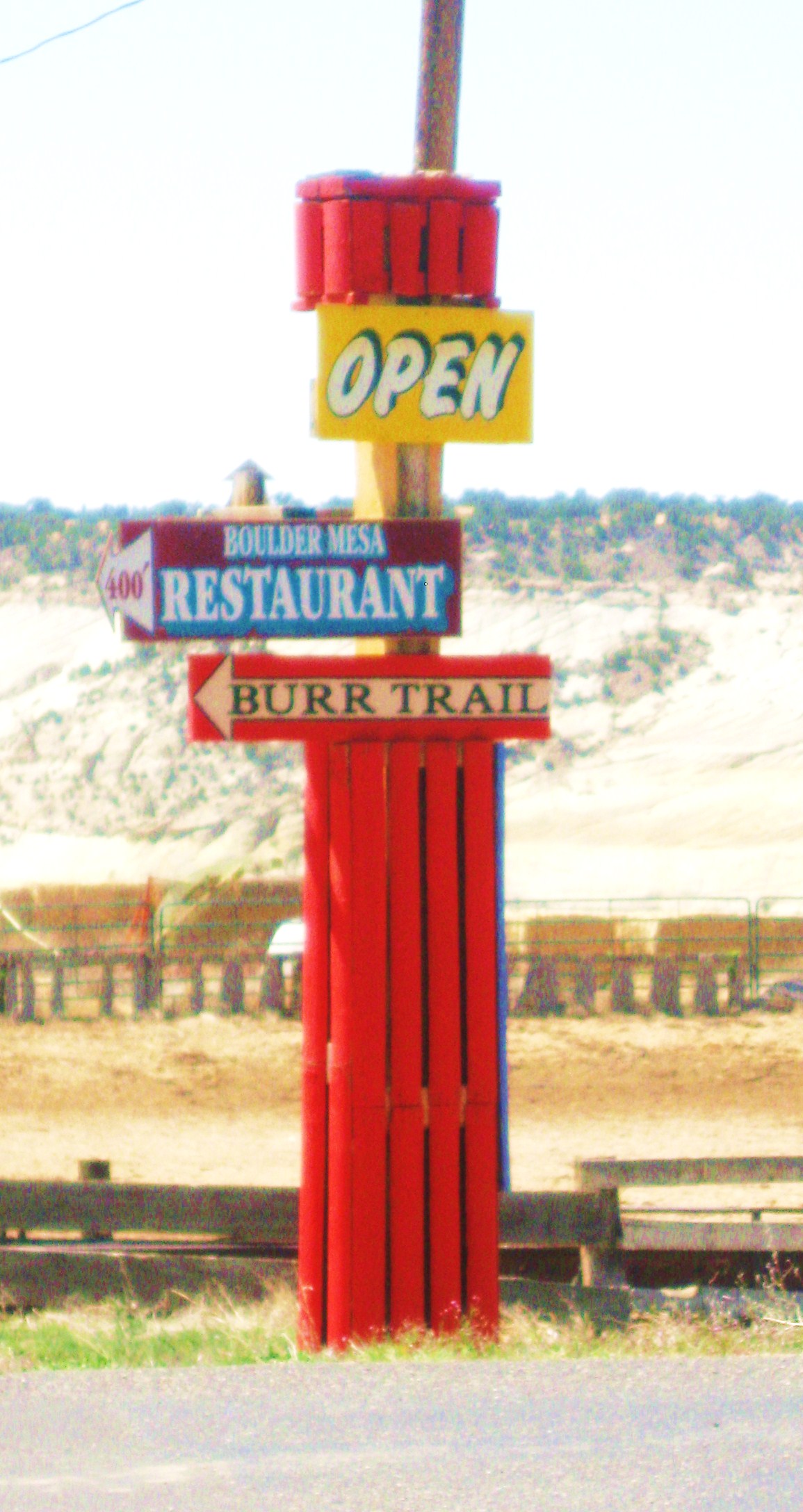
The Burr Trail Grill and Trading Post, the civilized beginning of the Burr Trail Scenic Backroad. -- Photo by Pat Bean

It was just after 11 a.m. when I pulled into Boulder, a tiny town of less than 200 that was just 35 miles away from Torrey.

This scenic town was once so inaccessible that it was the last place in America to still get its mail delivered by mule power. That changed after a road was finally built to it from Escalante in 1939. It was 1947, however, before Boulder got electrical power.

My timing to hit the town, which sits at an elevation of 6,700 feet in the shadow of 11,700-foot Boulder Mountain, was perfect. I could have a leisurely lunch at the Burr Trail Grill, so named because of its access to the trail that’s been a hot land issue for Utahns for many years.

Pointing the way. -- Photo by Pat Bean

As I sat there, eating a spicy, guacamole hamburger made from 100 percent organic beef raised in Boulder, and my split pea, asparagus and shallot salad, memories of my last meal here and my drive on the four-wheel drive trail flooded my little gray cells.

I had been accompanied back then by a professional photographer. We were paired up together to do illustrated newspaper stories on the Grand Staircase-Escalante National Monument that had been newly created by President Bill Clinton, and on the controversy surrounding the proposed paving of the Burr Trail.

The wild and scenic backroad, which is now partially paved, begins in Boulder – right next to where I was having lunch — and runs through Capitol Reef National Park’s Waterpocket Fold and then on to Bullfrog in the Glen Canyon National Recreation Area.

While the road is only about 70 miles long, it took the two of us from early morning to dusk to drive. Of course that included frequent stops and us getting lost a couple of times.

One special moment of the trip that I recalled this day was standing beside our turned-off vehicle, facing a landscape that appeared untouched by human hands, and being amazed at the quietness. It was as if all of a sudden I realized how amazing it was not to even hear the quiet hum of a refrigerator.

If ever I had a day I could repeat, this one would certainly be on the list.

But there was no time for regretting that this wasn’t that “Groundhog” day. There was still more of Highway 12 ahead. And next up was the mind-boggling Hogsback section of our drive.

I’ll tell you all about that tomorrow.

*Day 11 of the Journey, April 29, 2011

A break from Travels with Maggie and our journey from Texas to Idaho to post a photo for the weekly photo challenge. 

The photo below was taken on Merritt Island in Florida. It was a spectacular place to watch birds. 

Northern Pintails: Heads or Tails — Photo by Pat Bean

“The most difficult thing is the decision to act, the rest is merely tenacity. The fears are paper tigers. You can do anything you decided to do. You can act to change and control your life, and the procedure, the progress is its own reward.” — Amelia Earhart.

“National parks are the best idea we ever had. Absolutely American, absolutely democratic, they reflect us at our best rather than our worst.” Wallace Stegner.

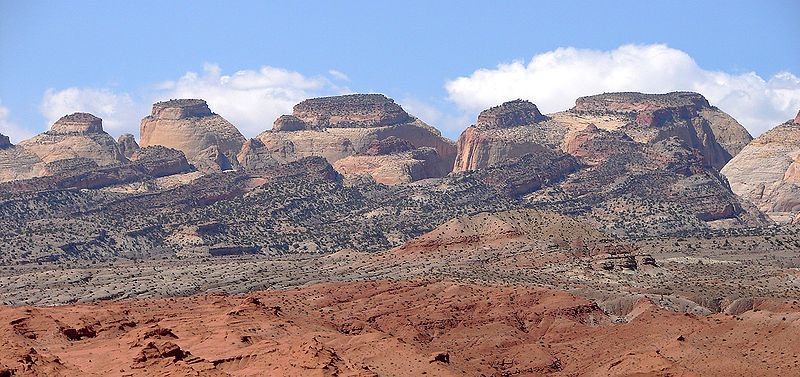
The domes of Capitol Reef. -- Photo courtesy Wikipedia

*Travels With Maggie

My soul-stirring day’s travel, full of colorful wonders of Mother Nature, didn’t end with the day’s driving. The magic continued at Capitol Reef National Park, a landscape created around 65 million years ago when forces deep in the earth created a wrinkle on the planet’s surface.

In earlier times, when I was driving a 4-wheel drive vehicle, I took the back, unpaved, steep, twisting road. which  went up and over the fold, into the park. Today, with my 24-foot Gypsy Lee, I more sedately drove into the park on Highway 24, which was still quite scenic.

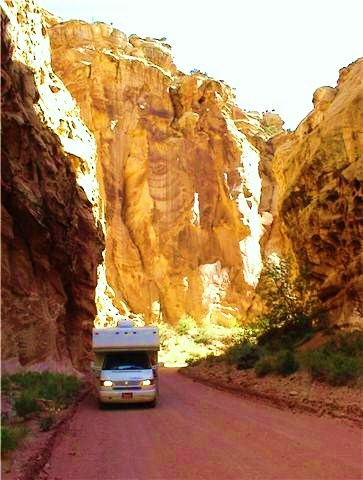
Driving down into the park’s gorge, a steep narrow road, was one of Gypsy Lee’s first adventures, and I still have the picture my oldest son, D.C., took of her that day.

This photo of Gypsy Lee down in Capitol Reef's gorge was taken in May of 2004, when she was just two months old and Maggie and I were both seven years younger. -- Photo by D.C. Bean

Thankfully this was not my first or even second visit to the national treasure, becauseI didn’t have too much time to gawk at the park’s features. With what I did have, I decided to hike a ways on the Cohab Canyon trail, which after a short ascent is fairly level.

Its trailhead is right near the park’s campground.

I walked slowly, not as interested in distance, as I was in taking in the smaller miracles so often overlooked by younger hikers. I know, because I was once one of them.

Today, however, I got my thrills from examining the swirl of patterns on sandstone rocks that lay jumbled along the trail, from a yellow butterfly flitting over some tiny pink flowers growing next to a just-beginning-to-bud cactus, from a mule deer staring at me from up the trail before quietly disappearing, and from the sight of an ash-throated flycatcher sitting up straight on a pinyon tree branch.

These were the kinds of things that interested me for the hour or so before I got back on the road for an 8-mile drive to Torrey, a small town just outside the park where I had reservations at Wonderland RV Park.

My head was so over-filled with the day’s amazing sights that I lay sleepless in my over-the-cab for a long while, watching stars overhead through my roof vent and listening to Maggie snoring on the couch below. She had decided I was too restless and retreated there for a better night’s sleep.

Have I ever mentioned how loudly Maggie snores?

*Continuing Day 10 of the journey, April 28, 2011.

 “Wilderness is not a luxury but a necessity of the human spirit.” Edward Abbey

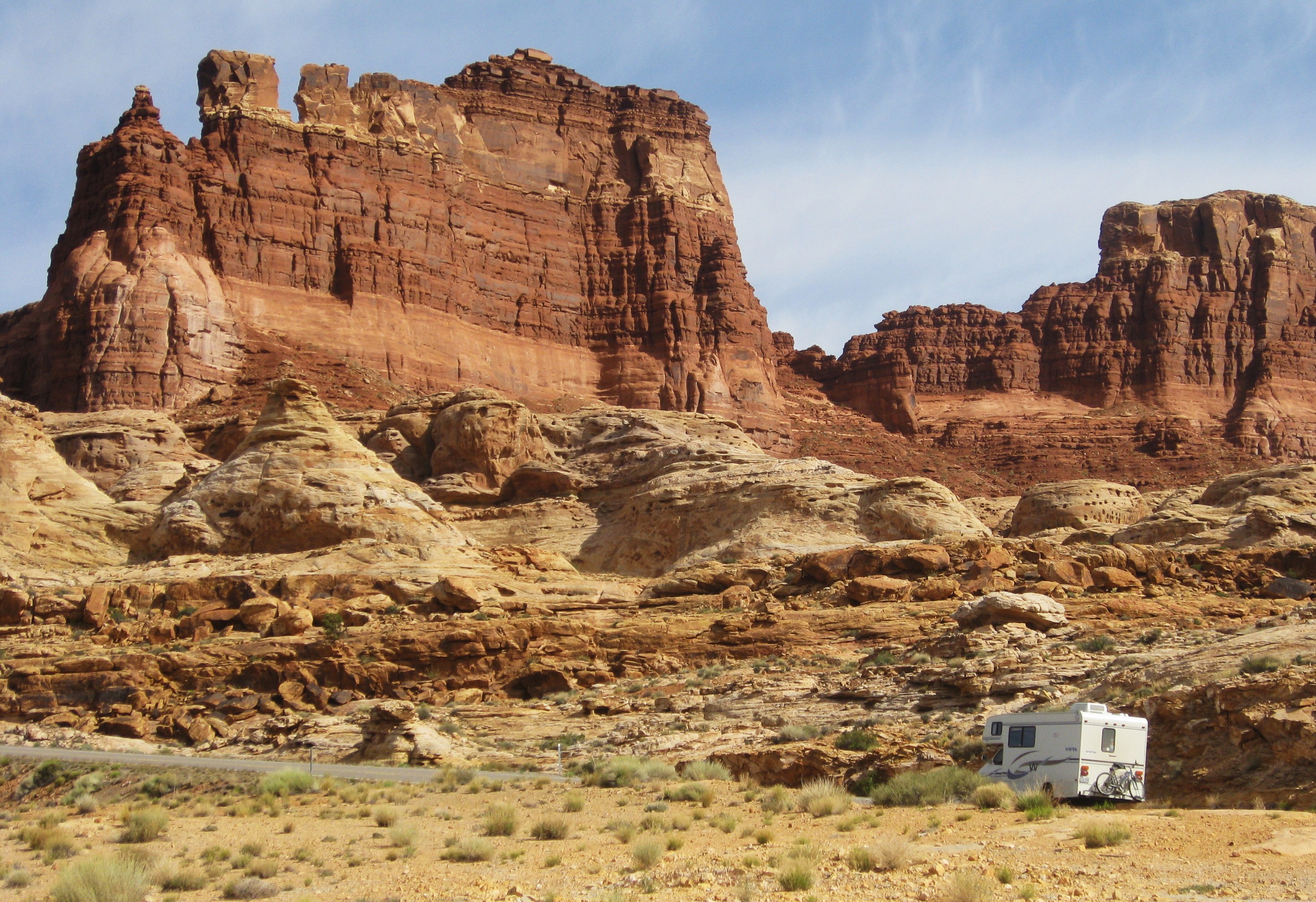
It wasn't enough to just drive through this red-rock landscape, I had to sometimes get out and touch the ground. Pictured above, my RV, Gypsy Lee, is dwarfed by this giant landscape near where the Colorado River crosses Highway 95. -- Photo by Pat Bean

Travels With Maggie*

I had an amazing scenic drive this day through some of Southern Utah’s most spectacular scenery, the landscape to which Edward Abbey first introduced me to in his irreverent “Monkey Wrench Gang.”

I read it first, then fate offered me an opportunity to explore and write about this awesome landscape when I was an environmental reporter writing about Utah land issues.

I would like to linger over this blog today, fully describing my eye-popping drive from Monticello to Capitol Reef National Park for you. But I’m sure I would get a bit redundant with the awesomes, fantastics and panoramics I would need to use to describe my emotions about the landscape found along Highway 95 and places like White Canyon, Fry Canyon, Dirty Devil River The Glen Canyon Recreation Area, Lake Powell, the Colorado River and Natural Bridges — just for the big starters.

So instead, I’m going to leave you with a few of my favorite Edward Abbey quotes, which I suspect will bore you less than my constant oohing and ahing superlatives.

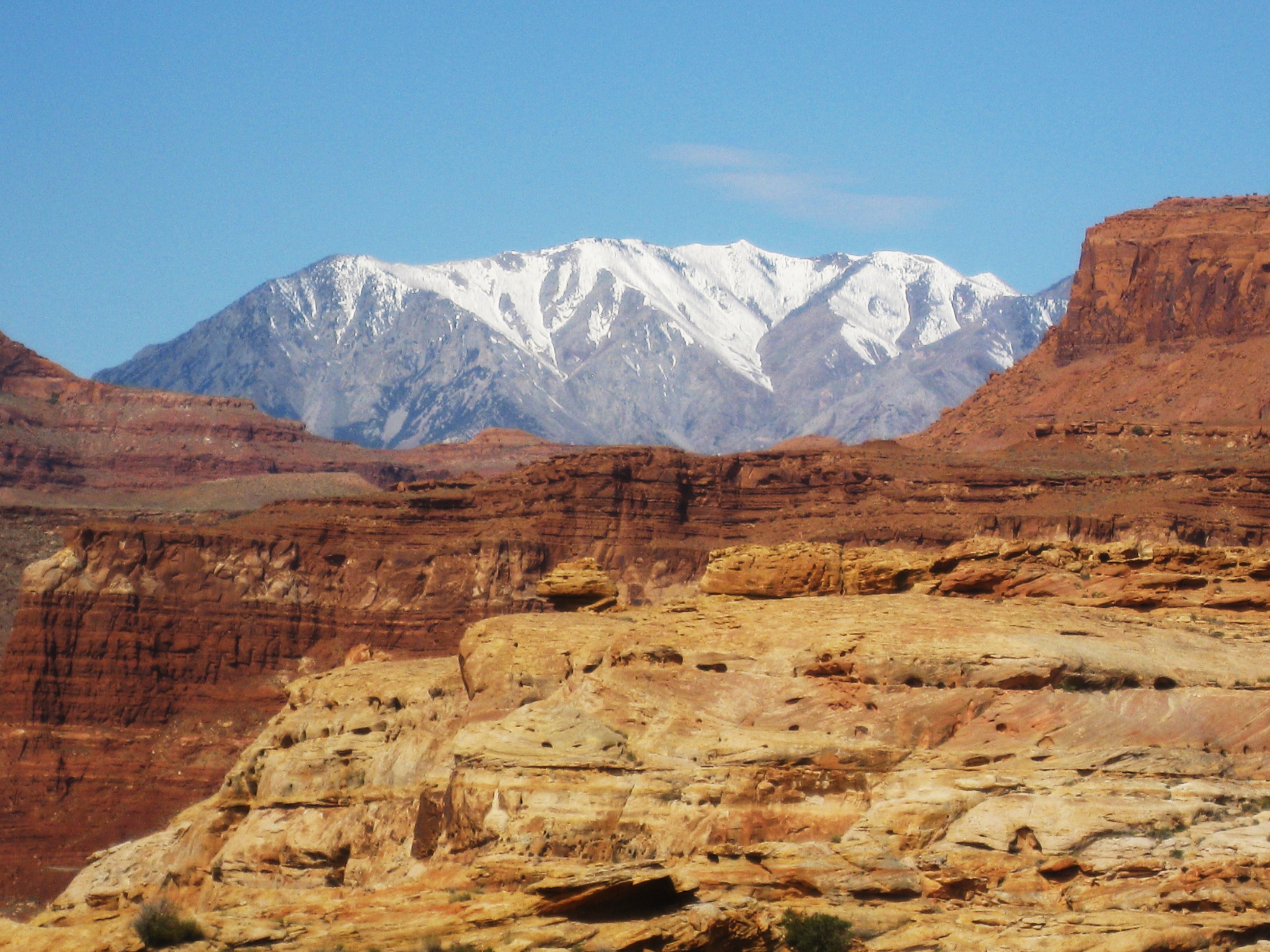
Red desert rock and snow-covered mountains, the perfect oxymoron. -- Photo by Pat Bean

Enjoy.

“May your trails be crooked, winding, lonesome, dangerous, leading to the most amazing view. May your mountains rise into and about the clouds.”

“I pledge my allegiance to the damned human race, and my everlasting love to the green hills of Earth, and my intimations of glory to the singing stars, to the very end of space and time.”

“The idea of wilderness needs no defense, it only needs defenders.”

“What is the purpose of the giant sequoia tree? The purpose of the giant sequoia tree is to provide shade for the tiny titmouse.

“One final paragraph of advice: Do not burn yourself out. Be as I am-a reluctant enthusiast… a part-time crusader, a half-hearted fanatic. Save the other half of yourselves and your lives for pleasure and adventure. It is not enough to fight for the land; it is even more important to enjoy it. While you can. While it is still there. So get out there and mess around with your friends, ramble out yonder and explore the forests, encounter the grizz, climb the mountains. Run the rivers, breathe deep of that yet sweet and lucid air, sit quietly for a while and contemplate the precious stillness, that lovely, mysterious and awesome space. Enjoy yourselves, keep your brain in your head and your head firmly attached to your body, the body active and alive, and I promise you this much: I promise you this one sweet victory over our enemies, over those deskbound people with their hearts in a safe deposit box and their eyes hypnotized by desk calculators. I promise you this: you will outlive the bastards.”

*Day 10 of the journey, April 28, 2011 

 “Every day is a journey, and the journey itself is home.” — Matsuo Basho

I passed by Mesa Verde National Park today, but last year when I came this same way I stopped for a visit and took this photo of the Balcony House. -- Photo by Pat Bean

Travels With Maggie*

I awoke this morning to an alarm clock of geese honking as they flew overhead. The sound, as always, soothed my soul. Wild things flying free, sharing the burden of making headway against the wind as they flew to whether they were going.

It was time for me to get up and get going, too.

While yesterday’s awesome drive over Wolf Creek Pass through the San Juan Mountains was a new experience for me, today’s drive would be through quite familiar territory.

Over the years, I’ve made numerous trips between my home in Northern Utah and family members in Texas. While I’ve always tried to find new roads to travel to get between the two states, more often than not on the return trip, I headed north at Santa Fe to Pagosa Springs and then went west on Highway 160 to Cortez and then north again through Moab to Ogden. It was the shortest way back home. .

On one of those trips, back in the late 1970s, I took the longer, steeper way home, heading north at Durango to Silverton and on to Grand Junction, Colorado. It was one of the first solo cross-country trips I made. And I can still recall the excitement of traveling through such fantastic country.

In my memory I can still see Twilight Peak from Highway 550, a route I didn't take this day. -- Photo courtesy Wikipedia

Up above Silverton, I came around a high, sharp curve and there, floating almost in front of me, was a hang glider. I pulled my car over to the side, got out and waved. To this day I still wonder where he came from and where he was going to land.

This day, however, I continued west through Durango, past the shadow of Mesa Verde, which I visited last year, and on to Cortez, where I stopped to resupply my refrigerator with fresh vegetables from a local market.

At the far side of Cortez, I turned north on Highway 491, which used to be Highway 666 until the name was changed because of the number’s “devilish” association. I’ve driven it under both names without any mishaps.

I ended the day’s drive in Utah, at a small RV park in the town of Monticello, where I slept soundly with the La Salle Mountains looking down on me and my dog, Maggie, curled up beside me..

*Day 9 of the journey, April 27, 2011

“It’s a dangerous business, Frodo, going out your door. You step onto the road, and if you don’t keep your feet, there’s no knowing where you might be swept off to.” J.R.R. Tolkien

An aerial view of Wolf Creek Pass and its ski area taken in August, 2008, after the snow melt. -- Photo by Doc Searls

Travels With Maggie*

“Way up high on the Great Divide” sang C. W. McCall in his 1975 recording of “Wolf Creek Pass.”

I experienced McCall’s lyrics,  although without the chickens, first hand this day, topping out my drive through the San Juan Mountains at 10,857 feet. Fresh snow had fallen during the night, and the trees on the sides of the steep mountains I traveled between were still draped in white.

In case you’re interested, McCall’ song can be heard at: http://tinyurl.com/3dvdo24

While the road, Highway 160, had been cleared of the storm’s droppings, it was still wet and slick – and quite icy in the two tunnels cutting through mountain rock.

Unlike the driver in McCall’s tune, however, my foot was frequently on my brakes. But since almost no other vehicles were on the road, and since I kept my speed slow enough to feel safe, my heart pounded only with the pleasant thrill of being privileged to drive through such a fantastic landscape.

I love dandelions, but then perhaps that's because I now don't have a lawn to maintain. -- Photo by Pat Bean

I passed quite a few large, scenic RV parks along my drive up and over Wolf Creek Pass, which traverses the mountains from South Fork to Pagosa Springs. But all were closed.

They reminded me why I usually took the more southerly route through New Mexico when heading northwest this time of year.

But I had no regrets. I may be an old broad, but I’m still up for an adventure.

I was quite happy, however, when I came upon the Riverside RV Park just outside Durango. It was open. While it had been a short day in miles, only 131, I was ready to take a break from sitting behind Gypsy Lee’s wheel.

And that I was assigned a site right next to a small pond, where mallards were floating, the ground was littered with dandelions, and where I could watch a robin pulling up a worm for dinner from the damp ground, was the cherry on the top of a hot fudge sundae.

Life was good once again. .

Day 8 of the journey, April 26, 2011.

“Finish each day and be done with it. You have done what you could. Some blunders and absurdities no doubt crept in, forget them as soon as you can. Tomorrow is a new day, you shall begin it well and serenely…” Ralph Waldo Emerson

Gypsy Lee in a better place than a dinky RV park in Alamosa. -- Photo by Pat Bean

Travels With Maggie*

My grandmother believed that trouble came in threes. I can’t tell you how many times in my life she was proved right, which is why I should have been more worried at the first setback of my perfect day.

My two previous overnight campgrounds were Colorado state parks with trails to walk, lakes to sit by, scenic landscapes out my window and birds to sing me awake in the morning. I expected tonight’s stay at San Luis State Park, just 20 miles down the road from the Great Sand Dunes, would offer much the same.

And well it might have if it hadn’t still been closed for the season – even though my Trailer Life Directory of RV campgrounds, my travel bible, said it opened for the season April 15.

The next closest campground I could locate was a KOA in Alamosa. It was another 25 miles to drive, but the directory’s ratings gave it a thumbs up, along with noting that it opened for the season on March 13.

Wrong again. It didn’t open until May 1.

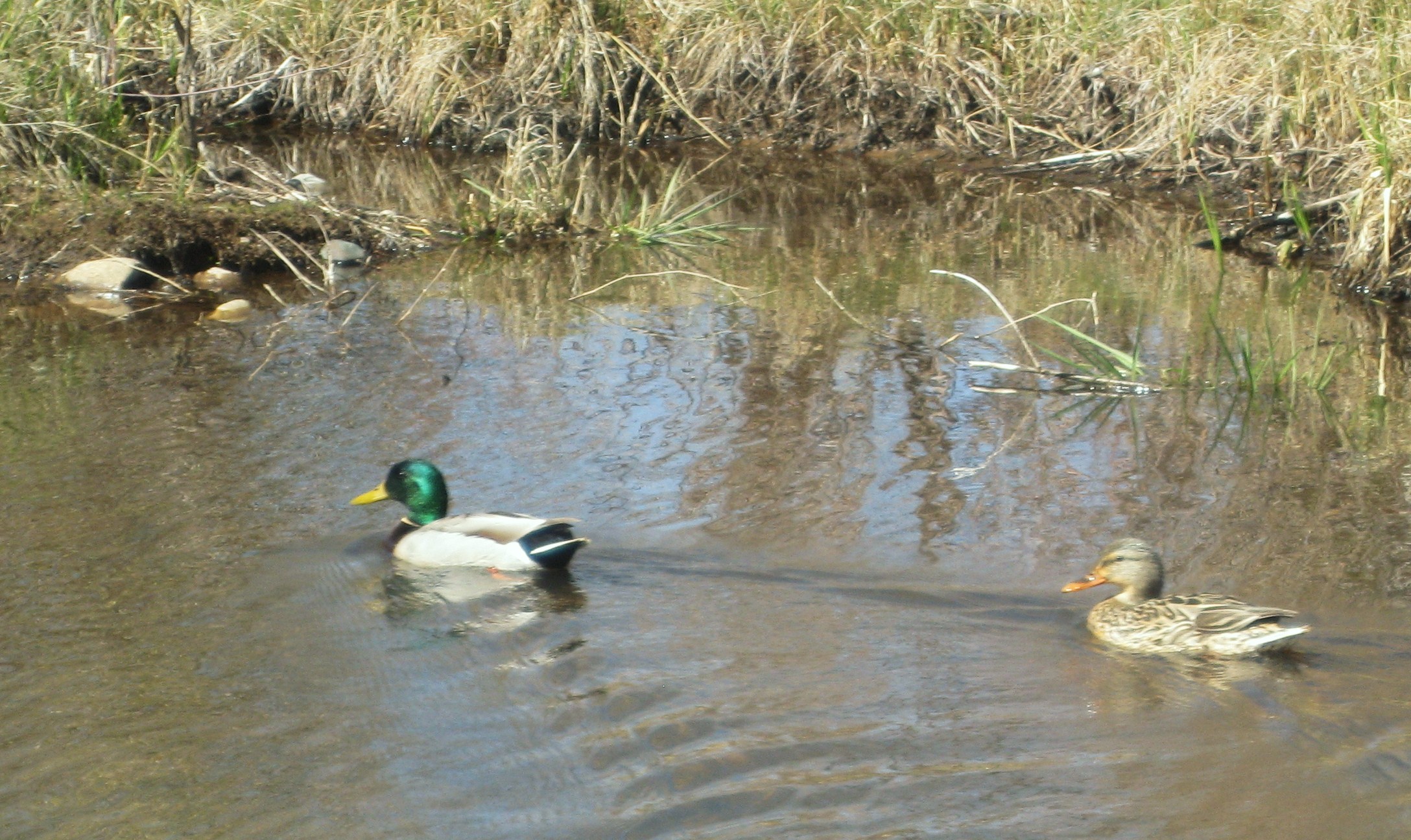
A pair of mallards cheer up any day. -- Photo by Pat Bean

I then realized my RV was pulling to the right and discovered the front passenger tire was low. My nearly new tire, I saw, had a nail in it. Quickly, I retreated to a tire store I had passed about five miles back up the road, thinking it would be an easy fix. Wrong.

Before beginning this trip, Gypsy Lee, which has over 115,000 miles on her, underwent some major wear and tear repairs, including new wheels to replace the corroded and cracked old ones. They were shiny, spiffy and expensive – and required a special key to unscrew their lug nuts, which someone had forgotten to give me.

The small Alamosa tire store, which was also a service station, couldn’t solve my problem. And by now it was after 6 p.m. and every place else was closed for the evening, even the place in Texas where I had bought the wheels. As a last resort, I called them thinking they could FedEx the part to Alamosa overnight.

I had air put in my tire, hoping it was a very slow leak, and retreated to a dinky RV park a few miles away where campers were allowed to dump their gray (dish-washing and/shower) water on the ground. I was not a happy camper. I might have whined a bit, except Gypsy Lee has a rule against such self-pity.

The best thing I have going for me as a lone female traveling this great country of ours is the confidence that I can handle what the road throws at me. This wasn’t the first, or the worse mishap, I had overcome in seven years of traveling.

So while I didn’t get a peaceful night’s sleep because of worrying about my situation, I awoke ready to solve it.

Thankfully my tire still had air in it, and the local Firestone tire shop I called as soon as they were open, said they could solve my problem. If they broke the studs getting the locks off, the sensible woman on the other end of the line told me, then they would just replace them. It wouldn’t be all that expensive.

It turned out they actually had a key for my wheels in stock, which they sold me for future emergencies. I was back on the road, my pocketbook only $22 thinner, within about 15 minutes.

Now let’s see. If I count the two closed RV parks and the nail-in-the-tire, that makes three things that went wrong yesterday.

If my grandmother was right, I had another perfect day ahead of me.

Continuing Day 7, April 25, 2001

Great Sand Dunes National Park in the shadow of the Sangre de Cristo Mountains. -- Photo by Pat Beab

The more sand that has escaped from the hourglass of our life, the clearer we should see through it.” Niccolo Machiavelli.

Travels With Maggie*

I reached John Denver’s “Rocky Mountain High” today. My journey west on Highway 160 took me through the Sangre de Cristo Mountains, the highest being 14,351-foot tall Mount Blanco. The steep winding road through the mountains topped out at a 9,468-foot snow-enhanced summit.

Since Maggie and I hit the mountains a bit past sunrise and well before sunset, we didn’t get to see why the mountain was given its Spanish name, Blood of Christ. The name is supposedly for the reddish glow the mountains take on in morning and evening light.

Even so, I was properly awed by the Sangre de Cristos’ splendor – and I was properly thankful for the new brake pads on my RV, Gypsy Lee, as Maggie and I dropped down the far side of them. And properly surprised at the detour we took off Highway 160 to see the Great Sand Dunes.

Located at the base of the snow-covered Sangre de Cristos were giant pink piles of sand, some as tall as 750-feet. I couldn’t help but feel they were geographically out of place. Which of course made them all that much more special.

Estimated to be anywhere from 12,000 to a million years old, the dunes were formed by mountain erosion transported by the Rio Grande River and its tributaries. The sand pile grew, and in some places is still growing, because the tiny wind-blown granules are trapped in a curved valley.

The dunes became a national monument in 1922, and a national park in 2000. I lingered at the visitor center and among the sand for a couple of hours before ending my detour and getting back on Highway 160.

Up to this point in time, it had been a perfect traveling day. Little did I know the pitfalls of travel that lay ahead of me. Tune in again tomorrow and I’ll tell you the tale.

Continuing Day 7, April 25, 2001

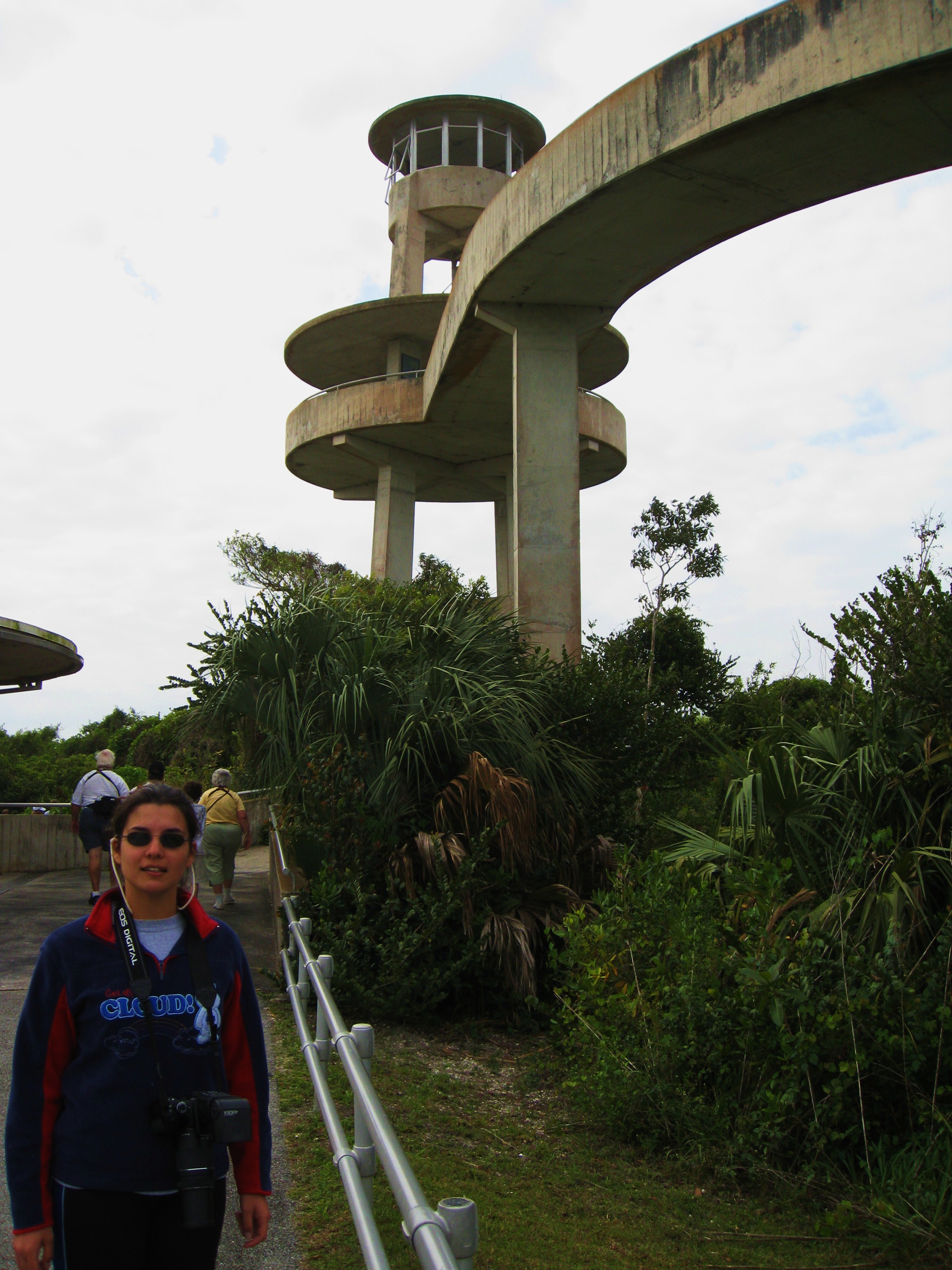
Observation tower in the Everglades and my granddaughter, Keri. -- Photo by Pat Bean


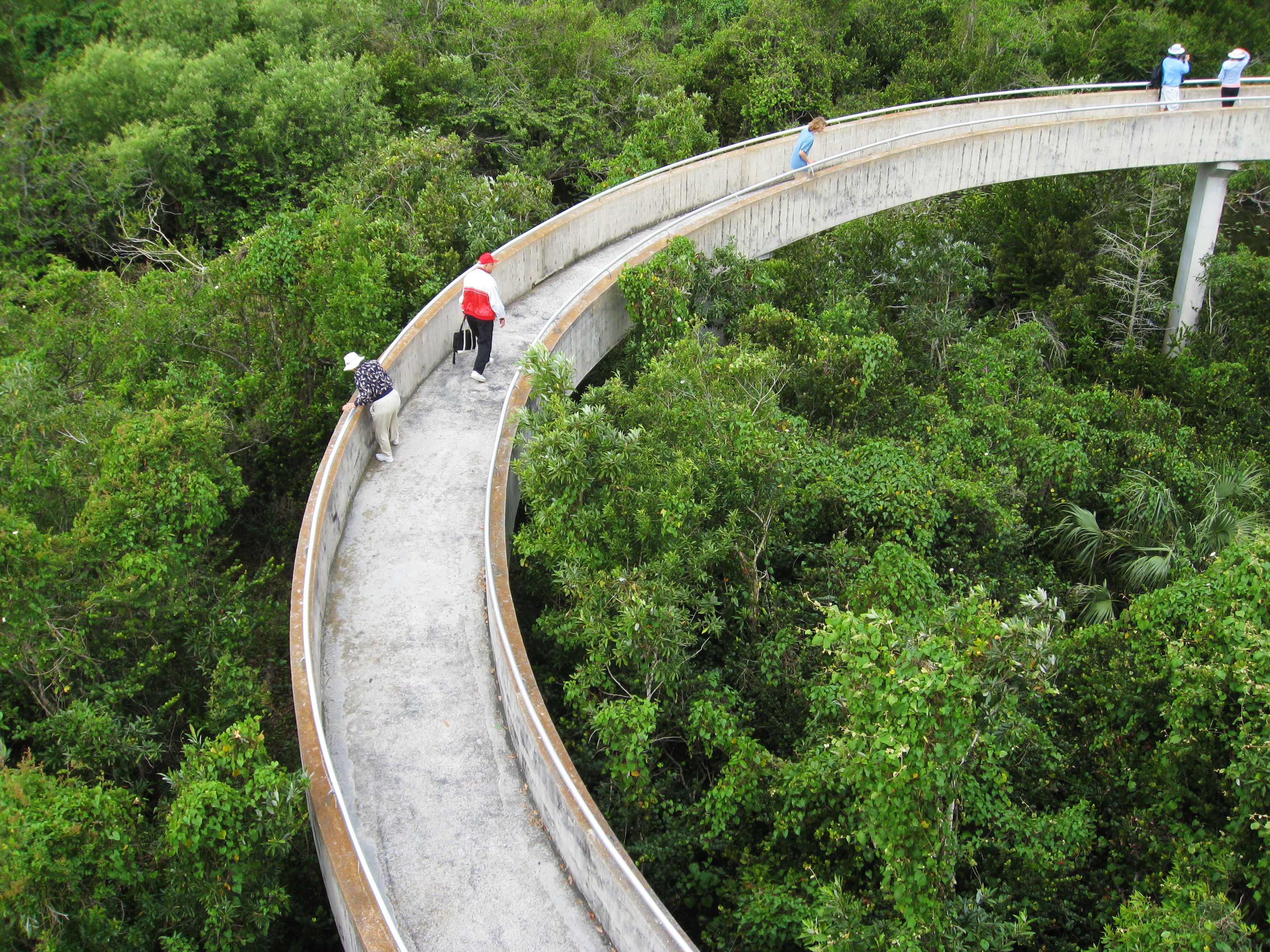
And round we go -- Photo by Pat Bean