Feeds:
Posts
Comments

Okefenokee Swamp

“We have met the enemy, and he is us.” — Pogo, alias Walt Kelly

Amazing What You Learn When You Travel

Bridge stand-off in the Okefenokee Swamp. — Photo by Pat Bean

Really? There’s an actual  Okefenokee Swamp? I thought Walt Kelly made the place up, the same as he did Pogo and all those other swamp cartoon characters. I must have missed a Georgia geography lesson, or else my Texas teachers were too enamored with tales of the Alamo to include any other state in their history lessons.

At 600 square miles, the Okefenokee Swamp should not have been so easily dismissed.

I got my first look at this geographical wonder at Swamp Park, a Walt Disney like educational and tourist attraction located on  Cowhouse Island  near where the Suwannee River begins life.

In wetter years, visitors to Swamp Park were treated to a boat ride down this waterway. But it was too dry when I visited the park in 2006. — Photo by Pat Bean

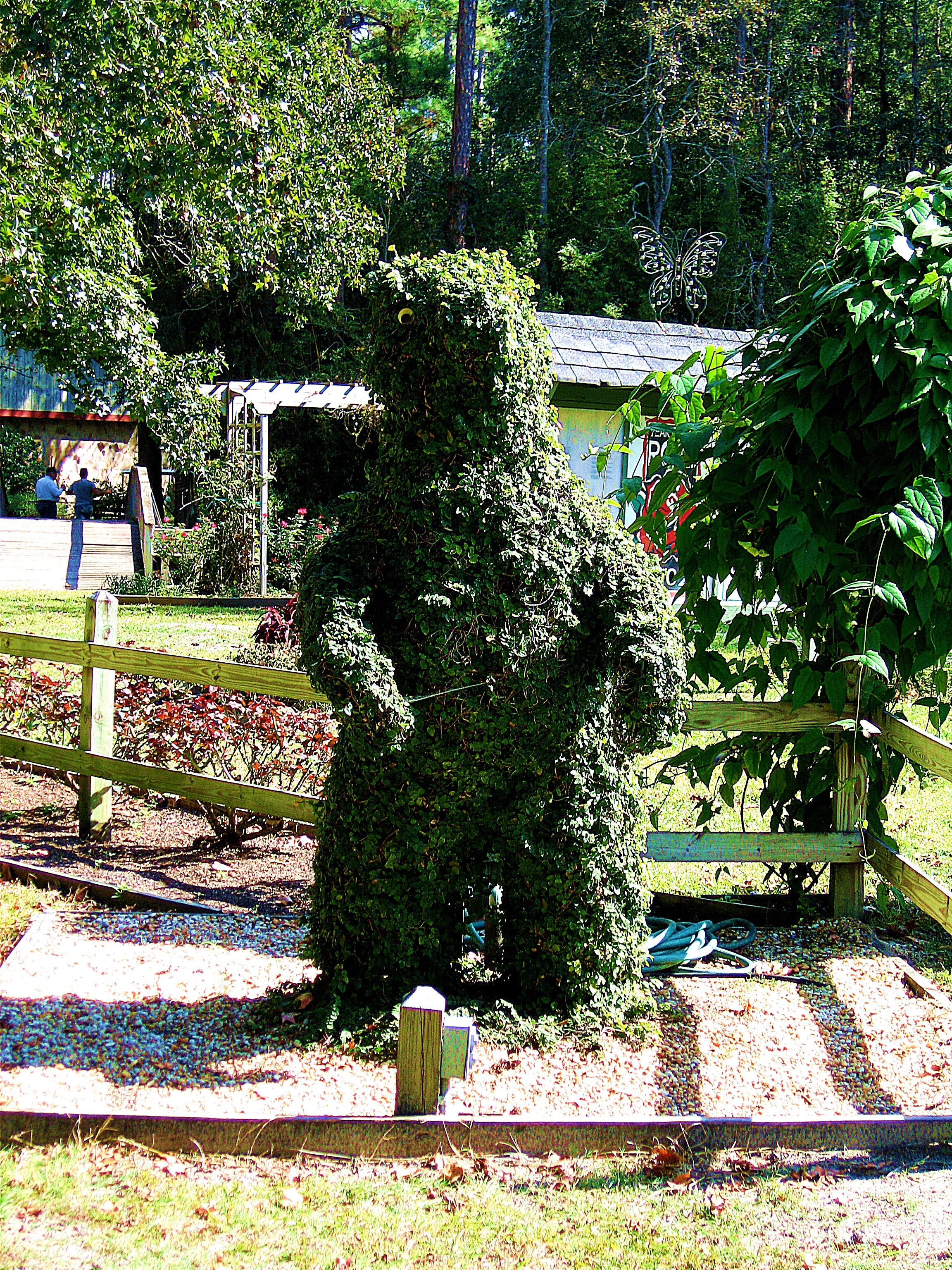
The park features plants trimmed to look like animals, scenic walkways above which alligators laze by a pond and an open air train pulled by a black, red and gold painted engine dubbed the Lady Swanee. The train’s tracks meander through stands of saw palmetto, and past a chickee (an open-air native American shelter) and a replica of a moonshine still. I assumed the sights were intended to give tourists an insight into past residents of the area.

The swamp’s name, Okefenokee, means trembling earth and refers to the land’s spongy moss base. I learned a lot more about the Okefenokee during a lecture given by a weathered local, who said he lived in the swamp alone in the winter.

“Bill collectors can’t find me, and I feel honored when I hear a panther scream,” he said. On a more educational note, he said the swamp’s dark water was the result of tannic acid leached from plants and that it was good to drink despite its color.

“We call it gator-ade.”  At this aside, he brought out several small alligators to give his audience a chance to see details of this ancient reptile survivor up close. I touched the smallest of them, thrilled to be part of the experience and more than a mere spectator.

Book Report: 32,985 words. I deserve my own Bean’s Pat for getting that much done today. It was laundry day, and it required a 50-mile round-trip into Burley to get it done.  I cheated on my blog, however. It’s a homework assignment for a Gotham travel writing class I took a couple of years ago. But the swamp was one of my stops on the six-month journey that is the subject of “Travels with Maggie.”

Bean’s Pat: Heart’s Garden http://tinyurl.com/97f7g6d Day After Day. The wondering wanderer’s blog pick of the day.


Lake Walcott Birds

            “Be as a bird perched on a frail branch that she feels bending beneath her, still she sings away all the same, knowing she has wings.” –Victor Hugo

Minus One Sharp-Tailed Grouse
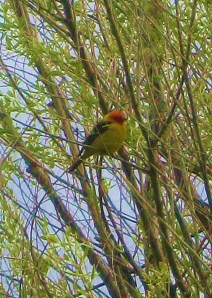
 

Only occasionally do I see western tanagers at Lake Walcott State Park. — Photo by Pat Bean

           I keep bird lists. These include a life list for all the bird species I’ve seen, a yearly bird list and a list of Lake Walcott birds. My life list stands at 702 bird species, the one for the year currently at 203 and the one for Lake Walcott, minus 1.

That one bird is the sharp-tailed grouse. Of all the birds that have been seen in the Lake Walcott area, it’s the only species not on my world list. Admittedly, it’s a rare bird for here, normally preferring more northern habitat, but I keep hoping.

Lake Walcott has, however, given me two lifers. A rare migrating Sabine’s gull that winters at sea, primarily off the West Coast, and a gray partridge, that calls Lake Walcott home year-round and which I’ve seen, among other places here, out the rear window of my RV.

Yesterday evening, the lake hosted a flock of Franklin gulls, a bird I’ve frequently seen but this was my first sighting of it here at the park. I think the flock was  just passing through because there were none of these gulls still around when Maggie and I took our walk this morning.
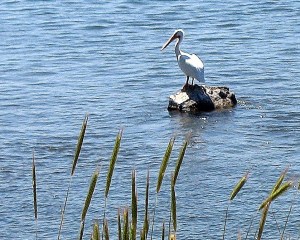
But white pelicans are on the daily bird-watching menu here. — Photo by Pat Bean

The visiting gulls, which both look and sound a lot like laughing gulls, were far enough out on the lake when I saw them that I had to use my binoculars to make an identification.

Birds I see here at the lake almost daily include white pelicans that make their nests on the opposite shore from me and which gather in great numbers below the dam where the Snake River froths up white as it flows down and over some rock ledges.

House sparrows, American goldfinches, black-headed grosbeaks, house finches, house sparrows, white-crowned sparrows, brown-headed cowbirds, Brewer’s blackbirds, red-winged blackbirds, mourning doves, robins, killeer, and broad-tailed and black-chinned hummingbirds visit my camp site almost daily.

And black-headed grosbeaks make daily visits to the bird feeders I put out. — Photo by Pat Bean

Common nighthawks and a variety of swallows fly overhead each evening. A red-tailed hawk frequents a huge nearby cottonwood tree; I wake to the hooting of a great-horned owl and the cooing of doves.  I watch western grebes, Canada geese, quacking mallards and an occasional pied-billed grebe and northern pintail swim about in the water.

Life is good for this wondering/wandering birder here at Lake Walcott. If I were to send a postcard, I’d say: “Wish you were here.”

Book Report: “Travels with Maggie” now stands at 31,331 words. While that’s just about 600 more words than yesterday’s final count, I did a lot of slashing and rewriting to make things read smoother. Rewriting can be both easier and more difficult than the first time around, which I already knew. The good news is that I’m having fun with it.

Bean’s Pat:  10,000 Birds http://tinyurl.com/8t62xry Check out these bee-eaters.

Lake Walcott State Park

“To find the universal elements enough; to find the air and the water exhilarating; to be refreshed by a morning walk or an evening saunter; to be thrilled by the stars at night; to be elated over a bird’s nest or a wildflower in spring – these are some of the rewards of the simple life.” John Burroughs.

Yet Another Amazing Morning Walk

Early morning on Lake Walcott — Photo by Pat Bean

            It’s been a busy past week: Computer problems and two 100-mile round-trips to try to get it fixed before buying a new one to end my frustrations, out-of-town visitors to my camp site here at Lake Walcott, unsuccessful struggles to meet a writing goal although I did add 5,000 new words to my travel book, falling way behind on correspondence, etc. etc.

            All of the above obstructions to my peaceful existence disappeared this morning when I took Pepper for an early morning walk. I let Mother Nature take the weight off my shoulders and simply let my mind an senses revel in the reflection of the sun on the lake, the sight of apples growing in a tree next to the trail to the boat docks, two perfect yellow flowers growing in the cranny of a rock wall smiling at the sun.

I returned to my RV refreshed and ready for the coming week, confident that whatever this week throws at me, I will embrace it and survive.

Thank you Mother Nature.

Book Report: My goal this week is 10,000 words on my travel book. Encourage me keep my fingers and brain moving.

Bean’s Pat: http://tinyurl.com/d9lsjxf Some days it’s just Monday. Blog pick of the day from the Wondering Wanderer

Confidence comes not from always being right but from not fearing to be wrong.” –Peter T. Mcintyre


I never saw a purple cow — or a blue bear. Did you. Garden sculpture at a Chama, New Mexico, art gallery. — Photo by Pat Bean

Mixed Up Animals 

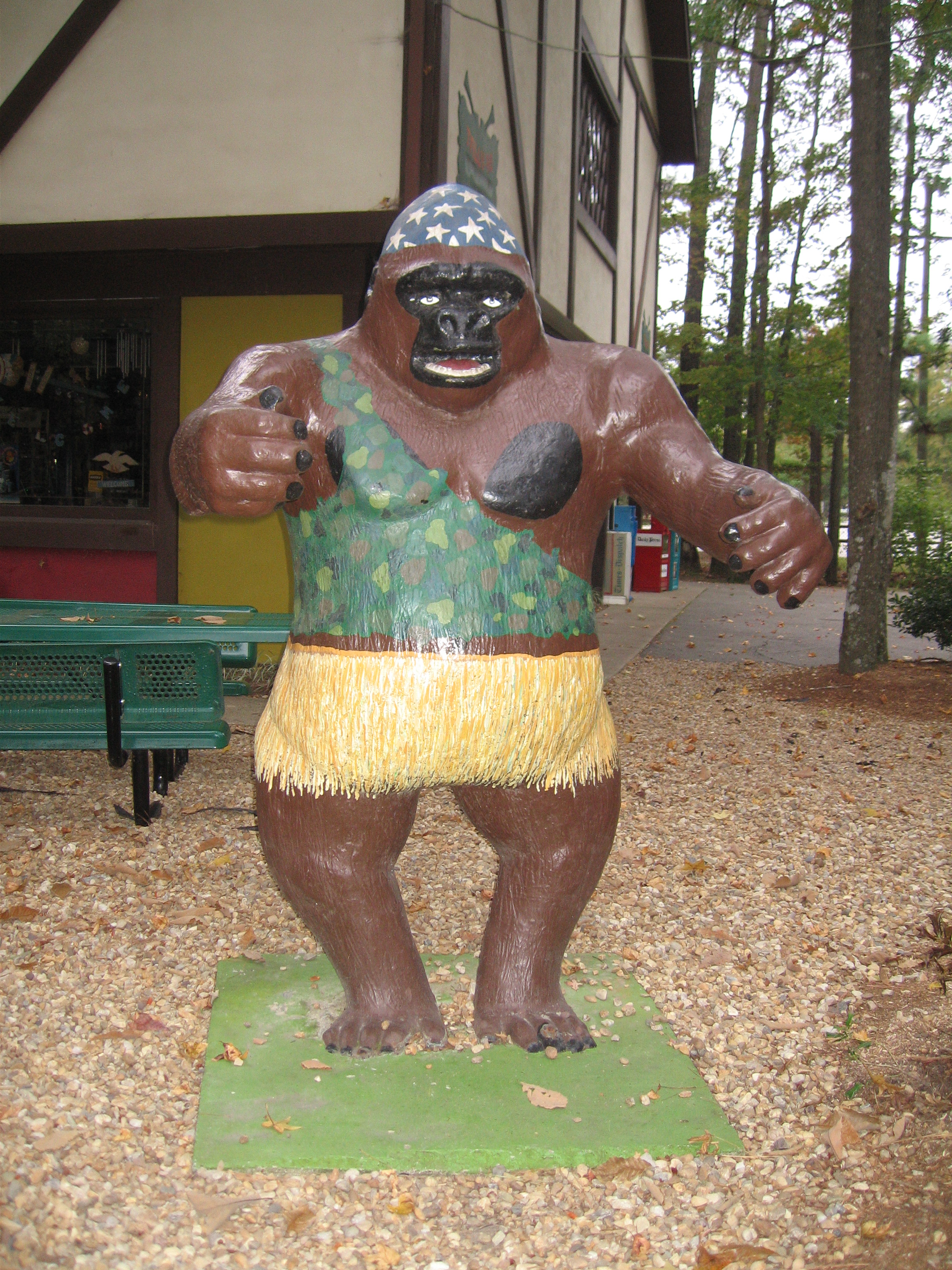
There’s just something wrong about a hula-dancing ape. Sculpture at an RV park in Virginia Beach. — Photo by Pat Bean

“Whenever people agree with me, I always feel I must be wrong.” – Oscar Wilde


           “Not all those who wander are lost.” J.R.R. Tolkien

Table Rock State Park

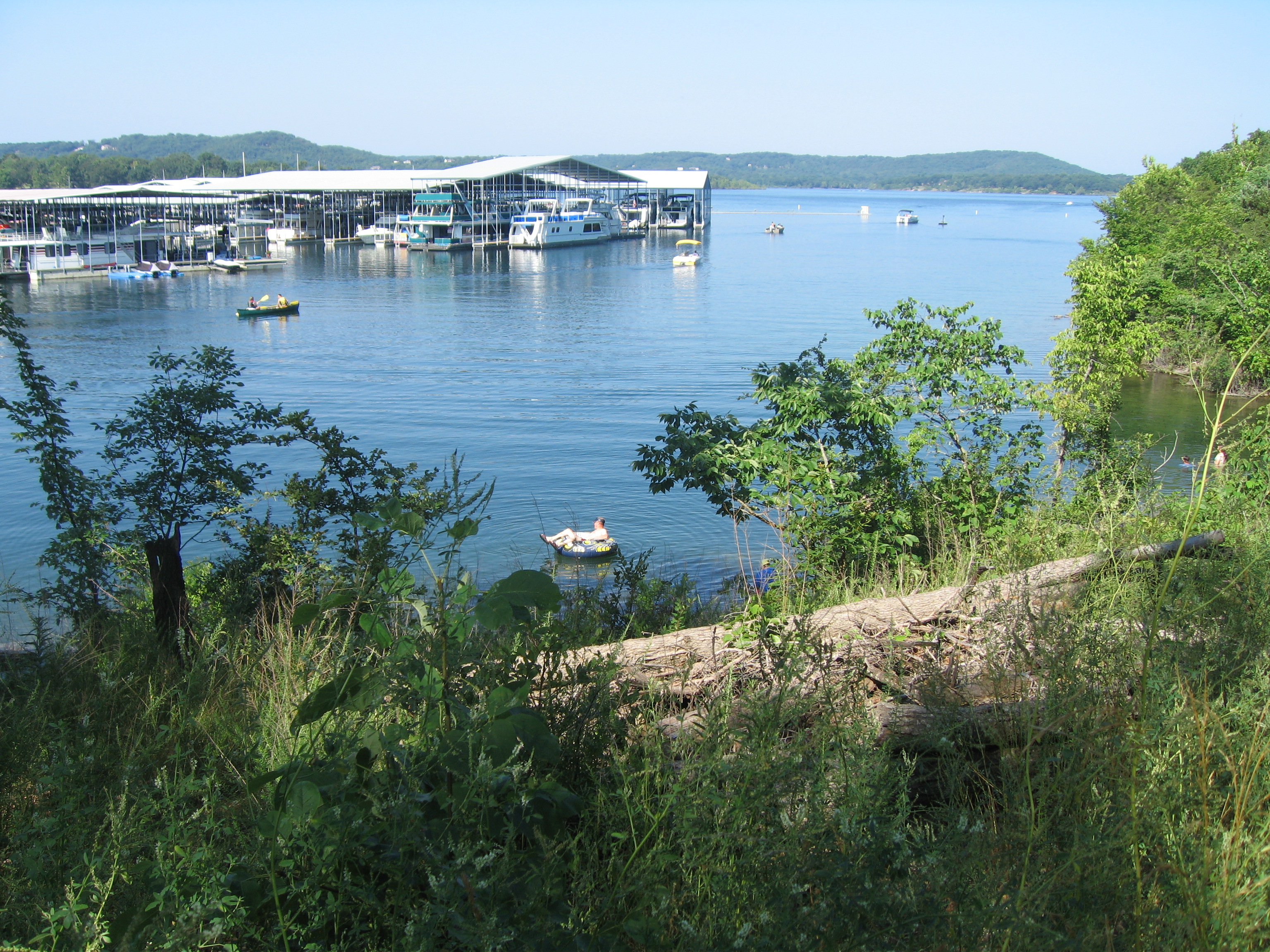
A view of Table Rock Lake and the marina from out the back of my RV. — Photo by Pat Bean

On the outskirts of Branson, which reminded me of Las Vegas, especially after it took me an hour to travel five miles down the town’s Main Street, is Table Rock State Park. This quiet oasis from the tourist trap, where the Titanic and Elvis still live and where legendary singers past their prime perform to appreciative audiences past their prime, was my home for four days.

I didn’t miss the city life at all. I only got caught up in the hour-long traffic jam because I wanted to see what the Branson hullabaloo was all about.

If you’re ever in the area, my suggestion is that you visit the park and not the city.

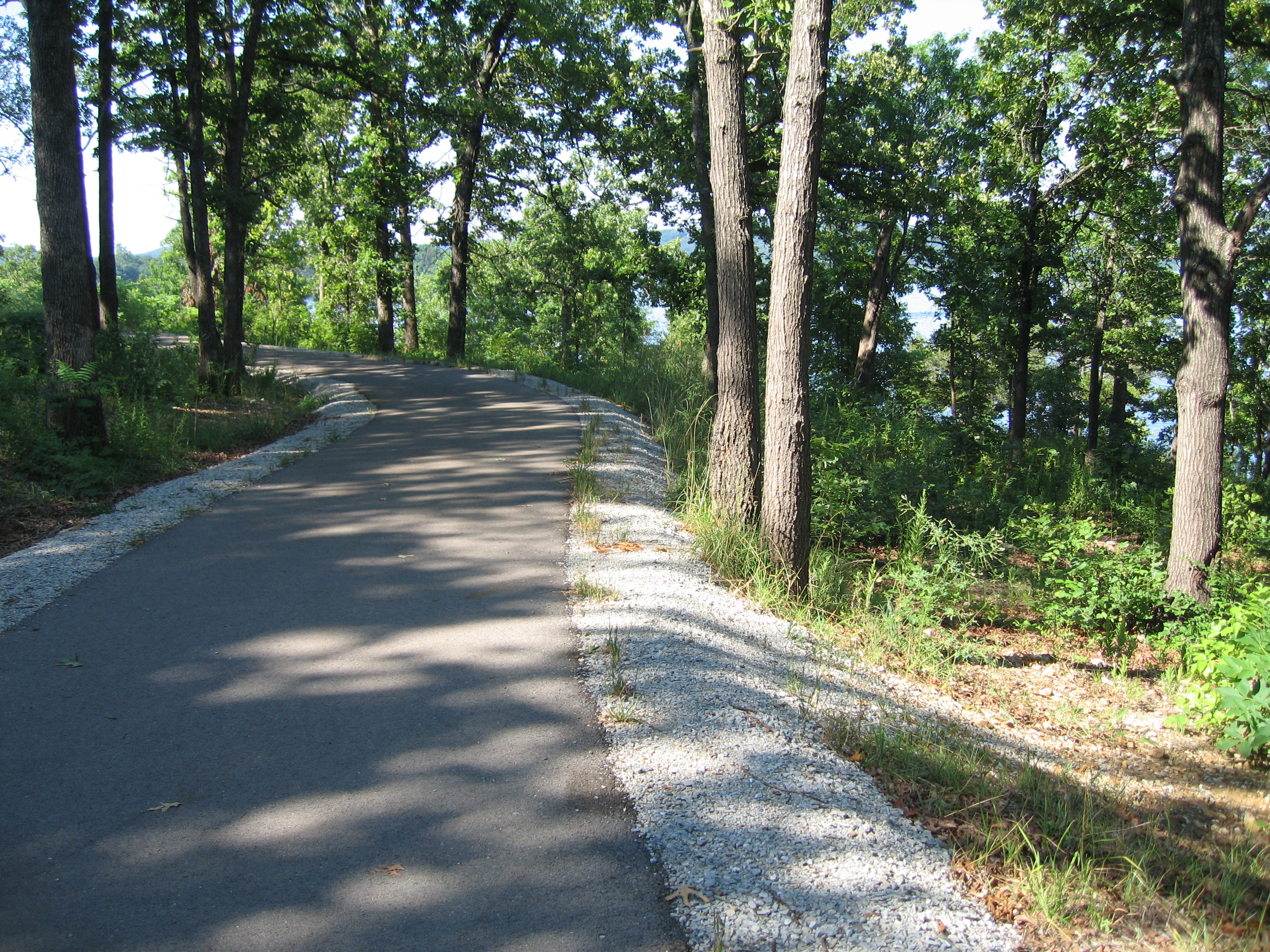
A section of the walking path that ran from the marina to the Belle Showboat that Maggie and I walked daily. — Photo by Pat Bean

My camp site backed up to Table Rock Lake and a three-mile long paved walking trail that went across a couple of wooden bridges to a marina in one direction and the Branson Belle Showboat in the other.

I walked the path early every morning with my canine traveling companion, Maggie, but pretty much kept to myself reading or  writing in the RV the rest of the time. I was content to simply watch the lake and campground goings on out my window.

I thought about taking in the show on the Belle but decided I didn’t want to spoil my lazy solitude. That’s one of the joys of traveling alone, not having to meet someone else’s travel expectations.

Book Report:  30,731. Only about 1,500 rewritten words today, but then I cut a couple of chunks of boring from the original. Leaving the boring parts out is some writing advice I’ve long tried to follow.

Bean’s Pat: http://tinyurl.com/dxyz5s8 A look back to the 1908 Olympics. Wow! Have things changed.

“The joy of living is his who has the heart to demand it.”  — Teddy Roosevelt

Roaring River State Park           

Missouri’s Roaring River wasn’t roaring when Maggie and I visited. — Photo by Pat Bean

Finding Oklahoma state parks to be my kind of place, I wondered if Missouri parks would be, too. I decided to find out on my way to St. Louis, even if it meant doubling the distance I had to travel to get there.

I considered the extra miles well worth it when I pulled into Roaring River State Park, where I had a fantastic site that backed up to a tiny creek.  Maggie and I also had our choice of several trails to hike. I chose the Pibern Trail, a narrow path that meandered in a loop through trees and thick vegetation for about a mile and a half. About halfway along our hike, I spotted my first Louisiana waterthrush, a small bird with a streaky breast and a prominent white eyebrow.

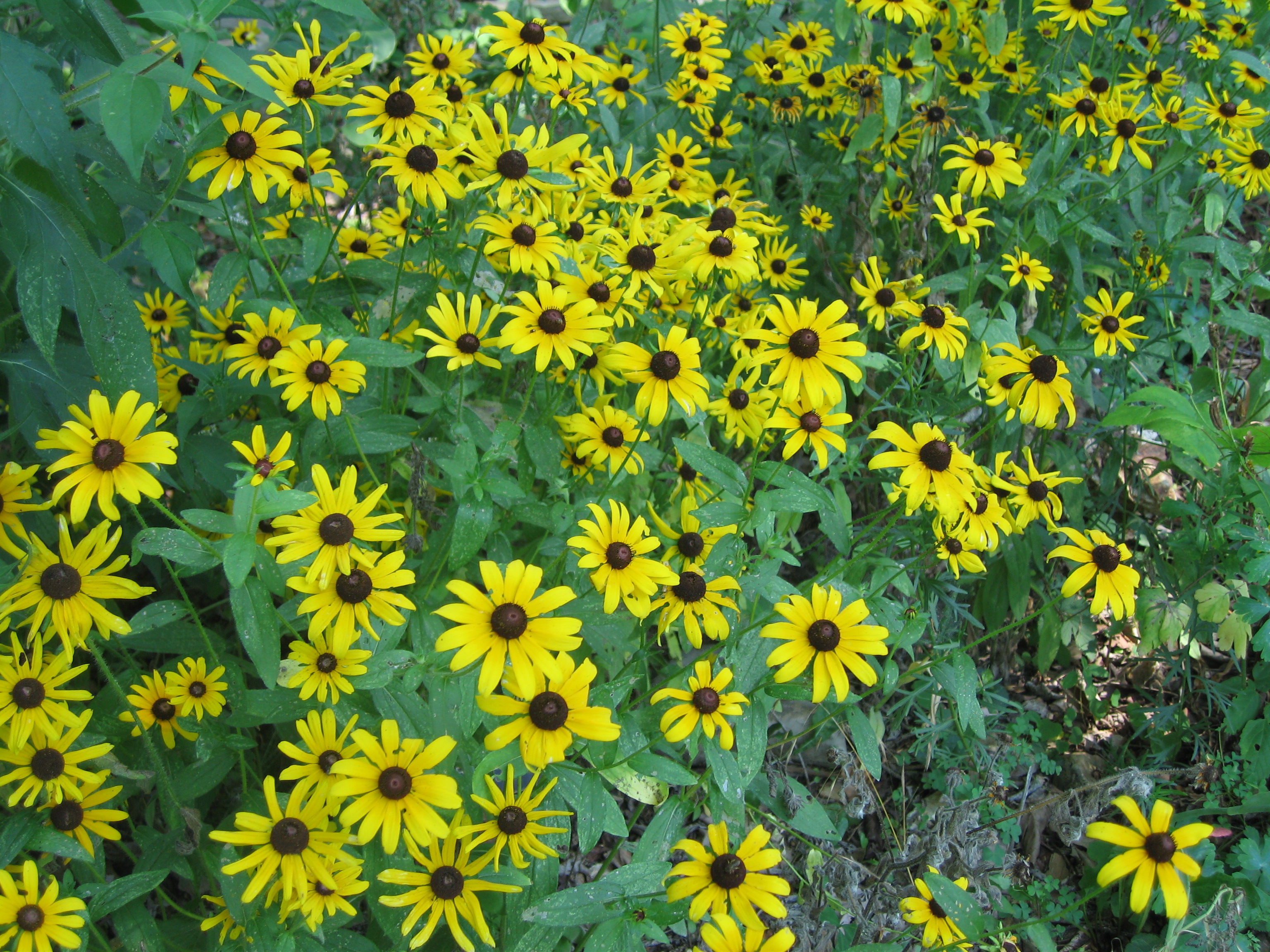
A patch of yellow flowers brightened the view near my RV site at Missouri’s Roaring River State Park. — Photo by Pat Bean

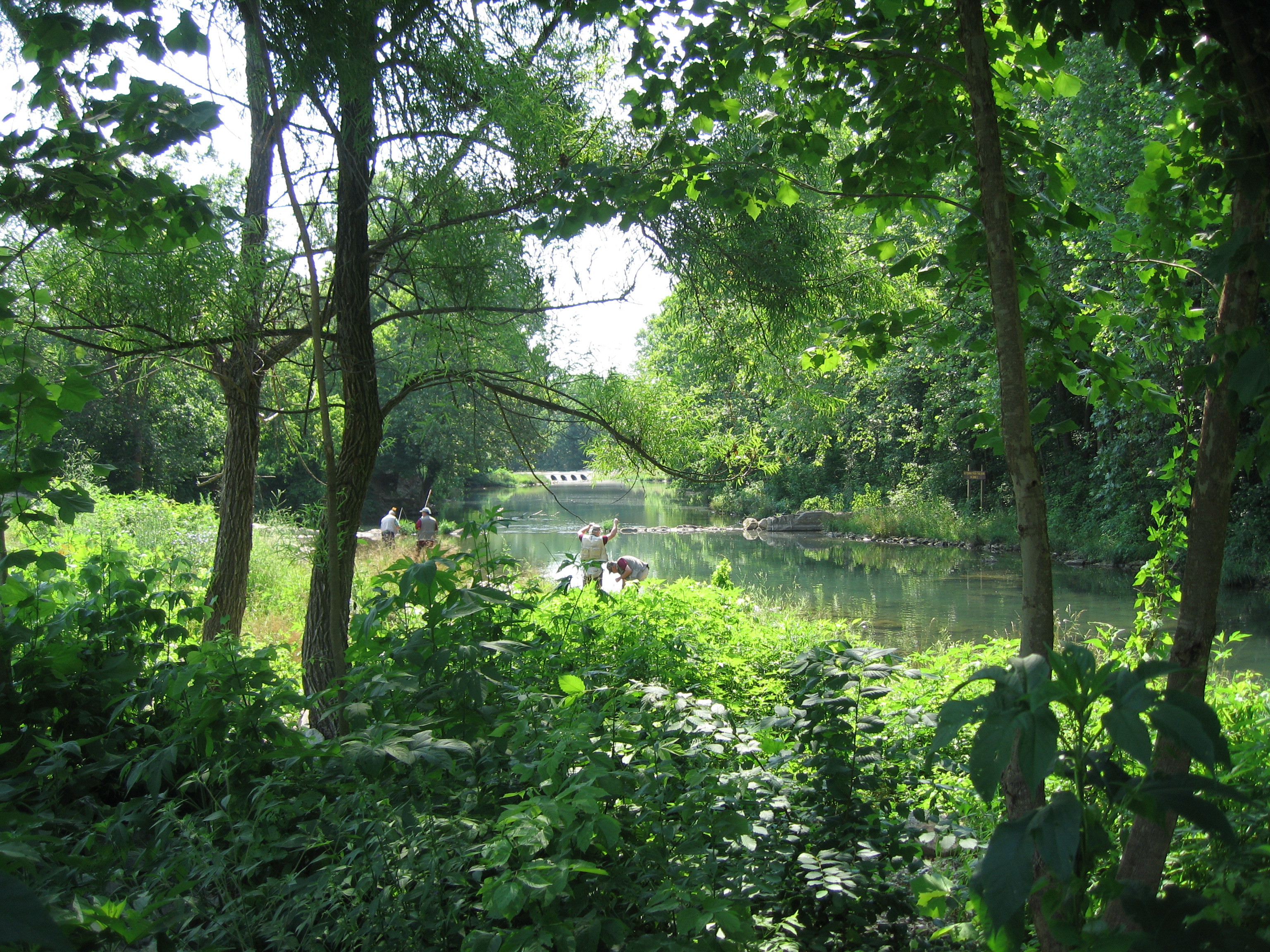
But early the next morning, when Maggie and I went looking for the “roaring river,” what we found instead was a purring stream whose banks were dotted with fly fishermen hoping to snag a trout.

We strolled beside it for a while, then made a visit to the park’s nature center, where two young boys were oohing and aahing over the bugs and snakes on exhibit there. I didn’t stay long. I was still recovering from my too-close encounter with an Ozark critter that found me during the Pibern Trail hike.

Both Maggie and I had each returned to the RV with a tick. Hers was dead already, I assumed from her monthly flea and tick killer application. Mine, however, was alive and sucking blood from my lower leg. It was the last time I went hiking in the Ozarks without a liberal dose of insect repellant on my body.

Book Report: Two days lost because the new keyboard for my #@%$** computer, which was only a little over a year old but which had given me problems almost from the day I bought it, didn’t fix the problem. The tech said it was probably the mother board. I’d had it!!!! I wasn’t going to put a single penny into that piece of  manure, an HP DV7 just in case anyone is interested, that I had come to hate. I bit the bullet and bought a new laptop, my first non HP one. It’s a Toshiba Satellite.  I spent the past two days playing with it. But it was back to business this morning, and I added another 2,000 rewritten words to my travel book. That seems to be my daily output when I don’t goof off.

Bean’s Pat: Every Day Wisdom http://tinyurl.com/96rkgw3 Advice I truly try to follow.

 “I hear lake water lapping with low sounds by the shore … I hear it in the deep heart’s core.” – William Butler Yeats.

“I’m an old-fashioned guy … I want to be an old man with a beer belly sitting on a porch, looking at a lake …” – Johnny Depp (Ditto, except instead of a beer belly it will be tits down to my waist.”

Sleeping by Water

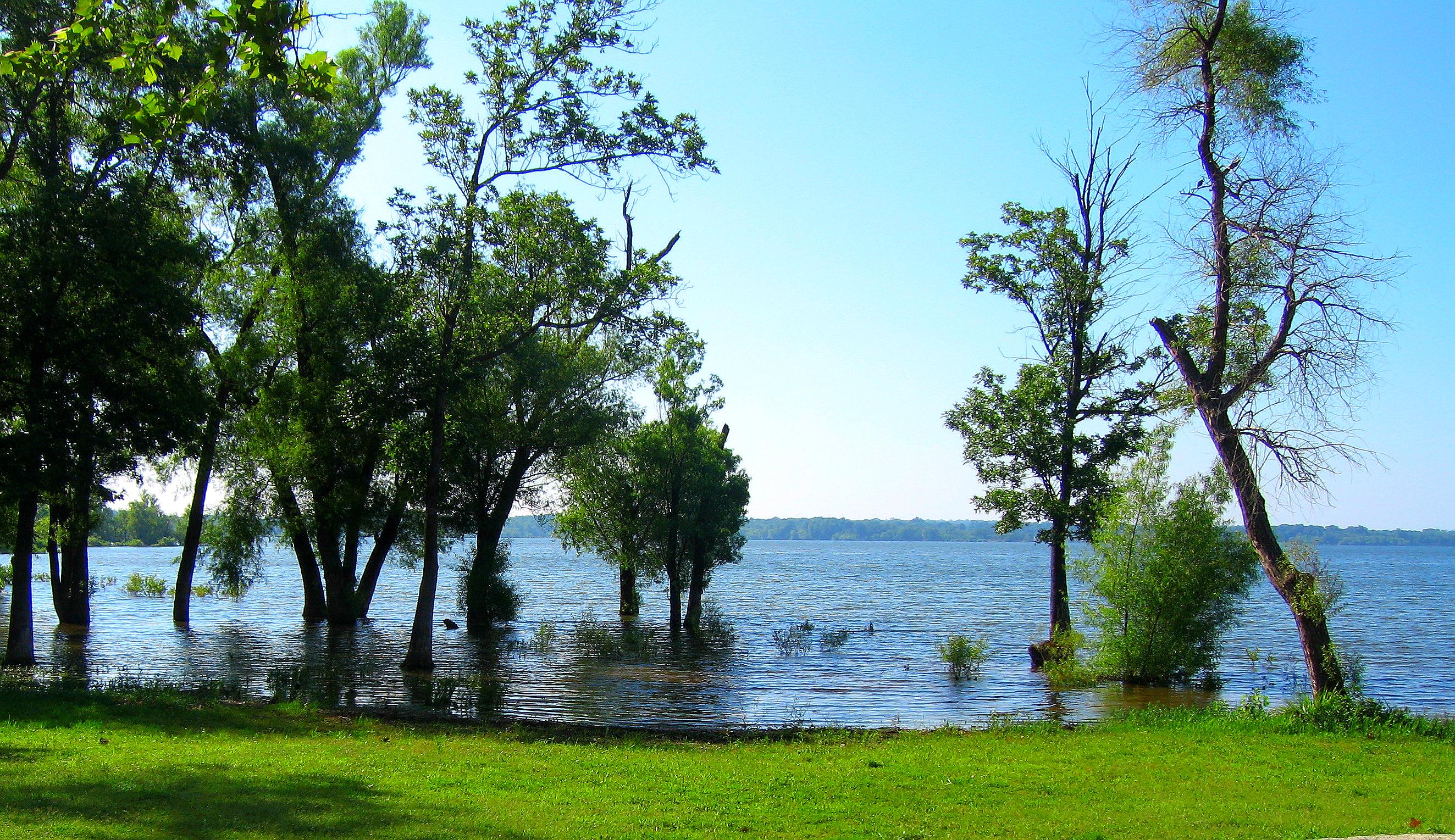
The view out my RV window at Grand Lake o’ the Cherokees at Bernice State Park in Northeastern Oklahoma. — Photo by Pat Bean

While my route only took me through a northeastern sliver of Oklahoma, I found three state parks in which to camp. In addition to Natural Falls, where the movie, “Where the Red Fern Grows,” was filmed, there were Lake Wister and Bernice, both of which are attached to lakes: Lake Wister, a 7,300-acre reservoir created by a dam on the Poteau River, and 46,500-acre Grand Lake o’ the Cherokees formed by the Grand River at Bernice.

The peacefulness and beauty of my nights by these lakes led me to continue seeking out similar campgrounds as I continued my travels – and parking my RV as close to water as I could get .

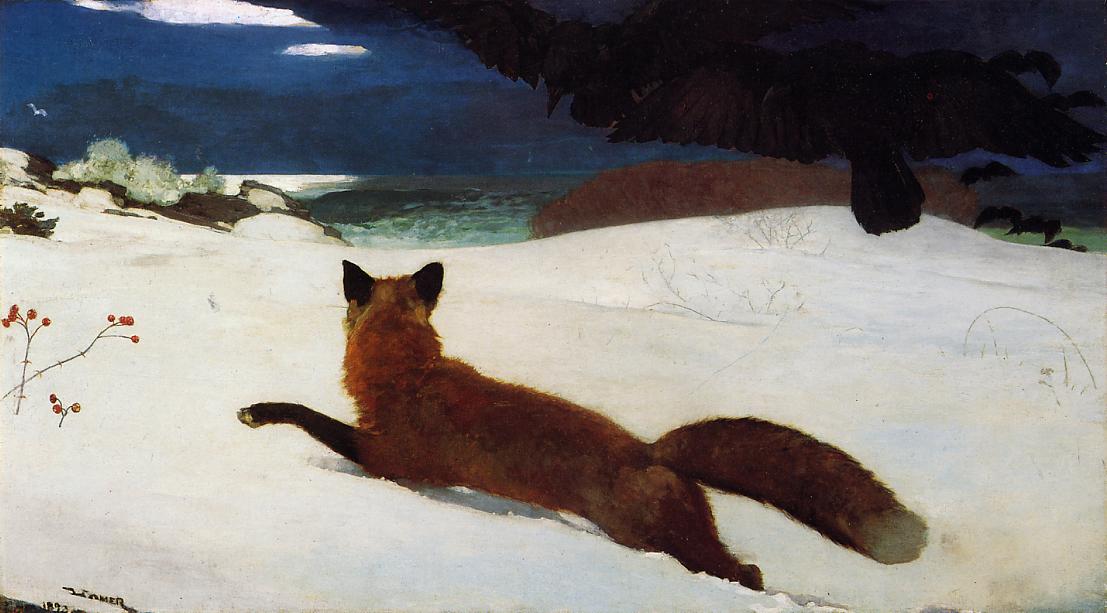
If you like Winslow Homer’s painting of the “Fox Hunt,” you should most certainly check out today’s Bean’s Pat.

Often I would find myself falling to sleep listening to the soft murmur of water sloshing up against one bank or another. It seemed fitting that one of the many books I read on my journey was “River Horse” by William Least Heat Moon, whose “Blue Highways” was one of my traveling role models.

In this later book, Moon, made his journey across America from the Atlantic Ocean at the New York Harbor to the Pacific Ocean near Astoria, Oregon, in a boat called Nikawa, or river horse in the Osage language.

Travels With Maggie: 27,682 words. The original draft was about 60,000 words, so I’m nearing the halfway point, although I’m thinking it might be closer to 70,000 words when I finish, despite the many cuts I’m making. The task of adding my voice to this travelogue is, I think, requiring more than eliminating the redundancies and any boring parks. I might have been farther along at this point except computer woes, which still have not been totally resolved, ate up the better part of two days.

Bean’s Pat: Golden eagle attacking a fox http://tinyurl.com/c29uogk Winslow Homer painted ravens harassing a fox, and I’ve seen ravens doing just that, but this photo is way more fantastic.

 “You’ve got to do your own growing, no matter how tall your grandfather was.” – Irish saying.

Great Sand Dunes National Park


Think of it. Grain by grain is how these great sand dunes grew. — Photo by Pat Bean


“The more sand that has escaped from the hourglass f our life, the clearer we should see through it.” — Niccolo Machiavelli

Great Sand Dunes National Park, Colorado. — Photo by Pat Bean

“There are no great limits to growth because there are no limits of human intelligence, imagination and wonder.” Ronald Reagan.


 “The point is that when I see a sunset or a waterfall or something, for a split second it’s so great, because for a little bit I’m out of my brain, and it’s got nothing to do with me. I’m not trying to figure it out, you know what I mean? And I wonder if I can somehow find a way to maintain that mind stillness.” – Chris Evans

And Lots of Birds and Scenic Trails

A walk among the tree branches at Natural Falls State Park in Oklahoma. — Photo by Pat Bean

Natural Falls State Park had it all, a waterfall, scenic trails and lots of birds. And I wasn’t the only one who thought so.

Producers of the heart-warming, “Where the Red Fern Grows,” based on the book of the same name by Wilson Rawls, used the park as a setting for the movie.

Natural Falls was my fourth stopping place on the six-month journey I’m detailing in “Travels With Maggie.”

My favorite hike while there meandered around a small lake and through the woods to a view of the park’s 77-foot namesake. At one point along the trail, a wooden footbridge took me up to tree branch level, where I paused awhile to listen to birds.

77-foot tall Natural Falls. — Photo by Pat Bean

By tracking the melody, I located a  northern cardinal and then a song sparrow that sang a duet from the same tree.

Nearby a yellow-rumped warbler, or butter-butt as birders call it, added its drum-beat chirp to the chorus. I identified it when it flashed its yellow rump at me.

Of course I lingered at the park for a couple of days. How does one leave such perfectness too quickly?

Book Report: Murphy’s haunting me. I spilled coffee on my computer yesterday, which is why I didn’t post. I had written my post and had added about 500 words to my book, Travels With Maggie, before the catastrophe hit, and I had to make a 100-mile round-trip to Best Buy in Twin Falls, Idaho. The fix is only temporary until I get the new keyboard in I ordered, and I’m still dealing with delaying quirks. I’ve been saying the S word a lot. Dookie computers. Can’t live without them, at least I can’t, and it’s hard as hell to live with them. The silver lining, which I always look for and usually find, is that I didn’t lose anything. I keep promising myself I’m going to back up, and I keep not backing up.

Bean’s Pat: http://tinyurl.com/cflc44d The deadly results of playing the comparison game. The wondering wanderer’s blog pick of the day.

Favorites: Travel Books

 “The world is a book and those who do not travel read only one page.” – St. Augustine

Ten of Hundreds


Lake Powell, which destroyed Glen Canyon and which wouldn’t ever have existed if Edward Abbey’s “Monkey Wrench Gang” characters had anything to say about it. — Photo by Pat Bean

I won’t say these are my 10 favorite travel books, because I could name 10 more just as easily. But these are books that influenced my decision to become rootless and make the road my home for the past eight years.

I Married Adventure, 1940, by Osa Johnson. I picked this book up at the library when I was about 10 years old. I was always sneaking into the adult section. I think I already knew I had wanderlust, and this book simply confirmed it. I, too, wanted adventure.

Blue Highways by William Least Heat Moon. My 22-foot RV, Gypsy Lee, is my version of Moon’s green van, Ghost Dancing. I loved this book so much that I’ve given dozens of copies away as gifts. The green-dotted scenic byways marked on today’s maps are my blue highways.

Road Fever, by Tim Cahill, I have loved everything this Wyoming author has written, especially this book that details a 15,000-mile trip from Tierra del Fuego to the top of Alaska. I’ve read everything this author has written that I could come across, including his many Outside magazine stories.

A Walk in the Woods by Bill Bryson. This book fueled my desire to walk the Appalachian Trail, but except for a few miles on various sections it’s a to-do list item that I’ve waited too long to get around to doing. But I still have time to hike at least a few more miles on this trail whenever I come across one of its many trailheads.

One of Charles Kuralt’s more popular “On the Road” episodes wat the time he hooked up with a botanist to put names to all the wildflowers he was seeing, like this fireweed. — Photo by Pat Bean

Travels With Charley by John Steinbeck. I read this book many years ago, but reread it when I took to the road in 2004. My wordsmith friend, Charlie Trentelman, mentioned that I was the female version of Steinbeck, thus the title of my travel book, “Travels With Maggie.” Thank you Steinbeck.

On the Road with Charles Kuralt. Charles Kuralt was also influenced by Steinbeck. Kuralt, meanwhile, is actually the traveler most like me. We were both journalists, and we both prefer looking at life’s brighter side. I cried when Kuralt died, and one of my favorite travel photos is of his “On the Road” RV that’s on exhibit at the Henry Ford Museum.

The Snow Leopard, by Peter Matthieson. A fantastic writer who makes one think. This book brought the Himalayas to life for me. I was privileged to have once heard this author speak.

Out of Africa by Isek Dinesen. Like Osa Johnson, this book made me want to travel to Africa. Not only did I do that in 2007, I visited Dinesen’s former coffee plantation in Nairobi.

Desert Solitaire by Edward Abbey. While I loved this book, Abbey’s “The Monkey Wrench Gang” is my favorite of all that he has written. It, too, could be considered a travel book in that it includes awesome descriptions of Utah and Arizona’s red-rock landscape.

The Great Railway Bazaar by Paul Theroux. No travel book collection would be complete without Theroux. This is my favorite of his many.

Book Report: Busy morning, then a four-hour lunch with a group of mostly crazy old broads, whose Bay of Pigs nickname rivals my former group of crazy old broad friends called the Murder of Crows, that I wouldn’t have missed for the world. It comes under my umbrella mantra of smelling all the flowers and grabbing all the gusto this life has to offer. While I will do some editing as part of the rewrite of my travel book late this afternoon, I doubt I will add any significant word count. It’s the story of my writing life, conflicting goals. The good thing is that I no longer flagellate myself for such lapses.

Bean’s Pat: Photos and Facets; http://tinyurl.com/ckpfxer No! It’s not the London Bridge you’ve been seeing on television.