Feeds:
Posts
Comments

Archive for the ‘Nature’ Category

“To find the universal elements enough; to find the air and the water exhilarating; to be refreshed by a morning walk or an evening saunter; to be thrilled by the stars at night; to be elated over a bird’s nest or a wildflower in spring – these are some of the rewards of the simple life.”  ~John Burroughs

Birding Day

I abandoned my blog this morning, and spent the day out birding with my son Lewis. I just barely got back, and words always fail me this time of day. So I’ll simply share one of the photos I took today. Hopefully you’ll think it worth my usual 350 words.

Great

Great egrets and roseate spoonbils at Surfside -- Photo by Pat Bean

Read Full Post »

“…we turned a point of the hill on our left, and came suddenly in sight of another and much larger lake, which, along its eastern shore, was closely bordered by the high black ridge which walled it in by a precipitous face … Spread out over a length of 20 miles, the lake, when we first came in view, presented a handsome sheet of water; and I gave to it the name Lake Albert, in honor of the chief of the corps to which I belong. …” John Fremont

Lake Albert's southeast end from Highway 395. -- Photo by Pat Bean

Travels With Maggie

Highway 395 stretches for 1,370 miles – from the Canadian border in Washington, down through Oregon, California, Nevada and back into California, where it ends just about 150 miles short of the Mexican border. .

I drove 730 miles of it heading south last month, beginning in Pendleton, Oregon, and ending when I turned west onto Highway 120 that would take me up and over 9,943-foot Tioga Pass through the Sierra Nevada Mountains and down into Yosemite Valley.

Much of the drive was on steep, narrow, winding roads with little traffic. I loved every moment of the journey.

Lake Albert from Albert Rim -- Wikipedia photo

The route winds through Oregon’s Battle Mountain State Park, the Umatilla, Malheur, Modoc, Toiyabe and Inyo national forests, and the X L Ranch Indian Reservation, passing numerous lakes on the way. There’s Goose Lake in Oregon, located near Fandango Pass that was used by early settlers to California; Nevada’s Washoe Lake, located between Reno and Carson City and popular with windsurfers; and Mono Lake in California, which was on my bucket list because of its importance to migrating shore birds.

A smaller lake that captured my attention was Oregon’s Lake Albert. Like Mono, it is too salty for fish to live in its waters. It has, however, a dense population of brine shrimp that make it a popular dining stopover for migrating grebes, phalaropes, terns, avocets, geese, stilts, ibis and other birds.

Albert Rim geology marker -- Photo by Pat Bean

Canada geese were the main occupants on the narrow lake the day I drove the 15-mile section of Highway 395 that overlooks the east side of the lake from just feet away. I stopped several times to admire the lonely and lovely view of pink hills reflecting onto the water from the opposite shore.

I also found myself fascinated by the geology marker that explained the lava ridge running parallel to the lake. Known as the Albert Rim, it’s one of the highest fault scarps in the United States.

Except for the highway, which ran between the basalt ridge and the lake, and an occasional passing vehicle, I suspected the landscape still looked pretty much as it did during John Fremont’s mapping expedition in central and southern Oregon back in the 1840s.

It’s rare to find a place so little impacted by we humans – and wonderful.

Read Full Post »

“If we had a keen vision of all that is ordinary in human life, it would be like hearing the grass grow or the squirrel’s heart beat, and we should die of that roar which is the other side of silence.” – George Eliot

Some squirrels can be downright sassy. -- Photo by Pat Bean

Travels With Maggie

Unlike all the other squirrels my canine traveling companion, Maggie, and I approached in the park early this morning, one didn’t quickly scamper away at the sight of us.

It held its ground, engaging us in a stare off. We got to within about 20 feet of it before Maggie could stand it no longer. With a sudden spurt of energy, she raced toward it.

She had 25-feet before her retractable leash would pull her up short, but she stopped before she hit the end. I think she knew, even before she started the chase, that she didn’t have a chance. She’s had a lot of experience with sassy squirrels during our many walks.

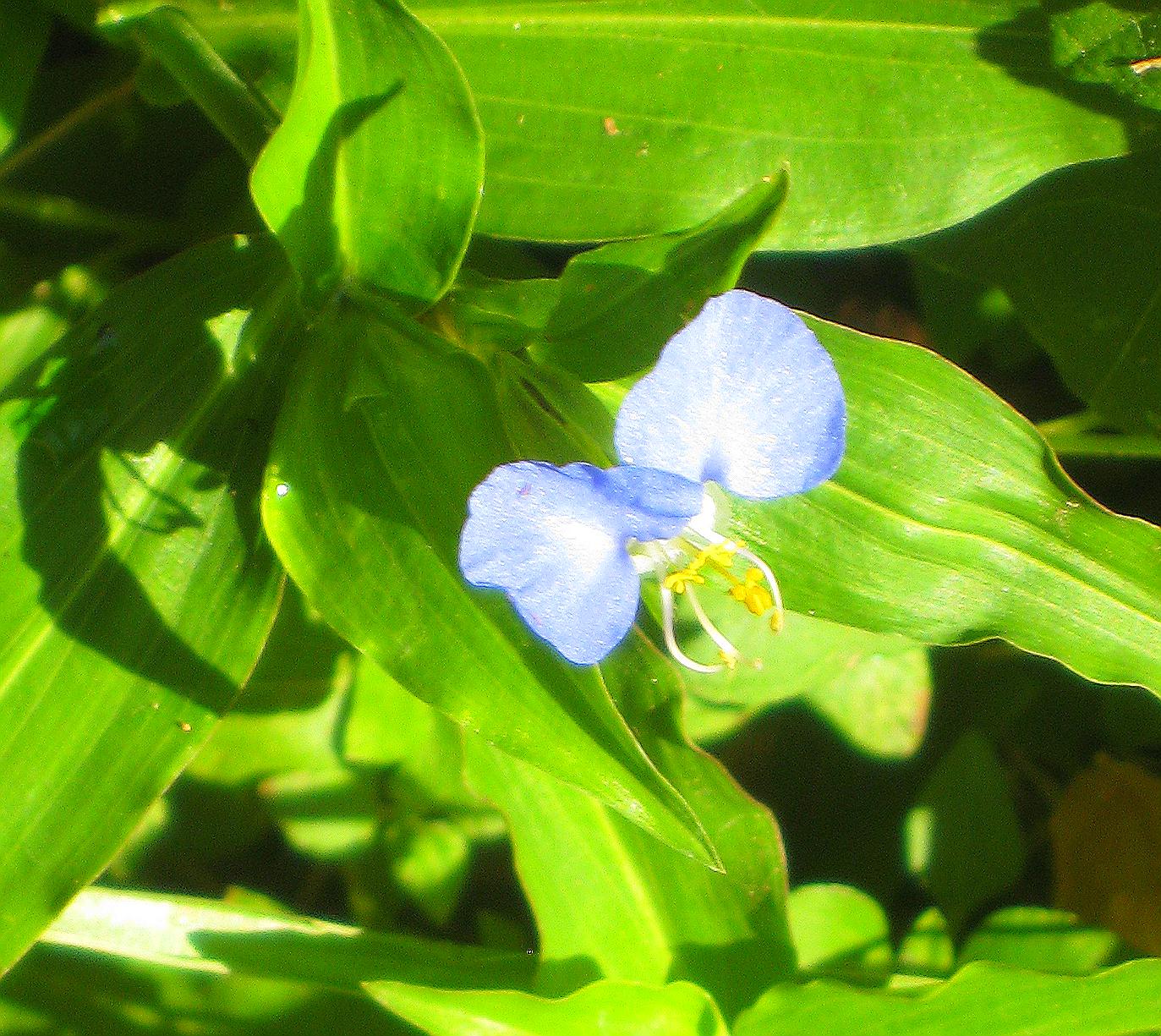
A small widow's tear blossom beneath a bush finally got my brain off squirrels and onto the wonders that Mother Nature always surprises me with when I take a walk. -- Photo by Pat Bean

The squirrel, which of course had headed up the nearest tree, was now looking down from a low branch chattering away in what could only be scorn for our intrusion. It had decided we were trespassers, that it owned the park and we had no business being here.

What, I wondered, had made this squirrel challenge us while all the others ran away.

It was like asking what makes some humans adventurous and some timid, why some of us love roller coaster rides and others shun what they consider such dangerous tomfoolery.

I often see parallels between animals and humans. I guess that’s why they’re often used to describe us humans, as in sly as a fox, slow as a snail, graceful as a cat, stubborn as a mule or swift as an eagle.

I never heard one, however, comparing us to a squirrel. What, I wondered would the adjective be: Sassy, brave, quick or foolish came to mind.

That squirrel hadn’t just taunted Maggie, it had taunted my brain.

Read Full Post »

“A leaf fluttered in through the window this morning, as if supported by the rays of the sun, a bird settled on the fire escape, joy in the task of coffee, joy accompanied me as I walked.” Anais Nin
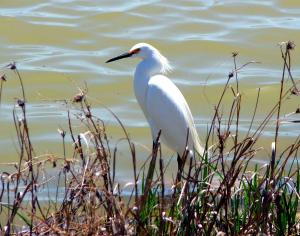
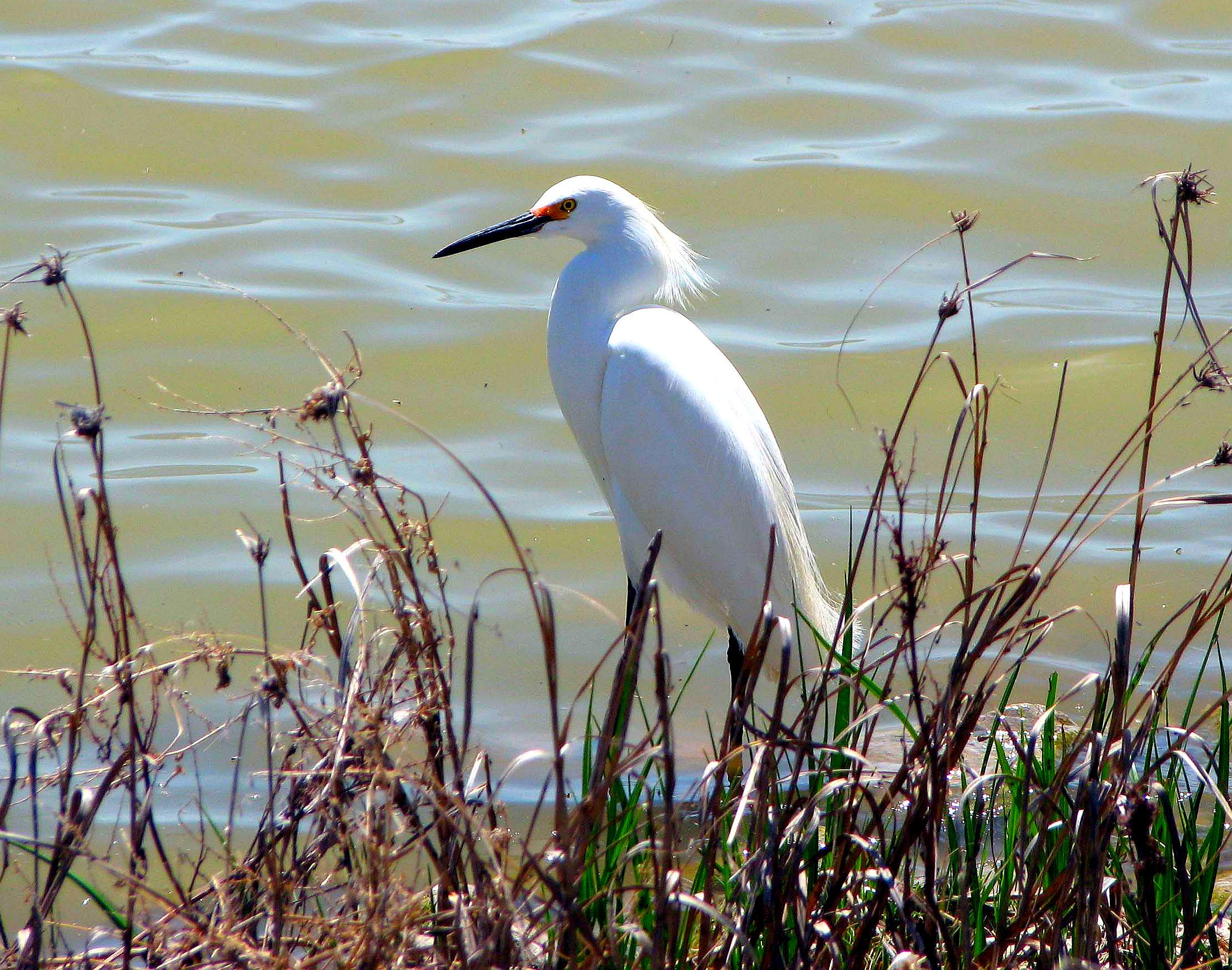
Snowy egret at the Bear River Migratory Bird Refuge in Utah. -- Photo by Pat Bean

Travels With Maggie

The landscape around the Texas Gulf Coast home of my son, Lewis, is always full of birds. It is why my binoculars are always sitting beside me when my RV, Gypsy Lee, is parked in his driveway.

Wrens, woodpeckers, warblers, hawks and ducks all visit or pass through his yard.

This morning, Carolina wrens inspected the gutters over his garage, a pair of cardinals sat on the utility wires attached to his roof and a flock of black-bellied whistling ducks flew overhead, alerting me to their presence with their high-pitched chorus as they winged past in V-formation.
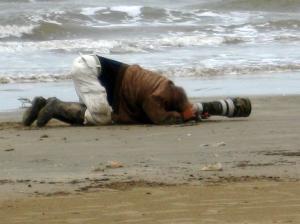
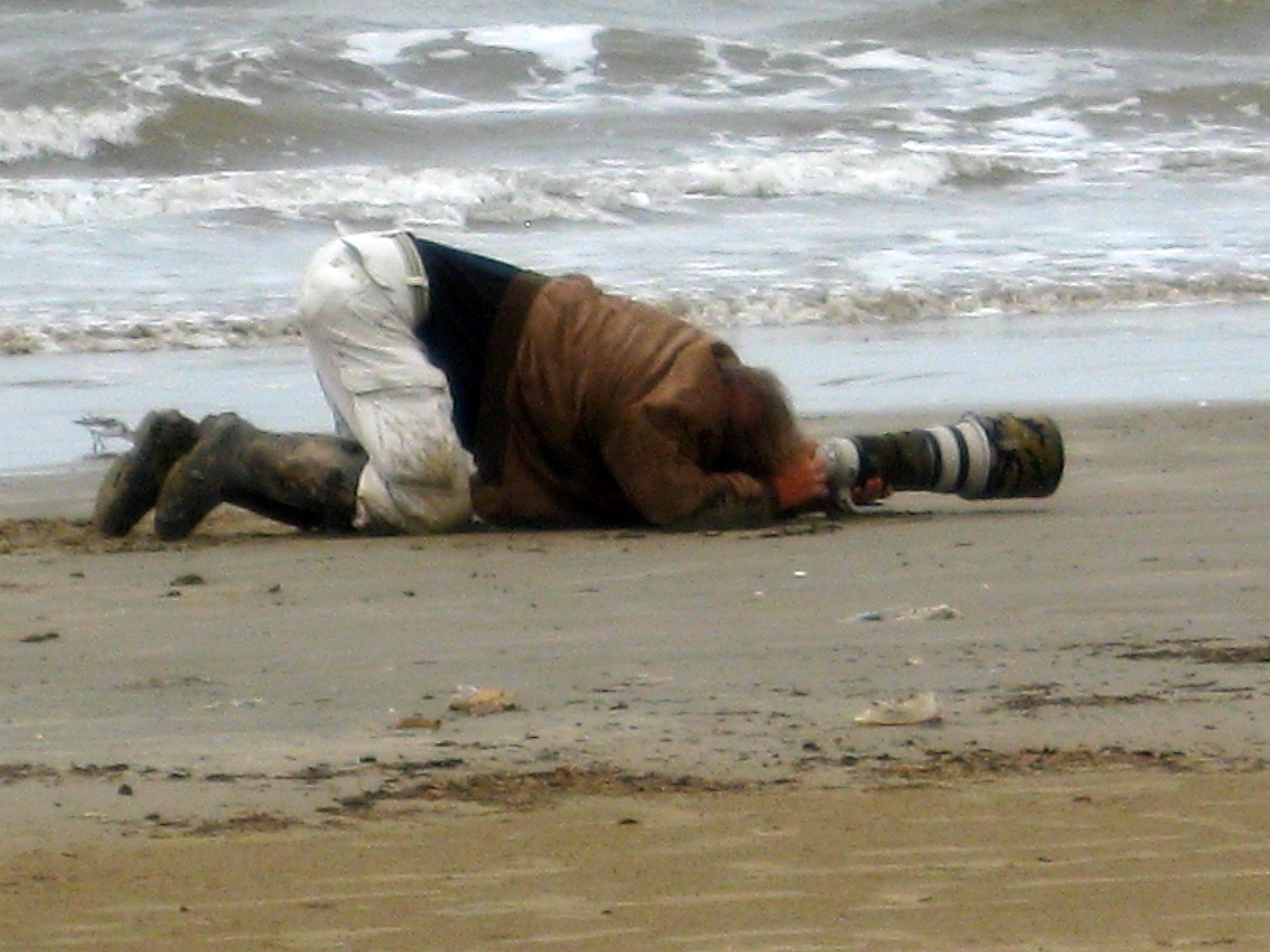
Is this a photographer taking picture of birds, or a birdwatcher photographing birds? -- Photo by Pat Bean

The park directly across the street from my son’s home offers even more entertainment for this passionate birder: Logger-head shrikes hang out in the trees, mockingbirds frequently chase away a red-tailed hawk when it comes around and goldfinches hang around the feeders in the yard next to the park.

I sometimes think I might be mistaken for a peeping Tom, or in my case a Jane, because I might appear to be looking in someone’s window when I’m simply watching a ruby-throated hummingbird flitting around the flowers.

If you really want to know how crazy we avid birders are, you should go see the movie, “The Big Year.” It’s about competitive bird watching. Or you can read the book, “The Big Year: A Tale of Man, Nature, and Fowl Obsession,” written by Mark Obmascik. It’s actually a true story and I couldn’t put it down once I started reading.


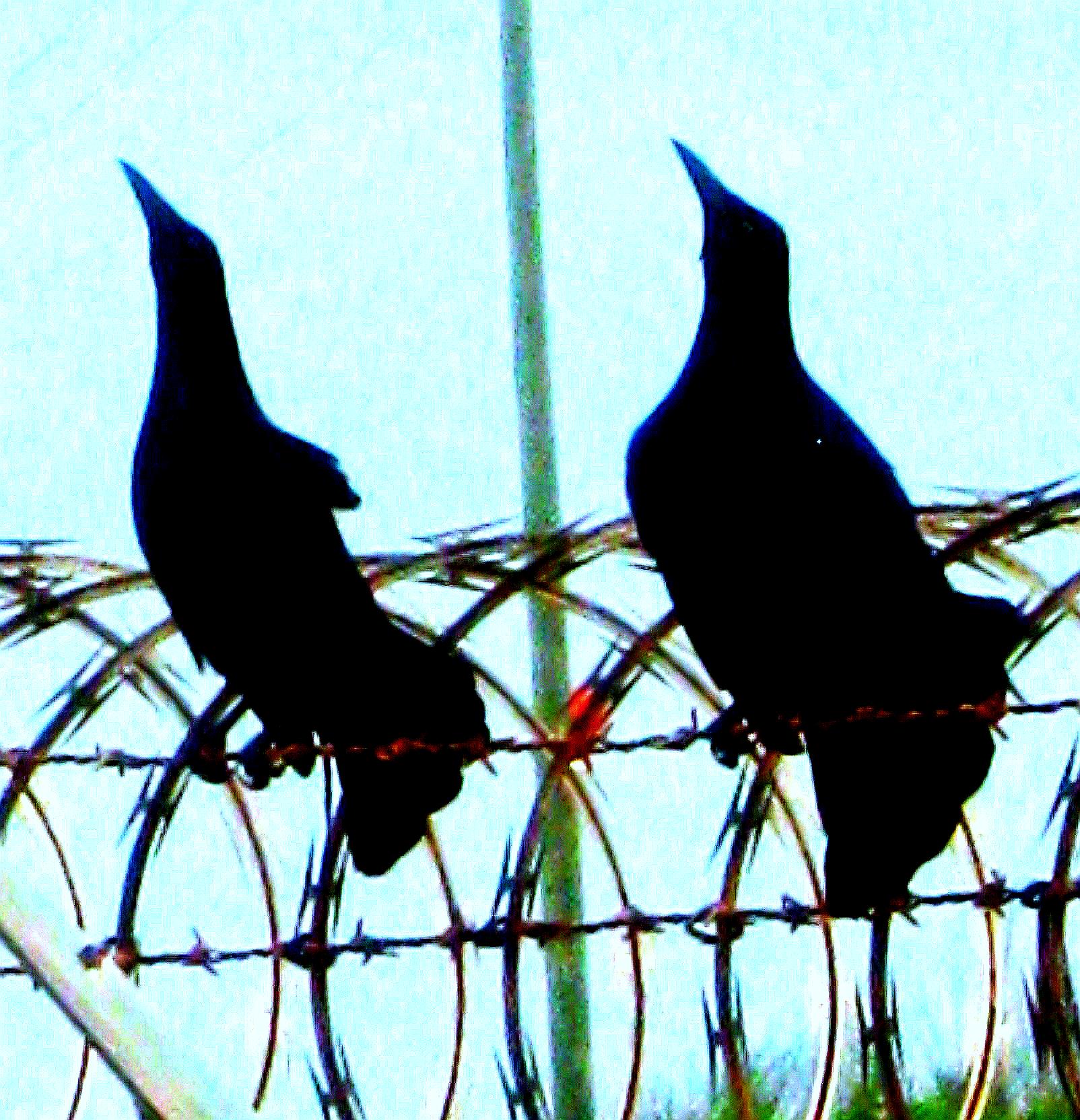
Great-tailed grackles near Surfside, Texas. -- Photo by Pat Bean

Recently, when I was down at the beach – to watch birds of course – I watched another bird watcher as he tried to take a picture of some skimmers. Watching him was almost as much fun as watching the skimmers myself. I wondered if he was more photographer than birder, or more birder than photographer, like me.

We birders are actually a funny, but much blessed lot. The day I realized I had joined the craziness was the day I took a 440-mile, one-day, round-trip drive just to see nesting ospreys.

In fact, many of the 122,000 miles I’ve put on Gypsy Lee the past seven years have been in pursuit of birds – from the elegant trogons in Southeast Arizona, to the marbled murrelets on the Oregon Coast, to the Atlantic puffins in Maine, and the Florida scrub jays in the Everglades.

It’s been one great feathered adventure after feathered adventure.

Perhaps that’s why, at least for a little while, I’m content to simply watch birds from the comfort of my RV that is parked in the driveway of my son.  

Read Full Post »

“Perhaps the truth depends on a walk around the lake.” Wallace Stevens


Looking down on Mono Lake from the Highway 395 overlook. -- Photo by Pat Bean

Travels With Maggie

My trip back to Texas from my summer in Idaho was a hurried affair. Usually I plan on arriving for my winter rounds with family just in time for Thanksgiving But a grandson’s wedding, which takes place tonight, moved that up by about six weeks.

Even so, I managed to knock two things off my to-do list, now more popularly called a bucket list, on my way back to my native Lone Star State.

Mono Lake and Yosemite National Park now have check marks beside them. .

It may be easier for some of you to understand why Yosemite was a place I wanted to visit than it is to understand why Mono Lake was on my list. After all, it’s simply a shallow, very salty, often smelly lake As we neared the lake basin, My canine traveling companion, Maggie, perked up at the smell, wrinkling her nose a bit as she caught the scent. . I’m not sure what she was thinking.


California gulls along the shoreline -- Photo by Pat Bean

 The odorous shoreline, however,  reminded me of Great Salt Lake, a place whose beauty I came to greatly appreciate while living next door to it for 25 years.

The Utah lake is larger and much younger than the smaller and much older California lake. Both, however, are part of the Western Hemisphere Shorebird Reserve Network that provides habitat for millions of migratory birds.

About the only species I saw on Mono Lake, however, was the California gull, which incidentally happens to be Utah’s state bird. It was given the honor after Mormon settlers in the Salt Lave Valley credited the gulls with saving their crops from a cricket infestation.

Neither lake has an outlet, and so remain the depository for everything that flows into them. Their importance to the ecosystem, however, has in recent years led to conservation practices engineered for their protection.

Mark Twain, in his “Roughing it,” called Mono Lake “a lifeless, treeless desert … the loneliest place on earth.”

I think otherwise.

Read Full Post »

 “A journey is a person in itself; no two are alike. And all plans, safeguards, policing, and coercion are fruitless. We find that after years of struggle that we do not take a trip; a trip takes us.” – John Steinbeck

My wandering mind waa on green jays as i drove Highway 36 toward Lake Jackson. -- Photo by Pat Bean

Travels With Maggie

With my canine traveling companion, Maggie, snoozing away in her co-pilot seat, I left Harker Heights, and my oldest son’s home, early for our drive to Lake Jackson, and my middle son’s home 250 miles away. It’s a very familiar drive for me, one I’ve made many times.

As I passed oil rigs, grazing cattle, cotton fields, mesquite trees and roadside sunflowers that let me know I was in Texas, I was glad to see the color green still existed. It had been missing on my drive two days earlier down Highway 190, clear evidence of the dastardly drought the state has been suffering. .

To all Texans living where heat and drought has scorched the landscape, I just wanted to show that green does still exist. This is the view from my RV window in Lake Jackson. -- Photo by Pat Bean

While admittedly things weren’t quite as lush as I remembered from past drives down Highway 36, the landscape was still a far cry from the brown and dying cedar trees, lack of grass and stunted and yellow cactus that had dominated my entry back into the Lone Star state on Tuesday.

The driving this day was easy with little traffic. As usual under such circumstances, my mind begins to wander. This day, it went south to the Rio Grande Valley, perhaps because I was thinking about when I would be able to go there and do some winter birding.

From Lake Jackson, where I was headed, it’s only a half day’s drive. I would have to see what bird festivals were going on down there in the coming months, I thought as I drove.

My mind must have still been with the fantastic green jays down there when I came to the Highway 35 turnoff, because I took it. I was looking for it in fact.

Oops!

I then realized that what I had actually been looking for was the Highway 36 turnoff that I always took when I returned from the valley. But then I had already been on Highway 36.
I guess I should have been paying more attention to where I was than where I wanted to go.

Anybody else out there have a mind that plays tricks on them like that?

If so, I hope you have a traveling companion like Maggie. She never yells at me when I take a wrong turn.

Read Full Post »

“I think we are bound to, and by, nature. We may want to deny this connection and try to believe we control the external world, but every time there’s a snowstorm or drought, we know our fate is tied to the world around us.” Alice Hoffman

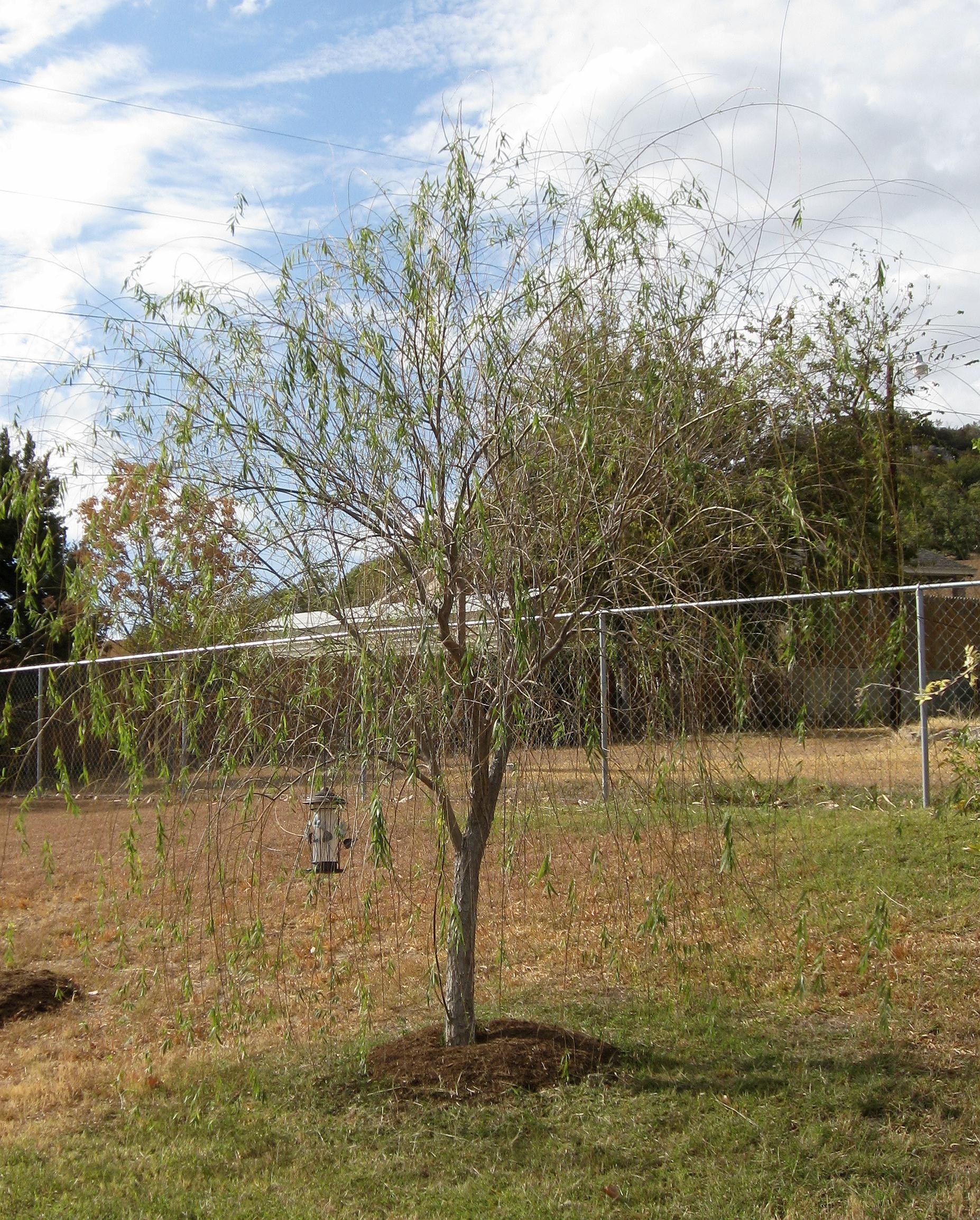
This isn't how a willow tree is supposed to look. -- Photo by Pat Bean

Travels With Maggie

From the heights of the morning’s glorious Texas sunrise, my first since mid-April, my journey to just north of Austin descended into horrifying reality of the drought the state has been suffering.

The sights hit me especially hard when I left Interstate 10 to follow Highway 190 for over 200 miles.

The scorched earth, brown and dying cedar trees, total lack of grass and yellow and stunted cactus were hard to stomach.. While I had been luxuriating beside a lake enjoying a mild Idaho summer, my native Texas had been suffering record temperatures without rain.

My Texas family had frequently informed me that this was so, but seeing it still broke my heart, especially when I saw skinny deer wandering the roadside huddled around one small patch of grass. It was very close to the road, and the deer stayed nearby instead of scampering away as my RV approached.

Laughter is not a bad thing when faced with hard times.

It made me glad I was traveling a lonely stretch of highway, especially since a bit farther on I passed two deer that had given their life for staying too close to the road. The turkey vultures seemed to be the only ones prospering on the landscape.

At my oldest son’s home in Harker Heights, I found his usual green lawn brown, and the limbs of the vibrant willow tree in his back yard scantily clad. And today, the water pipes buried in his front yard sprung a gigantic leak.

“It’s happening a lot all over the place,” said the plumber, who was too busy to come until the next day. As the landscape dries, it shifts around, often breaking things in the process.

Even Maggie noticed how things were different. A bit of a tenderfoot, she found the stiff dry grass on the edges of the road we walked not to her liking.

I watched as she carefully place one paw down, and then looked for a softer spot to place her next step. When she didn’t find it, she quickly came back onto the paved road to continue our evening walk.

In some places, this beautiful lantana plant is considered an invasive weed. It looked awfully good to me, however, when all else was suffering from the drought. -- Pat Bean

My daughter-in-law, meanwhile, has still managed to maintain a bit of color around their house. Her backyard flower bed , filled with what she called hardy plants, hinted that all was not lost.

 As I looked out on them this morning, I saw house wrens playing among the blossoms, while bright cardinals, finches, mockingbirds and sparrows visited the yard as well.

. I think they liked the color, too. And perhaps the bird feeders scattered about the yard as well.

Read Full Post »

 A Texas Sunrise: From Birth to Teenager  

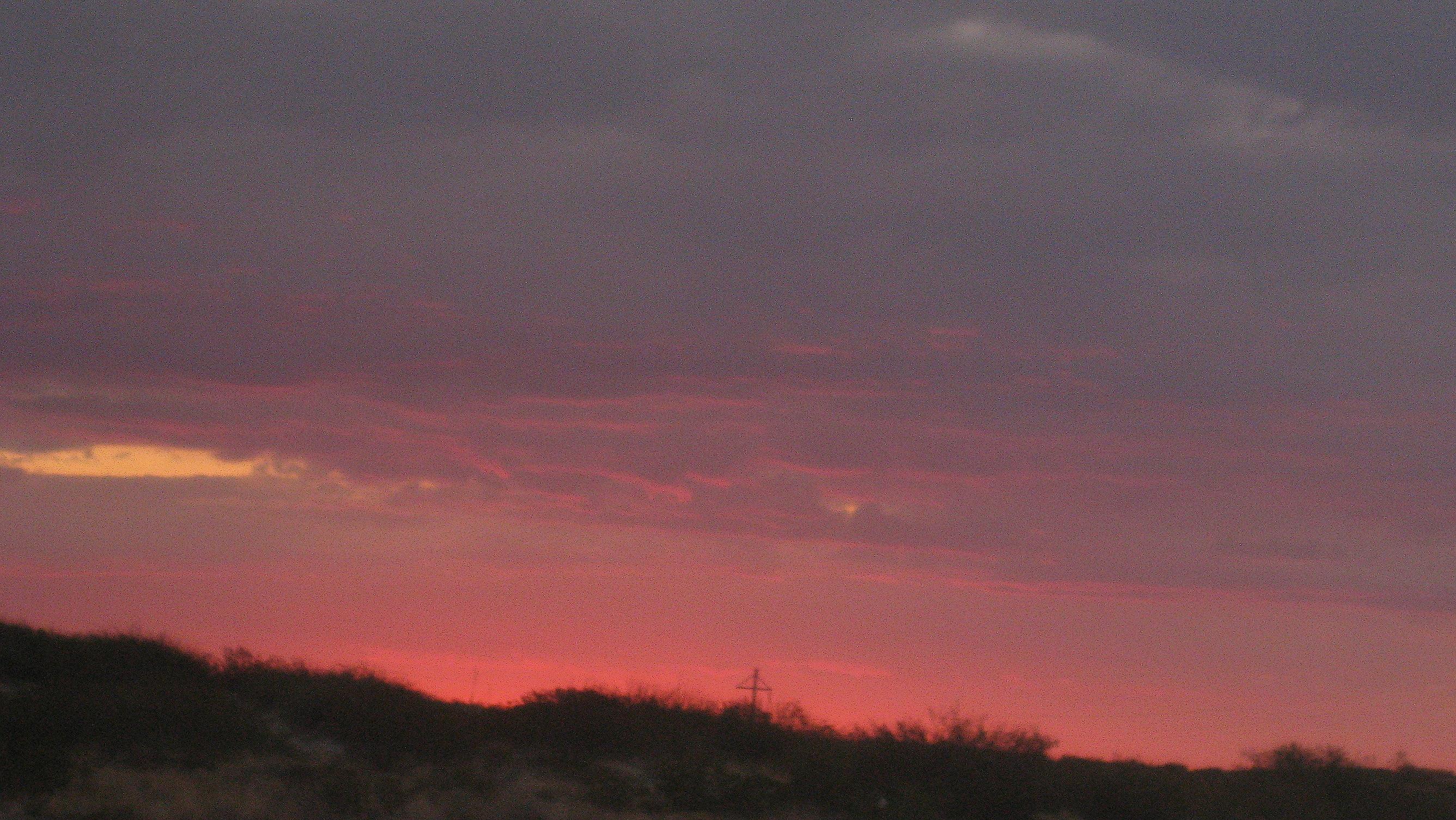
In baby breaths of pink and blue, the sun began its Texas day. -- Photo by Pat Bean

“Now is the time of the great fall migrations, and in truth the whole world seems built for birds on the wing. … For some birds, that translocation may be nothing more than a move from New Jersey to Georgia. For others … migration means flying from as far north as the Arctic circle to the tip of Argentina, roughly 10,000 miles away.” – Natalie Angier, “Songs and Sojourns of the Season

Travels With Maggie

I acted like a bird deciding that one particular minute when it takes to the air for its twice-annual migration.

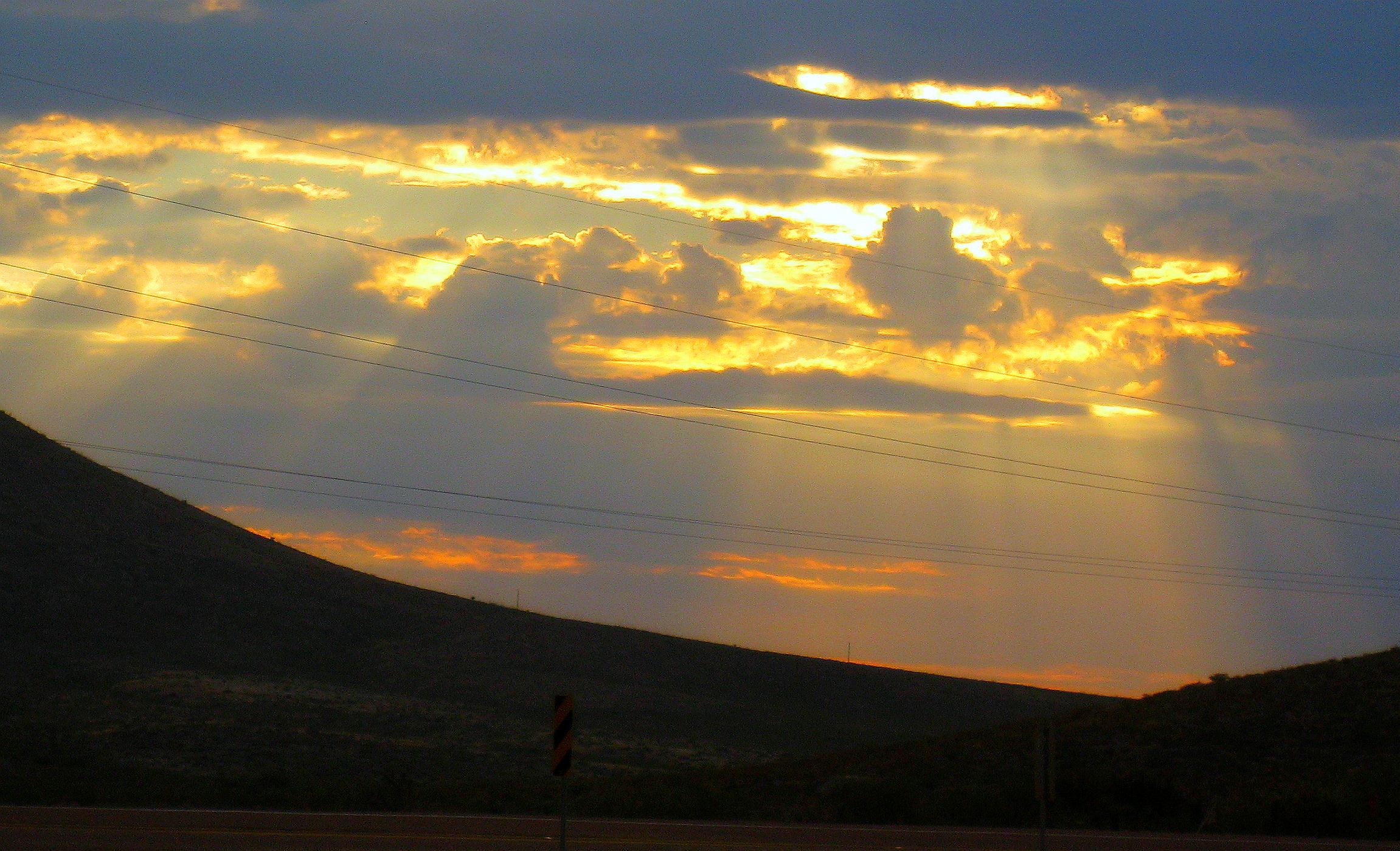
Now showing off like an energetic teenager, the sun continues its path upwards into a Texas sky. -- Photo by Pat Bean

I was on the road before dawn, heading east from El Paso, where my 300-mile journey from Tucson had taken me the day before, facing yet another 300-mile drive this day.

It was early enough when I drove away from the Mission RV Park that I had left the city lights behind me in time to catch that magical gray moment of the day when the world takes a second’s pause before beginning to turn on the light.

It had been awhile since I had seen this awesome start of the day, and its quiet power impaled my soul deeply.

A little farther down the road and the sun begin to make its arrival known in baby breaths of pink and blue. I stopped and tried to capture the birth with my camera.

I stopped again a short time later to take a photo of the sun’s teenage yea’s, the period of its daily growth when it is full of blazing energy and dazzling confusion.

This was my first Texas sunrise since April, and I couldn’t have asked for a better one. .

My planned 300-mile drive, meanwhile, turned to 600. I was that eager to feel the arms of my Texas loved ones around me once again.

Read Full Post »

 What is life? It is the flash of a firefly in the night. It is the breath of a buffalo in the wintertime. It is the little shadow which runs across the grass and loses itself in the sunset.”Crowfoot saying


Tangerine frosting coats the clouds as a tall poplar tree looks out over an Idaho sunset. -- Photo by Pat Bean


Read Full Post »

 “Sometimes it’s important to work for that pot of gold. But other times it’s essential to take time off and to make sure that your most important decision in the day simply consists of choosing which color to slide down on the rainbow.” Douglas Pagels

Travels With Maggie`

A walk around Silverbell Lake helped clear the cobwebs from my crowded brain. -- Photo by Pat Bean

Life caught up with me this past week. Too many miles in not enough days, too many amazing sights and not enough time to linger among them, and only three days to enjoy loved ones before I’m back on the road.

My preferred style of travel – no more than 150 miles a day with a couple of days sitting in between – has been blown to hell in a hand basket, the same one my grandmother said would take me there if I didn’t shape up.

Something had to give. And it did. I stayed off my computer and missed two days of daily blogging.

Instead, I lazed around my youngest daughter’s Tucson home, took Maggie for short walks, enjoyed the company of three grandsons, hiked around Silverbell Lake while everyone else fished, read a lot, and watched the turkey vulture and red-tailed hawks soar above, and doves, rock wrens, curved-bill thrashers, gila woodpeckers, northern flickers and rabbits play among the saguaro cactus.

My daughter, Trish, lives on the outskirts of the city and coyotes and bobcats often visit, she said. As do quail that usually trot past their back porch daily.

My son-in-law, Joe, described them for me, and I suspect they’re Gambel’s quail, although they could just as easily be California quail. Both species have the C-shaped plume dangling forward over the front of their heads.


A landscaped yard without grass. Drought-stricken area residents should take note. -- Photo by Pat Bean

I haven’t seen them yet. I think they’re taking a break from their daily routine – like me.

It’s back on the road tomorrow. I’m heading to Texas’ Gulf Coast and a grandson’s wedding. It will be another four days of 300-mile a day drives, although thankfully, well except for the first 50 miles, it will not be freeway driving.

Interstates were something I could not avoid for two entire days on my way from Yosemite to Tucson. It made me never want to go back to California, that and the fact I was paying $4.15 a gallon for gas there. The cost immediately dropped to $3,39 a gallon once I crossed the border into Arizona.

I’ll post pictures nightly of my next four days of driving so you can enjoy the road with me. Just don’t expect me to be too wordy. I’ll save those for later when life has once again slowed down.  


Read Full Post »

« Newer Posts - Older Posts »