Feeds:
Posts
Comments

Archive for the ‘Nature’ Category

“We do not remember days, we remember moments.” – Cesare Pavese     
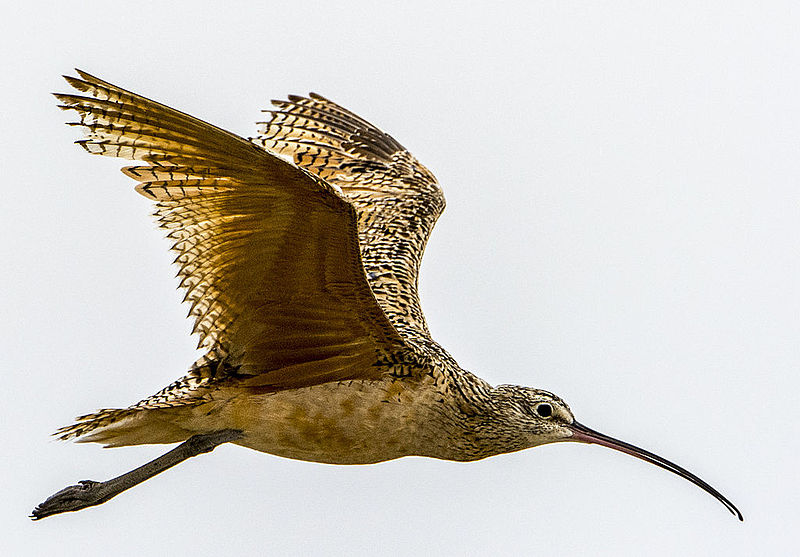
The long-billed curlew — Wikimedia photo by Jerry Kirkhart

AKA the Candlestick Bird

It was a June Day in 1998 and photographer Kurt Duce and I were on the unpaved, closed to the public, south causeway to Antelope Island. We had permission to four-wheel it on the rough passage because I was doing a series of newspaper articles on Great Salt Lake.

Long-billed curlew_– Wikimedia photo by Frank Schulenburg.

Since the road was rarely driven, a pair of long-billed curlews had built their nest right beside the one-lane passage. We stopped and got out for a better look, and several young chicks began and skittering to and fro in front of us. It was a great opportunity for me to quietly observe with my notebook in hand, and for Kort to get some rare photographs of this large shorebird and young.

We weren’t out of the car for more than about 30 seconds, however, when the two parents began dive-bombing us. It took off Kort’s hat with one pass. In less than 30 seconds the two of us were both back in our vehicle. I dare say you would have ducked for cover, too, if you got a close-up look at this bird’s wicked bill.

But it was one of those remembered moments that claim a prominent place in the file cabinets of my brain.

According to Wikipedia, the long-billed curlew was once known as the candlestick bird, and Candlestick Park and Candlestick Point in San Francisco, where these birds once inhabited, were named after this bird, which, however, disappeared from this landscape in the early 1900s.

Thankfully, however, it found other habitat and is currently not in danger of becoming extinct, as did its cousin, the Eskimo curlew, which has not been seen in over 30 years.

Serendipitously, a short time after I was dive-bombed by the angry bird parents, I heard a talk by author and conservationist Terry Tempest Williams,  who remarked: “I can’t help but believe that as long as the world supports the life of the long-billed curlew, we can be supported, too.”

I certainly agree.

Bean Pat: Watch a YouTube video of a long-billed curlew at https://tinyurl.com/y9tzvygf

         Pat Bean is a Lonely Planet Community Pathfinder. Her book, Travels with Maggie, is now up on Amazon at http://tinyurl.com/y8z7553y  Currently, she is writing a book, tentatively titled Bird Droppings, which is about her late-bloomer birding adventures. You can contact her at patbean@msn.com
Read Full Post »

Advice from a Tree: Stand tall and proud. Sink your roots into the earth. Be content with your natural beauty. Go out on a limb. Drink plenty of water. Remember your roots. Enjoy the view. – Ilan Shamir

They’re Huggable

Ralph Marston, author and publisher of The Daily Motivator, asks: “When was the last time you spent a quiet moment just doing nothing – just sitting and looking at the sea, or watching the wind blowing the tree limbs, or waves rippling on a pond, a flickering candle or children playing in the park?”

This live oak tree, thought to be more than a thousand years old, can be found on Goose Island State Park in Texas. It too, is one, whose sight causes me to linger. — Photo by Pat Bean.

My answer is yesterday, when I sat on my third-floor living room balcony, at first watching for the hummingbirds that visit my nectar feeder. When they didn’t come, I then simply stared at the multitude of trees visible from my perch. I know of no better way to calm my body and to fill it with a sense of rightness and peacefulness.

Seven tall Ponderosa pines grow in the courtyard. I often wonder why they are

here in the desert where they don’t belong – but I’m glad they are here. Also growing in the courtyard are the deciduous trees whose names I do not know, plus quite a few black olive trees, whose twisted trunks look as if they have been carved into artistic arrangements.

In the undeveloped desert area around my apartment complex, through which there is a short trail, grow a multitude of Palo Verde trees sporting green trunks and limbs. I’ve observed them through the seasons, sprouting greenish-yellow leaves during monsoon and then dropping them to conserve energy when the desert dries up and the heat sends all living things in search of shade.

Me, hugging a tree in Custer State Park in South Dakota. — Photo by one of the day’s traveling companions.

My former home in Utah, which I sold to go traipsing all across North America, had a huge wild elm tree in the backyard. It was the primary reason I had bought the home. It was so huge that it shaded my entire house, which also benefitted from the shadows cast by a tall Ponderosa pine tree on the opposite side. I needed no other air conditioning.

The trees here at my apartment complex in Tucson, where summer temperatures can reach 120 degrees — air conditioning is definitely needed — provide me the shade I need for the brief walks I take with Pepper, my canine companion, during the hottest part of the summer.

I don’t think I could live in a place without trees. And laugh you might, but I’m not just a tree lover, I’m a tree hugger, too. And I have the photo to prove it.

Bean Pat: The Silence of Nature https://travelsandtrifles.wordpress.com/2018/01/19/thesilence-of-nature/  “See how nature – trees, flowers, grass – grows in silence.”Mother Teresa

Pat Bean is a Lonely Planet Community Pathfinder. Her book, Travels with Maggie, is now up on Amazon at http://tinyurl.com/y8z7553y  Currently, she is writing a book, tentatively titled Bird Droppings, which is about her late-bloomer birding adventures. You can contact her at patbean@msn.com

Read Full Post »

Antelope Island

Antelope Island from the causeway on an overcast day. — Photo by Pat Bean

“Women, like men, should try to do the impossible. And when they fail, their failure should be a challenge to others.” – Amelia Earhart

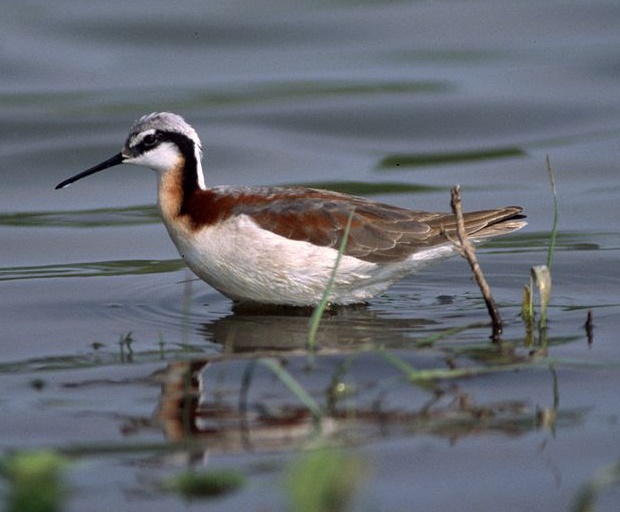
Wilson’s Phalaropes 

My newest writing work in progress, since Travels with Maggie is now published, is a book I’m calling Bird Droppings. It’s about my adventures, and that they have been, of being a late-blooming birder.

Female Wilson’s phalarope in breeding plumage. — Wikimedia photo

It’s a passion that addicted me at the age of 60, just when my body was beginning to revolt against my more strenuous outdoor activities of back-packing, white-water rafting, biking and skiing.

Recognizing the new hobby as a major blessing that kept me moving forward in my zest for life, I reveled in the new experiences. And the more I actually learned about birds, the more enamored I became with bird watching.

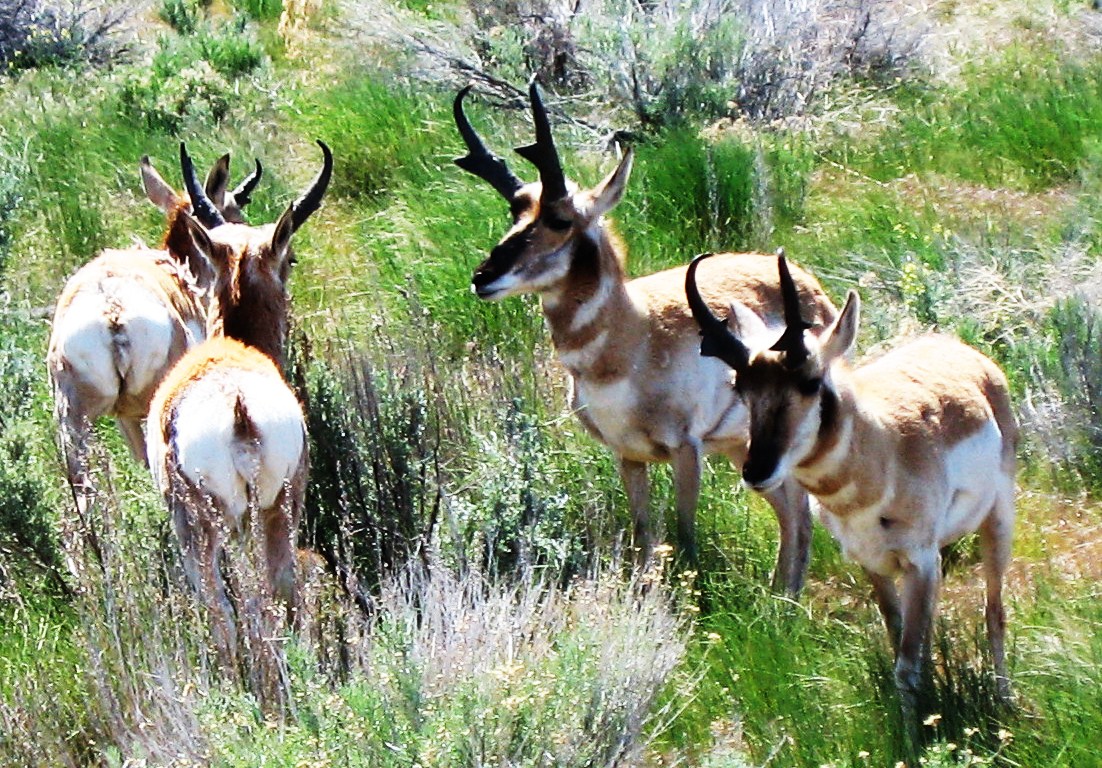
As I watched for birds on the island, I always saw other wildlife, and pronghorn antelope were frequently among them. — Photo by Pat Bean

At first, I relied on others to make identifications of birds in the field, but there came a point when I wanted to be able to be the first one to say that’s a yellow-rumped warbler or a ruddy duck. Those two, by the way are usually easy to identify. The first, also known as a butter butt, often moons you so you clearly see its golden backside, and the second has a blue bill and a stuck-up tail,

To satisfy my need to be able to identify a bird on my own, I began solo weekly visits, with field guides in hand, to Antelope Island in Great Salt Lake. I called the place my Birding 101 Lab and visited it almost weekly, throughout the seasons, for two years. I never had an outing to the island, which was reached by a six-mile causeway, in which I didn’t learn something new and fascinating.

One of the more interesting birds to me, since I’m a woman who raised five children almost entirely on her own, were the Wilson’s phalaropes. These nine-inch or so shorebirds are members of the sandpiper family. They flock by the hundreds of thousands to Great Salt Lake during the summer. I often watched them swimming around and around in circles, creating a vacuum that would bring up tiny bits of food to eat.

But the thing I enjoyed most about these birds, which I learned from my many bird books and field guides, was that they switched roles. The female had the brightest colored feathers, courted the males, and then left the egg sitting and rearing the young to the gentlemen as well.

As a mom who changed cloth diapers for five children without any help, I couldn’t help but admire the female phalaropes.

            Bean Pat: Refuge https://www.birdnote.org/show/terry-tempest-williams-reads-refuge One of my favorite authors reads a short piece in her soothing voice. This is a real treat, and less than 2 minutes long.

Pat Bean is a Lonely Planet Community Pathfinder. Her book, Travels with Maggie, is now up on Amazon at http://tinyurl.com/y8z7553y  You can contact her at patbean@msn.com

Read Full Post »

Flashing rays of the morning sun at Steinaker State Park near Vernal, Utah — where dinosaurs once roamed. — Photo by Pat Bean

“Exploration is really the essence of the human spirit.” — Frank Borman

Steinaker State Park

Pepper and me enjoying our morning walk at Steinaker State Park. — Photo by Pat Bean

“I’m fond of camping at state parks. I’ve truly never found one I haven’t liked. I’m also fond of traveling backroads and avoiding major highways and crowds, which you might say is how I ended up during one of my journeys spending a few days at Steinaker State Park near Vernal, Utah.

As far as campgrounds go, it had all the right stuff: a scenic lake setting and an ample tree-shaded campsite. But what made this off-the-beaten-path park special to me was the chance it offered for a bit of solitude among nature’s marvels. As our world population explodes, and more and more people seeking relief from the daily chaos discover the healing powers of Mother Nature, being alone on established trails and in parks has become a rare thing. Although opportunities exist to escape to this country’s true wilderness areas, at my age this has no longer become a viable option.

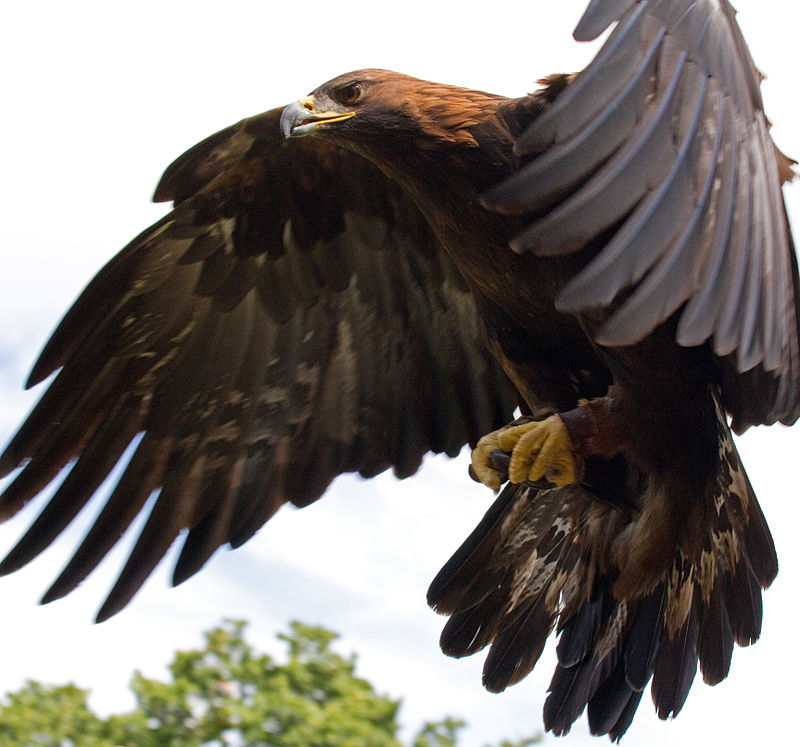
I wasn’t able to capture the golden eagle that morning, but I thought you would enjoy this Wikimedia photo by Tony Hiigett. I did.

While I wasn’t alone at Steinaker, which sits at an elevation of 5,500 feet, other campers were scattered enough that I seldom saw any of them. This was especially true when I took my early morning walks with Pepper, my canine companion.

The best morning was the one in which I was awoken by a hooting great horned owl, an  a golden eagle, its wings backlit by a rising sun, doing a flyover. It doesn’t get much better than that.

Bean Pat: Interesting Literature http://tinyurl.com/y9fjj7fr  Best poems about identity and self.

Pat Bean is a Lonely Planet Community Pathfinder. Her book, Travels with Maggie, is now up on Amazon at http://tinyurl.com/y8z7553y You can contact Bean at patbean@msn.com  (more…)

Read Full Post »

“Every day is a journey, and the journey itself is home.” –Matsuo Basho

A view of Texas Canyon on the South side of Highway 10 — Photo by Pat Bean

Coming and Going

Since moving to Tucson in 2013, I’ve made annual trips to visit my native Texas, where the majority of my children and grandchildren live. Since I can’t take Pepper, my canine companion on a plane with me, and also because I want to watch the passing landscape, I drive.

I divide the journey into two days, stopping overnight in Van Horn, Texas, because it’s close to the halfway point of my drive, and because there’s not much else 100 miles in either direction.

          Since my dog needs potty breaks, and this old-broad body needs them, too — and leg-stretching breaks as well, I rarely pass up a rest stop – even if it’s only about 60 miles from where I started the journey or 60 miles from home on the return to Tucson.

I mention that distance because that’s the location of the Texas Canyon picturesque rest stop on Highway 10 in the Dragoon Mountains, which are known for their giant granite boulders.

Curious about why there is a Texas Canyon, I did some quick research. The explanation I found on Wikipedia was: “In the mid to late 1880s David A. Adams arrived from Texas, soon to be followed by other family members. The family became the namesake of Texas Canyon, as word begin going around that there were ‘a bunch of damned Texans up there.’ Descendants still live and raise cattle on the old family ranch.”

There are rest stops on both the north and south sides of the highway, and every time I stop at them, the landscape always impresses me. The rocks that dominate the landscape are definitely Texas-sized.

Bean Pat :Best Bird of the Week http://tinyurl.com/ybhpy34z A Lincoln sparrow. I, too, like to keep track of the best bird of the week. Mine was a magpie, my favorite bird, which I saw on the roof of my friend Kim’s house in Ogden, Utah. It was the first magpie for me this year.

Pat Bean is a Lonely Planet Community Pathfinder. Her book, Travels with Maggie, is now up on Amazon at http://tinyurl.com/y8z7553y You can contact Bean at patbean@msn.com

Read Full Post »

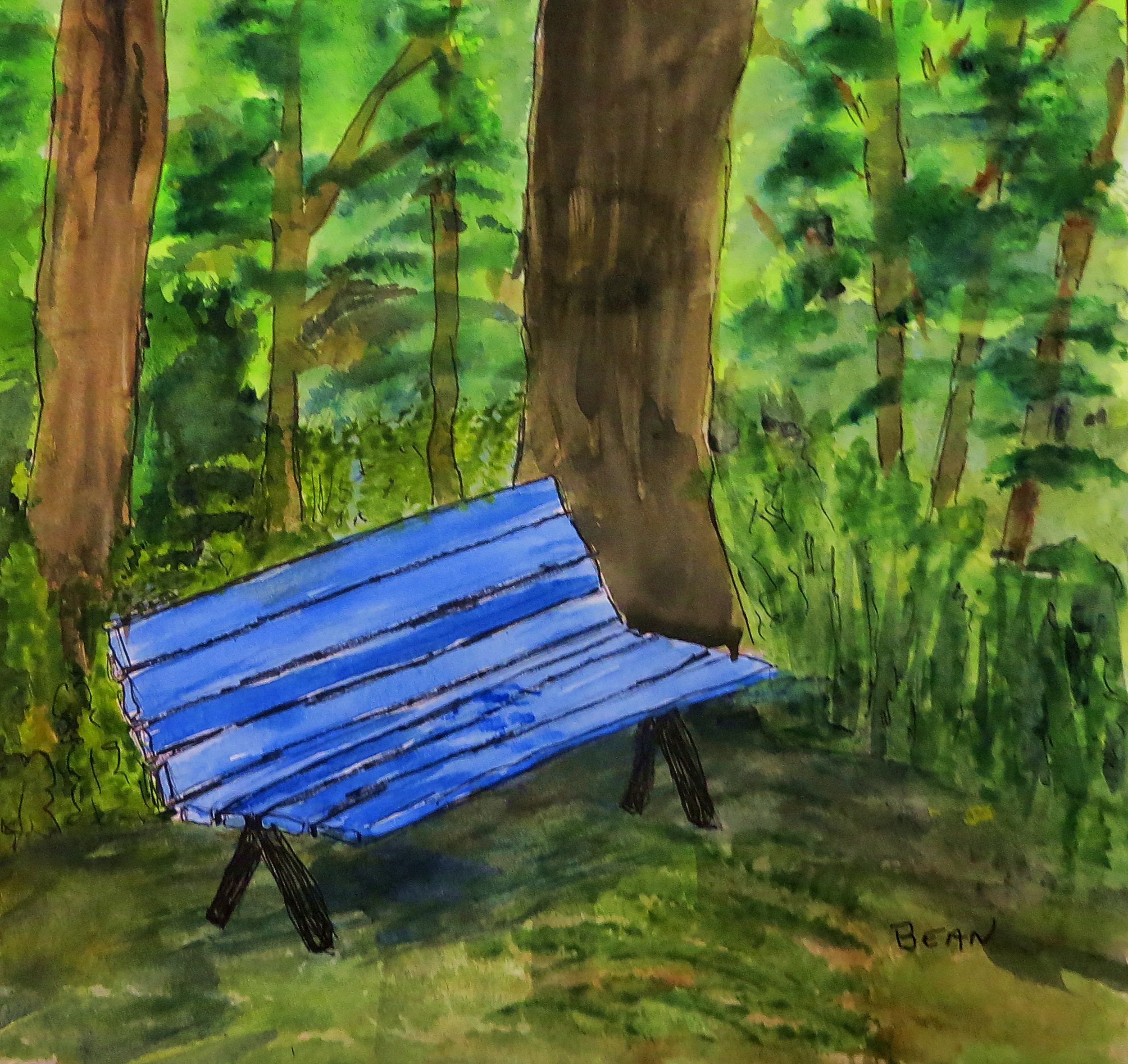
The Blue Bench — painted by Pat Bean

“Truly the bench is a boon to idlers. Whoever first came up with the idea is a genius: free public resting places where you can take time out from the bustle and brouhaha of the city, and simply watch and reflect.” – Tom Hodgkinson

Sitting, Watching and Listening

Dock benches at Tom’s Cove Campground on Chincoteague Island in Virginia. — Photo by Pat Bean

When I was a beginning birdwatcher, I thought patience was only an activity for couch potatoes. This non-activity simply wasn’t part of my vocabulary – or my life. But the birds I wanted to see didn’t always, in fact seldom, showed up in a timely fashion.

“Learn to sit quietly for half an hour and you won’t be disappointed,” a birding mentor told me. But 10 minutes was all I could manage for the first couple of years. I had to work up to it, but finally I caught on.

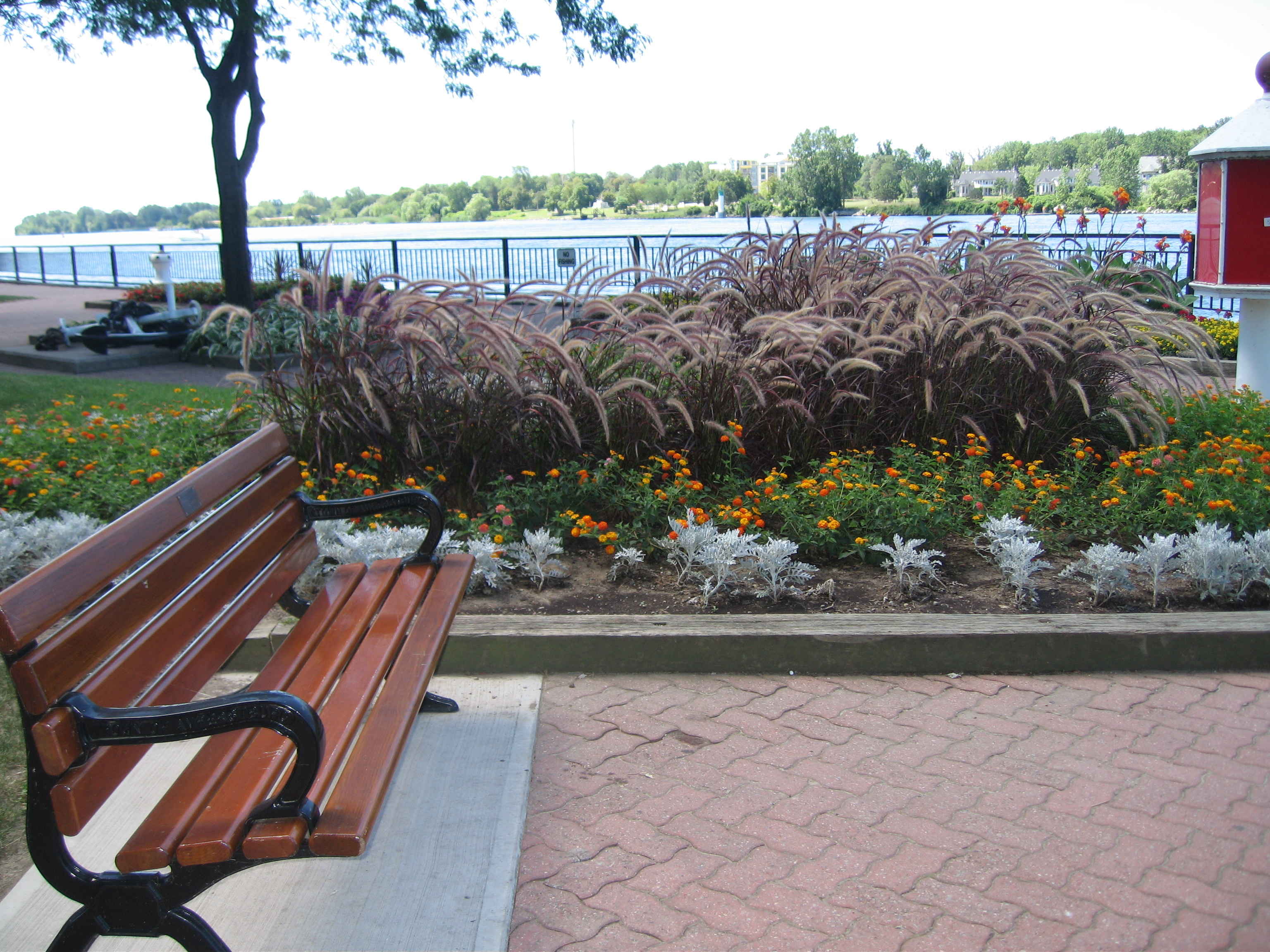
A bench at the Amherstburg Navy Yard in Ontario, Canada.


And once I did that, I began looking for places with interesting views to sit. And lo and behold I discovered the joy of benches. The blue one above, which I painted from a photograph (below left),

was located at Lake Walcott State Park in Southern Idaho. It looked out over a meadow filled with tall, grassy reeds where yellow-headed blackbirds could frequently be found.

The benches on the top left were located on a dock on Chincoteague Island in Virginia, where I spent a week. Gulls and boat-tail grackles liked to gather here.

And the photo on the right above was taken in Amherstburg, Ontario, Canada, where I watched a blue-winged teal swim about in the harbor and house sparrows pecking about in flowerbeds.

Sitting on a bench, in a delectable nature setting, has now become one of my “activities.”

It is much better any day than sitting meditation, which so far, I haven’t managed to do for more than five minutes at a time. My busy brain just won’t turn off when Mother Nature, and birds, aren’t around to keep my attention focused.

I guess you can now call me a bench potato.

Bean Pat: The Page Turner http://tinyurl.com/y9b2y3z3 Enjoy the photography of John Macdonald. I did.

Pat Bean is a Lonely Planet Community Pathfinder. Her book, Travels with Maggie, is soon to be released. You can contact her at patbean@msn.com

Read Full Post »


The desert landscape from my daughter’s Marana home on the southwest outskirts of Tucson. — Photo by Pat Bean

“Just sometimes every damned thing goes right? – Yhprum’s Law

Yup! It’s Monsoon Season in the Sonoran Desert

The ocotillos are lush-leafed and the saguaros are pumped. That’s what happens when you get a week or so of heavy downpours.

An ocotillo in bloom at Catalina State Park north of Tucson. I took this photo while I was still traveling full-time in my RV, and before I ever dreamed I would end up living in Tucson. — Photo by Pat Bean

These two cacti abound in Tucson, whose human development, especially in the Catalina foothills where I live, is tucked between and above the washes and arroyos that have been allowed to remain undeveloped so as to carry the falling water away quickly. The fact that there’s a bit of wildness remaining in the city, some of which is just seconds away from my apartment complex, is one of the reasons I’ve come to love Tucson.

I also enjoy the mountain ranges that encircle the city: The Tucson Mountains to the west. the Rincon Mountains to the east, the Santa Rita Mountains to the south, and the Catalina Mountains that are my backyard to the northeast. The sides of these mountains are now tinged a verdant green because of all the rain. It’s a cool view, especially after the 115 plus temperatures that plagued Southeastern Arizona for weeks.

I’ll enjoy it while I can, as soon the ocotillos will lose their green leaves to conserve the little water they’ll get in the coming months. They will become simply brown, tall thorny stems sticking up from the ground. The saguaros, meanwhile, will grow skinnier again, using the rain water they inhaled to maintain themselves through the waterless desert months.

Watching the changes that take place in the landscape around me, from day-to-day and season to season, gives me great pleasure. It connects me to Mother Earth.

Bean Pat: So Much Yarn https://theeternaltraveller.wordpress.com/2017/07/19 Take an armchair tour of England’s Yorkshire Market.

Pat Bean is a Lonely Planet Community Pathfinder. Her book, Travels with Maggie, is soon to be released. You can contact her at patbean@msn.com
 

Read Full Post »

Thorny Neighbors

I call this saguaro Old Man. I found him while walking a wash near my daughter’s home here in Tucson. He fell over and bit the dusk not too long afterward. — Photo by Pat Bean

Saguaros come in all sizes and shapes. Is it my imagination, or do you think this one is giving the finger to the low-flying balloon. — Photo by Pat Bean

“Some people are always grumbling because roses have thorns. I am thankful that thorns have roses.” – Alphonse Karr

Heat’s Up in Tucson

A cholla cactus in bloom. — Photo by Pat Bean

The temperature was 115 here in Tucson yesterday. Yuck! You need to be a cactus to survive in this weather, I think.

And then I remember that in 1956, I moved to the Texas Gulf Coast and didn’t have air conditioning for the next 10 years. How I survived, while changing cloth diapers (four kids in five years) continually for seven of those years, I have no idea.

I guess deep down I’m as tough as a cactus. Or once was. My outdoor adventures currently are confined to walking Maggie in the early mornings when it’s still a bit cool. She just gets taken outside long enough to do her business after that.

And a barrel cactus. — Photo by Pat Bean

Anyway, it seemed an appropriate day to post some of my cactus photos. I hope it’s cooler where you live.

Bean Pat: One of my favorite blogs is Brain Pickings. And I especially like these words of Albert Einstein, which seem especially appropriate these days. http://tinyurl.com/ydhxg629

Read Full Post »

“People often say that beauty is in the eye of the beholder, and I say that the most liberating thing about beauty is realizing that you are the beholder. This empowers us to find beauty in places where others have not dared to look, including inside ourselves.” – Salma Hayek

Secret, also know as Cecret, Lake in Albion Basin at the top of Cottonwood Canyon in Utah. — Wikimedia photo

A Day to Remember

I’m organizing photos that I removed from albums and put in a box when I got rid of or condensed everything so all my belongings would fit into a small RV back in 2004. Lately, I’ve been rummaging through that box.

Kim and me looking out over Secret Lake. I’m not sure who took the photo, most likely Cory, Kim’s son.

Of the many photos, my favorites are the ones of me enjoying Mother Nature’s outdoor wonders. My long-time friend Kim is there with me in many of these memories, like the one recaptured by the photograph on the right, which was taken at Secret, or Cecret as some people call it, Lake at the top of Albion Basin up Cottonwood Canyon in Utah.

As I recall it was an early July day, which is when spring wakes up in this high country, Notice the snow still visible in the background of the photo. I recall that the meadow at the trailhead, where Kim and I started our hike, as being saturated with wildflowers, Indian paintbrush, columbine, lupine, Jacob’s ladder, beard’s tongue, and elephant’s head (my favorite), just to name a few.

I can’t remember ever seeing so many different wildflowers crowed into one place as I did this day. I do remember trying, unsuccessfully, to name them all. The profusion of wildflowers accompanied Kim and I all the way up to Secret Lake, where we sat for a while enjoying the warm sun.

I’m not sure when this photo was taken, but since I don’t recall bird watching on the hike, I’m pretty sure it was before 1999. That’s when I got addicted to birds, and from that time forward, I was always looking for them. In fact, after that year, I couldn’t not see birds.

Bean Pat: A Slice of Life http://tinyurl.com/kjyblf8 The beauty of a garden, and one magnificent radish

Read Full Post »

“Joy in looking and comprehending is nature’s most beautiful gift.” – Albert Einstein

A male Baltimore oriole. — Wikimedia photo

My 477th Bird

Back in 2006, when I was still a full-time RV-er traveling across America, I found myself camped beside Grand Lake o’ the Cherokees at Bernice State Park in Oklahoma. On my second day there, I was up by 6 a.m., and after a quick cup of cream-laced coffee and a short walk with my canine traveling companion Maggie, I took off alone to explore the park’s nature trail. It was summer-hot and humid, and Maggie had seemed quite agreeable to be left behind to sit in her favorite perch in front of the air conditioner.

View of Grand Lake that I had through the window of my RV at Bernice State Park in Oklahoma. — Photo by Pat Bean

Several bird feeders set out near the trailhead were bustling with Carolina chickadees and American goldfinches, and as I watched, a nearby downy, North America’s most common and smallest woodpecker, drummed its own attention-getting beat. It was going to be a good day, I decided.

As I continued on down the path, I took plenty of time to breathe in the simple beauty around me: a yellow patch of wall flowers, the artistic composition of a small dead tree reclaimed by vines, and an occasional peek of a glistening, sun-speckled lake through thick foliage

I’ve often wondered how people who don’t take nature breaks stay sane in today’s fast-paced world? I suspect that the angry psychopaths who do evil and harm are among the deprived.

My thoughts were interrupted when a doe and her freckled fawn came into sight around a curve in the path. I froze, as did the two deer. We all stared intently. When I finally took a step forward, mom stepped into the woods. Her baby gave me one last look of interest then quickly followed. It amazes me how fast wildlife can disappear from sight.

A male Bullock’s oriole — Wikimedia photo

My thoughts were still on the deer when a flash of orange drew my attention. With eyes glued to my binoculars, I followed the color through the tree branches, and realized I was most likely looking at a Baltimore oriole. While common in the East, these orioles don’t visit the West, where I had lived when I took up birdwatching.

Out West, the Baltimore’s look-alike cousin is the Bullock oriole. I had seen hundreds of Bullocks, but this was my first Baltimore. It was what we birders call a lifer. While I rejoiced, I lamented the too brief view I had before the bird disappeared amongst the trees. I had identified the bird more because of its color and location than because of specific field marks.

Later in the day, as I was sitting at my table writing, the omission was rectified. A Baltimore oriole flew right outside my RV window, and then lingered in the area. It was a breeding male with a black head atop a bright orange body that had thin white streaks on black wings. A Bullock wears only a black cap atop its head and its black wings have prominent white patches on them.

After the oriole flew away, I got out my world bird list and added the Baltimore oriole to it. It was bird 477. I had been hesitant to put it on the list earlier because of the poor sighting. Life is good, I thought, as I added the date and place of its sighting beside the bird’s name.

As I had suspected, it turned out to be a very good day.

Bean Pat: Houston Art Car Parade http://tinyurl.com/mqug4ef For people watchers, too. As a writer, these photos are good examples of interesting characters.

Read Full Post »

« Newer Posts - Older Posts »