Feeds:
Posts
Comments

Archive for the ‘Nature’ Category

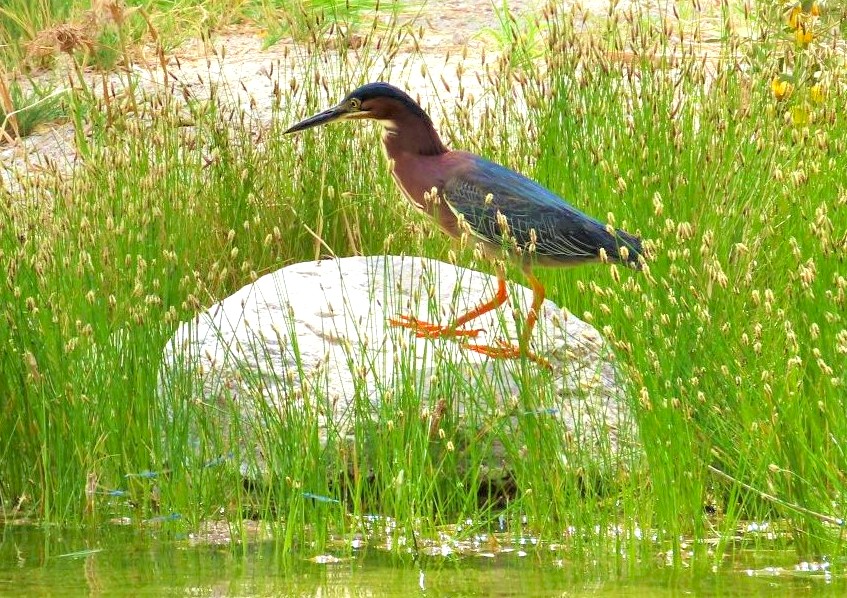
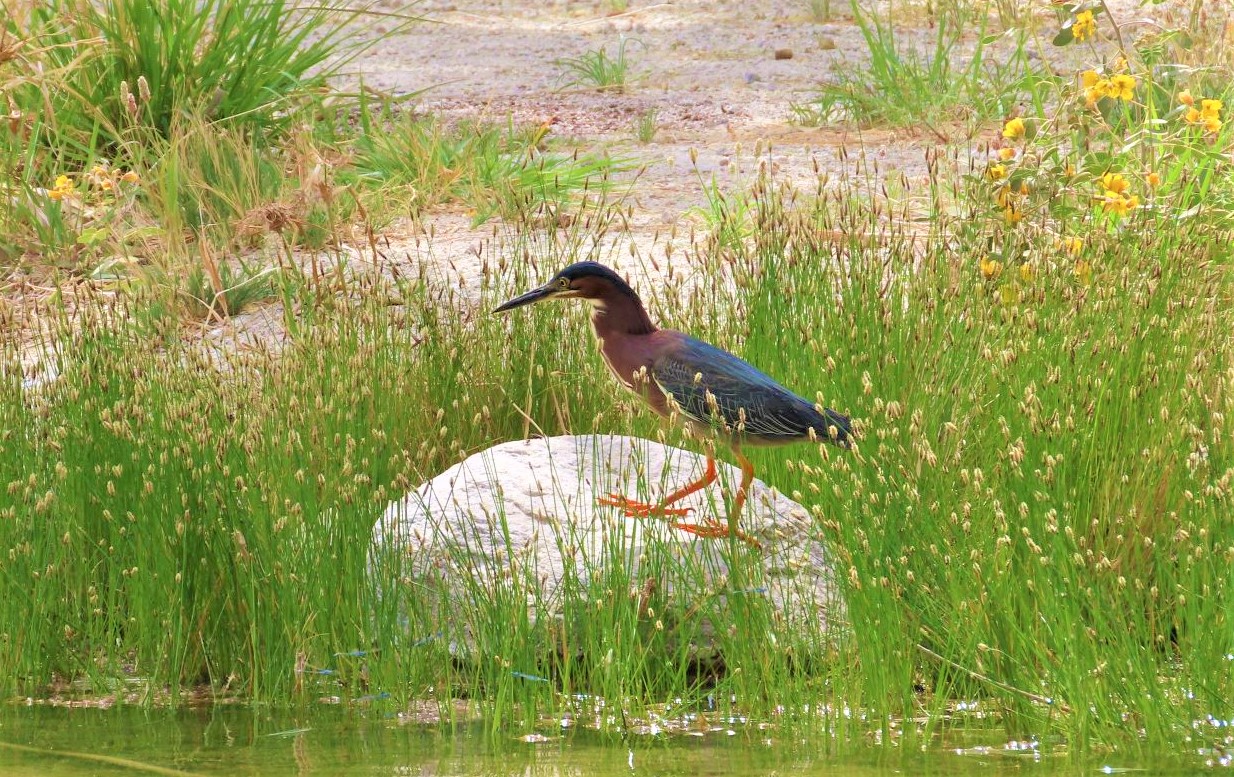
Add Tucson’s Agua Calliente Park, where I saw this green heron, to the list of places to visit for beauty and birds. — Photo by Pat Bean

“Everything has beauty, but not everyone sees it.” – Confucius

Aging My Way

During the nine years I was traveling around America in a small RV with my canine companion Maggie, I was often asked what place I liked best. The question always had me stumbling for an answer. To name just one and leave out all the rest of Nature and man’s wonders just seemed wrong.

Everywhere, and I do mean everywhere, I went had its own kind of beauty. This was brought home to me at an overcrowded El Paso RV Park where I was parked on a cement slab with large RV rigs hooked up six feet away to both my right and left.

I was bemoaning the fact that I had been stuck here because nothing greener was close enough to reach before dark.  And then I happened to glance outside my RV window.

Strutting across the cement was a California Quail with six young chicks following her. The sight made me rethink my idea of beauty, especially since one goal of my RVing years was to see as many species of birds as I could.

Meanwhile, here are a few other special places I’ve visited that have impressed me in one way or another – and where I got a new bird for my life list.  

Maine: Acadia National Park, where one can stand on the top of Cadillac Mountain and be the first person in the United States to have the sun touch their face. I saw a black-billed cuckoo here.

New Hampshire: Flume Gorge, for an unforgettable hike and birds like an ovenbird and a black-throated blue warbler.

Oregon: Brandon National Wildlife Refuge, where my bird list grew by a pelagic cormorant, black turnstone and a whimbrel.  

Utah: Zion National Park, a longtime special place for me, and where I saw a California condor flying overhead. These birds were brought back from the edge of extinction and I wrote about their recovery several times.

Texas: Brazos Bend State Park, even if an alligator sometimes required me to detour off a favorite hiking trail. It was here where I saw my first pileated woodpecker, a close look-alike of the extinct ivory-billed woodpecker.

And I could easily list another 100 sites without much thought. Look around you. Beauty is everywhere.

Pat Bean is a retired award-winning journalist who lives in Tucson with her canine companion Scamp. She is an avid reader whose mind is always asking questions (many of which are unanswerable), an enthusiastic birder, staff writer for Story Circle Network’s Journal, author of Travels with Maggie available on Amazon (Free on Kindle Unlimited), and is always searching for life’s silver lining. She also believes one is never too old to chase a dream.

Read Full Post »

Cumbres Pass in Colorado, a fall scene I stumbled into after taking a wrong turn during my RV-ing years. Thankfully, the sight is still embedded in my memories. — Photo by Pat Bean

Aging My Way

It amazes me how, in my eighth decade, I can finally sit so quietly, simply enjoying the sights around me and communing with my brain’s thoughts and memories. I’m finally able to let go of the intense need I’ve long had to constantly be doing, doing, and doing.

In my earlier years, the doing was a way to cope with a too young, too wrong marriage. The doing then became a necessity as I had five young children underfoot, and then a need to support the family financially.

When that was accomplished, the doing turned into a desire to celebrate a late, second adolescence because I had missed that first season of my life. At the same time, I was also deeply involved with an exciting job I loved, and which, because it was as a journalist and I was involved in reporting the world around me, was on my mind almost 24 hours a day.

When I retired in 2004, doing, doing and doing had become an ingrained habit. If I wasn’t constantly involved in some activity, I felt substantially reduced as a person. As a result, I planned my life so I was either always on the go or had an ongoing project, like traveling the country in an RV, writing a book, or seeing as many bird species as I could.  

I treasure those years of doing as I spent nine wonderful years living on the road during which I saw an abundance of this amazing country. And I did, finally, write that book. As for the bird watching, I’m still doing that, and I’m still writing – just at a much slower pace, which has left me with plenty of time for lollygagging.

What astounds and amazes me is just how much I’m enjoying it.

Pat Bean is a retired award-winning journalist who lives in Tucson with her canine companion, Scamp. She is an avid reader, an enthusiastic birder, staff writer for the Story Circle Network Journal, the author of Travels with Maggie available on Amazon (Free on Kindle Unlimited), is always searching for life’s silver lining, and these days aging her way – and that’s usually not gracefully.

Read Full Post »

This is a Green Heron that I saw here in Tucson at Agua Caliente Park. — Photo by Pat Bean

Aging My Way

Since my heart attack, and the installation of three stents in this old broad’s body, I’ve pretty much nested. It felt like a major triumph when two months out I could drive again, even if just to the doctor’s, pharmacy, grocery store and library.

Then on my first real outing, a party accompanied by “the girls” – my granddaughter and her wife – I took a fall. It was a little one, with me going down on my knee, rolling forward on my left side and just barely hitting my head. In my younger life, I would have just gotten up and been embarrassed if someone had seen me.

But I’m on blood thinners and my head and knee swelled up to gigantic proportions, so “the girls” rushed me to the emergency room for a CT scan. I was fine and the swelling soon went down. However, I was black and blue on my left side from my knees to my head for several weeks.

After that, I was reluctant to leave my comfortable abode except for necessities. It kind of felt like I had agoraphobia. I decided I didn’t like it – and in response recently set a goal of doing one outside activity a week. Last week, it was a pool party at the same friend’s house, but because I was accompanied by “the girls,” it kind of felt like I was cheating.

This morning, however, I got up early and went on an accessible bird watching outing all by myself. The event took place at Sweetwater Wetlands, one of Tucson’s birding gems. Before my heart attack, I had hiked the trail around the small lake often but hadn’t been back in recent months.

While most of the lake had been drained in anticipation of the upcoming annual burn to control invasive plant species and mosquitos, there were still birds around. These are the ones I saw as I walked along the accessible path with my rollator – or simply sat in it and watched: Say’s Phoebee, Gila Woodpecker, Green Heron, Least Flycatcher, Western Kingbird, Cooper’s Hawk, Vermillion Flycatcher, Gambel’s Quail, Kestrel, Black-Crowned Night Heron, Mourning Dove, Abert’s Towhee, and lots of Mallards of varying ages.

The Cooper’s gave us a nice fly-about view, but the Green Heron, which flew in and settled among the Mallards was my favorite sight of the morning. These birds have been a favorite since I saw one sitting on a branch barely above the water watching the scene below intently. Its watch paid off as a small fish swam beneath the branch and quickly became lunch for the heron.

Watching birds is still about the only thing I have patience for. Now, as I sit here in front of my computer in my cozy air-conditioned apartment, I’m thinking about what I will do for an outing next week. Stay tuned.

Pat Bean is a retired award-winning journalist who lives in Tucson with her canine companion, Scamp. She is an avid reader, an enthusiastic birder, staff writer for the Story Circle Network Journal, the author of Travels with Maggie available on Amazon (Free on Kindle Unlimited), is always searching for life’s silver lining, and these days aging her way – and that’s usually not gracefully.

Read Full Post »

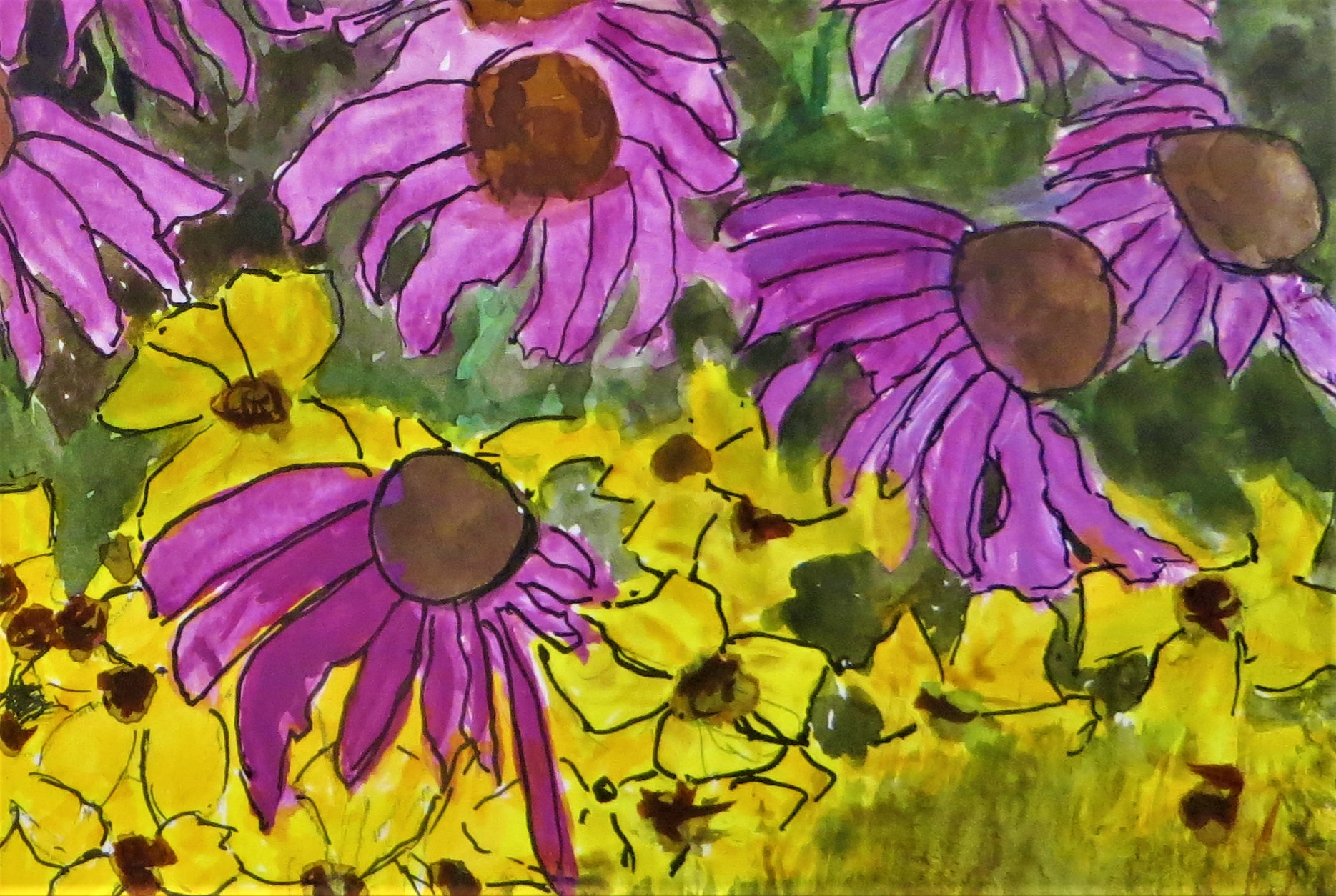
Yellow and Purple — Art by Pat Bean

Aging My Way

Did you know that if you live in the United States’ lower mainland, you’re never more than 135 miles from a McDonald’s. At least that’s what an Atlas Obscura article I read claimed.

Then with a pun for emphasis, the article said the “McFarthest” spot away from one of the fast-food restaurants was located in Nevada. The article then provided the GPS coordinates, with an added note to respect property rights if you decide to go.

Between 1956 and 1970, I lived in Lake Jackson, a small city on the Texas Gulf Coast that was founded in 1942, just two years after the first McDonald’s was opened in 1940. I often heard people, maybe even myself once or twice, decry that the city didn’t have a McDonalds. Well, Lake Jackson has grown substantially over the years, and now has more than one McDonald’s.

But since my way of thinking has changed much over the past 50 plus years, I’m not all together happy about that. I’ve become a big fan of wilderness areas, even if it’s just a place designated as wildlife habitat.

While some humans think we’re the only species that counts. I think differently. Besides, being able to just be surrounded by Mother Nature’s wonders every once in a while, is what has kept me sane all these years. Even as a kid, I treasured being hidden among the leaves up a tree. And when I saw my first mountain, I was hooked for life.  

During my 37-year newspaper journalism career, I was always looking for stories that would take me into undeveloped areas. I wrote about the return of wolves to Yellowstone, the polarized issues of Southern Utah wilderness areas, the creation of The Grand Staircase-Escalante Monument, Forest Service land swaps, troubling issues involving Great Salt Lake, and many other environmental issues.

The newspaper’s photographers even created a catch-phrase about me. “If you find yourself driving on an unpaved road, it must be a Pat Bean assignment.”

I miss those days. But I can’t imagine ever missing a McDonald’s.

Pat Bean is a retired award-winning journalist who lives in Tucson with her canine companion, Scamp. She is an avid reader, an enthusiastic birder, the author of Travels with Maggie available on Amazon (Free on Kindle Unlimited), is always searching for life’s silver lining, and these days aging her way – and that’s usually not gracefully.

Read Full Post »

A dull version of the Violet-Crowned Hummingbird, a bird that sneaks across Mexico’s border into Arizonia.

Aging My Way:

          I keep a list of all the bird species I see flying free in the wild. So far, I’ve seen 712. It’s been that way for a while, but I thought I had finally found two new ones this weekend.

As I set and partied outside to celebrate a friend’s birthday in the town of Sahuarita, a brown hummingbird suddenly caught my attention. This was after another bird flew into my sight and landed in a scenic dead tree.

I suspected this latter bird was a kite, but I wasn’t sure what species. My host Doris said someone had told her it was a Mexican bird, which made sense since we were partying in Southeast Arizonia near the border with Mexico.

I had no idea the specific species of either bird until I got home and looked in my birding field guides. I have two. My favorite is National Geographic’s Birds of North America. But I also use Sibley’s Guide to Birds, when I’m stumped or want a second opinion.

While I couldn’t say with surety what the Kite species was, because I didn’t get that close a look, I basically ruled out anything but a White-Tailed Kite, a bird I had previously seen on the Texas Gulf Coast at the San Bernard National Wildlife Refuge. This meant that even if my identification was spot on, it still wouldn’t count as a new bird.

I was more confident about identifying the little brown hummer. Despite its plainness, I was about 90 percent certain it was a Violet-Crowned Hummingbird, as it’s the only brown hummer that can be seen in North America, and then normally only in Southeastern Arizonia. This one was most likely a juvenile whose crown hadn’t come into its color yet, or one whose color wasn’t visible to me because I wasn’t looking through my binoculars at it. Some violet crowns, or so my field guide alluded to,  have color crowns that are duller or darker.

Anyway, I would really like to go back and have a second look at the hummer through my binoculars. I’m still kind of hesitant about adding it to my list – so, despite my high hopes my list continues to stand at 712.  

Pat Bean is a retired award-winning journalist who lives in Tucson with her canine companion, Scamp. She is an avid reader, the author of Travels with Maggie available on Amazon (Free on Kindle Unlimited), is always searching for life’s silver lining, and these days aging her way – and that’s usually not gracefully.

Read Full Post »

Great horned owlets hanging in during a storm. — Photo by Pat Bean

For the past couple of weeks, I’ve been spending an extra amount of time hanging out on my living room third-floor balcony, where I always see hummingbirds and often great horned owls during the day and a spectacular sunset almost every evening.

The views have become especially precious since I know I will be leaving them behind when I move to a new place mid-August. We humans are quite funny in that we tend to value more what we don’t have than what we do have. And that certainly includes more than just a pleasant view.

My new place offers me things I need, like a fenced patio for my dog, and it does have trees and birds and brilliant red and orange desert bird of paradise plants which make me happy. So, I will be receiving new gifts for my eyes, for which I’m thankful.

But in the meantime, I’m enjoying my tree-house view with more appreciation, knowing that I’m going to be leaving it behind. The attention I’ve given it let me take the owl photo above of this year’s great-horned owl siblings. During the 10 years I’ve spent in my apartment here, I’ve watched newly fledged owls learn their way around for seven.

I’ve also listened to their parents courting hoots early on in the year, but these more mature birds are more aloof and don’t hang around in full view as often as their young – who haven’t yet learned that man is the most dangerous beast on earth.

The favorite roosting spot of this year’s owlets is a tall Ponderosa Pine that stands in perfect view of my balcony They are a brother and sister, easily told apart because the female is quite a bit bigger than the male, a trait of just about all predator birds.

Recently I watched the pair during a rain and wind storm, one strong enough that it crashed down another large Ponderosa Pine here.  As I watched the owlets, the female actually seemed to hover over her brother as they stood high on a large branch right next to the tree trunk as smaller limbs and tree needles tossed to and fro around them. This was when I took the photo.

Last year, there were three owlets adjusting to the world here in Tucson’s Catalina Foothills. Their favorite hangout was usually the rooftops, and I usually only saw them when walking my canine companion, Scamp.

But for days and days, one of them spent many hours in what sounded like literal crying. It was quite an unpleasant screech. I suspect that it began after their parents stopped feeding them because it was time for them to be off on their own.

Shortly after this happens, the new crop of owls disappear, and the courting songs begin again soon after.

 I feel quite blessed to have had the past years with these owls. But it’s time for me to move on and start making new memories to cherish.  I can do that, too.

Pat Bean is a retired award-winning journalist who lives in Tucson with her canine companion, Scamp. She is a wondering-wanderer, avid reader, enthusiastic birder, Lonely Planet Community Pathfinder, Story Circle Network board member, author of Travels with Maggie available on Amazon (Free on Kindle Unlimited), and is always searching for life’s silver lining.

Read Full Post »

Night sky over the Grand Canyon

Mother Nature’s Silver Lining

 here are places in this world where, when looking up at the night sky, you can clearly see portions of the Milky Way, the galaxy we live in. It’s a magnificent sight. But those places get fewer and fewer every year because we humans are fond of lighting up the dark, creating a light pollution that dulls our view of the stars.

 Some cities, including Tucson where I live, have ordinances that limit artificial-light pollution. Supposedly, Tucson’s location in the heart of the Sonora Desert, has the darkest sky of any city its size in the country. And because of this, astronomers come from all over the world to visit nearby Kitt Peak National Observatory, home to some of the best sky observation telescopes in the world.

 I’ve visited the observatory, but only during the daylight hours. The best sky watching I’ve ever experienced came when I was rafting down the Colorado River through the Grand Canyon, especially in places where the canyon was tall and at its narrowest. As I lay in a sleeping bag on a sandy beach, I could actually see the stars move across the thin strip of visible sky.

 It was magical, a moment in nature that connected me with the whole of the universe. Thinking about those Grand Canyon nights still leaves me awed.

 Sky watching here in Tucson doesn’t compare. But I’ve never seen more spectacular sunsets than the ones that I see most nights from my third-floor balcony here in the city. They, too, are magical, a silver-lining for surviving the daily news.  

Pat Bean is a retired award-winning journalist who lives in Tucson with her canine companion, Scamp. She is a wondering-wanderer, avid reader, enthusiastic birder, Lonely Planet Community Pathfinder, Story Circle Network board member, author of Travels with Maggie available on Amazon (Free on Kindle Unlimited), and is always searching for life’s silver lining.

Read Full Post »

A view of the Grand Canyon and the Colorado River below from one of the many view points. The canyon is too big, and awesome, to be captured from a single point. — Photo by Pat Bean

          My latest travel book read is To Timbuktu by Mark Jenkins, an author I came to love over 20 years ago because of his articles in Outside Magazine, of which I’m a great fan.  

 Mark has a great way with words, such as his description in To Timbuktu of an equatorial mountain range: “…rumpled geology smothered by the octopus of botany,” he wrote.

As usual when reading, having one thought often cycles me to a related thought. This morning, I wondered how writers would describe the Grand Canyon, which I revisited for about the dozenth time this past week. So, I went searching for just such descriptions.

Most quotes that I found about the Grand Canyon echoed, in one way or another, the phrase that the author didn’t have the words to describe it.

But as I kept searching, I came across what John Wesley Powell, the first man to go down the entire length of the Colorado River through the entire Grand Canyon in 1869, had to say about this Arizona hole that was carved out over six million years ago. He wrote:

“The glories and the beauties of form, color, and sound unite in the Grand Canyon – forms unrivaled even by the mountains, colors that vie with sunsets, and sounds that span the diapason from tempest to tinkling raindrop, from cataract to bubbling fountain … The elements that unite to make the Grand Canyon the most sublime spectacle in nature are multifarious and exceedingly diverse.”

Another of my favorite authors, Ann Zwinger, whose trip through the Grand Canyon is described in her book Downcanyon, had this to say: “The astonishing sense of connection with that river and canyon caught me completely unaware, and in a breath, I understood the intense, protective loyalty so many people feel for the Colorado River in the Grand Canyon. It has to do with truth and beauty and love of this earth, the artifacts of a lifetime and the descant of a canyon wren at dawn.”

Having paddled through the Grand Canyon on the Colorado River twice, I well understood Ann’s words, especially about the impact of hearing canyon wrens welcome the day.

If you haven’t visited the Grand Canyon, above or below, you might want to add it to your bucket list, or at least read about it in books such as Zwinger’s Downcanyon or Powell’s journals of his epic 1869 and 1871 adventures.

Meanwhile, I’m going to get back to Jenkins’ Timbuktu adventure.

Pat Bean is a retired award-winning journalist who lives in Tucson with her canine companion, Scamp. She is a wondering-wanderer, avid reader, enthusiastic birder, Lonely Planet Community Pathfinder, Story Circle Network board member, author of Travels with Maggie available on Amazon (Free on Kindle Unlimited), and is always searching for life’s silver lining.

Read Full Post »

Gila Woodpeckers favor saguaro cacti for their homes, which is one reason I’m always looking at them. — Photo by Pat Bean

          One of the many delightful things about living in Tucson are the Saguaros, a slow-growing cactus that at about the age of 50 develops tree-branch arms. The cactus then lives on for another hundred years or so, continuing to grow more arms and stretch up toward the sky.

          They are visible all-around Tucson’s Sonoran Desert landscape. In the area’s monsoon seasons– sadly absent the past couple of years – the trunks of the cactus take in and store water to last it during the dry spells. You can visibly see the saguaros trunk bulge after a heavy rain.

For the nine years I’ve now lived in Tucson, I’ve also watched these cacti sprout enchanting white flowers with golden centers on the tips of their arms for a few weeks each spring.

This spring the blossoms were more abundant than I’ve ever seen them, plus the blossoms were also growing elsewhere on the cacti. It’s something I haven’t seen before, and neither have others. The phenomena has been strange enough that desert ecologists are trying to come up with an answer for it.

 One thought is that the area’s drought and above-average heat are behind the changes in the saguaros.

Meanwhile, I’ve noticed another phenomena here at my apartment complex in Tucson’s Catalina Foothills. We have an abundance of house sparrow babies. I can’t step outside my apartment without seeing a host (the name for a group of sparrows) littering the grass where I walk. I would enjoy them more if my canine companion Scamp didn’t think it would be fun to try and catch one, an action I highly oppose.

I do, however, enjoy waking up in the mornings to their cheery chirp…chirp…chirps.  

I suspect that their parents took advantage of the many thick bushes around the complex for nesting and the abundance of water sprinklers that are used to keep two of the apartment’s three courtyards green. I also suspect the abundance of sparrows is probably why our resident great horned owls continue to raise their young in the tall trees that look down on those courtyards.

So what is Mother Nature up to where you live?

Pat Bean is a retired, award-winning journalist who lives in Tucson with her canine companion, Scamp. She is a wondering-wanderer, avid reader, enthusiastic birder, Lonely Planet Community Pathfinder, Story Circle Network board member, author of Travels with Maggie available on Amazon (Free on Kindle Unlimited), and is always searching for life’s silver lining.

An old saguaro that I thought looked like an old man, whose death I watched over a period of several months.

Read Full Post »

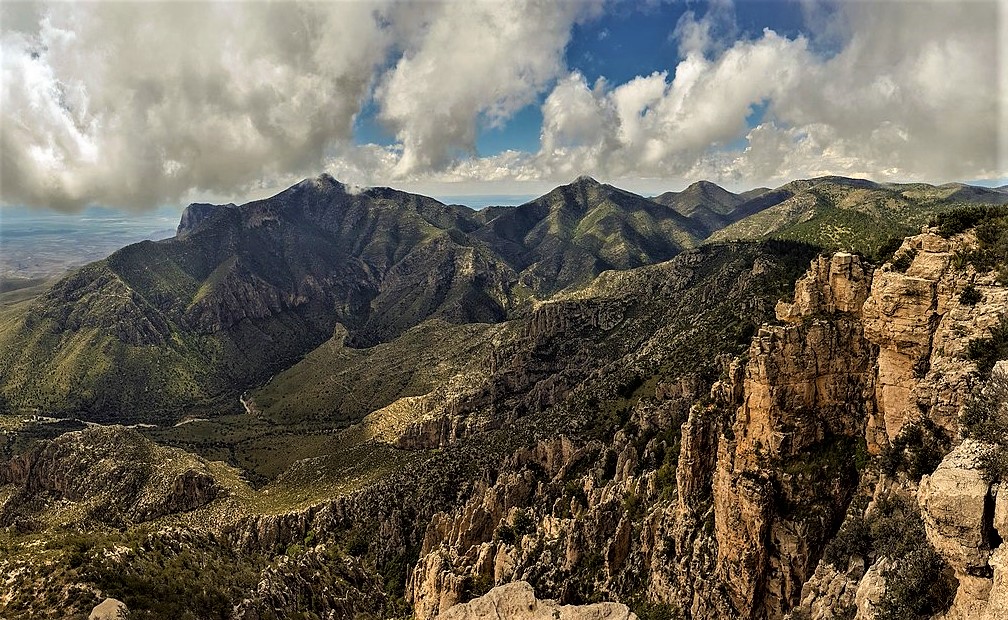
Guadalupe Peak in Guadlupe Mountain National Park in Texas. — Wikimedia Photo

One of the things I’ve concluded after eight decades of iving is that beauty can be found anywhere. It’s easy to believe this when you’re spending a day hiking in the magnificent Guadalupe Mountain National Park, which is what I was doing on a warm April day about 11 years ago.

Blooming cacti and ocotillo plants dotted the Chihuahuan Desert landscape, whose mountain scenery is a rare sight in mostly flat-land Texas. Overseeing this nature haven were the picturesque peaks of El Capitan (Yes, it has the same name as better know peak in Yosemite) and Guadalupe, the latter peak, at 8,752 feet, being the highest point in the Lone Star state.

It was 360 degrees of awesome, brought to life by collared lizards darting among the yellow and magenta colored prickly pear blossoms.

That sentiment about beauty, however, was challenged a few days later when in contrast, I found myself camped for the night in an El Paso RV park, my small Class C motorhome squeezed between two huge Class A vehicles with wide slide outs in a cement parking lot. In addition, the park was surrounded by a low rock fence beyond which passing traffic kept up a yowling roar.

It was the kind of place I avoided as carefully as I did the alligators in the Okefenokee Swamp when I visited. But time and distance left me no choice. It was the only place near enough I could reach before dark, and I never drove my RV at night. 

I tried to follow Garth Brooks’ advice about basing happiness on what you have and not what you don’t have, but I was still grumbling to myself about the drab view as I sat at my table and stared out the window of my motorhome.

I wanted a meandering creek whose gurgles would lull me to sleep, and a large tree to sit beneath while reflecting on my day, and perhaps a small camp fire whose flames I could get lost in. During my nine years on the road, I spent many a night in just such a setting.

 Thinking of those nights, I admonished myself to be thankful for my life, and started to get up and get a book to read. That’s when the beauty happened.

A Gambel quail, followed by nine chicks, strolled into view. The She was headed across the cement to the far side of the campground, and she was followed by 11 chicks. And trailing behind them was another adult quail, a bit gaudier than the first so I assumed he was the male parent.

The birds brought a smile to my face, and my optimistic view that beauty could be found everywhere was renewed.

Why, I asked myself, had I ever doubted that beauty could be found everywhere, even if you don’t go looking for it.

Bean Pat: Guadalupe Mountain National Park: Here, you’ll find one of the finest examples of an ancient, marine fossil reef on Earth.

Pat Bean is a retired journalist who lives in Tucson with her canine companion, Scamp. She is a wondering-wanderer, avid reader, enthusiastic birder, Lonely Planet Community Pathfinder, Story Circle Network board member, author of Travels with Maggie available on Amazon, and is always searching for life’s silver lining.

Read Full Post »

Older Posts »