Feeds:
Posts
Comments

Archive for the ‘Books’ Category

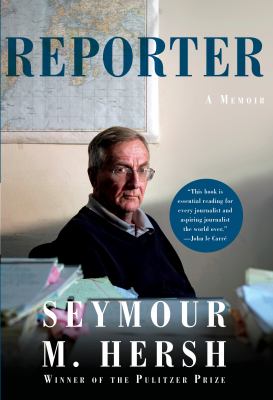
I’m currently reading this book — and loving it.

          A love of books, of holding a book, turning its pages, looking at its pictures, and living its fascinating stories goes hand-in-hand with a love of learning.” – Laura Bush

What I’m Reading

          I’m reading In My Mind’s Eye, a collection of short essays written by Welch author Jan Morris when she was in her nineties. Jan is one of my favorite authors, and I’m loving her unvarnished look at the world through the lens of age.

Dr. Johnson’s Dicitionary, first published in the 18th century is still lurking around in book stores.

Jan, who was once James and served in the military and climbed Mount Everest in the 1950’s, has written almost too many travel and history books to count. In My Mind’s Eye is a kind of daily diary, however. Topics range from talking to your cat to her idea of a smile test.

On Day 59 in the book, Jan talks about looking through her vast collection of books for Dr. Johnson’s dictionary, fifth edition, 1788. As he picks up the book, Jan notices the damage on the spine and remembers that it was put there by her “darling daughter,” 50 years ago when her pram was parked by the bookcase.

Who in the heck is Dr. Johnson? I stopped reading and looked him up. He was Samuel Johnson, considered one of the best writers of the 18th Century, and best known for his Dictionary of the English Language. I love reading a book in which I learn something new.

Meanwhile, another of my favorite days in Jan’s book is the one in which she rewrote the words to the battle hymn Onward Christian Soldiers.

Onward friends and neighbors, into the kindly sun,

          Where we are paid-up members, each and every one.

          We need no theologians, no doctrinal guff,

          No military idioms, no sham repentance stuff –

          We take the worthy with the nasty, the gentle with the rough.

          The absolute of absolutes. Kindness is enough.!”

Kindness is my word for the year.

  Bean Pat: To all the many, many authors who have challenged my mind and broadened my horizons.

Pat Bean is a retired journalist who lives in Tucson with her canine companion, Scamp. She is a wondering-wanderer, avid reader, enthusiastic birder, Lonely Planet Community Pathfinder, Story Circle Network board member, author of Travels with Maggie available on Amazon, and is always searching for life’s silver lining.

Read Full Post »

          Come Fairies, take me out of this dull world, for I would ride with you upon the wind, and dance the mountains like a flame.” – William Butler Yeats

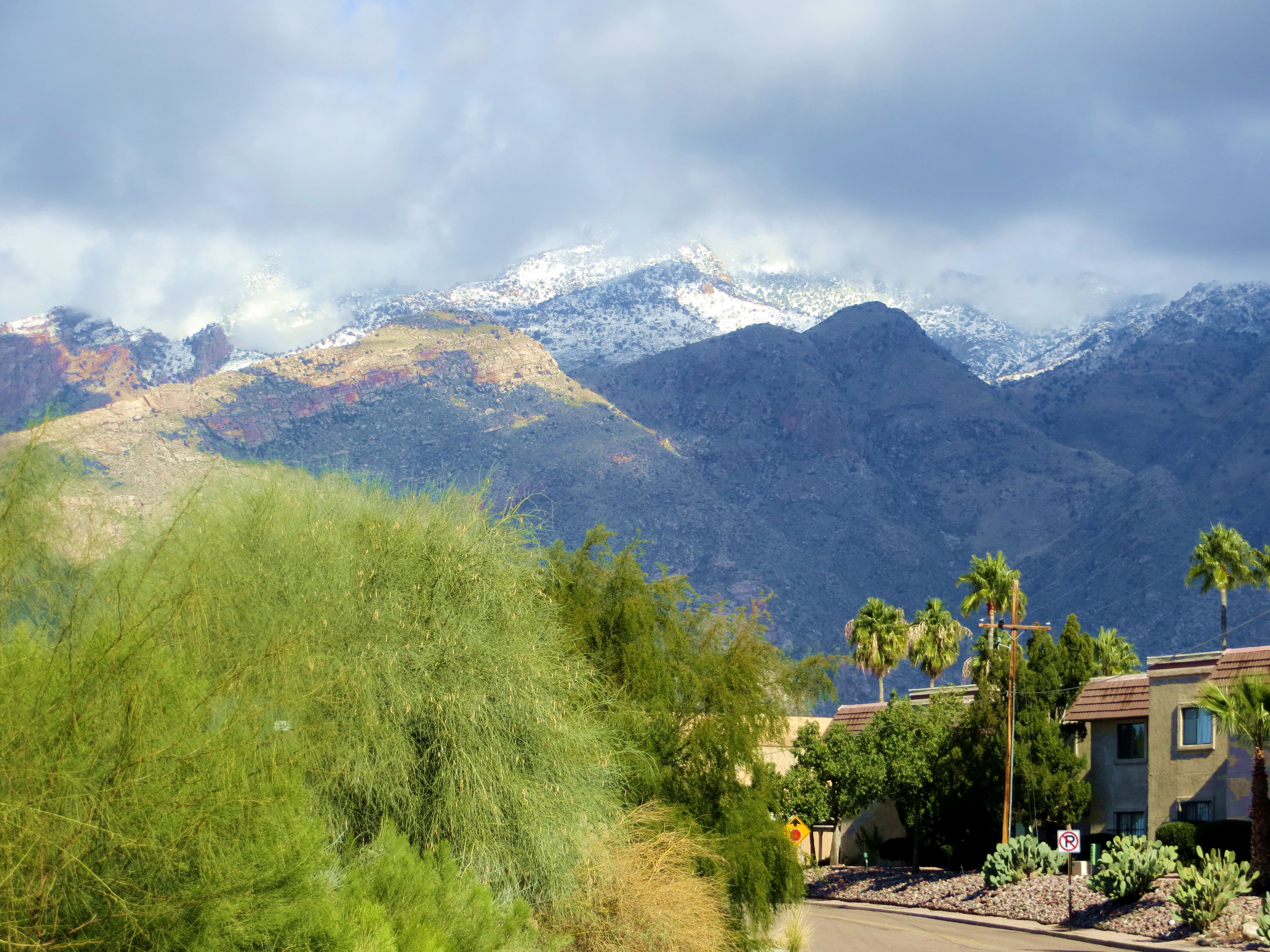
A rare view of Mount Lemmon with snow on its peaks. — Photo by Pat Bean

Morning Thoughts

I was in my early teens before I left the flatlands of Texas and saw my first mountain. It was love at first sight.

I suspect that love was one of the reasons I settled in Tucson for my retirement years, instead of in Texas where the majority of my children live and where I had planned to settle after my full-time RV-ing years.

One of the first things I see every morning, when I look off my bedroom balcony or while I’m walking my canine companion, Scamp, is Mount Lemmon. I live in its shadow, and just looking at it fills my heart with joy.

Mount Lemmon, at 9,159 feet, is the tallest one in the Santa Catalina Range. Its name is rare in that it honors a woman, botanist Sara Plummer Lemmon who hiked to its peak in1881.

It’s currently the monsoon season here in the Sonoran Desert, and while it’s been a dry one, the mountain still exudes a green patina at midday. In the early mornings, the rising sun casts shadows that define its nooks, crannies, and canyons. And in the evening, as the mountain reflects back the last rays of the sun, it takes on a rosy glow.

The mountain’s face is ever-changing, and I never tire of looking to my north.

Some people need to live by the sea, others in a forest. I need to live by a mountain. It steadies me and sings to my soul – and always lets me know which direction I’m facing

Check out Travels with Maggie on Amazon.

Bean Pat: One of my favorite books is Men to Match My Mountains by Irving Stone. Sara Plummer Lemmon and Isabella Bird, who is the author of A Lady in the Rocky Mountains (also a favorite book) add notes to history showing women can match the mountains, too.

Pat Bean is a retired journalist who lives in Tucson with her canine companion, Scamp. She is a wondering-wanderer, avid reader, Lonely Planet Community Pathfinder, Story Circle Network board member, author of Travels with Maggie available on Amazon, enthusiastic birder, and is always searching for life’s silver lining.

Read Full Post »

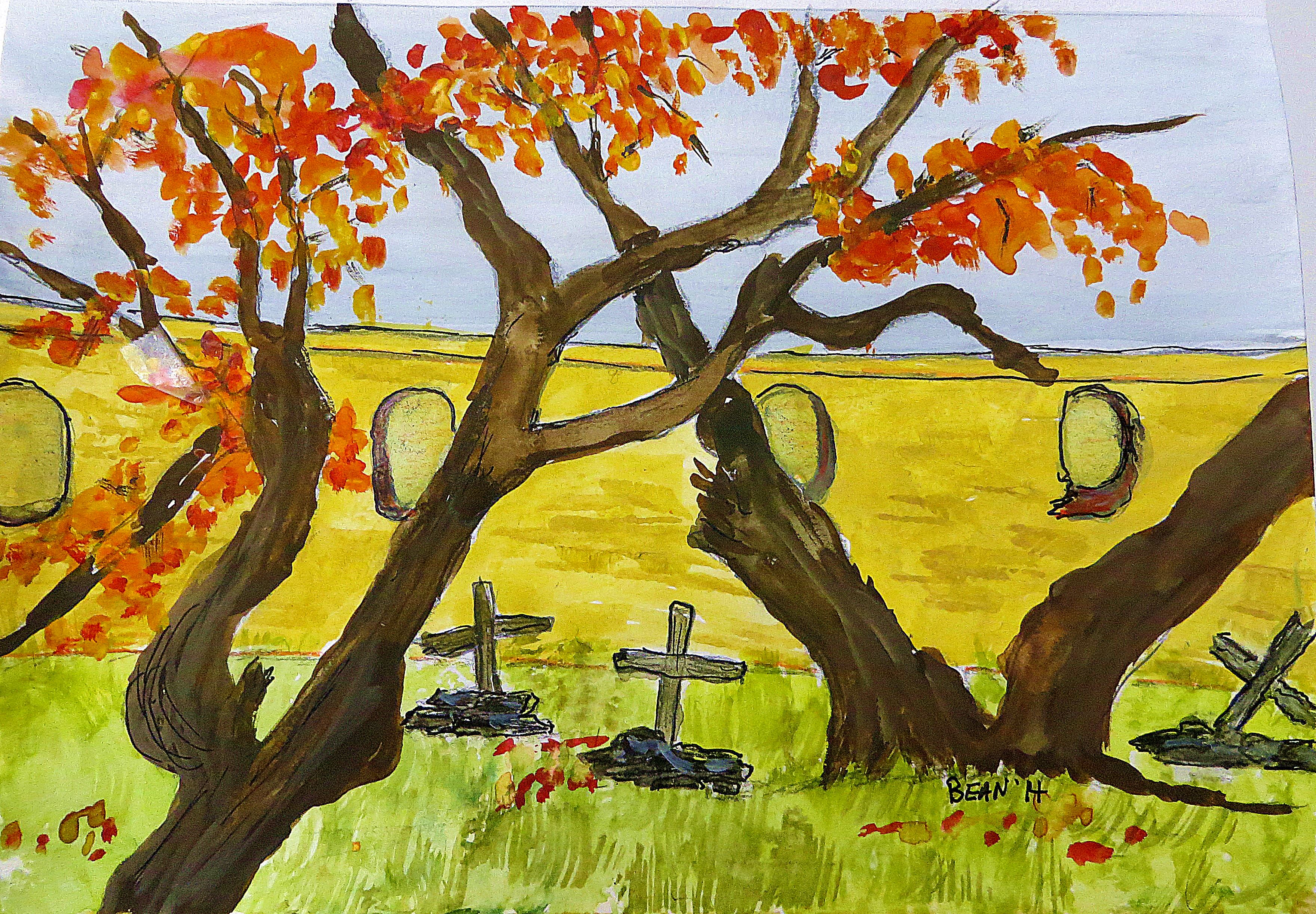
Piddling around with art is one of the things that is always on my daily to-do list. Some days I paint, and some days I don’t. This simple one of a tree and meadow were done a couple of years ago.

          By taking the time to stop and appreciate who you are and what you’ve achieved – and perhaps learned through a few mistakes, stumbles and losses – you actually can enhance everything about you. Self-acknowledgment and appreciation are what give you the insights and awareness to move forward toward higher goals and accomplishments.” — Jack Canfield

Morning Thoughts

          As I picked up my daily journal yesterday morning, I noted that it was 8:30 a.m. I then wrote “It’s not yet nine a.m. and I have walked my dog Scamp, made my bed, washed dishes, blogged and read a chapter in Carole King’s memoir. A Natural Woman.”

I paused for a moment, then laughed as I continued writing. “It feels good to give myself credit for the things I’ve done instead of beating myself up for all the things on my to-do list that I haven’t done.”

          All I can say is that at 80, it’s about time.

Reading my journals of the past, I discovered that I was constantly abusing myself for not doing everything I planned or wanted to do, even though in the earlier journals when I was a working mother, I found myself amazed that I had managed to do so much.

While I no longer beat myself up, today’s to-do list is, as always, longer than my attention and energy can handle. I like it that way. It assures that I will never wake up and find myself with nothing to do.

But being OK with not accomplishing it all is a blessing that has only come with age. I like that, too.

Check out Travels with Maggie on Amazon.

Bean Pat: Silly Saturday https://tidalscribe.wordpress.com/2019/09/14/silly-saturday-the-past-unblogged/ A plug for blogging that made me laugh.

Pat Bean is a retired journalist who lives in Tucson with her canine companion, Scamp. She is a wondering-wanderer, avid reader, Lonely Planet Community Pathfinder, Story Circle Network board member, author of Travels with Maggie available on Amazon, enthusiastic birder, and is always searching for life’s silver lining.    *****

Read Full Post »

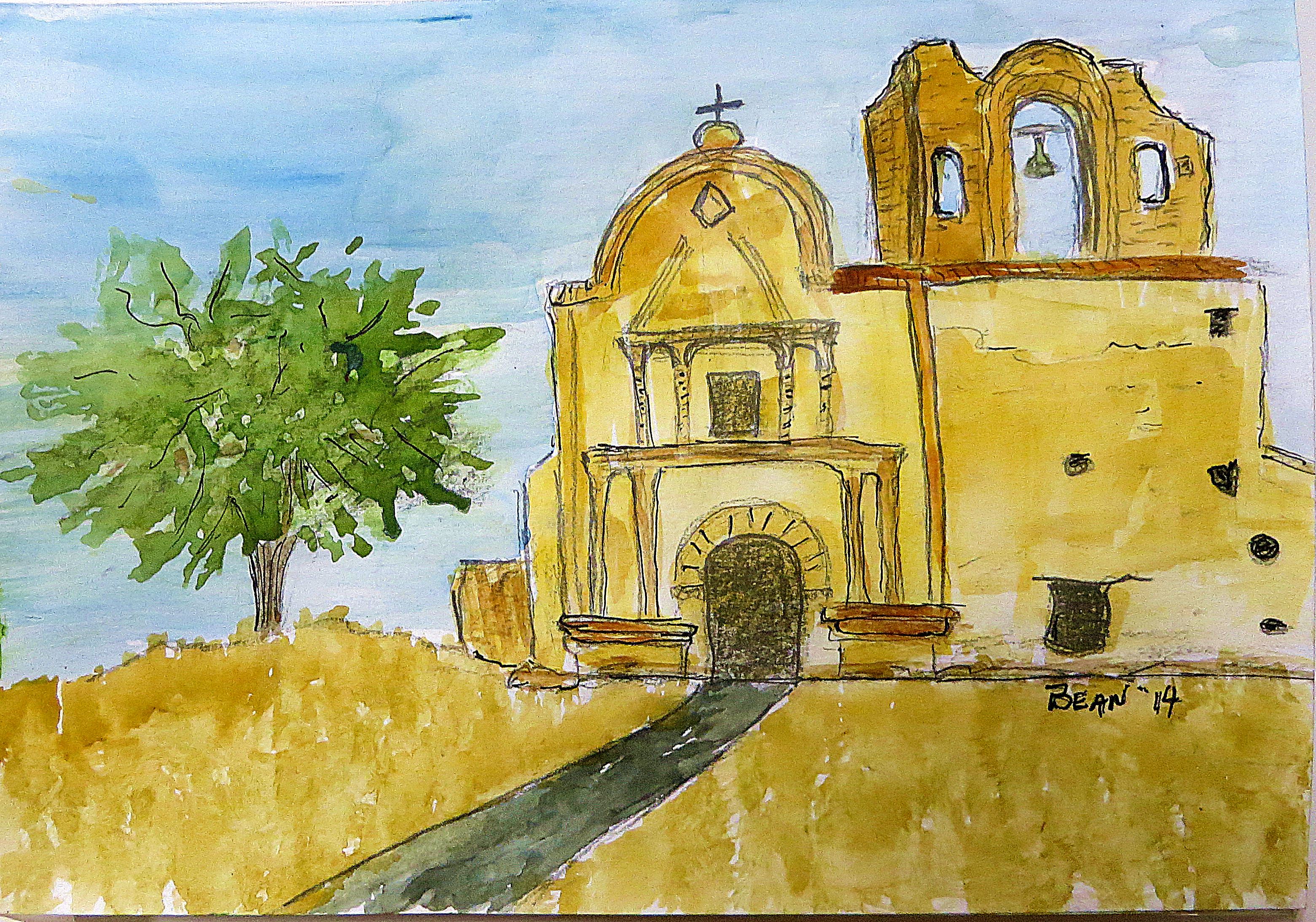
Mission San José de Tumacácori: I did an onsite sketch of the mission on a painting field trip a while back, then added watercolors when I got back home.

          “The books that help you most are those which make you think the most.” – Pablo Neruda

Morning Thoughts

          I buy books and eBooks from Amazon, I buy books at Barnes and Noble, I buy books from Bookmans (a used book store here in Tucson), I buy audible books, and I go to the library weekly. Just thinking about not having something within arm’s reach to read at any given moment would be cause for a panic attack.

This was the view behind the mission, which is located off Highway 19 south of Tucson. It’s an interesting place to visit if you’re in the area. — Art by Pat Bean

Thus, it was that I found myself standing in front of the “Good Reads” book stand that welcomes visitors to the Dusenberry-River Library, the closest library branch to my apartment in Tucson’s Catalina Foothills. The stand contains mostly current best-sellers, and I usually make my first selection of books to check out here before moving on to look for more esoteric choices.

“So, what do you like reading?” A kindly voice asks. “A little bit of everything except for horror,” I told the tall, slender woman adding books to the stand.

“Maybe you’ll like this,” she asks, pulling a book from the backside of the stand. “It’s well-written and funny,” The book was Maybe You Should Talk to Someone by Lori Gottlieb, and is about a therapist and her therapist.

“Sounds interesting,” I said, and put the book into my bag for later check out. (I’ve already started reading it, and I love it.)

She then brought out a second book, one I knew was a popular book club selection and had gotten rave reviews. She asked if I had read it.

I sort of frowned, then noted that I had started it but found it unoriginal and boring. I felt guilty about saying this, until she smiled and said, “I’m so glad you said that. I tried to finish it twice but couldn’t. But everyone else I’ve talked with absolutely loves it.”

I’m hoping to meet up with this library worker the next time I visit.

Check out Travels with Maggie on Amazon.

Bean Pat: Libraries everywhere. Visit one soon.

Pat Bean is a retired journalist who lives in Tucson with her canine companion, Scamp. She is a wondering-wanderer, avid reader, Lonely Planet Community Pathfinder, Story Circle Network board member, author of Travels with Maggie available on Amazon, enthusiastic birder, and is always searching for life’s silver lining.

Read Full Post »

“You have your way. I have my way. As for the right way, the correct way, and the only way, it does not exist.” — Friedrich Nietsche

I was trying to come up with a name for this recent watercolor and all I could think of was “Happy Poppies.” I asked my friend, Jean, what she would name the painting, and she came up with “Poppies ,Poppies,” and invoked a scene from “The Wizard of Oz.” Our two minds certainly aren’t on the same page. — Watercolor by Pat Bean

Time Changed the Lens in my Eyes

How each of us views life is colored by a unique perspective – our own. Truth is usually somewhere in the middle. I first began to see this years ago when I compared how different reporters covered the same event, and then by listening to my adult children render five different accounts of the same event – or if I added in my two cents, six different accounts.

Eyewitnesses of events can vary so greatly they sound like two different happenings. For example, when I was an environmental reporter, I might lead my story about a speech by a lumber industry spokesman by using his quote: “A tree can produce enough oxygen to keep five or more people alive for a year.” But the paper’s business reporter’s lead would more likely quote him saying: “Logging is the lifeblood of hundreds of small communities; stop cutting trees and people will starve or turn to welfare.”

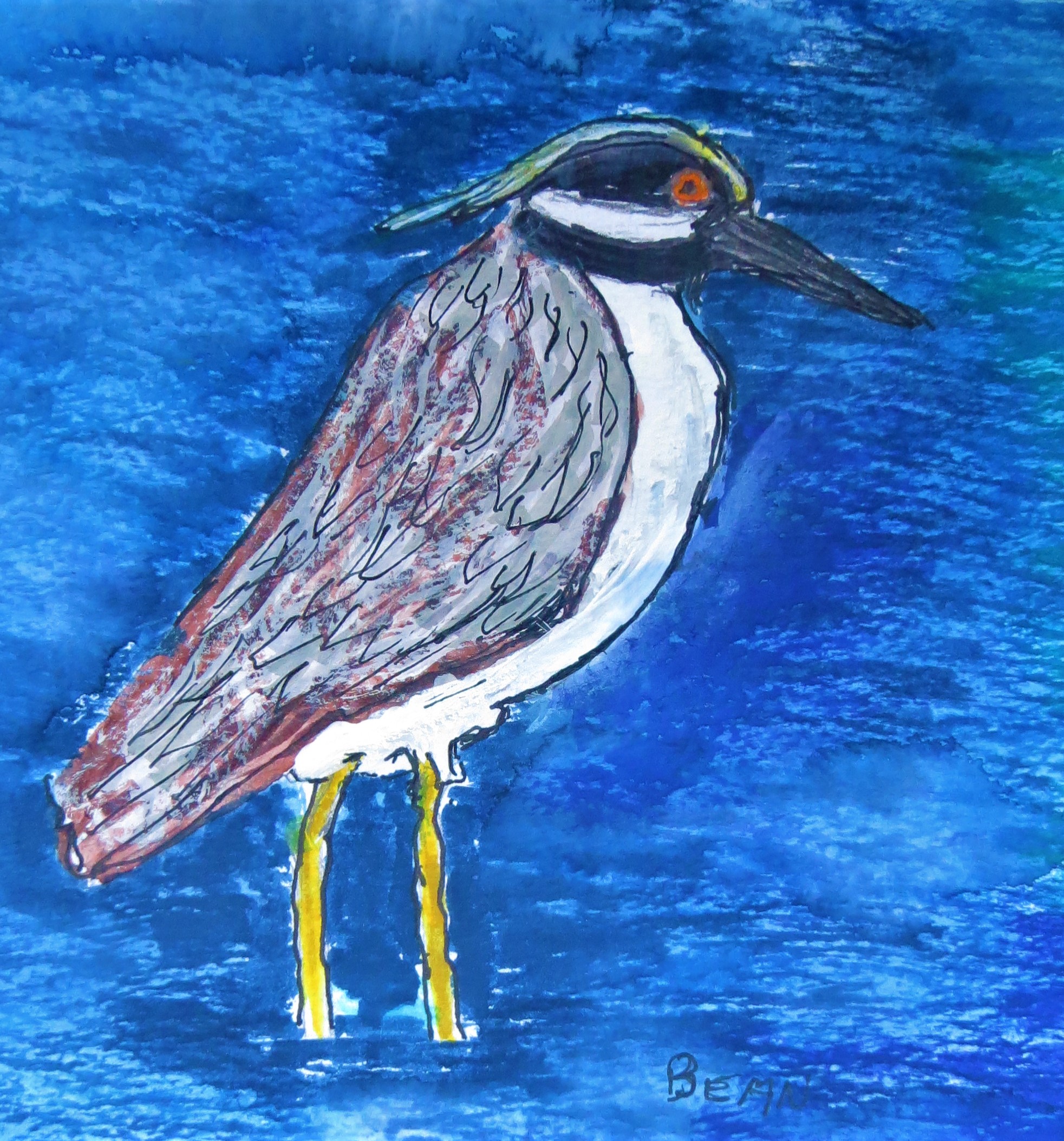
An art teacher once told me to set out to paint a bad painting as an exercise to free my anxiety. Well, this one fits that description. I was not happy at all with how this yellow-crowned night heron turned out. Life is like that. You win some and lose some.

Both of us are accurately quoting the speaker, but the reader is likely to only like, or even believe, the story that bends in his or her direction. The polarity of politics today certainly supports this conclusion.

But I also got to thinking about how this dichotomy even works as we age while reading Mary Karr’s book, The Art of Memoir. “Getting used to who you are is a lifelong spiritual struggle,” she explained while talking about how age can change how we look at our own pasts.

Susan Branch, author of “The Fairy Tale Girl,” explains this phenomenon by noting: “The thing I like about getting older is finally getting a handle on what the heck was going on back then.”

I’m also reading Dani Shapiro’s book, Still Writing, and she says: “…the idea that there is ever a definitive spot from which life can be understood is, I think, to miss the point of the ever-evolving nature of consciousness and life itself.”

I find it quite interesting that these three writers, so unalike in their personalities and writing styles, all seem to agree that everyone sees things differently, and as we age, even we begin to see things differently than we did when we were younger. I know I do.

Confusing, but it keeps life interesting.

Bean Pat: Bird Note https://www.birdnote.org/ A great way to learn about birds from your comfortable living room.

Check out Travels with Maggie on Amazon.

Pat Bean is a retired journalist who lives in Tucson with her canine companion, Scamp. She is a wondering-wanderer, avid reader, Lonely Planet Community Pathfinder, Story Circle Network board member, author of Travels with Maggie available on Amazon, enthusiastic birder, and is always searching for life’s silver lining.

Read Full Post »

Cooper’s Hawk. Once I became addicted to birdwatching, I couldn’t not see birds. And occasionally I got lucky and got a good photograph. — Photo by Pat Bean 

“Does the road wind uphill all the way?  Yes. To the very end. Will the journey take the whole day?  From morn to night, my friend.” — Christina Rossetti (1830-1894)

Dredging up the Past

I’ve begun work on my memoir, which friends have been urging me to do for years. Like most people’s lives, mine has good parts and bad parts. My book, Travels with Maggie, is 100 percent upbeat, focusing only on the life’s sunshine. I’m happy with it.

If you’re looking for a good book with lots of trivia about America’s cities and landmarks, check out Travels with Maggie on Amazon. It’s G-rated and an excellent book to read together with your kids. Maggie was my canine companion on the six-month birding trip. — Book cover by Sherry Watcher.

For the past year or so, I’ve been working on a second book about my adventures as a late-blooming, bird-watching old broad, tentatively titled Bird Droppings. It also looks at the world through Pollyanna’s eyes. I’m thinking I might start trying to market the chapters I’ve written as single essays.

Meanwhile, as I think about my memoir, tentatively titled Between Wars, a book that will focus on my 37 years as a journalist while also being the mother of five children, and surviving a nasty divorce, I know I will have to put the rose-colored glasses in the trash bin.

I’m not sure I can do it. But I’ve started going back through all my journals and finding I at least enjoy doing the research.

For example, as a former river rat who took two, 16-day, white-water rafting trips down the Colorado River through the Grand Canyon, I almost couldn’t stop laughing after reading this entry:  The difference between a fairy tale and a river trip: The fairy tale begins “Once upon a time,” while the river trip tales begins: “No shit! There I was…”

            This past day’s entry also contained some quotes that are still worth repeating.

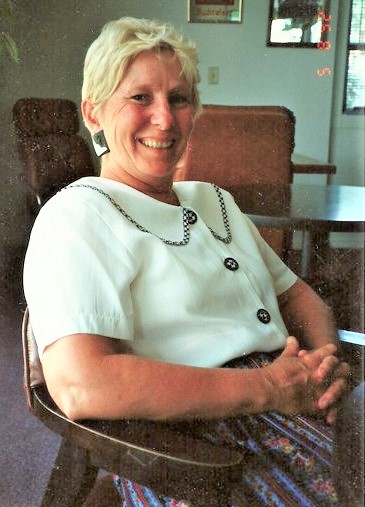
Me, at the Standard-Examiner in 1992, when I was the paper’s environmental reporter. It was my favorite newspaper job, and I held it for 10 years before I became city editor to get more money.. — Photo by Charles Trentelman.

“To the dull mind all nature is leaden. To the illuminated mind the whole world burns and sparkles with light.” — Ralph Waldo Emerson. I think I was reading one of Emerson’s journals at this time.

I was also probably reading one of Natalie Goldberg’s writing books, too. For I wrote down this quote of hers. “If you do not fear the voices inside you, you will not fear the critics outside you.”

I also wrote down some thoughts of my own, in quote form. “At one time in life, I sought logic in everything. Now I know better,” and “If our thoughts were not continually shifting, we’d be a broken record to ourselves.” – Pat Bean

Bean Pat: What a Waste https://brevity.wordpress.com/2019/08/29/what-a-waste/ Leonard Bernstein and scammed writers.

Pat Bean is a retired journalist who lives in Tucson. She is a wondering-wanderer, avid reader, Lonely Planet Community Pathfinder, Story Circle Network board member, author of Travels with Maggie available on Amazon, enthusiastic birder, and is always searching for life’s silver lining


Read Full Post »

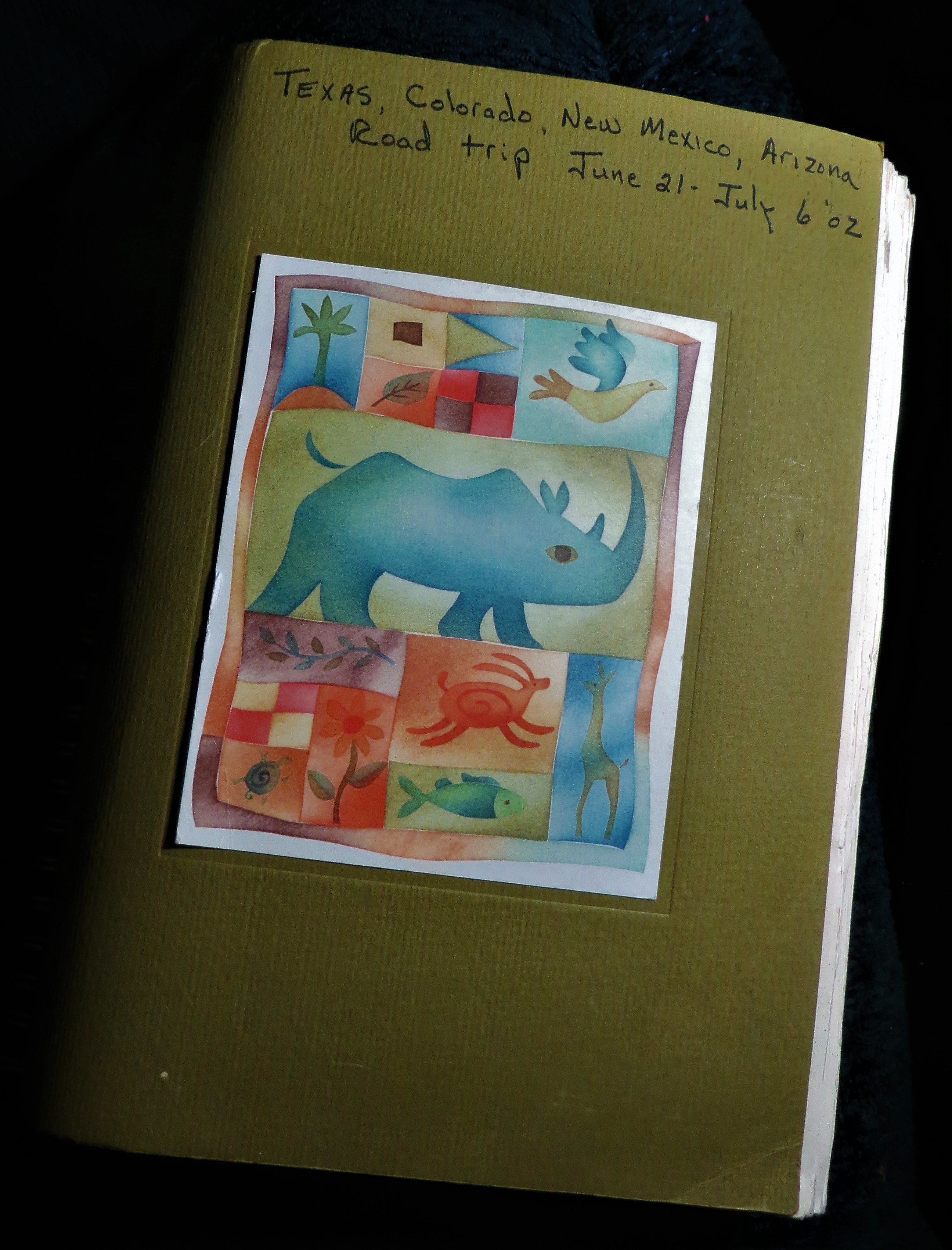
Road Trip: June 21 – July 6, 2002

“The real voyage of discovery consists in not seeing new landscapes, but in having new eyes.” – Marcel Proust

A page from my Journal.

After spending way too much time driving to the end of the road in Canyonlands National Park, I knew most of the rest of the day’s explorations would have to come through the windshield of my vehicle. That was OK because I was traveling through familiar territory that I had been through many times.

My Journal

While I often tried to drive new roads and see new sights on my trips to Texas to visit family once or twice a year, the one I was traveling this time was the shortest and the most used. Shortly after leaving Canyonlands, I stopped in Moab, one of my favorite towns, to gas up and get snacks for the road. Cheetos and a Coke, I suspect, as this is my usual travel fare.

But even in my hurry to get down the road, I did stop for about 10 minutes at Wilson Arch to take a few pictures.  Wilson Arch is about 25 miles south of Moab and quite visible from the road (Highway 191). There is also a half-mile trail leading up to and around it.

The first time I spotted the 46-foot-high by 91-foot-wide arch,, I had been amazed. It simply stood there without fanfare.

Today there are turnouts and interpretive signs noting that Wilson Arch was named after Joe Wilson, a local pioneer who had a cabin nearby. Additionally, the signs say the rock formation is entrada sandstone and that the arch was formed when ice-filled cracks formed and caused parts of the rock to break off. At least that’s my interpretation of the more scientific data.

Whale Rock in Canyonlands National Park. — Photo by Pat Bean

On the same page of my journal that I noted my stop at Wilson Arch this day, I also listed the birds I saw, a habit I followed each day of my journey and one I continued in my book, Travels with Maggie about my later RV-ing years. And yes, the same Maggie who made this trip with me is the same one in the book.

The birds this day included American robin, European starling, California gull, magpie, raven, violet-green swallow, Say’s phoebe and pinyon jay, the latter being a species I saw for the first time and which I added to my then-growing life list.

Bean Pat: All about the Everglades https://earthstonestation.com/2019/03/06/two-people-that-saved-the-everglades-earnest-coe-marjory-stoneman-douglas/  Great blog for nature lovers like me.

Now available on Amazon

Pat Bean is a retired journalist who lives in Tucson with her canine companion Pepper. She is a wondering-wanderer, avid reader, Lonely Planet Community Pathfinder, Story Circle Network board member, author of Travels with Maggie available on Amazon, enthusiastic birder and is always searching for life’s silver lining. She can be reached at patbean@msn.com

Read Full Post »

“The Eskimos had fifty-two names for snow because it was important to them: there ought to be as many for love.: — Margaret Atwood

The view this morning from my living room balcony. — Photo by Pat Bean

Yea! A Pajama Day

I sat comfortably near my Living Room window this morning, drinking cream-laced coffee, reading the New York Times, and watching snow fall outside. What a great moment.

Pepper would rather watch the snow than walk in it. — Photo by Pat Bean

It made up for the fact that just a short time earlier, I had walked my canine companion Pepper in drizzling rain. Neither of us was too happy about it. Thankfully, instead of her usual dawdling, Pepper did her business quickly and headed briskly back to the stairs leading to our third-floor walkup apartment, where we both shook ourselves off before opening the door.

Pepper and those stairs are this old broad’s exercise program, so I’m not complaining.

Nor am I complaining about the snow. It’s a rare occurrence in Tucson, which sits in the Sonoran Desert. Besides, a snowy day is a good pajama day with a good book. I might even finish the two I am currently reading: Around the World in 50 Years by Albert Podell, and One More Warbler: A Life with Birds by Victor Emanuel and then start reading the next book on my reading list, My Own Words by Ruth Bader Ginsburg.

Let it snow, let it snow.

Now available on Amazon

Bean Pat: Forest Garden https://forestgardenblog.wordpress.com/2019/02/22/still-learning-how-to-see/  Thoughtful words and powerful images.

Pat Bean is a retired journalist who lives in Tucson with her canine companion Pepper. She is a wondering-wanderer, avid reader, enthusiastic birder and is always searching for life’s silver lining. Check out her book Travels with Maggie, available on Amazon, to learn more. She can be reached at patbean@msn.com

Read Full Post »

“When I have bad days, I just eat chocolate ice cream and dance to the “Lion King” soundtrack. It’s really odd, but it’s true.” Blake Lively

I discovered that this now out of print book about New York Cities Top Cats can be bought for $40 used.

Two Top Cats 


I recently started attending a writing group at my local library. It’s about the sixth group I’ve attended, searching for one that fit me, since moving to Tucson a few years ago. The others were all quite nice, but not exactly what I needed as a writer. This last one fits me perfectly. It’s a small group of serious writers who want to become both better writers and published writers.

Fortitude

That’s me — exactly.

During weekly meetings, up to six members submit a short piece for critique by the other writers in attendance. One of the more recent pieces was quite polished and excellent.  It was a section from an essay about the National Census, with a focus on counting the homeless in New York City.  The author used the two New York Public Library lion statues as an analogy, noting that they looked out and saw all. It was a piece of writing that I wished I had written, perhaps because of my long intrigue about the history of those two lions.

This native Texan, who has always lived well West of the East, has been blessed to have spent time in that magical – well you can’t be a writer and not think of it in that way – New York Library three times. And on each visit, I spent part of that time staring at those two killer felines, who are the stars in the book Top Cats: The Life and Times of the New York Public Library Lions published in 2006.  I would have bought the book when I discovered it had been written, except it is out of print and a used copy these days is selling for $40.  Instead, I tracked down what information I could about them from free website sources that included  Wikimedia, the New York Library, and New York City history pages.

Patience

What I discovered, briefly, first from Henry Hope Reed’s book, The New York Public Library, is that sculptor Edward Clark Potter was paid $8,000 to create the modeling for the two lions and the Piccirilli Brothers carved the statues for $5,000 using pink Tennessee marble. The lions were completed in time for the library’s official dedication in 1911.

Not particularly admired at first, The New York Times, which kept a close watch on the public reaction to the sculptures, reported that letter writers found the lions too tame. They were “mealy-mouthed,” “complacent,” and “squash-faced.” One critic compared their appearance to a cross between a hippopotamus and a cow and declared them “monstrosities.”

The lions were first called Leo Astor and Leo Lenox, after The New York Public Library founders John Jacob Astor and James Lenox. Later, they were known as Lady Astor and Lord Lenox – even though they are both male lions.

In the 1930s, they were renamed Patience and Fortitude for the qualities New York Mayor Fiorello LaGuardia felt New Yorkers needed to survive The Depression. These names stuck. Patience guards the south side of the Library’s steps and Fortitude the north.

After World War II, the two began to symbolize holidays – wreaths and floral arrangements accompanied seasonal changes and sports fandom, with Mets or Yankees hats sometimes perched atop their heads.

Decades of pigeon deposits, climbing children, and decoration eventually took its toll. In 2004, the city spent two weeks and $114,000 to steam-clean and scrub the lions with a toothbrush before applying mortar to expanding cracks.

I think a revisit to Patience and Fortitude, and that magical library, is back on my ever-growing bucket list, which for this wandering-wonderer never seems to get any shorter.

Bean Pat: Brevity https://brevity.wordpress.com/2019/02/13/how-to-be-a-writer-in-five-steps/ Good writing advice for those of us with words in our brains that cry to be let out. This is one of my favorite blogs for writers.

           Pat Bean is a retired journalist who lives in Tucson with her canine companion Pepper. She is a wondering-wanderer, avid reader, enthusiastic birder and is always searching for life’s silver lining. Check out her book Travels with Maggie, available on Amazon, to learn more. She can be reached at patbean@msn.com

Read Full Post »

When snow melts, the creeks do rise. — Watercolor by Pat Bean

“No matter what people tell you, words and ideas can change the world.” – Robin Williams

Remembering my Grandmother

I was reading High Tide in Tucson, an essay anthology by Barbara Kingsolver who mentioned that she was often tempted to use one of her grandmother’s axioms when asked to commit to a future obligation. “Lord willing, and the creeks don’t rise,” she wrote.

My grandmother used to say exactly the same thing — and suddenly my wondering-brain was wanting to know the origin of the phrase  …  and then I was putting down Kingsolver’s book for a bit of research.

As usual, I came up with conflicting stories. One is that the phrase was first used by Benjamin Hawkins, U.S. General Superintendent for Indian Affairs between 1796 and 1818. Supposedly he used it in a letter to Thomas Jefferson requesting his presence in Washington D.C. in which he replied he would be there “God willing and the Creek don’t rise,” meaning the Creek Indians.

Barbara Kingsolver is one of my favorite authors — and I’m loving this book of essays by her.

Others believe that Creek merely refers to a stream, and that it was simply a hayseed rural term meaning if nothing stops me or all goes well. One example for this is a mock rustic speech from an 1851 Graham’s American Monthly Magazine: “Feller-citizens — I’m not ’customed to public speakin’ before sich highfalutin’ audiences. … Yet here I stand before you a speckled hermit, wrapt in the risen-sun counterpane of my popilarity, an’ intendin’, Providence permittin’, and the creek don’t rise, to go it blind!”

Another example of early use of the phrase, according to Wikipedia, is from the 1894 Lafayette Gazette: “We are an American people, born under the flag of independence and if the Lord is willing and the creeks don’t rise, the American people who made this country will come pretty near controlling it.”

It’s also said to be a sign-off tag line of the 1930s’ radio broadcaster Bradley Kincaid. My grandmother liked to listen to the radio so maybe this is where she picked it up. And finally, it has also been attributed to Abraham Lincoln and Andrew Jackson, among others, on the usual principle that attaching a famous name to a story validates it.

Well, that was enough information, if not exactly uncomplicated, to placate this wondering-brain of mine — until the next time it is wants answers. In the meantime, God willing and the creek don’t rise, I’ll go back to reading High Tide in Tucson. And in case you’re wondering about that title, Kingsolver explains it in her first essay.

Bean Pat: In tribute to Mary Oliver https://deborahbrasket.wordpress.com/2019/01/20/mary-oliver-washed-in-light/  Her words live on.

Now available on Amazon

Pat Bean is a retired journalist who lives in Tucson with her canine companion Pepper. She is a wondering-wanderer, avid reader, enthusiastic birder and is always searching for life’s silver lining. Check out her book Travels with Maggie, available on Amazon, to learn more. She can be reached at patbean@msn.com

Read Full Post »

« Newer Posts - Older Posts »