Feeds:
Posts
Comments

Archive for the ‘Birds’ Category

Male ruby-throated hummingbird on guard duty. -- Photo by Joe Schneid

“Two birds disputed about a kernel, when a third swooped down and carried it off.” Proverb from the Congo.

Travels With Maggie

I usually start my morning with the first hint of gray coloring over the ebony of the night. It’s as if my body stirs with the announcement that the golden globe creeping up from the eastern horizon might bring with it a spectacular sunrise.

This morning in Camden, however, the sun was hiding behind an overcast sky. Instead Mother Nature graced me with a different gift. As I lay abed, thinking about which of the things on my to-do list I would tackle first, a hummingbird landed on the nectar feeder I had put out yesterday, carefully placing it so I could easily see any winged visitors from my RV window.

While all the bird presented to me in the dim morning light was its dark profile, I knew it was probably one of the two ruby-throated hummingbirds that I had watched play king of the nectar feeder the day before. Identifying hummingbird species in Arkansas is a snap for anyone – if it’s anything other than a ruby-throated, it’s a rare bird sighting.

Female ruby-throated hummingbird. -- Photo by Joe Schneid

As I had watched the two scrappers find the nectar feeder within minutes of my hanging it up, the pair had been a blur of whirring wings performing a territorial dance. As soon as one would land on the red lip of the feeder, the other would come zinging down at it.

This morning, my lone, dawn visitor sat still as a bittern stretching its long neck in the weeds to camouflage itself. About every 30 seconds or so, the hummer would dip its thin bill down into the feeder to sip up nectar. It was warming up its fragile body from the cool night – raising its resting 250-per-minute heart rate back up to its daytime rhythm of about 1,200 heart beats a minute.

Such numbers fascinate me, as does the fact that this tiny dynamo weighs less than half an ounce , beats its wings over 50 times a second and can hover and fly in any direction, including upside down.

Meanwhile, I wondered where the second hummer from yesterday was this morning, perhaps at the duplicate feeder hanging from my daughter’s patio roof on the other side of her property. I suspect ed that once they had refueled, they might resume their territorial game.

I can’t wait for the show to begin. But in the meantime I have a to-do list to tackle.

Read Full Post »

Worthy of a Georgia O'Keeffe painting. -- Photo by Pat Bean

“When you take a flower in your hand and really look at it, it’s your world for the moment. I want to give that world to someone else. Most people in the city rush around so, they have no time to look at a flower. I want them to see it whether want to or not.” Georgia O’Keeffe

Just for Today

Mother Nature has her secret treasures, even in big cities.

For example, I spent five years looking in prime birding habitat for a brown creeper, which although illusive isn’t rare. I finally found it just three blocks away from my oldest daughter’s Dallas suburb home.

The Dallas Metroplex is also full of small parks, like the one just off Miller Road in Rowlett, where there’s a small pond, and where I got my grandson, David, first interested in birding. As we started off on a trail that would lead us behind backyards to the edge of Lake Ray Hubbard, we came upon a red-shouldered hawk just as it caught a mouse.

Orange is such a cheerful color. Don't you agree? -- Photo by Pat Bean

Boys being boys, he found that quite exciting – actually so did I.

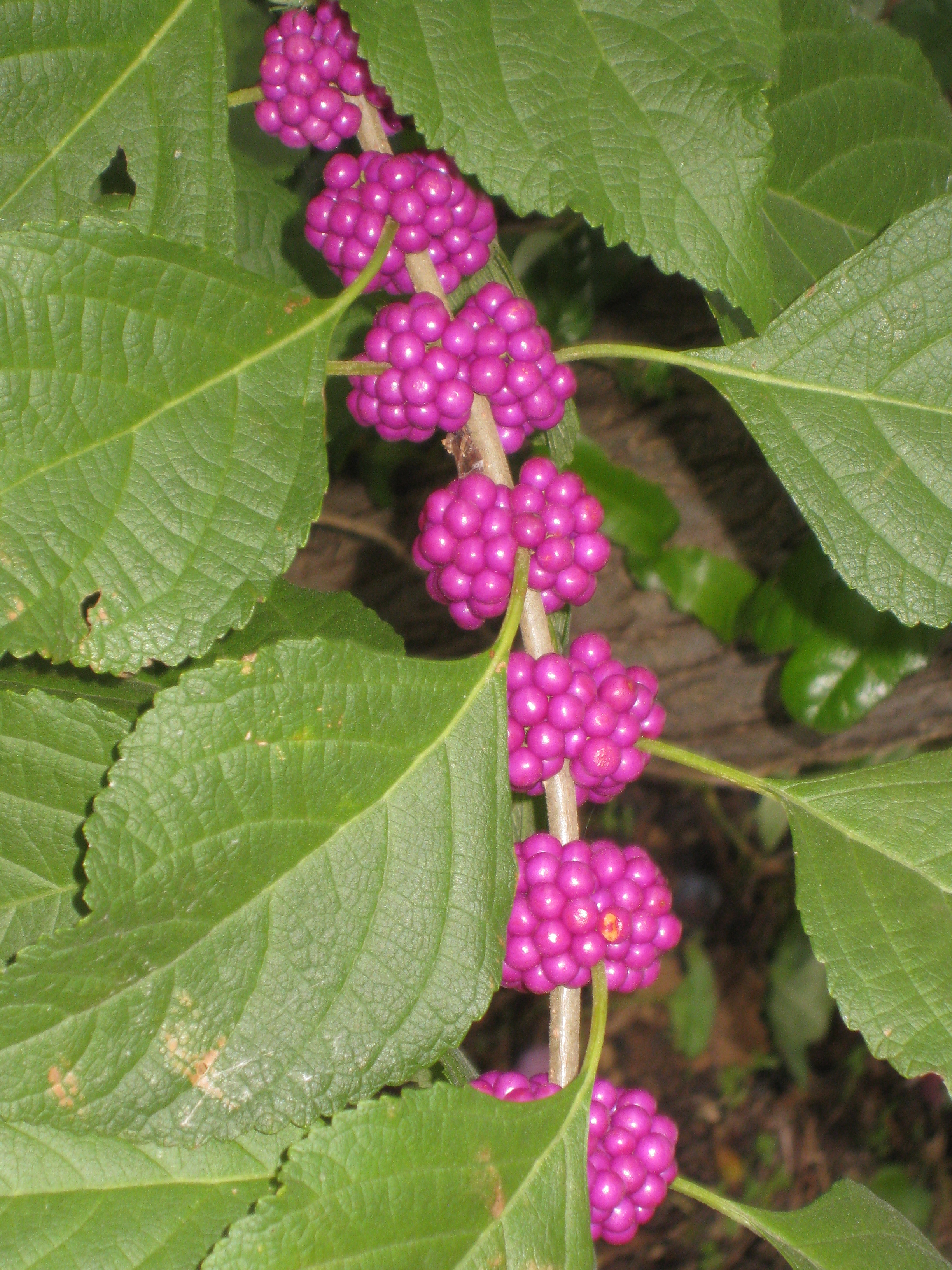
But purple makes the heart sing.

For a bit more of Mother Nature when I’m in the Dallas area, I escape to nearby Cedar Hill State Park, where I volunteered for a few months as campground host a couple of years back.

 It was here that I saw my first painted bunting and my first yellow-billed cuckoo – and watched as a rainy winter gave way to a colorful spring.

I thought this morning, which is going to turn into a busy day, might be the perfect opportunity to share a bit of the park’s color with you. Then I can go exploring with my daughter, Deborah, in search of more big city sights.

We’re celebrating her birthday a couple of days late by going out on the town. I’ll probably tell you all about it soon.

Read Full Post »

Freshly sprouted blossoms shout out their spring song. -- Photo by Pat Bean

“It is singular how soon we lose the impression of what ceases to be constantly before us. A year impairs, a luster obliterates. There is little distinct left without an effort of memory, then indeed the lights are rekindled for a moment – but who can be sure the Imagination is not the torch-bearer? Lord Byron

Travels With Maggie

Spring is bursting out all over!”

The song lyrics played joyously through my head this morning as I took my dog, Maggie, outside to do her business. The trees were budding, the dandelions were sprouting, a cool breeze stirred my hair, the squirrels were chattering and the birds were twittering.

Back at my desk in front of my computer, I was curious as to what musical from my past had been the inspiration for the song. I suspected it was “Oklahoma “but wasn’t quite sure.

Will I remember that it was a yellow-eyed great-tailed grackle I saw this morning, or will memory rename the bird a Brewer's blackbird? -- Photo by Pat Bean

I Binged, which is what I do instead of Googling, and discovered my memory had tricked me twice. The actually lyrics are “June is bursting out all over,” and the musical in which the song was featured is “Carousel.”

Memory is such an unreliable source.

This fact was made extremely plain to me when my children, now all grown and most with children of their own, began recalling past incidents in their childhood. Although all five of them may have experienced the same thing at the same time, each of their stories were different. More startling was that none of the tales fit my own memories of the events.

How could this possibly be? I still don’t know the answer, although I’ve learned a lot about human nature since the differing stories began being shared.

These memory quirks we all seem to share, however, have increased my appreciation for being a writer. Blogging daily in a public forum, which I have been doing since the first of the year, has become a way of making my life more tangible, to the point that sometimes things don’t seem real until I write them down.

And what was real this morning was that spring, not June, was bursting out all over.

Read Full Post »

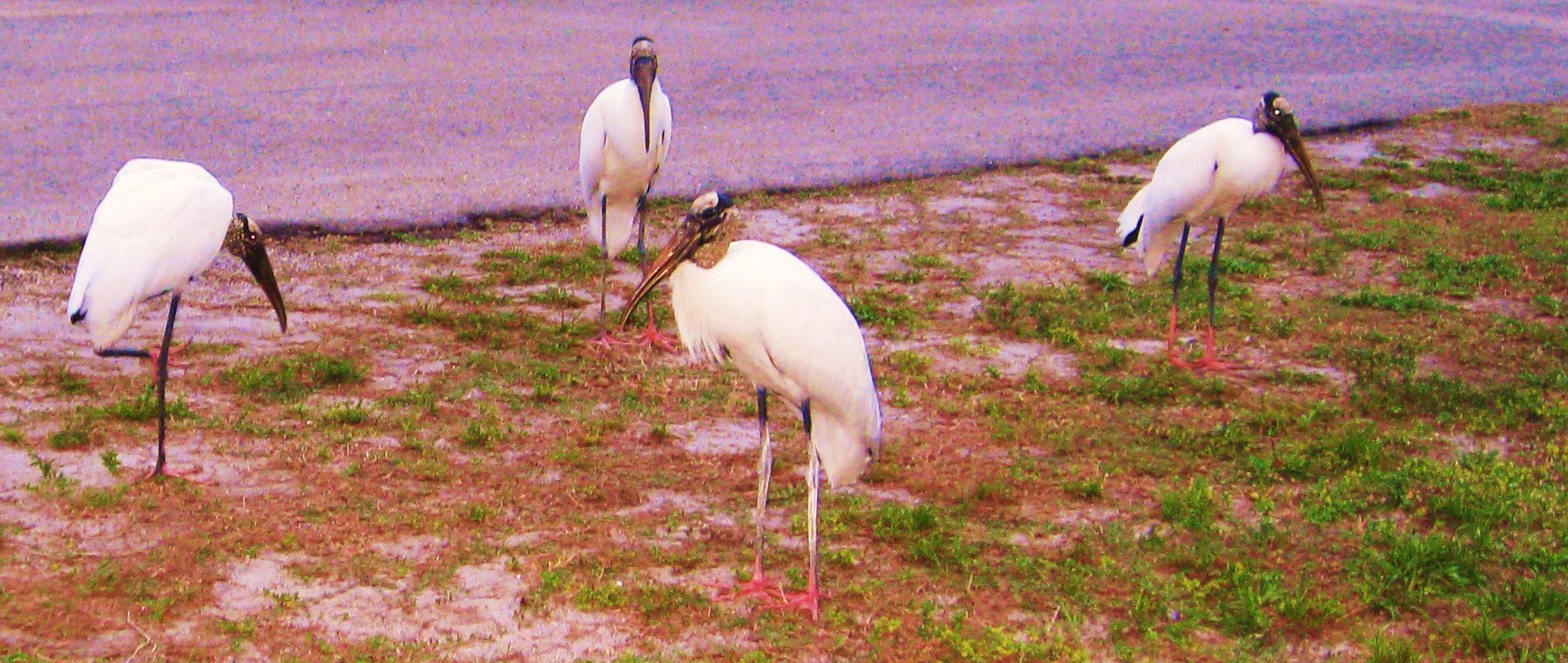
Wood storks right out my RV was a common sight during the month my RV spent on Pine Island in Florida. -- Photo by Pat Bean

  “The real fun of traveling can only be got by one who is content to go as a comparatively poor man. In fact, it is not money which travel demands so much as leisure, and anyone with a small, fixed income can travel all the time.” Frank Tatchel, “The Happy Traveler,” 1923

The view from my RV's rear window at Cade County Park near Sturgis, Michigan. -- Photo by Pat Bean

Travels With Maggie

Several people have asked me lately, how I can afford my life on the road. My response is that the way I do it is probably cheaper than maintaining a house, for sure if you have a mortgage or pay rent.

I have a basic budget for food, entertainment, gas and lodging of $60 a day. It was $50 seven years ago, but both gas and RV park fees have increased since then.

A daily break down might be $30 RV park, $20 gas (My small RV gets 15 mpg and I don’t do long drives), and $10 food. I rarely eat out.

However, a week’s stay some where saves gas money for things like a trolley car tour, a bookstore purchase or museum fees. When my budget is strained, I simply sit more.

Staying at a state park that has RV hookups, which is my overnight lodging of choice, usually costs only about $20, which gives me some leeway for commercial parks that might charge $35 a night, and I’m running into more and more of these lately.

For safety reasons I don’t skimp on choosing a clean, populated, lighted park. An emergency overnight stop for me is a Wal-Mart parking lot, which I only have used one time in seven years, and that was to escape traveling in a sudden storm.

I didn’t choose my way of life to sit in a parking lot. I want a view and a place to hike.

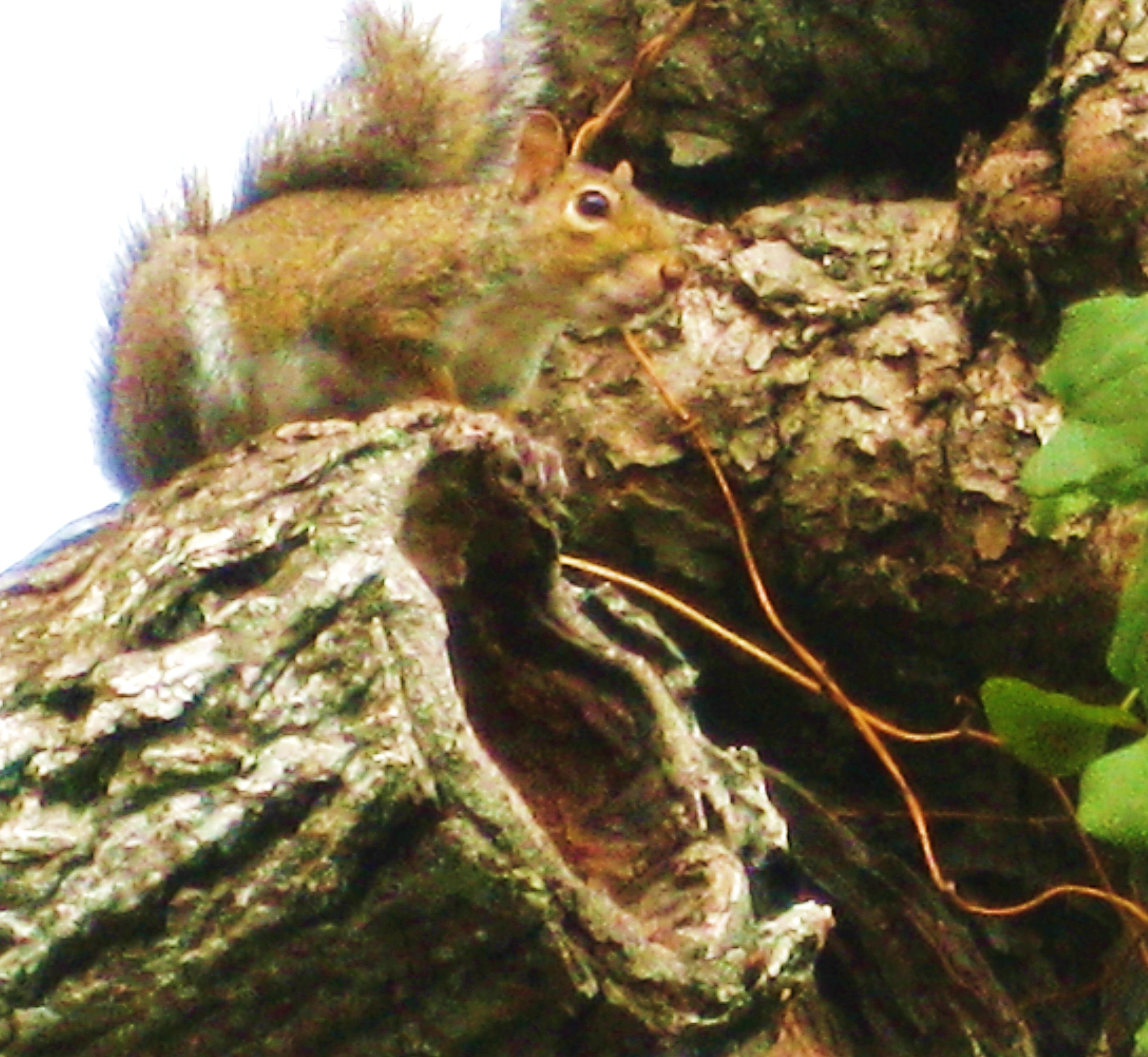
A squirrel viewed from my RV when it was parked at my son's home in Lake Jackson, Texas. -- Photo by Pat Bean

Free winter parking at my kids’ homes, where I can usually hook up to their electricity, usually saves me enough to cover the cost of regular maintenance for my RV. The bonus here is that I get to spend time with loved ones.

In addition I’m serving as a campground host at an Idaho park for four months later this year, where in exchange for some part-time chores, I get a free campground site with a lake view and free utility hookups. The money I save during this time will be used for more on-the-road adventures.

Living in a 22-foot home (which I bought when I sold my home) where everything has a place, also means I save money simply by not buying things. It’s amazing how much money you can save this way, even on clothes when the space to store them is tightly limited. I basically live in pants, shorts, T-shirts and tennis shoes.

Not counted in this breakdown are my monthly expenses for health and vehicle insurance, and my phone and air card bill for my computer. I do all my money transactions on the computer, and thankfully have an angel of a daughter-in-law who forwards my mail for free.

Except for an occasional credit card bill to cover emergencies, I have no bills.

So there you have it. Frank Tatchel was right. It just takes a bit more money these days than I suspect he was talking about in 1923.

Read Full Post »

Canada Geese at the Great Salt Lake Nature Center -- Photo by Pat Bean

 “Poets who know no better rhapsodize about the peace of nature, but a well-populated marsh is a cacophony.” — Bern Keating

Looking across Farmington Bay at the Wasatch Mountains. -- Photo by Pat Bean

Favorite Hikes:

 One of my favorite hikes when I lived in Northern Utah was a gentle trek on a circular boardwalk found at the Great Salt Lake Nature Center. http://tinyurl.com/45jykl6

Located in the Farmington Bay Waterfowl Management Area just north of Salt Lake City, the mile and a half circular trail provides excellent views of wetlands wildlife.

 It was a trail I hiked early on weekend mornings, or in the early evenings after getting off from work. Whatever the time, however, my walk always began with a chorus of marsh wrens that was soon joined by a background of croaky frog chirps.

Hike slowly and look closely so you don't miss such things as the yellow-headed blackbird hiding in the rushes. -- Photo by Pat Bean

And there always surprises, like coming around a corner of cattail or bulrush to see coots or pied-billed grebes floating in a small bit of open water. Or climbing to the top the 30-foot observation tower to see avocets and northern shovelers off in the distance, and song sparrows and red-winged blackbirds flitting around below.

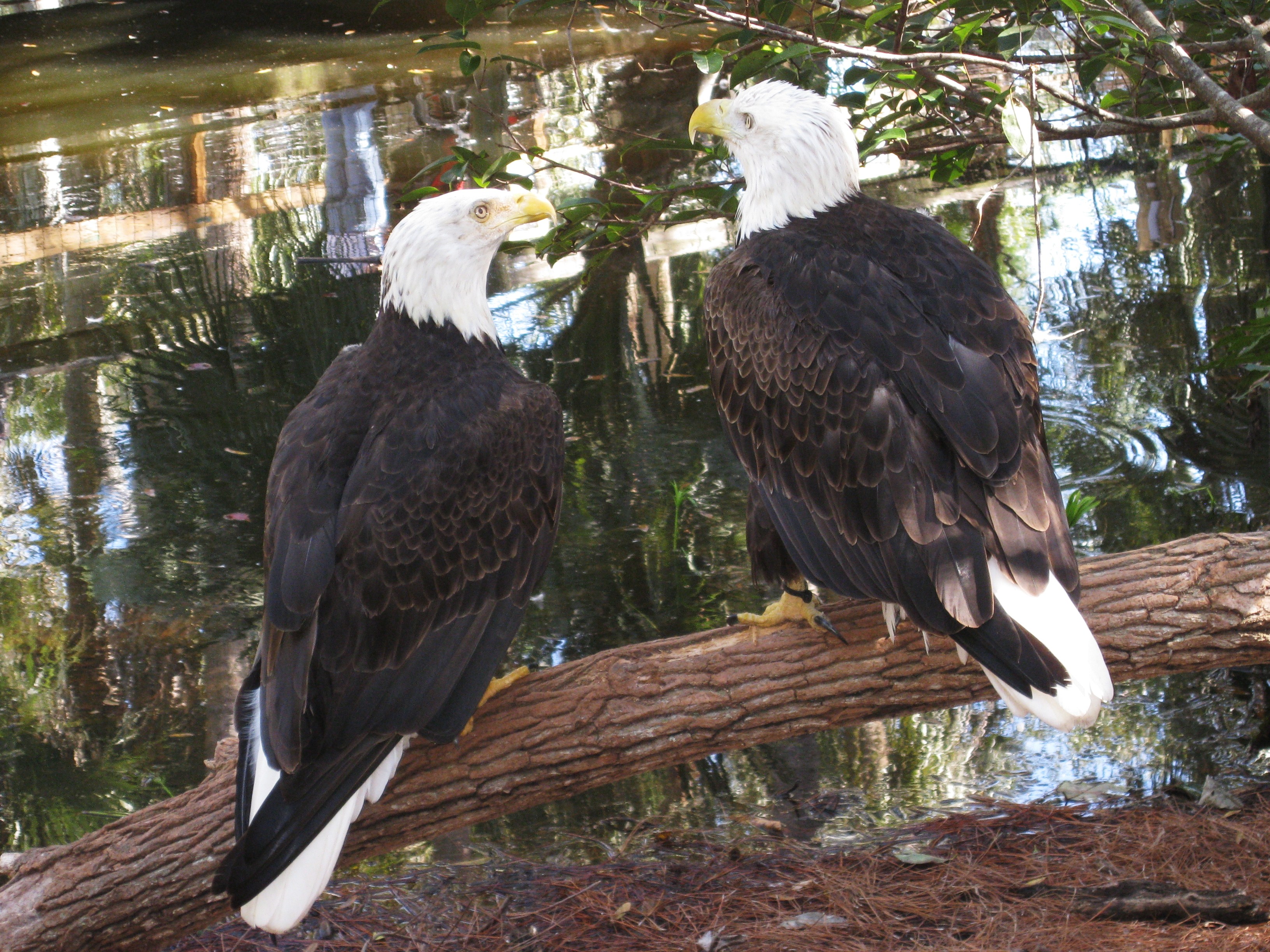
On a couple of occasions I even saw red foxes, including a den of young ones. And I almost always saw northern harriers and kestrels circling overhead. In the winter, bald eagles were a frequent sight, as were tundra swans in the spring.

Once a flock of graceful sandhill cranes flew close overhead, their rattling trumpet call echoing through the air. It was an experience that stirred my soul and made me grateful just to be alive. If you’re ever in the area, it’s a hike not to miss.

Just be sure and take some mosquito repellent with you. Mother Nature is kind, but not always considerate.

Read Full Post »

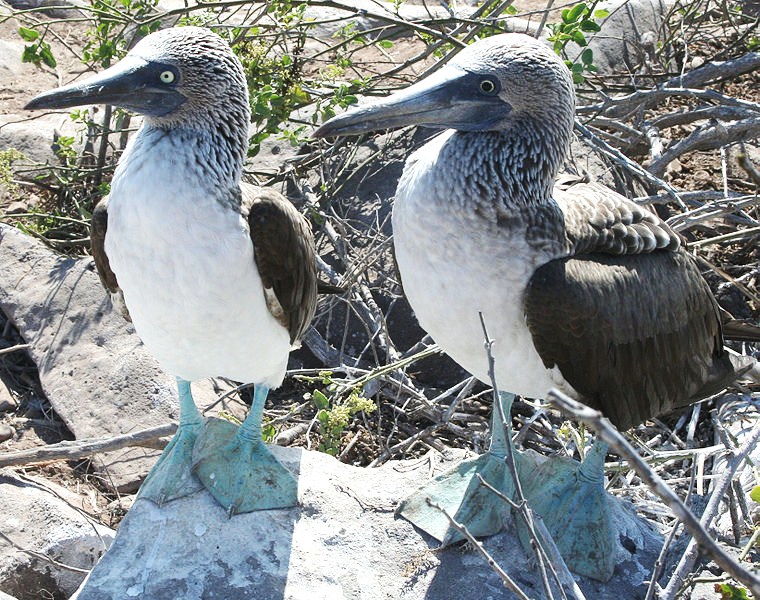
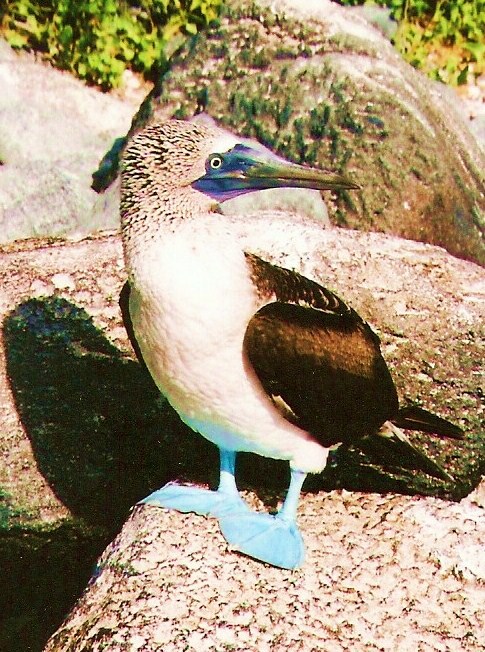
Blue-footed booby. The male is on the left. Note the smaller appearing pupil. -- Photo courtesy Wikipedia

 “Work like you don’t need the money, love like your heart has never been broken, and dance like no one is watching.” — Aurora Greenway

Journeys

The large white and brown bird with the blue feet didn’t recognize my right to the hiking path. Its Galapagos Island home, where man has not yet imposed his predatory nature, let it assume it was my equal.

I stopped about a foot away and was quickly mesmerized as the two of us, human and bird, stared eye-to-eye. Since the pupils in its pale yellow eyes appeared smaller than that of the bird sitting on two eggs beside the path, I knew I was being confronted by a male booby.

Without taking its eyes from me, the booby blocking my path lifted his bright blue right foot. He gave me a quizzical look, then lifted his blue left foot and then his right foot again. Finally I lifted my tennis-shoe clad right food in reply.

A blue-footed booby, looking as if he was searching for a Dr. Seuss book in which to be a star.

 For the next couple of minutes, he and I did a Hokey Pokey. It probably was the same dance he used in courting his mate.  Our comedic interlude with music playing only in our heads might have gone on longer if it hadn’t been  interrupted by our group’s tour guide, who chaperoned us to keep the Galapagos wildlife safe.

“Don’t tease the bird,” he said when he saw me.

“I’m not,” I replied. “The booby invited me to dance with him.”

At the guide’s disbelieving frown, I moved on down the trail. When I turned back around for one last look at my dancing partner, he raised a blue foot as if saying good-bye.

Such unexpected moments are what travel is all about.

Read Full Post »

It's the missing part of Mount St. Helens that tells the story. -- Photo by Pat Bean

“Accuracy of observation is the equivalent of accuracy of thinking.” Wallace Stevens

 Travels With Maggie

To artists, negative space is the blankness that exists around painted objects. Such space can sometimes be the most interesting thing on a canvas. Consider Rubin’s painting of a vase that when taken away creates the image of two facing profiles.

The professor in a drawing class I once took emphasized the importance of this empty space by having us draw it instead of the solid form before us.

I’ve learned since then that missing elements can tell us as much about what we’re seeing as what’s before us.

It's the negative space that's the more important image of Rubin's vase. -- Photo courtesy Wikipedia

How can one look up at the crater on Mount St. Helen’s without understanding that part of the mountain is missing? Such a conclusion can conjure up the image of a volcano erupting and remind us of how fragile life is.

When I’m out walking and the chattering of birdsong is stilled, I know to look to the sky. There just might be a hawk flying overhead.

Hollow footprints let me know who or what has trodden a path before me.

A branch with missing leaves might tell me a moose munched as it passed by.

A New York city street where no one walks warns me I might not want to walk there either.

The missing elements of a scene remind me of a saying among communicators, like journalists: Just because you heard what I said doesn’t mean you heard what I said.

So it is that just because you’re looking at a beautiful landscape doesn’t mean the painting is complete. Look again to find what’s missing. The story before you might change

Read Full Post »

Life's "no problem" when you're cruising Jamaica's Black River. -- Photo by Pat Bean


“Yesterday is dead, tomorrow hasn’t arrived yet. I have just one day, today, and I’m going to be happy in it.” Groucho Marx

Travels With Maggie

Lonely Planet’s lead article in this month’s newsletter (http://www.lonelyplanet.com/us) features one day itineraries for five cities: Barcelona, Toronto, London, Paris and Istanbul.

I wanted to both scream and cry at the audacity of such a notion. The thought of spending so few hours in these fabulous cities, which I’ve not yet visited, made me quite sad.

Then I thought about places I’ve visited when circumstances only allowed me a single day, like Jamaica, Guayaquil, Fairbanks, Glacier National Park and Nairobi. While each of these places deserved more than a mere day to explore, there would be some big holes left in my experiences if I had missed them.

George, the alligator that responded to the Black River boatman's summons. Honest! -- Photo by Pat Bean

In Jamaica, which I visited while on a Caribbean Christmas cruise, I spent several hours in a giggley-jiggly bus with a guide explaining the sights and Jamaica’s “no problem mon” attitude, then took a float trip down the Black River where egrets ganged up in mangrove trees and an alligator named George came at the boatman’s call. Honest.

Guayaquil was the Ecuadorian starting point for my trip to the Galapagos Islands. Here I was served chicken and watermelon for breakfast at the quaint Andaluz Hotel before taking a walk on the city’s beautiful Waterfront Parkway. That night I watched the stars come out from a rooftop restaurant that overlooked the Guayas River.

In Fairbanks, Alaska, I spent a night at a quaint bed-and-breakfast and then the better part of the next day at the fantastic University of Alaska Museum before moving on to Denali National Park .

Glacier National Park in Montana was a detour when I drove the Alaskan Highway. The main event here was simply driving the awesome and scenic 57-mile Going to the Sun Highway. The frosting on the  entrée was a grizzly bear that stopped traffic. Fortunately my halt offered a good view of this magnificent creature.

Nairobi, Kenya, was the starting point for my magnificent two-week African safari. Here I stayed in the same hotel favored by Ernest Hemingway, explored the grounds of the University of Nairobi, which was just next door, and toured the home (now a museum) of Karen Blixen, alias Isek Dineson and author of “Out of Africa.”

I guess if that’s all you have, one day is quite enough. But I sure hope that if I ever get to Lonely Planet’s big five that I have more than 24 hours to linger.

Read Full Post »


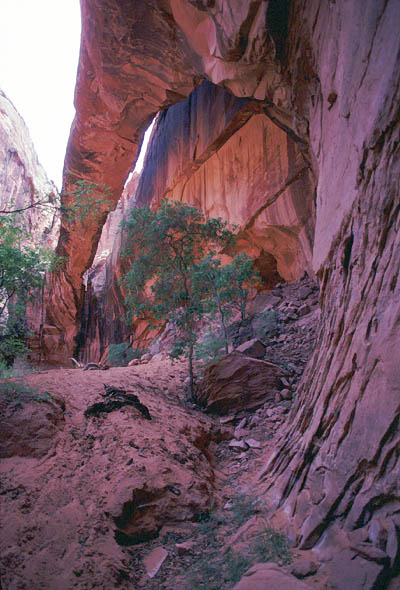
Morning Glory Natural Bridge -- Photo by Jay Wilbur

“I still find each day too short for all the thoughts I want to think, all the walks I want to take, all the books I want to read and all the friends I want to see.” John Burroughs  

Travels With Maggie

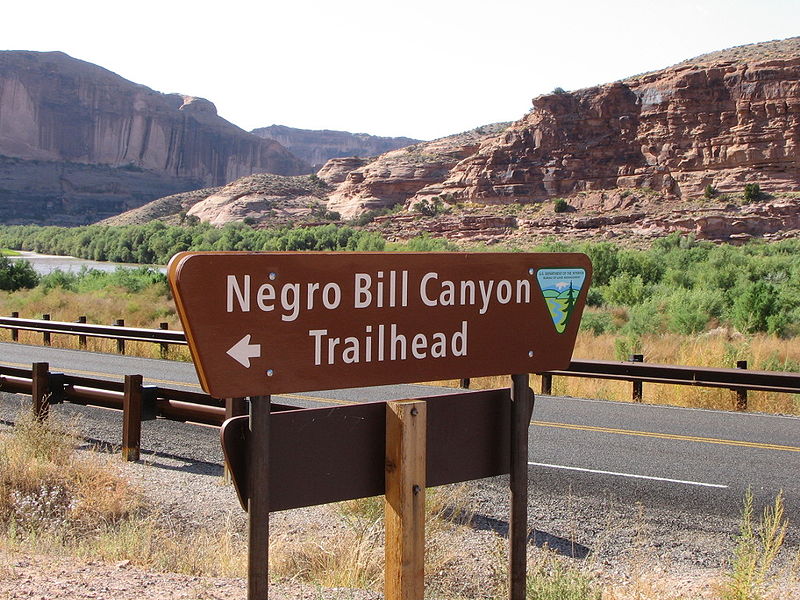
 I learned about Negro Bill Canyon Trail at the visitor center in Moab, Utah, where I asked if there was a good hiking trail on which I could take my dog.

Moab is located adjacent to Arches National Park that has fantastic trails, but dogs are not allowed on them. The kindly desk clerk directed me to take Highway 191 north to Highway 128, which parallels the Colorado River, and then to look for a small parking area at the trailhead after about three miles.

It was easy to find and soon my dog and I were hiking up a narrow canyon trail that weaved across a small stream.

My hiking companion at the time was not Maggie. It was Peaches, a beautiful golden cocker spaniel who was then 15 years old. Since this was my first significant hike since foot surgery, the dawdling footsteps of her four legs and my two legs were perfectly matched.

It was actually a great pace as the trail, with its tinkling stream, red rock walls, willow groves and other wonders of nature, deserved adequate time to be properly admired. After about two miles, the trail forked. Peaches and I took the path veering to the right, which went about another half mile before ending at Morning Glory Natural Bridge, a 75-foot tall, 243 foot arch span overseeing an alcove.

Here, in this grand and peaceful setting, with a canyon wren serenading us, Peaches and I ate a leisurely lunch from my small backpack before heading back. It was the last hike Peaches and I took together.

Negro Bill Canyon Trailhead sign off Highway 128 with the Colorado River flowing past on the far side of the road.

The next time I hiked the trail, I had Maggie, a black cocker spaniel whom I had rescued from a life of abuse. She had been a year old at the time, and from her actions on the trail I realized this was probably her first off-pavement walk, certainly her first time to cross a stream. She either had to be coaxed or carried across. .

While she never became the great hiker Peaches was, Maggie’s now quite eager to get off the beaten path. In that, she and I are alike.

*Negro Bill Canyon is named after William Granstaff, a cowboy who ran cattle in the canyon in the late 1870s. While the name is not exactly politically correct, it’s more so now since the name was changed from the original “N” word.

Read Full Post »

One of the lesser goldfinches Maggie and I saw on our morning walk. -- Photo by Pat Bean

Our greatest strength as a human race is our ability to acknowledge our differences, our greatest weakness is our failure to embrace them.” — Judith Henderson

 Travels With Maggie

 Some days I wake up eager to write on a topic that burned itself into my brain as I slept, usually because the subject was on my mind before I went to bed. I consider these good days.

 On others, I wake brain-dead, wondering what in the heck I’m going to write about. This morning was one of these.

 Some days, Maggie sleeps in until 10 a.m. Others, like this morning, she wakes up early and immediately demands that I take her for a walk. Yes. I know. My children already have informed me that my canine companion bosses me around.

 But I welcomed her demands this morning, knowing that walks fertilize my brain. The birds clinging to a thistle finch bag feeder we passed did the rest.

I jumped to the conclusion that they were American goldfinches, which are extremely common all across the country. A closer inspection of the birds through binoculars, however, and I discovered my mistake. I was looking at lesser goldfinches, whose range rarely extends farther east than my current location in Central Texas.

An American goldfinch -- Photo by Pat Bean

 The adult males of both species are brilliant yellow and black (females are duller and in the case of the lesser more green than yellow), but the lesser has a black head and back, while the American only wears a black cap and has black wings that contrast with a yellow back. Both species are beautiful birds.

 And that got me thinking about the assumptions people make when confronted with differences in general. I suspect that erroneous assumptions, like my confusion as to which goldfinch I was seeing, are way too common. And just like my goldfinches, most of our assumptions usually have nothing to do with right or wrong.

One kind of beauty, one color of skin or one way of thinking may be no better or no worse than another kind of beauty, a different color of skin or a second, third or fourth way of thinking.

I suspect the world could do with fewer assumptions and more appreciation of differences. What do you think?

Read Full Post »

« Newer Posts - Older Posts »